

 Home
Home Chiang Mai(




Wat Pak Nam
Rating: 4.2/5 (5 votes)
 Search By
  Map
Map 
 Have Map
  No Map
Chachoengsao attractions
Attractions in Thailand
Open Days: Daily
Opening Hours: 08:00 – 17:00
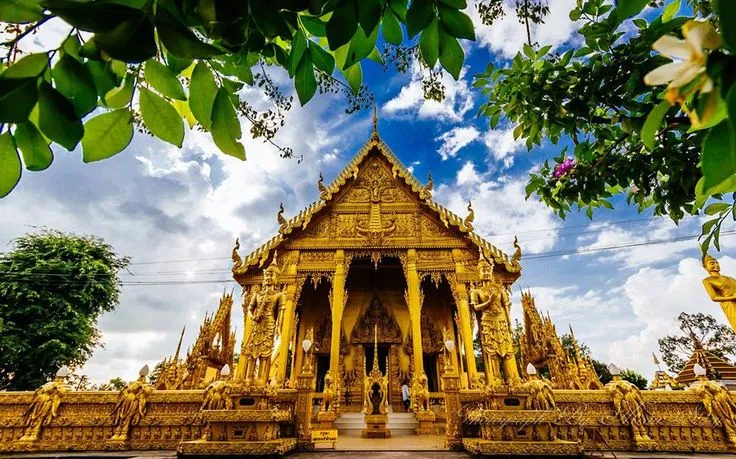
Wat Paknam Cholo, Chachoengsao is a community temple along the Bang Pakong River basin in Bang Khla District, known for both local devotion and the area’s historical narrative. One of the strongest visual impressions that draws visitors here is the “all-golden ubosot” whose shine is unmistakable from the moment you arrive, and the closer you step in, the more you can sense the community’s intention to care for the temple as a spiritual center and a place where the story of the land is preserved alongside daily faith. The temple is associated with conflict in the late Ayutthaya period, and it also connects to the “Memorial Stupa of King Taksin the Great,” reflecting local memory of victory and the protection of the realm passed down through generations. If you want a calm, unhurried temple visit, a place where local history feels tangible, and a solid anchor point for a one-day route across Bang Khla–Khlong Khuean–Chachoengsao town, Wat Paknam Cholo is a worthwhile starting point.
For travelers who want to explore Chachoengsao without limiting themselves to only the most famous spots in the town center, riverside community temples often offer both quiet and the feeling of having seen something real rather than simply ticking off a check-in. Wat Paknam Cholo still feels like a living local temple: people come to make merit on ordinary days, and its straightforward atmosphere keeps worship from being rushed by crowds. Within that simplicity, the place holds layered details—from its geography as a canal mouth where water flows into the Bang Pakong River, to stories of warfare and the creation of a historical memorial within the same area. Visiting this temple is therefore not only about the beauty of gold, but also about following the “story” embedded in the heart of the site.
The word “Paknam” (river mouth/canal mouth) in the temple’s name captures the nature of its setting: a canal flows past the front of the temple and joins the Bang Pakong River. In river-basin societies, this kind of location often becomes a naturally strategic point—a route for travel, a livelihood corridor, and a place where people once established footholds for commerce, transport, and, in times of conflict, troop movement. In the late Ayutthaya era, when instability came in multiple waves, local narratives therefore link the temple and its surrounding area with the positioning of Burmese forces, both land and naval. This is why Wat Paknam Cholo is not simply a riverside temple; it is a place the community collectively recognizes as a site where “major events once occurred,” adding a layer of remembrance to merit-making and worship.
According to local tradition, Wat Paknam Cholo originally began as a monastic hermitage during the late Ayutthaya period and has an estimated age of around 200 years. The area is said to have served as a Burmese military position before a battle in which the Burmese forces were defeated by the army of King Taksin the Great. After that event, a chedi was commissioned at this location as a memorial. In Thai tradition, building a memorial is not only an architectural act; it gives communal memory a tangible marker—a place where later generations can stand with their children and grandchildren and recount what the land endured, and why peace in the present should be valued and protected. This is one reason a temple that appears calm and simple can still hold a strong historical core.
The memorial referenced is the “Memorial Stupa of King Taksin the Great,” seen locally as a symbol of victory and the restoration of the realm. Over time, the original stupa was severely eroded by water and collapsed completely in 1948 (B.E. 2491). Later, the Fine Arts Department reconstructed the stupa on the original site. This transition highlights something many temple-goers overlook: riverside temples exist in close relationship with nature. The river landscape supports fertility and community life, yet the same water can gradually erode built structures. Restoration by the responsible authorities therefore becomes both heritage preservation and an adaptation to a landscape that changes over time.
Once inside the temple, the most striking feature is the all-golden ubosot. The gold tone makes the entire setting feel bright and energized, and many visitors come specifically to photograph it. Yet what is most worth remembering beyond images is the feeling of a sacred space still used in real religious life. The ubosot is not merely an artwork to admire; it is the ceremonial core of the temple. Its true beauty lies in how it naturally settles people down. When light meets the golden surface and softens across the space, visitors tend to lower their voices, slow their steps, and become more attentive to their inner state—which is exactly what many people seek when they come to a temple in a fast-paced world.
At present, the temple also has ongoing work related to the crystal wall (kamphaeng kaeo) and golden entrance archways, which gradually completes the visual harmony and order of the compound. If you visit while some areas are being improved, it is best to walk mindfully, avoid approaching construction materials, and prioritize safety. Community temples often develop step by step, matching available resources and timing. Seeing the temple actively evolving also reflects the continuing faith of local residents who support improvements year after year.
Another noteworthy point is the large traditional wooden sermon hall (sala kan parian), featuring classic Thai roof ornaments such as chofa, bai raka, and hang hong. These elements are not only decorative; they are part of a visual language of belief that elevates an ordinary building into a sacred space. In community temples, a wooden sermon hall is often the heart of lived activity—where people gather on merit-making days, for ceremonies, chanting, and forms of learning that were central in earlier times. If you walk past the hall and notice the wood grain, the marks of use, and the simplicity of the structure, you will see what “the temple lives with the community” truly looks like, because this is not a display piece; it is a space that has been used for a long time.
The temple is also said to have an “ancient boat from the era of King Taksin,” which is often cited as another point of interest. Old boats displayed at temples can serve as a window into river-basin life, because waterways were the community’s lifeline. Having a historic boat to see helps later generations learn without relying purely on imagination. By observing the boat’s shape and proportions, you can connect the object to travel, transport, and the historical role of rivers in Thai society—where waterways once functioned as roads, marketplaces, and channels of news. If you are visiting with children, this is a strong place to begin a conversation about how people traveled in the past and why riverside temples mattered, making history easier to understand without rote memorization.
To visit Wat Paknam Cholo in the right spirit, it helps to allow time and avoid rushing. Morning visits are comfortable, with gentle light that makes the gold look softer and supports respectful photography. Late afternoon can also be suitable because crowds tend to thin out, leaving more quiet space for prayer and reflection. If you are traveling with family or elderly relatives, it is best to avoid the hottest hours so the experience remains genuinely comfortable rather than something you try to finish quickly.
Basic temple etiquette remains important, especially in the ubosot and areas where people may be chanting or meditating. Dress respectfully, avoid clothing that is too short or overly tight, speak softly, remove shoes where indicated, and avoid standing in the way of others who are paying respects. If you want photos, choose angles that do not disturb others, and avoid poses that are inappropriate in a sacred area. The best temple photographs are not the most attention-grabbing ones, but those that naturally respect the place and the people around you.
In terms of merit-making, community temples usually keep things simple but sincere. You can donate as you wish, offer a set of necessities, or join Buddhist holy-day activities according to the temple’s schedule. If you come to “make a wish,” it helps to set a clear, concrete intention—such as asking for mindfulness in problem-solving, the discipline to work honestly until results appear, or the strength to stay healthy for your family—and then commit to doing good consistently in daily life. The steadiness of faith comes from turning a wish into motivation to act, rather than waiting for a miracle.
Getting There Wat Paknam Cholo is in Bang Khla District, Chachoengsao. Driving is the most convenient option. Set your map destination to “Wat Paknam Cholo” and follow local roads toward the Bang Pakong riverside area. Once you enter the community zone, drive carefully because the roads are local and you may see motorcycles and pedestrians crossing at intervals. The temple provides parking as appropriate to the available space. For a quieter atmosphere, visit in the morning or before late afternoon so you can walk comfortably and avoid feeling rushed.
After paying respects, if you want to make the day more complete, you can easily plan a route across Bang Khla–Khlong Khuean–Chachoengsao town, where there are riverside markets, viewpoints, and other important temples. Starting with Wat Paknam Cholo gives the day a calm “core” with both atmosphere and story, before you continue on to local food or riverside photo stops. This route works well for Thai travelers and also for international visitors who want to experience local life in a way that feels authentic rather than overly staged.
| Place Name | Wat Paknam Cholo, Chachoengsao |
| Address | Bang Khla District, Chachoengsao |
| Summary | A riverside community temple along the Bang Pakong River basin, best known for its all-golden ubosot and local historical narratives linked to the late Ayutthaya period and King Taksin the Great, including a memorial stupa site connected to collective memory of the area. |
| Highlights | 1) The all-golden ubosot, visually striking and still actively used as a sacred ceremonial space 2) A traditional wooden sermon hall with classic Thai roof ornaments (chofa, bai raka, hang hong), reflecting old community-temple character 3) Historical narratives and the memorial stupa site associated with King Taksin the Great 4) Noted points of interest such as an old boat linked to river-basin ways of life |
| History / Period | According to local tradition, the site began as a monastic hermitage in the late Ayutthaya period and is estimated at around 200 years old. The area is linked to conflict in the era of King Taksin the Great, with a memorial stupa site. The original stupa reportedly collapsed due to water erosion in 1948 (B.E. 2491), and the Fine Arts Department later reconstructed it on the original site. |
| Abbot (Latest) | Phra Khru Kasem Chonlakhet |
| Fees | No admission fee (donations welcome) |
| Facilities | Parking (subject to available space), resting areas within the grounds, restrooms typical of a community temple |
| Nearby Tourist Attractions (Approx. Distance) | 1) Bang Khla Floating Market – 2.2 km 2) Wat Pho Bang Khla – 1.6 km 3) Wat Chaeng, Bang Khla – 2.0 km 4) Wat Paknam Cholo (riverside viewpoint area in front of the temple/community) – 0.0 km 5) Bang Pakong Riverside Route (community stop-points along the local route) – 3.0 km |
| Popular Restaurants Nearby (Approx. Distance + Phone) | 1) T Time Restaurant (Bang Khla) – 4.0 km – Tel. 080-251-0555 2) Rom Mai Sai Than – 0.5 km – Tel. (verify before adding) 3) Hom La-Oei Cafe – 0.2 km – Tel. (verify before adding) 4) Ban Nam Chan by Kunawut – 1.2 km – Tel. (verify before adding) 5) Aiya Kuay Jub – 0.8 km – Tel. (verify before adding) |
| Popular Accommodations Nearby (Approx. Distance + Phone) | 1) Tala Bangkla Riviera Resort – 7.8 km – Tel. 062-323-7424 2) T-Vintage – 3.7 km – Tel. 092-689-4442 3) JK Living Hotel and Service Apartment – 18 km – Tel. 092-742-9929 4) Heaven Hotel Chachoengsao – 29 km – Tel. 038-511-150 5) Sappaya Hotel by Lotus Valley Golf Resort – 45 km – Tel. 038-835-555 |
Frequently Asked Questions (FAQ)
Q: What is Wat Paknam Cholo best known for?
A: It is best known for its all-golden ubosot and local historical narratives linked to King Taksin the Great, including the memorial stupa site in the area.
Q: How long is the history of Wat Paknam Cholo?
A: Local tradition says it began as a monastic hermitage in the late Ayutthaya period and is estimated to be around 200 years old.
Q: What is the memorial stupa site connected to?
A: It is connected to local memory of conflict and victory in the era of King Taksin the Great. The original stupa reportedly collapsed due to water erosion, and it was later reconstructed on the original site.
Q: How long should I plan to spend at the temple?
A: Typically about 1–2 hours is suitable for worship, viewing the golden ubosot, the old wooden hall, and enjoying the riverside atmosphere without rushing.
Q: When is the best time to visit for a calmer atmosphere?
A: Morning is comfortable and pleasant for walking and viewing details, while late afternoon is often quieter and more suitable for prayer and reflection.
Q: What etiquette should I follow when entering the ubosot?
A: Dress respectfully, speak softly, remove shoes where indicated, and avoid photography or activities that may disturb others who are chanting or meditating.
 Wat Pak Nam Map
 Category:
  Group:
  Tag: ●Wat Pak Nam●wat paknam cholo ●wat paknam cholo chachoengsao ●golden ubosot wat paknam cholo ●golden ubosot chachoengsao ●bang khla temple ●bang khla travel ●chachoengsao temple ●king taksin memorial stupa ●bang pakong river temple ●bang khla floating market near wat paknam cholo Last Update: 1 WeekAgo
Comment
 Nearby Attractions
| Keyword (Advance) |
 Region
|
 Muang Chachoengsao(
 Copyright 2012,