

 Home
Home Chiang Mai(




Tham Nang Sib Song
Rating: 2.6/5 (14 votes)
 Search By
  Map
Map 
 Have Map
  No Map
Chachoengsao attractions
Attractions in Thailand
Open Days: Open Daily
Opening Hours: 08:00 – 17:00
Tham Nang Sib Song is one of Chachoengsao’s most intriguing “Unseen cultural” spots, sought out by travelers who enjoy local folklore and oral legends. What you see today is not a vast, tourist-style cave, but a laterite sinkhole and a deep water pit whose story has been told for generations, becoming a symbol of Ban Hin Dat in Dong Noi Subdistrict, Rachasarn District. The appeal here is not spectacle or heavy tourism infrastructure, but a sense of “just enough mystery” that makes visitors want to listen, ask questions, and stand quietly for a long moment—linking what lies before them to a narrative that has crossed time and generations into the present.
Tham Nang Sib Song is located in Village No. 14, Ban Hin Dat, Dong Noi Subdistrict, Rachasarn District, Chachoengsao Province, and it is often described as being near—or next to—Wat Hin Dat. This proximity gives the visit a gentle blend of community atmosphere and local faith. Many visitors begin by entering the temple grounds respectfully, taking in the quiet rhythm of the village, and then walk on to the laterite sinkhole that forms the heart of the legend. Approaching the site in this order feels natural and matches the pace of the area, and it also helps explain why a place that looks simple at first glance can carry far more meaning than expected.
What most people focus on first is the “laterite water pit,” a deep opening descending into the ground with a relatively narrow mouth. Local accounts commonly say the water inside sits almost full most of the time, and no one can clearly state how deep it truly is. In the eyes of the community, this is not just a water source; it is a place wrapped in story, which is why people treat it with respect and extra caution. At times, the area around the mouth of the pit has been adjusted for safety—such as edging or barriers—so visitors can see the opening clearly while reducing the risk of getting too close.
A frequent question is: “Why is it called a cave when it looks like a pit?” The answer lies in local language and the shared imagination formed through repeated storytelling. In community memory, there are accounts that the opening was wider in the past, and that some believed it could connect through to other important places. As these stories were retold across time, the word “cave” became less a strict geological description and more a cultural label—signaling that this is a meaningful place, a mysterious place, and a place with enough story to remain unforgettable.
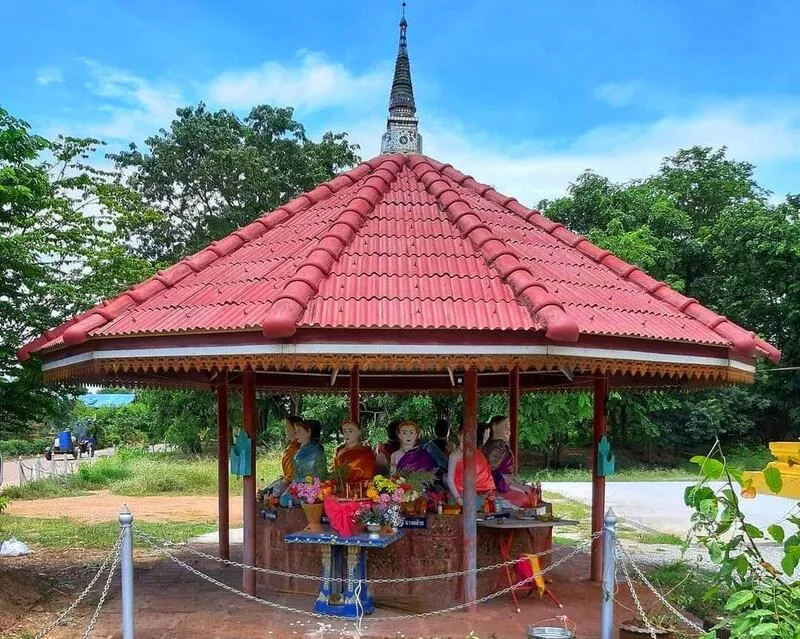
The legend most closely tied to the name “Tham Nang Sib Song” connects to Thai folk literature about Phra Rot and Meri and the tale of the Twelve Sisters (Nang Sib Song). Many Thais recognize the title even though details may vary by local retelling. In Ban Hin Dat, the narrative core often evokes the image of the Twelve Sisters being confined, and this site is regarded as one of the story’s “scenes.” When a legend is anchored to real landscape, visiting the place can feel like stepping into a living setting—one that immediately calls the story to mind and feels more layered than a simple natural hollow in the ground.
The fascination does not stop at the pit itself. It extends into a network of places held together by local belief, one of the most frequently mentioned being “Lan Phra Rot Chon Kai” (the field associated with Phra Rot’s rooster-fighting tale). Some community narratives connect it as part of the same legendary geography, even saying the pit or hollow could link through to that site. In practice, visitors do not “test” anything risky, but the existence of this kind of story makes a trip through Dong Noi especially easy to retell—because you are not only seeing a location, but also witnessing how a community gives a place meaning through shared memory and oral tradition.
Another well-known local account describes a cow that once fell into the pit and died. Concern over safety led villagers to seek ways to “cover” or reduce the hazard. One version of the story says they planted a bodhi tree to conceal the mouth of the pit, but the tree later fell, exposing the opening again. What remained visible became the laterite hollow that people came to call “Tham Nang Sib Song” up to the present. Stories like this reflect a familiar truth in rural Thailand: a place can be both “nature” and “community memory” at the same time—and it is memory that makes people keep the story, keep the name, and keep inviting others to see it with their own eyes.
In cultural terms, Tham Nang Sib Song is often regarded as a community heritage spot and a learning place where folklore is still clearly legible in the landscape. It shows that “legend” does not live only in books—it can be woven into real geography. When you look closely, the site’s charm comes from overlapping layers: the natural layer (laterite and the deep hollow), the lived layer (local efforts to make it safer), and the narrative layer (Phra Rot, Meri, the Twelve Sisters, and Lan Phra Rot Chon Kai). Together, these layers turn a small site into a distinctive destination within Chachoengsao.
Making the visit “worth it” here does not mean packing in the most activities. It means choosing a pace that suits a place built on quiet. Morning tends to be comfortable, with softer light and fewer people, making photography easy and the walk unhurried. Late afternoon can offer more depth in the light, especially if you want the laterite texture to stand out. What is best avoided is arriving right after rain if the ground near the opening is damp or mossy, since humid natural surfaces can be slippery and safety should always come first.
Getting There If you start from Chachoengsao city, plan to drive toward Rachasarn District, then continue into Dong Noi Subdistrict and Ban Hin Dat. A practical landmark is Wat Hin Dat, since Tham Nang Sib Song is commonly said to be nearby. Once you reach the village area, park in an appropriate spot and walk carefully to the site. Traveling by private car is the most convenient option because this is a rural area where public transport is not as frequent as in larger towns. Visiting during daylight also makes the narrow community roads easier and safer to navigate, giving you enough time to explore without rushing.
What makes this trip both pleasant and safe is “respecting the place.” Tham Nang Sib Song is not designed for high-volume tourism; it is part of a living community. Keeping noise low, not leaving litter, dressing respectfully if you pass through the temple area, and avoiding risky behavior near the pit—such as climbing the edge, leaning over, or dropping objects inside—are basic courtesies that protect both visitors and the calm of the community. If you bring young children, close supervision is essential because a naturally deep opening is not a safe area for playful wandering.
If you want to build a “complete story route,” the Dong Noi pace works best when you move gently: begin at Wat Hin Dat to absorb the community atmosphere, then visit Tham Nang Sib Song, and afterward continue to Lan Phra Rot Chon Kai, which is often mentioned alongside it in local literary context. This creates a narrative flow that suits cultural travelers, photographers, and anyone who enjoys meaningful travel without rushing. For an easy finish, plan a meal in the Rachasarn area or at a local roadside shop on the way back—simple, comfortable, and complete.
In the end, Tham Nang Sib Song may take “little time” to view with your eyes, but it tends to stay “a long time” in memory. When you stand before the laterite hollow and deep water pit, it becomes clear why the community has kept the story alive, and why the name continues to be spoken across eras. In a world that moves faster every year, places like this act as a gentle pause—inviting you to slow down, listen through to the end, and leave with the understanding that “culture” is not always in a museum. Sometimes it lives in a small laterite hollow that a community continues to speak into existence.
| Place Name | Tham Nang Sib Song |
| Location | Village 14, Ban Hin Dat, Dong Noi Subdistrict, Rachasarn District, Chachoengsao |
| Address | Village 14, Ban Hin Dat, Dong Noi Subdistrict, Rachasarn District, Chachoengsao (near Wat Hin Dat) |
| Place Summary | A laterite hollow and deep water pit in Ban Hin Dat, associated with the “Nang Sib Song” folk legend and the Phra Rot–Meri storyline, known as a cultural-storytelling destination in Rachasarn |
| Highlights | A deep laterite pit with water near the top, a quietly mysterious atmosphere, rich community storytelling, and easy pairing with Wat Hin Dat and Lan Phra Rot Chon Kai |
| Period / Context | Community cultural landscape (oral folklore passed down across generations) |
| Key Evidence | Located near Wat Hin Dat in Ban Hin Dat (Village 14), featuring a laterite hollow/deep pit, and maintained as a learning site for the local “Nang Sib Song” narrative connected to Lan Phra Rot Chon Kai |
| Name Origin | The name “Tham Nang Sib Song” is linked to the Phra Rot–Meri folk tradition and the Twelve Sisters (Nang Sib Song) tale preserved through local retellings |
| Travel (Summary) | Most convenient by private car: drive to Rachasarn District, enter Dong Noi Subdistrict, and follow the Wat Hin Dat landmark; park appropriately and walk carefully to the site |
| Facilities | Community/temple-area surroundings for short stops; practical parking in the village area; bring drinking water and mosquito repellent for comfort |
| Nearby Attractions | 1) Wat Hin Dat (Approx. 1 km) 2) Lan Phra Rot Chon Kai (Approx. 8 km) 3) Wat Tao-It (Yanrangsri) (Approx. 12 km) 4) Wat Sakae Ngam (Approx. 20 km) 5) Wat Sothon Wararam Worawihan (Approx. 35 km) |
| Popular Restaurants Nearby | 1) Somkid Phochana (Approx. 10 km) Tel. 093-218-1094 2) Baan Nui Cafe (Approx. 12 km) Tel. 094-625-9439 3) Ayutthaya Boat Noodles (Rachasarn) (Approx. 10 km) Tel. 090-927-3793 4) Jae Thip Noodles (Approx. 10 km) Tel. 081-890-1552 5) Jongcharoen Made-to-Order Dishes (Approx. 11 km) Tel. 089-811-2761 |
| Popular Accommodations Nearby | 1) Vasa House (vasahouse) (Approx. 18 km) Tel. 099-452-6152 2) Luubplern Resort (Approx. 22 km) Tel. 082-242-0441 3) Nanthana Resort (Approx. 25 km) Tel. 099-607-5398 4) Hollywood Banna (Homestay) (Approx. 20 km) Tel. 087-127-2923 5) Son Cafe Homestay (son cafe homestay) (Approx. 26 km) Tel. 080-560-6465 |
| Current Status | Open as a community cultural site; visitors should be cautious near the pit and respect the temple/community environment |
| Contact (Verified) | Dong Noi Subdistrict Administrative Organization (SAO) Tel. 0 3856 3200, 0 3856 3202 |
Frequently Asked Questions (FAQ)
Q: Where is Tham Nang Sib Song located?
A: It is in Village No. 14, Ban Hin Dat, Dong Noi Subdistrict, Rachasarn District, Chachoengsao, and it is close to Wat Hin Dat.
Q: Why is it called a “cave” when it looks like a laterite pit?
A: The name comes from community storytelling and folklore describing the hollow’s depth and “cave-like” mystery, so “cave” functions as a cultural label rather than only a geological description.
Q: What is the best time to visit?
A: Morning or late afternoon is ideal for comfortable weather and easier photography. Avoid visiting right after rain if the ground near the opening is damp or slippery.
Q: What should I prepare before visiting?
A: Wear comfortable shoes with good grip, bring drinking water, a hat or umbrella, and mosquito repellent. Dress respectfully if you will pass through the temple area.
Q: Are there any safety precautions?
A: Yes. Do not climb the edge, lean over the opening, or drop objects into the pit. Supervise children closely, as the opening is naturally deep and potentially hazardous.
Q: What else should I visit nearby to make the trip worthwhile?
A: Many visitors pair the trip with Wat Hin Dat and Lan Phra Rot Chon Kai, as they are connected through local storytelling and create a more complete cultural route in one day.
 Tham Nang Sib Song Map
 Category:
  Group:
  Tag: ●Tham Nang Sib Song●tham nang sib song ●tham nang sib song chachoengsao ●rachasarn district attractions ●dong noi ban hin dat ●twelve sisters legend thailand ●phra rot meri folklore ●cultural attractions chachoengsao ●unseen chachoengsao ●laterite sinkhole thailand ●local legend travel thailand Last Update: 4 DayAgo
Comment
 Nearby Attractions
| Keyword (Advance) |
 Region
|
 Muang Chachoengsao(
 Copyright 2012,