

 Home
Home Chiang Mai(




Monthon Prachin Hall (Old Provincial Hall)
Rating: 3/5 (10 votes)
 Search By
  Map
Map 
 Have Map
  No Map
Chachoengsao attractions
Attractions in Thailand
Open Days: Daily (Exterior Viewing) / Monday – Friday (Office Contact, Except Public Holidays)
Opening Hours: Exterior Viewing Available All Day / Approx. Office Hours 08.30 – 16.30 (For Official Inquiries)
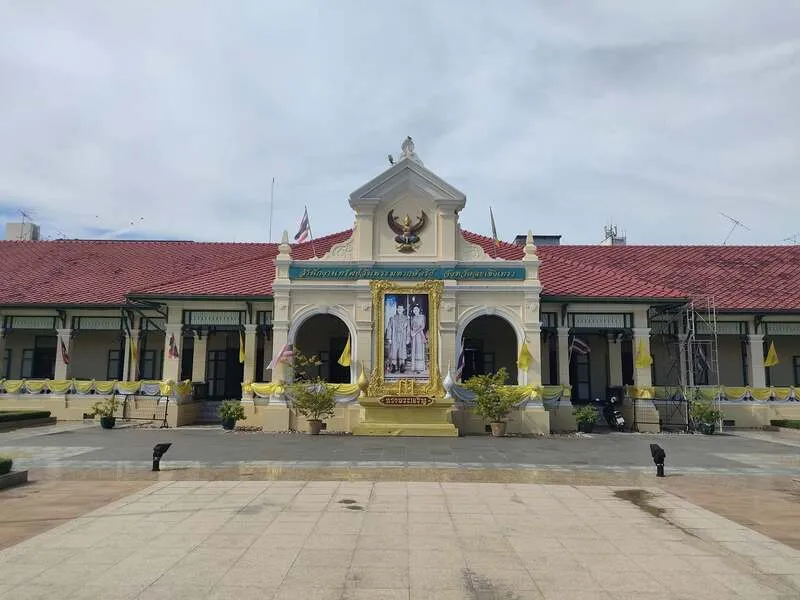
Monthon Prachin Hall (Old Provincial Hall), Chachoengsao Province or as locals in Paet Riw commonly call it, “the old provincial hall,” is a one-storey European-style historic building in the Neo-Classical tradition. Built in 1903 (B.E. 2446) during the administrative reforms of King Chulalongkorn (Rama V), it stands as a physical symbol of Thailand’s transition from the old muang (city-state) system to a centralized modern bureaucracy. The building’s elegant form is defined by its projecting entrance pavilion, the Garuda emblem on the gable, and three arched doorways at the front. It later suffered severe fire damage on 1 January 1984 (B.E. 2527) and was subsequently conserved and restored to its original appearance. Today, it functions as the Chachoengsao Provincial Office of the Crown Property Bureau, while also serving as a photogenic landmark and an easy starting point for a city route that connects smoothly to Wat Sothon Wararam Worawihan, Ban Mai 100-Year Market, and the Bang Pakong River waterfront.
If you look at “Monthon Prachin Hall” simply as a sightseeing spot, you may see only a beautiful old building. Yet what gives it real presence and deeper meaning is the fact that it is a tangible piece of evidence of Siam’s transformation into a modern state at a time when the kingdom faced both external pressures and internal change. As the country worked to standardize administration nationwide, this building was not merely an old government structure that happened to survive – it became a “window into history” that shows how the thesaphiban (monthon) reform system existed in everyday life across the eastern provinces, and how it helped shape Chachoengsao into the Bang Pakong river city we recognize today.
In the late 19th century, the older muang-based administration remained highly flexible from region to region, with governors exercising authority tied closely to local networks and geography. As foreign influence expanded across Southeast Asia, Siam needed a more modern and centralized administrative system to strengthen political stability, economic management, and national sovereignty. The thesaphiban reforms under Rama V developed alongside the concept of establishing “monthon” – regional administrative units overseen by commissioners appointed from the center – integrating governance, finance, and justice into a single standardized framework. “Monthon Prachin” became one of the key structures in the eastern region, and this Monthon Hall in Chachoengsao was the administrative hub where the new system operated in real, day-to-day practice.
Therefore, the construction of the building in 1903 carried strong symbolic significance. It was a period when the state asserted an image of order, standardization, and modernity through “official architecture.” A Neo-Classical European form conveyed stability, rational governance, and a sense of international modernity. At the same time, the building reflects how Western architectural tastes and techniques were adapted to Thai materials and climate. This makes Monthon Prachin Hall more than an attractive landmark – it is an “architectural language” through which the modern state declared that the new administrative order had arrived in the provinces.
Local historical context adds another compelling layer: the figures connected to the building’s early use. Prince Marupong Siriphat (Krom Muen Marupong Siriphat) was the first royal figure to use this building as a place of official work in the capacity of a special commissioner and acting superintendent of Monthon Prachin. The presence of royal officials and central representatives working from a purpose-built administrative hall signaled the area’s importance as a regional center. It also positioned Chachoengsao as a practical bridge between Bangkok and the eastern provinces in governance, justice, and finance during the thesaphiban era.
Architecturally, the building is remembered first for its balanced, dignified look as a one-storey European-style government hall. Built of brick and plaster, it measures about 73 meters in length and about 19 meters in width. The floor plan extends in two wings, creating a long, stable silhouette that echoes European civic architecture, yet it remains well-suited to a riverside Thai town. Open verandas at the front and rear help ventilation and reduce humidity, while the two side walls are solid for structural strength and privacy. This arrangement gives the building both aesthetic elegance and functional practicality in a hot, humid climate.
The most eye-catching details include the projecting entrance pavilion and the gable adorned with the Garuda – the national emblem – representing state authority and official status. Beneath the Garuda, a plaster inscription reads “Chachoengsao Provincial Hall” with the year B.E. 2449 (1906), reflecting the building’s continuous official role and the way it was later defined within the provincial system. The main entrance features three arched doorways, a classic architectural gesture that creates a sense of grandeur without heaviness. From an appropriate viewing distance, the proportions of the pavilion, arches, and rhythmic openings align into a clean, dignified composition – fitting for a monthon-level administrative center and, later, a provincial hall.
The hipped roof, covered with traditional kite-shaped clay tiles, is another element that makes the building feel locally adapted. Although the overall style leans European, the choice of a hipped roof works well in Thailand’s climate by handling rainfall effectively and dispersing heat. The roof height steps down in relation to the building’s width, creating a layered silhouette and pleasing shadows, especially in morning and late-afternoon light. When sunlight hits the plaster ornamentation and the entrance lines, the architectural depth becomes more pronounced – a reason photographers often find the structure highly rewarding without needing excessive editing.
The building is not only a relic of the past; it has a long record of continuous use and changing roles through different eras. After serving as the Monthon Hall and later as the Chachoengsao Provincial Hall, it became the office of Chachoengsao Municipality in 1963 (B.E. 2506) until 1975 (B.E. 2518), when the municipality moved to a new site. The building then entered a period of transition in management and use. It was officially registered as a historic monument in the Royal Gazette on 10 May 1977 (B.E. 2520), a milestone that confirms its recognized architectural and historical value as part of the city’s heritage.
Nevertheless, the event most remembered by locals is the major fire on 1 January 1984 (B.E. 2527), which caused extensive damage. Even without seeing “before and after” images, it is easy to imagine how destructive a fire could be to an old brick-and-plaster structure, impacting both the main fabric and ornamental plaster details. In a sense, the fire marked a low point in the building’s life, but from another angle it became the turning point that led to serious conservation efforts later on.
In 1992 (B.E. 2535), Her Royal Highness Princess Maha Chakri Sirindhorn visited the fire-damaged, abandoned building. That visit helped bring renewed attention to the structure as a heritage asset that should not be left to decline. In 1997 (B.E. 2540), the Fine Arts Department undertook conservation work to restore the building according to its original design. Later, in 2005 (B.E. 2548), the Crown Property Bureau carried out another major improvement, after which the building resumed active use as the Chachoengsao provincial office of the Crown Property Bureau. The building’s story therefore reflects a cycle common to many heritage sites: active official use, decline, recognition of value, and revival through restoration that respects the original form.
Viewed through the lens of cultural travel, the building becomes even more engaging because every architectural choice has a reason. Neo-Classical design emphasizes symmetry, rhythm, and clear geometric forms – ideal for communicating governmental authority. In terms of city geography, the building sits within central Chachoengsao, close to the Bang Pakong River, making it easy to reach and convenient to connect with riverside attractions. Being located near a major temple, an old riverside market, and viewpoints along the river means visitors can plan a half-day or full-day itinerary without long drives, while enjoying history, faith, community life, and river scenery in one continuous route.
For visitors who want to “read the city through architecture,” one especially interesting observation is how the Garuda emblem on the gable conveys the building’s former status as a center of state authority at both monthon and provincial levels. The plaster inscription with the provincial hall name and date is a trace of administrative transition as the modern system evolved. The three arched entrances and the rhythm of openings suggest a concept of welcoming people into an official space while maintaining order and dignity. These details transform a visit from merely “taking a photo and leaving” into a more meaningful experience of interpreting the memory of the state and the city through real, physical architecture.
For those seeking the best photographs, the most flattering time is typically morning or late afternoon, when the light casts shadows that reveal the depth of plaster details and architectural lines. On clear days, the building’s surfaces contrast nicely with the sky for a classic look. On overcast days, the mood turns more solemn and nostalgic. Photography enthusiasts often capture both wide compositions to emphasize the building’s long wings and overall symmetry, and close-up frames focusing on the entrance pavilion, the Garuda gable, and the three arches – the building’s most recognizable signature elements.
If you want a full, satisfying cultural route, it works well to link Monthon Prachin Hall with other key sites in the city as a loop: start at the old hall in the morning to observe details and take photographs, continue to Ban Mai 100-Year Market for riverside community life, then visit Wat Sothon Wararam Worawihan to pay respects to Luang Pho Sothon, the spiritual centerpiece of Chachoengsao, and finish with a meal at a popular riverside restaurant. This kind of itinerary naturally combines “architecture – community – faith – food” in a single day, suitable for both Thai travelers and international visitors who want to understand the city through multiple dimensions.
What makes this building especially valuable for history-minded visitors is that it stands as a rare, direct remnant of the “monthon” administrative structure – a system no longer used today. Yet the traces remain in the name “Monthon Prachin” and in a building originally designed to support that framework. Standing in front of the structure can feel like touching a moment when Thailand was reorganizing governance nationwide. This experience can be as educational as visiting a museum, but with one important difference: the building remains in its authentic urban context rather than being separated from it. That is the special charm of living architectural heritage in a real city environment.
In conservation terms, the building is also a notable example of restoration that aims to preserve the original character as much as possible. After the fire, multiple components required repair and reconstruction. Good conservation does not mean making something look “brand new;” it means restoring function while respecting the original form and intent. Because the building is still used as an office today, it benefits from ongoing physical maintenance. At the same time, visitors should respect that it is an active workplace and follow site guidance so that tourism and official use can coexist appropriately.
Visitors who hope to see the interior should contact the office in advance, as the building functions as an administrative workplace. In practice, exterior viewing and photography from the front area are usually the most convenient. For deeper learning, visitors can look for on-site signage or relevant published references, and connect the story to other learning points in the province, including community-based cultural sites around the historic market area. This approach helps clarify how Chachoengsao evolved during the transition from the muang system to the modern centralized bureaucracy.
Getting There If traveling by private car from Bangkok, you can take Bang Na – Trat Road (Highway 34) and connect into central Chachoengsao, then head toward the Marupong Road area in Mueang Chachoengsao District where the building is located. Another convenient option is the Eastern Line train: get off at Chachoengsao Station and continue by taxi or local transport to Marupong Road within a short time. Within the city, private transport or ride-hailing services are generally the easiest choices, especially if you plan to stop at multiple attractions in one route.
After arriving, it is worth spending time walking around the building to capture details that are clearer from angled viewpoints, such as eaves lines, the open verandas, front and rear openings, and the long-winged proportions that communicate the building’s identity as a “regional administrative center” from the thesaphiban era. If you have more time, extending the route to Ban Mai 100-Year Market or the Bang Pakong riverfront adds a richer atmosphere, allowing you to experience Chachoengsao in one day through government history, community life, and natural riverside scenery.
| Name | Monthon Prachin Hall (Old Provincial Hall) / Crown Property Bureau Office, Chachoengsao |
| Address | 122/6 Marupong Road, Na Mueang Subdistrict, Mueang Chachoengsao District, Chachoengsao 24000, Thailand |
| Place Summary | A historic Rama V-era government building and a landmark of the thesaphiban (monthon) reforms of Monthon Prachin. A one-storey Neo-Classical European-style structure distinguished by a Garuda gable and three front arches, later damaged by fire and restored for continued use today. |
| Key Highlights | Neo-Classical European civic architecture adapted to Thailand’s climate, projecting entrance pavilion, Garuda emblem gable, three arched front doorways, two-wing plan, open front & rear verandas, and strong historical value tied to administrative modernization. |
| Period | Built in 1903 (B.E. 2446), Rama V Era / Thesaphiban (Monthon) Reform Period |
| Brief Historical Timeline | Served as the Monthon Prachin administrative hall during thesaphiban reforms; later used as Chachoengsao Provincial Hall; then as Chachoengsao Municipality Office (1963–1975). Registered as a historic monument (10 May 1977). Severely damaged by fire (1 January 1984). Conserved to the original design (1997) and improved again for official use as the Crown Property Bureau provincial office (from 2005 onward). |
| Key Evidence & Features | Garuda national emblem on the gable, plaster inscription “Chachoengsao Provincial Hall” with B.E. 2449, three arched front entrances, open front & rear verandas, hipped roof with kite-shaped tiles, and a two-wing plan with four access sides. |
| Name Origin | “Monthon Prachin Hall” reflects its original role within the monthon administrative system of the thesaphiban era, while “Old Provincial Hall” is a local name used to distinguish it from later government buildings. |
| Travel | By Car: From Bangkok via Highway 34 (Bang Na – Trat) into central Chachoengsao, then to Marupong Road. By Train: Eastern Line to Chachoengsao Station, then taxi/local transport to Marupong Road. In Town: Private transport or ride-hailing is recommended for flexible multi-stop itineraries. |
| Facilities | Parking availability in the central city area (varies by time), strong photo spots at the facade, many nearby cafes and restaurants, and convenient walk/drive connections to the old town and riverfront. |
| Fees | No admission fee for exterior viewing (for interior access, contact the office in advance). |
| Current Status | In active use as the Crown Property Bureau Office, Chachoengsao, and widely visited as an architectural heritage landmark in the old town area. |
| Contact Number | Last Verified 2026-02-18: 0 3853 5301 to 3 (Ext. 114), 0 3853 5306 |
| Nearby Tourist Attractions (Approx. Road Distance) | 1) Wat Sothon Wararam Worawihan ~2.8 km 2) Ban Mai 100-Year Market ~1.2 km 3) Chachoengsao City Pillar Shrine ~1.6 km 4) Somdet Phra Srinagarindra Park (Chachoengsao) ~2.2 km 5) Nakhon Nueang Khet Old Market ~20 km |
| Popular Restaurants Nearby (Approx. Road Distance) | 1) Ban Mai Rimnam Paet Riw Tel. 038-512-064 ~1.2 km 2) Me Restaurant Chachoengsao Tel. 081-959-5649 ~1.0 km 3) Eakanake (Eakkanake) Tel. 081-949-1394, 038-511-193 ~1.4 km 4) Je Lek Kai Sap (Tha Khai Area) Tel. 083-113-6168 ~3.8 km 5) La Mai Yang Tel. 090-990-7901 ~8.5 km |
| Popular Accommodations Nearby (Approx. Road Distance) | 1) Yenjit Resort Tel. 038-511-200 ~1.1 km 2) The Brown House Hotel Chachoengsao Tel. 083-011-4212 ~1.8 km 3) Heaven Hotel Chachoengsao Tel. 038-511-150, 094-343-0444 ~2.4 km 4) JK Living Hotel & Service Apartment Tel. 092-742-9929, 038-511-255 ~2.1 km 5) Suntara Wellness Resort & Hotel Tel. 033-590-250, 081-548-0114 ~6.5 km |
Frequently Asked Questions (FAQ)
Q: When was Monthon Prachin Hall built?
A: The building was constructed in 1903 (B.E. 2446) during the reign of King Chulalongkorn (Rama V) to serve as the administrative center of Monthon Prachin under the thesaphiban reforms.
Q: What architectural style is the building, and what are its key features?
A: It is a one-storey Neo-Classical European-style civic building, notable for its projecting entrance pavilion, Garuda gable, three arched front doorways, two-wing plan, and open verandas at the front and rear.
Q: What is the building used for today, and can visitors enter?
A: It is currently used as the Crown Property Bureau Office in Chachoengsao. Exterior viewing and photography are generally convenient, while interior access should be requested in advance to ensure appropriateness.
Q: When did the fire occur, and how was the building restored?
A: A major fire occurred on 1 January 1984 (B.E. 2527) and caused extensive damage. The Fine Arts Department later conserved the building according to its original design in 1997 (B.E. 2540), and it was improved again in 2005 (B.E. 2548) before returning to active use.
Q: If I have only half a day, what route is recommended?
A: A practical half-day loop is to start at Monthon Prachin Hall, continue to Ban Mai 100-Year Market, visit Wat Sothon Wararam Worawihan, and finish with a riverside meal in central Chachoengsao for a complete mix of architecture, community life, faith, and food.
 Monthon Prachin Hall (Old Provincial Hall) Map
 Category:
  Group:
  Tag: ●Monthon Prachin Hall (Old Provincial Hall)●monthon prachin hall ●old provincial hall chachoengsao ●chachoengsao historical building ●neoclassical architecture thailand ●rama v era building ●thesaphiban reform ●things to do in chachoengsao ●paet riw attractions ●bang pakong river attractions ●heritage architecture chachoengsao Last Update: 4 HourAgo
Comment
 Nearby Attractions
| Keyword (Advance) |
 Facebook Fanpage
 Region
 Landmarks and Memorials(
 Royal Palace(
 Art, Craft Centres, Tradition(
 Museums(
 Historical Houses and The Ancient City(
 Educational Places
 Museum for Study(
 Library(
 Educational Gardens, Farm(
 University
 Places of Worship
 Temple(
 Mosque(
 Other religious and spiritural sites(
 Research and Development
 Royal Project(
 Suburban Living
 Village, Community(
 Local Market(
 Floating Market(
 Nature and Wildlife
 National Parks and Marine Reserves(
 Mountain (Doi)(
 Dam, Reservoir, Lake(
 Waterfalls(
 Caves(
 River, Canal(
 Bays and Beaches(
 Islands(
 Other natural attractions(
 Entertainment and Agricultural
 Zoos and Aquariums(
 Animal camps and shows(
 Farm, Parks, Gardens and Ecotourism(
 Spas and Wellness
 Spas and Wellness(
 Travel Articles, Recipes
 Travel Review, Food Review(
 Copyright 2012,