

 Home
Home Chiang Mai(




Chachoengsao Fort and City Wall
Rating: 3.3/5 (6 votes)
 Search By
  Map
Map 
 Have Map
  No Map
Chachoengsao attractions
Attractions in Thailand
Open Days: Open daily
Opening Hours: 07:00 – 17:00
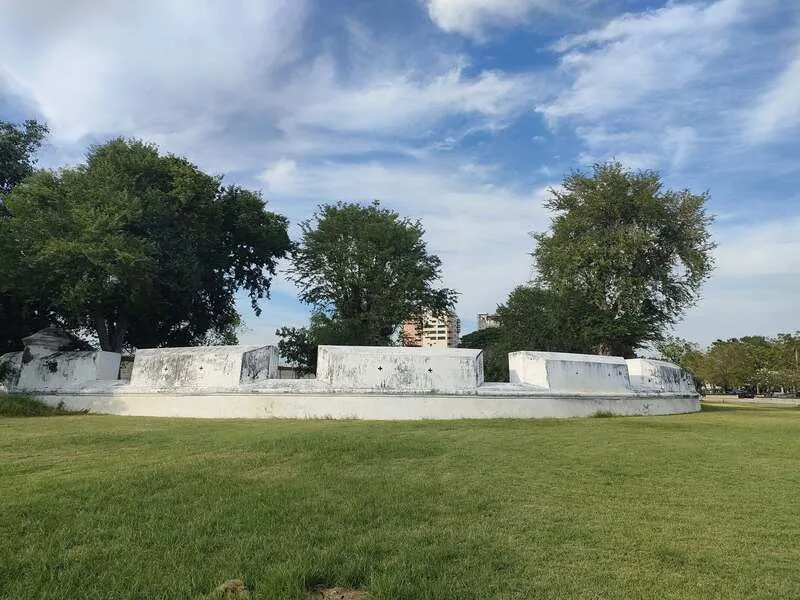
Chachoengsao Fort and City Wall is a heritage site from the reign of King Rama III, built in 1834 (B.E. 2377) to control the eastern defensive line of the capital under the strategic geography of the Bang Pakong River basin. The site later became associated with the Ang Yi uprising in 1848 (B.E. 2391), reflecting the economic and social tensions of a river-port trading town in that era. Today, the area has been landscaped into a riverside public park where visitors can walk along remnants of the old brick wall, learn the history of Paet Riw (Chachoengsao), and connect a one-day itinerary to Wat Sothon, Ban Mai Market, and other riverside neighborhoods in the same trip.
Chachoengsao Fort and City Wall is one of the clearest symbols of Paet Riw as an “eastern frontier city” of early Rattanakosin. Looking from the Bang Pakong River, you can sense how the state sought to control waterways that served both as the lifeblood of commerce and as a military corridor. Building a city wall was not merely stacking bricks into a high barrier; it was a declaration of state authority, an instrument for organizing an urban space, and a practical response to geopolitical uncertainty at a time when Siam faced pressures from border conflicts and rapid changes in regional trade.
Historically, the fort and wall were constructed during the reign of King Rama III in 1834 (B.E. 2377). The king appointed Krom Luang Rak Ronnaret as the chief commander of the construction, with the purpose of strengthening defenses on the eastern approaches to the capital. The idea of fortifying key towns like Chachoengsao aligned with the state’s wider strategy to secure areas connected to the Gulf of Thailand coastline and the eastern provinces, and to prepare for threats that could advance toward Bangkok by both land and river routes.
On the strategic map of Siam at the time, Chachoengsao was not simply a stopover but a junction of several layers of movement. First, as a Bang Pakong riverside town, it facilitated the transport of people, goods, and supplies from provincial areas toward the center. Second, its proximity to coastal zones and trading networks encouraged active circulation of people, especially Chinese communities and commercial networks along the river system. Economically, these networks were vital to the state; administratively, they required governance and oversight to prevent conflicts and extra-legal influence. Third, the town held a military function because the eastern corridor demanded vigilance against external movement and required safeguarding approaches to the capital beyond the western and northern directions.
In heritage descriptions, the Chachoengsao city wall is characterized as a brick-and-mortar structure running parallel to the Bang Pakong River. The overall plan is rectangular, with a moat surrounding the city and defensive elements such as parapets and observation points at key corners. Dimensions cited across multiple references generally fall around 275–300 meters in width and 500–565 meters in length, indicating a clearly defined defensive boundary capable of supporting garrison activity and internal movement. For visitors today, even though the wall is not fully intact on every side as in its earliest form, the remaining old brickwork and the riverside landscape still allow you to imagine a frontier town with watch duty, controlled entrances, and elevated vantage points overlooking the waterway.
To understand why King Rama III invested in city-fortification systems in important provincial towns, it helps to view the early 19th century political and security context. This was a period when Siam maintained a traditional state structure while confronting a rapidly expanding commercial world. The kingdom benefited from junk trade with China, tax and duty systems, and the tax-farming mechanism that relied on private operators and merchant networks to collect revenue. Such income supported stronger defenses and infrastructure. At the same time, the expanding economy brought growing concentrations of labor and people in port towns, particularly Chinese communities who came to work, trade, and build businesses around the capital. Large populations operating within competitive commercial conditions naturally created both opportunity and friction, including contestation over benefits, informal networks, and conflicts with state authority or local administrators.
Geopolitically, the Rama III era required managing relationships and tensions in the region, including with powers such as Vietnam, as well as handling issues involving tributary polities and border areas. Conflicts across mainland Southeast Asia drove the state to increase readiness, especially along corridors connected to the eastern provinces where routes served both strategic movement and resource logistics. The Chachoengsao wall, therefore, was not an isolated defensive project but part of a broader effort to “organize space” so the state could respond faster to threats through troop deployment, supply accumulation, river-traffic control, and coordination with neighboring towns.
Looking at everyday life in Paet Riw during that period, river towns were where economic activity pulsed: markets, piers, transport of agricultural produce and necessities, and multi-ethnic communities living side by side. Such towns needed governance that could maintain order and structures that could defend. The wall and fort served both functions. Symbolically, the wall marked the boundary of a city under state authority. Practically, it controlled movement, improved security, reduced the risk of sudden attacks, and provided strategic positions for defense or mobilization when emergencies arose.
The event that makes Chachoengsao Fort and City Wall stand out in historical memory is the Ang Yi uprising in 1848 (B.E. 2391). Consistent with the account provided, the group involved Chinese actors associated with opium-related activities and attacks on trading vessels, escalating to the killing of the governor, Phraya Wiset Ruechai, before seizing the fort and wall as a stronghold. This episode should not be viewed only as a criminal case; it reflects the socio-economic structure of provincial trading towns in an era of rapid commercial expansion, increasing wealth flows, and labor migration, where secret societies and labor associations could play real roles in work organization, mutual protection, and bargaining power.
As a form of overseas Chinese association, Ang Yi networks took different shapes in different places. In some contexts, they began as mutual-aid structures among laborers and merchants; however, where profits were high and control over specific businesses or trade routes mattered, such networks could evolve into organizations that challenged state authority. Chachoengsao was particularly conducive to the emergence of such networks because it was a river town with shipping activity, markets, and substantial labor. When pressures accumulated—whether from disputes over interests, law enforcement, taxation, or competition among community groups—conflict could erupt into violence.
The fact that the insurgents chose to seize the “fort and city wall” underscores the strategic value of these structures. A wall offers strong defensive positioning, elevated sightlines, and a layout designed for protection. When suppression became necessary, the state had to deploy a commander with high authority and legitimacy. King Rama III ordered Chao Phraya Khlang (later Somdet Chao Phraya Borom Maha Prayurawong) to lead forces to restore order. Reports describe heavy casualties among the insurgents. The episode became a lesson for the state in governing diverse, commercially active port towns, and a lesson for urban communities that a wall built to defend against external enemies could also be used as a base in internal conflict.
After the unrest, Chachoengsao continued to develop through later centuries as Siam’s transportation and administration changed. As roads and railways gained importance, many river towns shifted from port-centered trade nodes toward service and administrative centers. What often remained were traces of earlier strategic planning: moats, wall lines, and riverfront zones that once functioned as the “front” of the city. Chachoengsao Fort and City Wall thus serves as a physical record that lets modern visitors connect to the past without relying only on textbooks. You can walk along the brickwork, sense the density of the materials, see the river-facing perspective, and understand why this location was selected as the heart of the city’s defensive system.
Visiting the site today works well for both history-minded travelers and those seeking a short, relaxed stop in the city center. The surrounding area has been landscaped for easy walking, with places to sit, catch the river breeze, and enjoy Bang Pakong views that are central to Chachoengsao’s charm. For the best atmosphere, mornings feel calm with soft light for observing details and photographing the old brick line, while late afternoon into evening suits riverside views and an easy transition to nearby dining spots.
Another reason the site lends itself to deeper storytelling is the way it connects national history with local history. The names and years anchor the place to key figures in Thai history: King Rama III as the monarch of a commerce-driven era who strengthened state capacity, Krom Luang Rak Ronnaret as the construction leader, and Chao Phraya Khlang as the state’s principal commander in the suppression. When the narrative is grounded in geography—the Bang Pakong River, Maruphong Road, Na Mueang subdistrict, and riverside market communities—it becomes clear that history did not happen only in royal courts but also in real towns where people lived, traded, and negotiated power every day.
For travelers who enjoy “walking through an old town” itinerary, this spot links smoothly to nearby attractions. Wat Sothon adds a layer of faith and cultural life, Ban Mai 100-Year Market adds trade heritage and an old riverside community setting, Somdet Phra Srinagarindra Park adds green relaxation, and a short drive further connects to Bang Khla Floating Market and Bang Pakong riverside routes. The result is a one-day Chachoengsao trip that can feel complete: history, devotion, and local riverside life, without extensive driving.
Getting There From Bangkok, you can take the Bangna–Trat route (or the Burapha Withi expressway sections where applicable) and connect into Chachoengsao city via the main highways heading to Mueang District. Once you reach the Na Mueang area, set your map pin to Maruphong Road, which is where the fort and wall area is located. Train travel is also possible by getting off at Chachoengsao Station, then continuing by local transport such as songthaew, taxi, or ride-hailing into the Bang Pakong riverside zone. Distances within the city center are manageable, and walking on foot afterward is a practical way to take in the river atmosphere.
| Place Summary | A Rama III-era heritage site on the Bang Pakong River, built as part of the eastern defensive line of the capital and linked to the Ang Yi uprising in 1848 (B.E. 2391). Today it functions as a riverside public park and an accessible point for learning Paet Riw (Chachoengsao) history. |
| Location / Address | Maruphong Road, Na Mueang Subdistrict, Mueang Chachoengsao District, Chachoengsao 24000, Thailand |
| Highlights | Old brick wall remains along the Bang Pakong River, easy walking environment, strong historical narrative of an eastern frontier city, and convenient links to city-center attractions. |
| Era / Period | Early Rattanakosin (Built in 1834 / B.E. 2377) |
| Key Evidence / Historical Notes | Constructed during King Rama III to strengthen eastern defenses; associated with the Ang Yi uprising in 1848 (B.E. 2391) when the fort and wall area was seized as a stronghold before suppression by state forces. |
| Name Origin | Named after its function as the fortification and city wall system of Chachoengsao, located in the Na Mueang area along the Bang Pakong River. |
| Open Days | Open daily |
| Opening Hours | 07:00 – 17:00 |
| Fees | Free admission |
| Facilities | Riverside park area, seating/rest points, river-view walking paths, photo spots, and public parking nearby. |
| Current Status | Heritage site and riverside leisure area open to visitors during listed hours. |
| Nearby Tourist Attractions | 1. Wat Sothon Wararam Worawihan (Approx. 2 km) 2. Ban Mai 100-Year Market (Approx. 3 km) 3. Somdet Phra Srinagarindra Park, Chachoengsao (Approx. 2 km) 4. Chumphot-Phanthip Museum House (Approx. 4 km) 5. Chalerm Phrakiat Park by the Bang Pakong River (Approx. 3 km) |
| Popular Restaurants Nearby | 1. Mathuros Ruern Pae (Approx. 0.5 km) Tel. 038-511-958, 081-864-2929 2. Chuan Ma Restaurant (Approx. 2 km) Tel. 081-496-6265 3. Baan Mai Rim Nam, Paet Riw (Approx. 2 km) Tel. 038-512-064 4. Baan Pa Nhu (Ban Mai 100-Year Market) (Approx. 3 km) Tel. 038-817-336 5. Baan Pheum Boon (Approx. 3 km) Tel. 038-535-099 |
| Popular Accommodations Nearby | 1. The Brown House Hotel (Approx. 3 km) Tel. 083-011-4212 2. Suntara Wellness Resort & Hotel (Approx. 5 km) Tel. 063-345-1181 3. Heaven Hotel Chachoengsao (Approx. 4 km) Tel. 038-511-150, 094-343-0444 4. JK Living Hotel & Service Apartment (Approx. 4 km) Tel. 092-742-9929, 038-511-255 5. Cho House 8 Riw (Approx. 3 km) Tel. 081-172-8383 |
Frequently Asked Questions (FAQ)
Q: When was Chachoengsao Fort and City Wall built?
A: It was built in 1834 (B.E. 2377) during the reign of King Rama III, with Krom Luang Rak Ronnaret appointed to oversee the construction.
Q: Why was Chachoengsao considered an eastern frontier city?
A: The town sits on the Bang Pakong River basin, a key transportation and strategic corridor linking the eastern provinces and routes toward the capital, so fortifications helped the state control movement and strengthen security.
Q: How is the Ang Yi uprising connected to this site?
A: In 1848 (B.E. 2391), insurgents seized the fort and wall area as a stronghold before state forces were dispatched to suppress the uprising and restore order.
Q: What time of day is best to visit?
A: Mornings are ideal for calm walks and soft light for photos, while late afternoon to early evening is best for Bang Pakong river views and pairing the visit with nearby riverside dining.
Q: What attractions can I visit next in the same day?
A: You can continue to Wat Sothon Wararam Worawihan, Ban Mai 100-Year Market, Somdet Phra Srinagarindra Park, or other riverside spots in the city center.
Q: Is there an entrance fee?
A: No. Admission is free.
 Chachoengsao Fort and City Wall Map
 Category:
  Group:
  Tag: ●Chachoengsao Fort and City Wall●chachoengsao city wall ●chachoengsao fort ●things to do in chachoengsao ●bang pakong river ●chachoengsao history ●rama iii thailand ●eastern frontier city ●ang yi rebellion ●heritage site in thailand ●old town chachoengsao Last Update: 14 HourAgo
Comment
 Nearby Attractions
| Keyword (Advance) |
 Region
|
 Muang Chachoengsao(
 Copyright 2012,