

 Home
Home Chiang Mai(




Bang Pakong Barrage
Rating: 4.2/5 (5 votes)
 Search By
  Map
Map 
 Have Map
  No Map
Chachoengsao attractions
Attractions in Thailand
Open Days: Tuesday–Sunday
Opening Hours: 08.00–16.00
Bang Pakong Barrage is one of those places that gives the phrase “things to do in Chachoengsao” a deeper meaning than simply hunting for a nice view or a photogenic spot. This is a key piece of water-management infrastructure for the Bang Pakong River Basin, with real impact on everyday life in Thailand’s Eastern region—from preventing saltwater intrusion into the river, to supporting the freshwater system for domestic use, agriculture, and the rising demand that comes with expanding cities and industry. If you want a trip that offers knowledge and a close look at the “system behind the scenes” that helps secure freshwater, while also giving you a calm riverside atmosphere where you can stroll and take photos, Bang Pakong Barrage is a clear choice—especially for travelers who enjoy learning-focused outings and prefer seeing the real site rather than only reading about it.
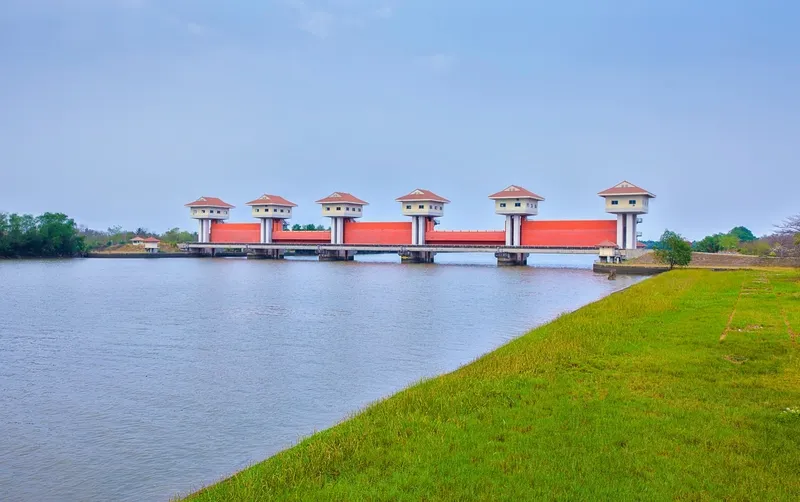
The barrage is located around Ban Phai Sawek in Bang Kaeo Subdistrict, and it sits roughly 6 kilometers downstream from Chachoengsao town along the Bang Pakong River. That makes it an easy escape from the city for a half-day or day trip. One of the most appealing aspects of visiting is the “open” feeling of the riverside setting. Looking along the water, you can clearly see both the breadth of the Bang Pakong River and the structure of the barrage working as part of a wider water system. This kind of view helps even first-time visitors to irrigation engineering understand that “water” is not just a natural resource we use and forget—it is a system that requires design, control, and ongoing management to balance human demand with the river’s ecological sensitivity.
Before talking about where to walk and which photo angles to try, it helps to understand how a “barrage” differs from a large storage dam in many people’s imagination. A barrage is not mainly built to store water in a huge reservoir; instead, it is designed to control water level and flow in a river—especially in areas vulnerable to high tides and saltwater pushing upstream. When sea levels surge, saline water can move back up the river. If saltwater intrusion advances further inland, it can directly affect tap-water production, agriculture, and freshwater ecosystems. That is why the Bang Pakong Barrage is often described as a “barrier against saltwater intrusion,” helping protect freshwater quality during high-risk periods by working together with drainage and water-level control measures that match seasonal and real-time conditions.
For people living in Chachoengsao and nearby areas, the barrage’s benefits may not show up as daily numbers, but they are felt through the “continuity of freshwater” that supports major regional activities. The Eastern region includes farmland, urban communities, and fast-growing industrial areas, so water demand is significant. As demand rises, the need for reliable allocation and quality management becomes even more critical. The Bang Pakong Barrage is therefore one of the structures developed to strengthen water security, reduce the risk from severe drought periods or tide-driven salinity, and make local water-use planning more workable—especially at a time when natural conditions are increasingly variable and seasons no longer follow the familiar patterns as predictably as before.
In terms of a practical “history” that visitors can grasp, the Bang Pakong Barrage is documented as having begun construction in 1996 and started operation in 2000 under the Royal Irrigation Department. These details show that the project was not created overnight. It was the result of long-term planning and investment to address saltwater intrusion and strengthen the overall water security of the Bang Pakong Basin. When you stand on-site and look along the line of gates and structural elements, the experience feels different from reading a few figures online—you can sense the scale and the intention of the engineering, designed to manage a river whose conditions change constantly. That challenge requires data, forecasting, and accumulated operational experience working together.
As a travel spot, Bang Pakong Barrage has a distinctive kind of charm. It does not require much physical effort—no hiking and no long-distance travel—yet it offers a broad view of how nature and human-built systems interact. The Bang Pakong River creates a calm, easy-on-the-eyes atmosphere, and the riverside breeze naturally helps you relax. At the same time, the structure often prompts visitors to ask questions: Why does the water rise higher at certain times? Why do they need to release water? Why is salinity control necessary in some periods? These are the beginnings of learning-based travel, because once you understand the “reason this place exists,” walking around and looking at the view becomes an experience with meaning rather than just a quick stop.
For atmosphere and photography, the best times to visit are usually morning to late morning when the light is soft, or late afternoon when the sun is gentler and the air is cooler. Visiting outside peak heat makes it easier to walk comfortably and spend more time taking in the place. If your goal is wide-angle river views with the barrage structure, the photos look best when the light reflects off the water and the shadows of the structure add depth and a sense of story. If you enjoy documentary-style photography, this is a strong location for capturing “water systems” through elements such as the gate line, structural geometry, and the relationship between river scale and engineered control—images that are hard to get from typical nature viewpoints.
Because this site is tied to essential infrastructure and irrigation operations, safety and respect for restricted zones should be treated as priorities. Avoid approaching areas with warning signs or barriers, do not climb on structures, do not stand in risky spots, and take extra care if visiting with children or older family members. The most comfortable way to enjoy a place like this is to remain within permitted viewing areas, take in the full picture, and let the site continue its operational role while you use the riverside setting as a space to rest. The key purpose of a barrage is “system function,” not adventure. Following basic rules helps keep your visit safe and supports the long-term usability of the area.
For trip planning, Bang Pakong Barrage is ideal for a half-day visit or a short outing that does not need to feel rushed—especially if you are staying in Chachoengsao town or already exploring riverside spots nearby. A simple plan is to stop for the view in the morning or late afternoon, then continue to a riverside restaurant or a cafe, and return to town for the next stop. This style of travel feels like a visual reset and a quick recharge: you get the river air, the breeze, and the quiet without traveling far or spending much time preparing.
Getting There Visiting Bang Pakong Barrage is best by private car. From Chachoengsao town, drive out along the Chachoengsao–Bang Khla route into Bang Kaeo Subdistrict. In the Ban Phai Sawek area, watch for signage pointing to the barrage and the designated entrance. If traveling from Bangkok, it is convenient to enter Chachoengsao town first, then continue toward Bang Khla or the Bang Pakong riverside areas depending on your planned route. It helps to allow extra time and keep the trip unhurried, because the main appeal here is spending enough time to truly take in the river view and the barrage structure—standing still for a moment, walking slowly, and absorbing the relationship between the river and the engineering rather than stopping for only a few minutes and moving on.
In closing, if you want a Chachoengsao destination that is different from the usual temples and cafes, Bang Pakong Barrage is a worthwhile choice. It offers a close look at Thailand’s real-world water management while providing a calm riverside setting that is genuinely restorative. A visit here gives both comfort and understanding—especially once you see that a barrage is not simply a structure, but part of the ongoing protection of one of the region’s most important resources: freshwater that supports communities, agriculture, cities, and the river ecosystem of the Bang Pakong Basin.
| Place Summary | Bang Pakong Barrage is a river barrage / water-control gate system in the Bang Pakong Basin. It plays a major role in preventing saltwater intrusion and supporting freshwater management for the Eastern region. The riverside setting is calm and well-suited to short, learning-oriented visits. |
| Address | Ban Phai Sawek area, Bang Kaeo Subdistrict, Mueang Chachoengsao District, Chachoengsao (via the Chachoengsao–Bang Khla route) |
| Key Highlights | A real-world water-management structure in the Bang Pakong Basin, supports saltwater intrusion control and freshwater security, calm riverside views, strong documentary-style photo potential, and a convenient drive from the town center. |
| History / Timeline (Verified) | Construction began in 1996 and operations began in 2000, under the Royal Irrigation Department. |
| Key Context | A core part of water management in the Bang Pakong River Basin, recognized for preventing saltwater intrusion and supporting freshwater allocation for major regional uses. |
| Getting There | By private car: From Chachoengsao town, drive toward Bang Khla and enter Bang Kaeo Subdistrict (Ban Phai Sawek zone), then follow signs to the barrage and the designated parking/entrance points. |
| Current Status | Open for visits during the site’s operating days and hours. |
| Verified Contact Number | 0-3809-3743 |
| Nearby Tourist Attractions (Approx. Distance) | 1) Wat Sothon Wararam Worawihan – 12 km 2) Baan Mai 100-Year Market – 10 km 3) Wat Saman Rattanaram – 20 km 4) Bang Khla Floating Market – 25 km 5) Wat Pak Nam Jolo – 28 km |
| Nearby Restaurants (Approx. Distance + Phone) | 1) Khrua Im Suk by Ban Yu Pen Suk – 2 km – 06-5526-3636 2) Pae Daeng (Paet Riw) – 2.9 km – 09-1970-6677 3) U Cup Coffee x Farmers Market – 3.7 km – 08-2915-4635 4) Sun Up – 4.1 km – 08-2468-6663 5) Mummie Cafe & Restaurant – 4.7 km – 06-3925-9456 |
| Nearby Accommodations (Approx. Distance + Phone) | 1) Suntara Wellness Resort & Hotel – 12 km – 08-1548-0114 2) JK Living Hotel & Service Apartment – 10 km – 09-2742-9929 3) Heaven Hotel Chachoengsao – 10 km – 09-4343-0444 4) The Wish Hotel & Condo Chachoengsao – 11 km – 08-8521-5234 5) The Brown House Chachoengsao – 10 km – 08-3011-4212 |
Frequently Asked Questions (FAQ)
Q: What days is Bang Pakong Barrage open?
A: It is open Tuesday through Sunday.
Q: What are the opening hours?
A: 08.00–16.00
Q: Where is Bang Pakong Barrage located?
A: It is in the Ban Phai Sawek area of Bang Kaeo Subdistrict, Mueang Chachoengsao District, about 6 kilometers downstream from Chachoengsao town along the Bang Pakong River.
Q: What is the main purpose of Bang Pakong Barrage?
A: Its key function is to help prevent saltwater intrusion into the Bang Pakong River and support freshwater management for the area’s major needs.
Q: When is the best time to visit for atmosphere?
A: Morning to late morning or late afternoon is recommended, as the air is more comfortable and the light is better for riverside views.
Q: Is it easy to get to Bang Pakong Barrage?
A: Yes. It is most convenient by private car, driving from Chachoengsao town toward Bang Khla and entering Bang Kaeo Subdistrict, then following signs to the barrage.
 Bang Pakong Barrage Map
 Category:
  Group:
  Tag: ●Bang Pakong Barrage●bang pakong barrage ●bang pakong dam ●chachoengsao attractions ●things to do in chachoengsao ●bang pakong river ●saltwater intrusion prevention ●irrigation barrage ●water management thailand ●chachoengsao viewpoint ●riverfront travel Last Update: 2 DayAgo
Comment
 Nearby Attractions
| Keyword (Advance) |
 Region
|
 Muang Chachoengsao(
 Copyright 2012,