

 Home
Home Chiang Mai(




Banmai 100 year Market
Rating: 4.2/5 (5 votes)
 Search By
  Map
Map 
 Have Map
  No Map
Chachoengsao attractions
Attractions in Thailand
Open Days: Monday – Sunday
Opening Hours: 08:00 – 17:00
Ban Mai 100-Year-Old Market (Riverside Century-Old Market), Chachoengsao If you are looking for a place to visit in Chachoengsao where you can “stroll, eat well, take beautiful photos, and soak up the living riverside community vibe” that still feels authentic every single day, Ban Mai 100-Year-Old Market is one of the most fitting answers. This is not a market created purely for tourism; it is a historic riverside market on the Bang Pakong River that has grown alongside local people and trade for more than a century, becoming a gentle, heartfelt portrait of Paet Riu (Chachoengsao) in its most sincere form.
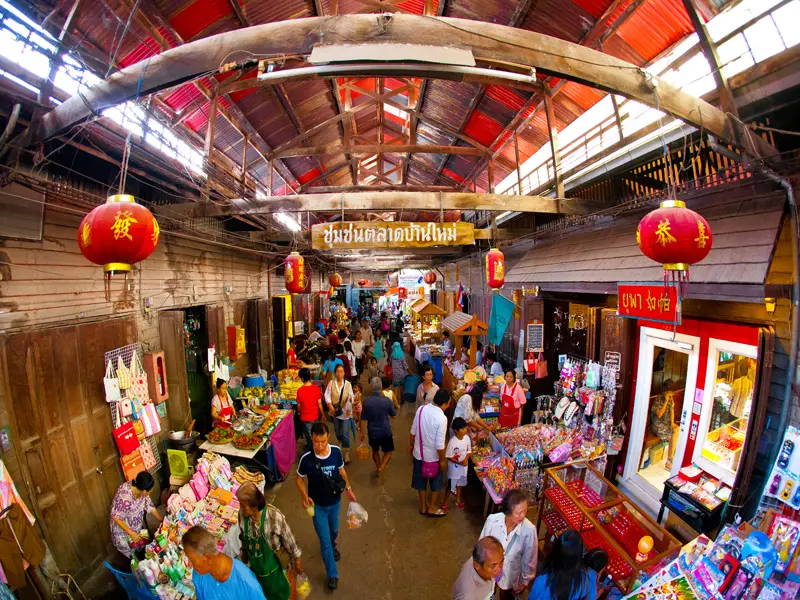
Ban Mai 100-Year-Old Market sits on Suphakit Road along the Bang Pakong River. It is a wooden heritage market that reflects the rhythm of riverside community life, offering a wide mix of Thai and Chinese savory dishes and sweets, old-school drinks, traditional-style coffee, and vintage souvenirs. The atmosphere is slow and unhurried, making it ideal for a half-day to full-day outing—especially on Saturdays and Sundays, when the market becomes noticeably more lively.
What makes Ban Mai special is not only its long history, but also the way its old wooden houses and storefronts remain part of a real community. The Bang Pakong River still frames everyday life here, so walking through the market can feel like visiting an elder relative’s neighborhood in an old town rather than ticking off a typical tourist checklist. Along the way, you will see more than merchandise: traces of memory appear in old shop signs, well-worn wooden shelves, friendly calls to customers, and the comforting aroma of coffee brewed with practiced hands.
The market is located on Suphakit Road in Na Mueang Subdistrict, Mueang Chachoengsao District, close to the Bang Pakong River. That setting immediately explains why the community and the market grew together. In earlier times, the river served as a major route for travel and trade. People moved by boat, transported goods by water, and exchanged products at the riverside. A riverside market was therefore more than a place to sell things; it was a meeting point, a news hub, and a space that strengthened community ties.
Historically, Ban Mai 100-Year-Old Market is often described as being established “before or around the reign of King Rama V” and has lasted well over 100 years. It stands as a living piece of spatial evidence showing how river towns and local economies were connected. Its heritage is not locked away in a museum; it remains in daily use through ongoing trade and the lives of people who still feel connected to the Bang Pakong River.
As time passed, the city expanded and commerce shifted from waterways to roads. Many old markets across Thailand gradually declined or were replaced by modern construction, but Ban Mai chose a different path: preserving its “way of life” while adapting so it could continue into the present. A key part of that preservation has been community collaboration, leading to the formation of the “Ban Mai Market Preservation Club” (Chomrom Rak Talat Ban Mai). The group helps oversee the overall direction, supports activities that encourage visitors to return, and—most importantly—ensures that preservation is not only romantic nostalgia, but also a sustainable livelihood for local residents.
That is why visiting Ban Mai means more than shopping. Every cup of traditional-style coffee, every plate of curry rice, and every Thai or Chinese sweet you take home supports the community economy directly. It helps income circulate back to local people and allows a culturally valuable heritage market to remain very much alive—and to endure with dignity.
The charm of Ban Mai feels effortless. The old wooden buildings by the river naturally create soft, classic photo backdrops. You will notice walkways guiding you along rows of shops, small openings revealing the Bang Pakong River, locals chatting in familiar accents, and visitors unconsciously slowing their pace. This is what genuine community-based travel feels like: the place gently pulls you away from hurry without making you force it.
If you want to explore the market in a way that feels complete and well-paced, start with lighter bites and drinks first—old-fashioned beverages, herbal refreshments, or traditional coffee with a nostalgic sweetness. Then move on to more filling savory dishes such as curry rice or noodles. These foods are a hallmark of true old markets because they taste like well-practiced home cooking rather than meals designed mainly for image. Follow with sweets that include both Thai and Chinese desserts, reflecting the diversity of an old riverside trading community, and finish with souvenirs that carry a vintage feel—old-style toys, small handicrafts, or local herbal products.
The food scene that people often mention at Ban Mai is its “true old-market variety.” You will find curry rice counters laid out in a simple, familiar style; long-running neighborhood noodle shops; old-school drinks made with traditional methods; Thai sweets with coconut and sugar aromas that are increasingly hard to find today; and Chinese-influenced snacks tied to the area’s long history as a trading town. Together, these tastes become the “flavor of place,” turning a market walk into a way of reading the city through food.
Saturdays and Sundays are typically the busiest. By nature, community markets draw more visitors on weekends, and vendors often bring out more goods than on weekdays. The result is a more energetic walk with more choices, ideal for anyone who wants to see the market at its fullest. Weekdays are calmer, better for slow strolling, taking photos without crowds, and lingering by the Bang Pakong River without needing to dodge streams of people.
The recommended time to arrive is from early morning to late morning. The weather is still comfortable, many shops have their full selection available, and the light is excellent for photography—especially if you like warm tones that highlight wood textures and soft shadows. Late afternoon is better for resting, sipping coffee, or enjoying something chilled rather than walking intensely, because riverside sunlight becomes stronger. The upside is a gentler pace and a more relaxed atmosphere for sitting and chatting.
Getting There: Reaching Ban Mai 100-Year-Old Market is straightforward, whether you are planning a short trip from Bangkok or a full-day exploration of Paet Riu (Chachoengsao).
If you drive, head into Chachoengsao town and continue toward Suphakit Road, a key route that connects toward Bang Nam Priao District. Watch for access routes into the market area along the Bang Pakong River, park in the designated areas, and then walk in. The market is best enjoyed on foot at a slow, relaxed pace, so comfortable shoes make a noticeable difference and encourage you to stop and taste along the way.
If you prefer not to drive, traveling by train is a good option because Chachoengsao is easy to reach from Bangkok. Once you arrive at the station in town, you can transfer to local transport to Suphakit Road and the riverside market area. This approach also lets you experience more of the old-town rhythm and makes it easy to continue to other key spots in the city within the same day.
For maximum convenience, vans or buses from Bangkok into Chachoengsao town are also popular. After arrival, transfer to local transport to reach the market. This plan works well for international visitors or anyone who wants to keep navigation simple, because many of Paet Riu’s main attractions in the town area connect without difficulty.
As you continue walking, you will notice that the market’s beauty is not only in its age, but in the balance between the old and the contemporary. Some shops keep a vintage style, while others adapt slightly for newer visitors, yet the overall identity remains clearly that of a Bang Pakong riverside market. Walking slowly helps you spot details—old wooden pillars, sun-faded paint, shop names tied to original owners or family lines, and the way vendors speak with customers as if they remember each other. This kind of familiarity is increasingly rare in modern retail spaces.
Another reason Ban Mai works well for families is that it teaches without needing instructional signs. Bring children and you can naturally explain why houses once faced the river, why local food includes both Thai and Chinese influences, how old-fashioned drinks were once everyday staples for grandparents, and how a place that looks like a tourist destination today was once a true commercial center for the community.
If you enjoy photography, Ban Mai offers many styles in one place: street photos of people browsing, nostalgic frames focusing on wooden houses and classic signage, calm riverside scenes along the Bang Pakong, and food shots that look delicious without over-styling. The key is to walk slowly and pay attention to light, shadow, and wood textures—your photos will feel more like stories than simple check-ins.
To keep community-based travel meaningful, visitors should share basic etiquette: walk carefully, avoid loud noise that disturbs residents, respect home-front spaces and walkways, and keep the area clean. If you want close-up photos of people or shopfronts, asking permission first often makes the moment warmer. Many vendors are happy and proud that their market is still valued.
To maximize your trip, you can use Ban Mai as a central anchor and connect to nearby attractions around Paet Riu with minimal travel time. The surrounding area includes religious sites, Chinese temples, the city pillar shrine, and riverside landmarks. This plan suits families, photographers, and food lovers alike, because it delivers fullness, calm, and multiple perspectives of a river town in a single day.
In the end, the charm of Ban Mai 100-Year-Old Market is how it makes the idea of “preservation” feel real and close to you. You experience it through walking, tasting, and talking. Visiting becomes a small break for the mind and a practical way to support a community at the same time. If you want to know Chachoengsao beyond a quick pass-through on the way to somewhere else, start with this riverside market—and you will understand why Paet Riu’s appeal lasts as steadily as the Bang Pakong River beside it.
| Place Name | Ban Mai 100-Year-Old Market (Riverside Century-Old Market) |
| Location | Suphakit Road, Na Mueang Subdistrict, Mueang Chachoengsao District, Chachoengsao |
| Place Summary | A century-old riverside market on the Bang Pakong River reflecting traditional community life, known for Thai–Chinese food, old-school drinks, vintage souvenirs, and a heritage wooden-house atmosphere. |
| Key Highlights | Heritage wooden riverside vibe, classic market food (savory & sweet), traditional coffee and old-fashioned drinks, vintage-style souvenirs, relaxed walk suitable for families and photographers. |
| Period | Over 100 years old (often referenced as established before/around the reign of King Rama V). |
| Preservation / Community Steward | Ban Mai Market Preservation Club (Chomrom Rak Talat Ban Mai) |
| Travel | Car: Drive into Chachoengsao town, head to Suphakit Road, then walk into the Bang Pakong riverside market area / Train or Van: Arrive in town, then transfer to local transport to Suphakit Road. |
| Current Status | Open to visitors. |
| Contact Number | 038-817-336 |
| Nearby Tourist Attractions With Distance | 1) Wat Uphaiphathikaram – 0.4 km 2) Sawang Sattadhammasathan Foundation – 0.4 km 3) Wat Laem Tai – 1.2 km 4) Bang Pakong Riverside Clock Tower – 1.7 km 5) Chachoengsao City Pillar Shrine – 2.5 km |
| Popular Restaurants Nearby With Distance + Phone | 1) Pad Thai Boran Tan Maprao – 0.1 km 2) CHUK DI Restaurant – 0.1 km – 038-513-975, 094-478-3785 3) Sam Mae Krua (Tao Fuen) – 0.1 km – 087-602-8174 4) Sui Tha Yai – 0.1 km – 081-586-1919 5) Pae Oei 100-Year Coffee – 0.1 km – 084-667-7881 |
| Popular Accommodations Nearby With Distance + Phone | 1) Baan Bang Pakong – 3.5 km – 081-134-3333 2) JK Living Hotel and Service Apartment – 4.2 km – 092-742-9929, 038-511-255 3) December to Remember (House) – 4.3 km – 094-491-7791 4) Sun Thara Wellness Resort Hotel – 5.8 km – 038-823-317 5) The Wish Hotel & Condo Chachoengsao – 6.7 km – 088-521-5234 |
Frequently Asked Questions (FAQ)
Q: Is Ban Mai 100-Year-Old Market open every day?
A: Yes. It is open Monday through Sunday, and weekends are usually the most lively.
Q: What are the opening hours of Ban Mai 100-Year-Old Market?
A: 08:00 – 17:00.
Q: How long should I plan to spend at the market?
A: A half-day visit is ideal (about 2–4 hours), and you can extend it to a full day by adding nearby attractions in Paet Riu (Chachoengsao town area).
Q: Which day is best if I want the most shops and the busiest atmosphere?
A: Saturdays and Sundays typically have more vendors and a more energetic market vibe than weekdays.
Q: What nearby places are easy to visit after the market?
A: Nearby options include Wat Uphaiphathikaram, the Sawang Sattadhammasathan Foundation, Wat Laem Tai, the Bang Pakong Riverside Clock Tower, and the Chachoengsao City Pillar Shrine.
 Tel: 038817336
 Mobile: 0861484513, 0898817161, 0896664266
 Banmai 100 year Market Map
 Category:
  Group:
  Tag: ●Banmai 100 year Market●ban mai market 100 years ●baan mai market chachoengsao ●chachoengsao old market ●riverside market thailand ●bang pakong river market ●chachoengsao travel guide ●things to do in chachoengsao ●chachoengsao local food ●day trip from bangkok chachoengsao ●vintage market thailand Last Update: 4 DayAgo
Comment
 Nearby Attractions
| Keyword (Advance) |
 Facebook Fanpage
 Region
 Art, Culture and Heritage
 Historical Sites and Monuments(
 Landmarks and Memorials(
 Royal Palace(
 Art, Craft Centres, Tradition(
 Museums(
 Historical Houses and The Ancient City(
 Educational Places
 Museum for Study(
 Library(
 Educational Gardens, Farm(
 University
 Places of Worship
 Temple(
 Mosque(
 Other religious and spiritural sites(
 Research and Development
 Royal Project(
 Village, Community(
 Floating Market(
 Nature and Wildlife
 National Parks and Marine Reserves(
 Mountain (Doi)(
 Dam, Reservoir, Lake(
 Waterfalls(
 Caves(
 River, Canal(
 Bays and Beaches(
 Islands(
 Other natural attractions(
 Entertainment and Agricultural
 Zoos and Aquariums(
 Animal camps and shows(
 Farm, Parks, Gardens and Ecotourism(
 Spas and Wellness
 Spas and Wellness(
 Travel Articles, Recipes
 Travel Review, Food Review(
 Copyright 2012,