
lovethailand home >Northeastern Travel Attractions >Si Sa Ket Travel Attractions >Huai Thap Than >Prasat > Prasat Ban Prasat
TL;DR: Prasat Ban Prasat is located at Wat Prasat Phanaram, Ban Prasat, Prasat Subdistrict, Huai Thap Than District, Si Sa Ket Province, open Daily, hours 08.30 – 16.30.
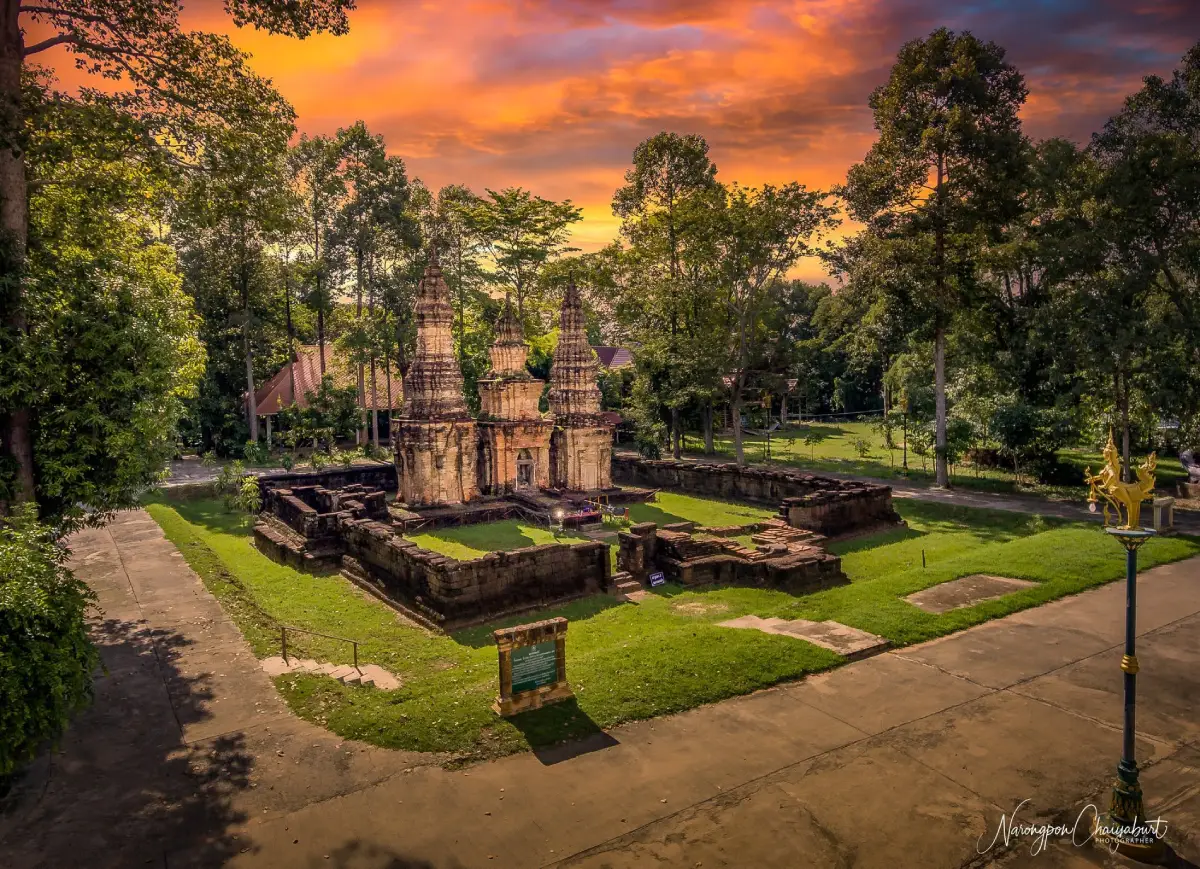
Prasat Ban Prasat
Open Days: Daily
Opening Hours: 08.30 – 16.30
Prasat Ban Prasat, also known as Prasat Huai Thap Than or Prasat Ban Non That, is an ancient Khmer sanctuary located inside Wat Prasat Phanaram at Ban Prasat, Prasat Subdistrict, Huai Thap Than District, Si Sa Ket Province. The site is one of the notable brick Khmer monuments in western Si Sa Ket and consists of 3 brick sanctuary towers standing on the same laterite base. The towers are arranged along a north-south axis and face east, following the sacred orientation commonly found in Khmer religious architecture. With its brick towers, sandstone door frames, lintels, laterite enclosure, and surviving gopura remains, Prasat Ban Prasat is an important cultural destination for travelers who want to understand Khmer art, Brahmanical-Hindu belief, and living community faith in Lower Northeastern Thailand.
The monument is especially interesting because it was modified in later periods. Its roof structure is often compared with Prasat Sikhoraphum in Surin Province, but the towers at Prasat Ban Prasat appear taller and more striking within the temple grounds. This later modification gives the site a layered historical character. Visitors do not see only the original Khmer-period sanctuary; they also see how the structure was reused, adapted, repaired, and absorbed into the living religious landscape of a local Thai village temple.
The site has several names. Prasat Ban Prasat refers to the village where the monument stands. Prasat Huai Thap Than connects it with Huai Thap Than District, while Prasat Ban Non That is another local name found in tourism and community information. These names show how the monument is remembered in different contexts: by the local community, by travelers, by administrative sources, and by people interested in Khmer archaeology.
The architectural plan is clear and easy to understand. The 3 brick towers stand on one laterite platform and are arranged from north to south. The central tower is slightly larger than the 2 flanking towers, although its roof section is lower. This creates a distinctive silhouette when viewed from the eastern side. Even though the side towers were substantially modified in later periods, the original 3-tower layout can still be read clearly from the surviving base, tower positions, and architectural remains.
The sanctuary faces east, the direction of sunrise, light, renewal, and ritual entrance in ancient Khmer sacred architecture. The central tower has its main entrance on the eastern side, marked by a sandstone door frame and lintel. Beginning a visit from the east allows travelers to understand the original ritual axis of the site. This was not simply an entrance for movement; it was a symbolic passage into a sacred precinct.
The main construction materials are brick, laterite, and sandstone. Brick was used for the body of the towers, laterite for the shared platform and enclosure wall, and sandstone for important architectural elements such as door frames, lintels, and carved details. This combination is common in Khmer monuments in the Lower Northeast. Each material served a different purpose: brick created the tower mass, laterite provided structural strength, and sandstone allowed refined carving and sacred imagery.
The central tower has a square plan with indented corners. This design gives the tower depth, shadow, and vertical rhythm. The indented-corner plan is an important feature of Khmer religious architecture because it makes the structure more dynamic than a simple square building. Although the roof has been modified, the tower still preserves a strong sacred form and functions as the visual center of the monument.
The lintel of the central tower depicts a standing figure above a kala face, with garland motifs and standing figures in ornamental niches. The carving was not completed, so the main figure is not identified with certainty as a specific deity or sacred personage. Even so, the kala face, garland, and shrine-like framing clearly belong to the symbolic language of Khmer art. The kala motif often functions as a protective element at the threshold of sacred space, while garland and niche designs enrich the ritual meaning of the entrance.
The unfinished carving is one of the most fascinating details at Prasat Ban Prasat. It allows visitors to see traces of the working process of ancient artisans. Instead of presenting only a fully finished image, the lintel preserves part of the carving process: layout, shaping, and incomplete details. For travelers interested in Khmer stone carving, this is a valuable feature because it shows how religious imagery was created step by step.
The northern and southern towers were heavily modified in later periods, especially at the roof and doorway sections. The doorways were filled in with brick, leaving the towers sealed on all sides. However, sandstone door frames and architectural remains still show the earlier form of the towers. This later alteration makes the site historically complex and helps visitors understand that ancient monuments were not always frozen in their original condition. They were repaired, transformed, and reinterpreted by later communities.
In front of the southern tower is a fragment of a lintel depicting the Churning of the Ocean of Milk. This Hindu myth tells of gods and demons churning the cosmic ocean to obtain amrita, the nectar of immortality. The theme appears in several Khmer monuments and expresses ideas of cosmic renewal, divine cooperation, power, and sacred transformation. The presence of this lintel fragment at Prasat Ban Prasat confirms the strong Brahmanical-Hindu character of the original sanctuary.
Based on its artistic features, Prasat Ban Prasat dates to around the 16th–17th Buddhist centuries and belongs to the Khleang-Baphuon artistic tradition of Khmer art. The Khleang style emphasizes solid structure and restrained elegance, while the Baphuon style is known for refined ornament, balanced composition, and rich symbolic imagery. The monument therefore represents an important phase in the development of Khmer art in what is now northeastern Thailand.
The sanctuary was built to enshrine the Trimurti according to Brahmanical-Hindu belief. The Trimurti refers to the 3 major divine functions represented by Brahma, Vishnu, and Shiva: creation, preservation, and dissolution. The presence of 3 towers on one shared base can be read in relation to this religious concept. The layout is not only visually balanced; it also reflects a sacred worldview in which cosmic functions were represented through architecture.
The sanctuary is enclosed by a laterite wall with gopura gateways. Current visible evidence highlights important gateway remains on the eastern and southern sides. The enclosure wall marked the boundary between ordinary space and sacred space, while the gopura functioned as a ceremonial entrance. Walking around the wall and gateway remains helps visitors understand the original ritual order of the site, not merely the tower group at the center.
Because the monument stands inside Wat Prasat Phanaram, it remains connected with present-day Buddhist and community life. Local people do not regard the site only as an archaeological ruin. They also come to worship, make vows, ask for blessings, and join annual religious activities. This continuing faith gives Prasat Ban Prasat a living cultural role that extends beyond its ancient Khmer origin.
The most important annual event associated with the site is the Phra That worship tradition held on the full moon day of the 3rd lunar month. This event connects the Khmer monument, the Buddhist temple, and local community belief. People gather to pay respect, make merit, and preserve the cultural identity of Ban Prasat. For visitors, the event shows how ancient heritage continues to live within modern village ritual.
The atmosphere at Prasat Ban Prasat is calm and shaded. The monument is not a large historical park, but its details are rewarding. Visitors can walk close to the brick towers, see the texture of old brick and laterite, observe sandstone door frames, and examine the remaining carved fragments. The site is ideal for travelers who prefer quiet heritage places and want to see Khmer architecture within a real temple community.
A good walking route begins on the eastern side, where the 3 towers can be viewed together. From there, visitors should focus on the central tower, its sandstone doorway, and the lintel above the entrance. After that, walk to the northern and southern towers to observe later modifications and sealed doorways. Then examine the lintel fragment depicting the Churning of the Ocean of Milk near the southern tower, followed by the laterite enclosure wall and gopura remains.
The main zones of interest include the eastern entrance area, central tower, northern and southern flanking towers, shared laterite base, sandstone door frames and central lintel, Churning of the Ocean of Milk lintel fragment, laterite enclosure wall, gopura remains, Wat Prasat Phanaram temple area, and the space used for the annual Phra That worship tradition. Seeing these zones in sequence helps visitors understand the site as a complete sacred landscape.
For photography, the eastern front offers the strongest view of the 3 towers. Side angles show the altered roofs and the relationship between the central and flanking towers. Close views of the laterite base, sandstone doorway, and carved fragments are useful for capturing the texture of the monument. Morning and late afternoon light are ideal because the softer sunlight brings out the colors of brick, sandstone, and laterite.
Getting to Prasat Ban Prasat from Si Sa Ket city is straightforward by private car or rental vehicle. Take Highway 226 for about 39 km toward Huai Thap Than District, then turn right and continue for about 8 km to Wat Prasat Phanaram at Ban Prasat. The route is suitable for travelers driving between Si Sa Ket and Surin and can be combined with other Khmer heritage sites along the way.
Getting There by private car is the most convenient option because it allows visitors to combine the site with Wat Pa Pracha Rangsan in Huai Thap Than, Prasat Wat Sa Kamphaeng Yai in Uthumphon Phisai, Prasat Wat Sa Kamphaeng Noi, and Prasat Sikhoraphum in Surin Province. Travelers using rail transport can get off at Huai Thap Than Railway Station and continue by local vehicle or hired transport to Wat Prasat Phanaram.
A normal visit takes about 30–60 minutes. Travelers who want to study the lintel, sandstone door frames, laterite enclosure, gopura remains, and later modifications should allow around 1–1.30 hours. The monument is compact, but its meaning is best understood by looking slowly at structure, material, and artistic details.
Visitors should dress respectfully because the site is located inside a temple. Climbing on the towers, standing on fragile bases, moving stones, writing on brick or sandstone, touching carved details unnecessarily, and leaving litter are inappropriate. Responsible travel helps preserve the monument and respects the monks, local worshippers, and community members who continue to care for the site.
Prasat Ban Prasat is a good stop for a Khmer heritage route in western Si Sa Ket. Travelers can begin from Si Sa Ket city, visit Prasat Wat Sa Kamphaeng Noi and Prasat Wat Sa Kamphaeng Yai, continue to Prasat Ban Prasat, and then proceed toward Surin Province. This route allows visitors to compare different types of Khmer monuments: hospital chapels, large Hindu sanctuaries, and smaller brick tower groups within local temples.
As a learning site, Prasat Ban Prasat helps explain that Khmer monuments in the Lower Northeast were not all identical. Some were large temple complexes, some were arokayasala hospital chapels, and some were small village sanctuaries connected with Brahmanical-Hindu worship. This site is especially useful for understanding 3-tower brick sanctuaries, later architectural modification, and the continuity of sacred places in local communities.
Compared with other Khmer sites in Si Sa Ket, Prasat Ban Prasat stands out because of the combination of its 3 brick towers and later modified roof forms. Prasat Wat Sa Kamphaeng Yai is known for scale and rich lintels, Prasat Wat Sa Kamphaeng Noi for its arokayasala layout, and Prasat Ban Prasat for its distinctive brick tower group inside a living temple. Together, these sites reveal the diversity of Khmer heritage in Si Sa Ket Province.
The site also demonstrates how local belief keeps ancient monuments alive. The annual worship tradition, local vows, and community respect show that Prasat Ban Prasat is not separated from present-day life. It remains a sacred place where archaeology, Buddhism, Hindu memory, and village identity meet. This living continuity is one of the reasons the site is meaningful for both Thai and foreign visitors.
What makes Prasat Ban Prasat memorable is the combination of form, faith, and atmosphere. The 3 brick towers on one laterite base create a strong visual identity. The central lintel with a standing figure above a kala face preserves Khmer symbolic language. The Churning of the Ocean of Milk fragment connects the site with Hindu cosmology. The laterite wall and gopura remains show the sacred boundary. The temple setting keeps the place spiritually active.
Visiting Prasat Ban Prasat is therefore more than a brief stop at an old brick monument. It is an opportunity to experience the layered history of Lower Northeastern Thailand through a compact but highly meaningful site. For foreign travelers seeking a quieter cultural destination in Si Sa Ket, the sanctuary offers a clear encounter with Khmer art, Brahmanical-Hindu symbolism, Buddhist temple life, and local community faith in one place.
| Name | Prasat Ban Prasat, also known as Prasat Huai Thap Than / Prasat Ban Non That |
| Location | Wat Prasat Phanaram, Ban Prasat, Prasat Subdistrict, Huai Thap Than District, Si Sa Ket Province |
| Address | Prasat Subdistrict, Huai Thap Than District, Si Sa Ket 33210, Thailand |
| Coordinates | 15.106944, 104.033333 |
| Highlights | Three brick Khmer towers on one laterite base, later modified roof forms, sandstone door frames, lintel with a standing figure above a kala face, Churning of the Ocean of Milk lintel fragment, laterite enclosure, and gopura remains |
| History | Ancient Khmer sanctuary dated to around the 16th–17th Buddhist centuries in the Khleang-Baphuon artistic tradition, built to enshrine the Trimurti according to Brahmanical-Hindu belief and later modified in subsequent periods |
| Name Origin | The name Prasat Ban Prasat relates to Ban Prasat village and Wat Prasat Phanaram. Prasat Huai Thap Than connects the site with Huai Thap Than District, while Prasat Ban Non That appears in local information. |
| Distinctive Features | Three east-facing brick towers aligned north-south on a shared laterite base, with the central tower slightly larger than the side towers, sandstone doorway, modified side towers, and laterite enclosure wall |
| Key Evidence | Shared laterite platform, 3 brick towers, sandstone door frames, lintel with a standing figure above a kala face, Churning of the Ocean of Milk lintel fragment, laterite enclosure, eastern and southern gopura remains, and evidence of later architectural modification |
| Travel Information | From Si Sa Ket city, take Highway 226 for about 39 km to Huai Thap Than District, then turn right and continue for about 8 km to Wat Prasat Phanaram at Ban Prasat. |
| Current Status | Open to visitors as an archaeological site inside Wat Prasat Phanaram and a sacred community landmark of Ban Prasat, Huai Thap Than District |
| Open Days | Daily |
| Opening Hours | 08.30 – 16.30 |
| Fees | Free Admission |
| Facilities | Parking inside the temple area, walking area around the archaeological site, Buddhist worship area, shaded temple surroundings, and road access from Huai Thap Than District |
| Main Areas / Zones | 1. Eastern entrance area 2. Central sanctuary tower 3. Northern and southern flanking towers 4. Shared laterite platform 5. Sandstone doorway and lintel with a standing figure above a kala face 6. Churning of the Ocean of Milk lintel fragment 7. Laterite enclosure wall and gopura remains 8. Wat Prasat Phanaram temple area 9. Annual Phra That worship event area |
| Local Festival / Cultural Event | Annual Phra That worship tradition on the full moon day of the 3rd lunar month, an important community faith event at Ban Prasat |
| Abbot / Caretaker | Wat Prasat Phanaram and Ban Prasat community care for the temple area together with Prasat Subdistrict Administrative Organization. The ancient monument is under the Fine Arts Department through the 10th Regional Office of Fine Arts, Nakhon Ratchasima. |
| Local Contact | Prasat Subdistrict Administrative Organization, Tel. 045-826545 10th Regional Office of Fine Arts, Nakhon Ratchasima, Tel. 044-471518 CBT Thailand Tourism Information, Tel. 0-4451-4447 |
| Official Website / Official Page | Prasat Subdistrict Administrative Organization: prasat.go.th 10th Regional Office of Fine Arts, Nakhon Ratchasima: finearts.go.th/fad10 |
| Nearby Tourist Attractions | 1. Wat Prasat Phanaram, about 0 km 2. Wat Pa Pracha Rangsan, Huai Thap Than District, about 9 km 3. Huai Thap Than Railway Station, about 9 km 4. Prasat Wat Sa Kamphaeng Yai, Uthumphon Phisai District, about 18 km 5. Prasat Wat Sa Kamphaeng Noi, Uthumphon Phisai District, about 32 km 6. Ku Sombun, Bueng Bun District, about 33 km 7. Prasat Sikhoraphum, Surin Province, about 36 km |
| Nearby Restaurants | 1. Kai Yang Huai Thap Than, about 8 km, Tel. 045-699-197 2. 69 Menu, Huai Thap Than Branch, about 8 km, Tel. 085-555-7322 3. Kuai Jap Khun Nee Huai Thap Than, about 8 km, Tel. 086-382-4142 4. Ploensuk Cafe Jaew Hon + Moo Kratha, about 9 km, Tel. 089-669-4613, 083-992-8120 5. Mai Madan Kai Yang Huai Thap Than, about 9 km 6. Laulee Coffee Huai Thap Than, about 9 km |
| Nearby Accommodations | 1. Chom Dao Resort Huai Thap Than, about 8 km, Tel. 094-305-9503 2. Ban Ai Din Resort Huai Thap Than, about 9 km, Tel. 045-699-301 3. Fahsai Resort Huai Thap Than, about 10 km, Tel. 089-941-2709 4. Onanong Resort, Uthumphon Phisai District, about 24 km 5. Tree House Hotel Si Sa Ket, about 47 km, Tel. 045-611-563, 080-477-7854 |
Frequently Asked Questions (FAQ)
Q: Where is Prasat Ban Prasat located?
A: Prasat Ban Prasat is located inside Wat Prasat Phanaram at Ban Prasat, Prasat Subdistrict, Huai Thap Than District, Si Sa Ket Province. It is about 47 km from Si Sa Ket city by the main route via Highway 226 and the local road from Huai Thap Than.
Q: What are the opening hours of Prasat Ban Prasat?
A: The site is open daily from 08.30 to 16.30. Morning and late afternoon are the best times for walking and photographing the brick, laterite, and sandstone details.
Q: Is there an admission fee for Prasat Ban Prasat?
A: No. Admission is free. Visitors should dress respectfully and behave appropriately because the monument is located inside a temple area.
Q: Does Prasat Ban Prasat have other names?
A: Yes. It is also known as Prasat Huai Thap Than and Prasat Ban Non That. These names refer to the same Khmer monument in Ban Prasat, Huai Thap Than District.
Q: Why is Prasat Ban Prasat important?
A: Prasat Ban Prasat is an ancient Khmer sanctuary dated to around the 16th–17th Buddhist centuries in the Khleang-Baphuon artistic tradition. It was built to enshrine the Trimurti according to Brahmanical-Hindu belief and remains an important Khmer heritage site in Huai Thap Than District.
Q: What should visitors not miss at Prasat Ban Prasat?
A: Key highlights include the 3 brick towers on one laterite base, the central lintel with a standing figure above a kala face, the Churning of the Ocean of Milk lintel fragment, the laterite enclosure, gopura remains, and the later modified roof forms.
Q: How can travelers get to Prasat Ban Prasat?
A: From Si Sa Ket city, take Highway 226 for about 39 km to Huai Thap Than District, then turn right and continue for about 8 km to Wat Prasat Phanaram at Ban Prasat.
Q: Does Prasat Ban Prasat have a local cultural event?
A: Yes. The annual Phra That worship tradition is held on the full moon day of the 3rd lunar month, connecting the Khmer monument, the temple, and the living faith of Ban Prasat community.
 Category: ●Art, Culture and Heritage
 Group: ●Historical Sites and Monuments
Last Update : 2 MonthAgo
 Last Update : 2 MonthAgo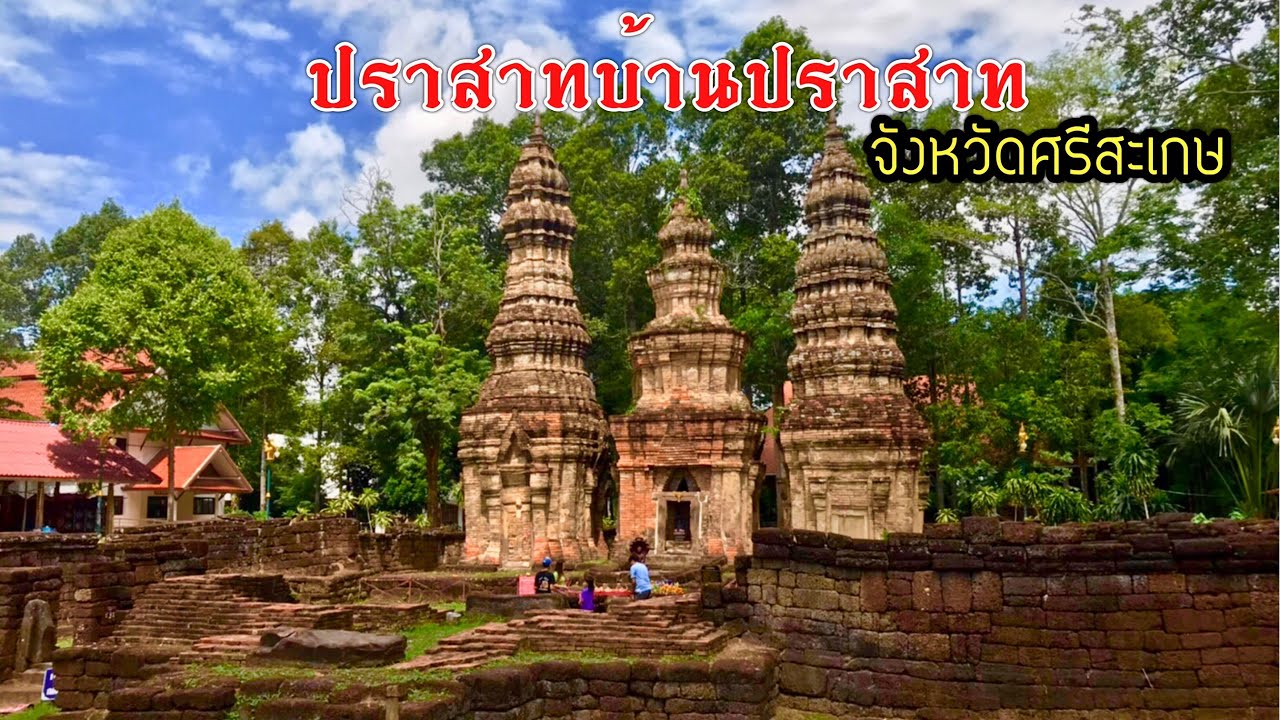
 Click to Access the Navigation Map GPS
 Historical Sites and Monuments(12)
 Landmarks and Memorials(1)
 Art, Craft Centres, Tradition(8)
 Places of Worship
 Temple(13)
 Other Sacred Sites(3)
 Suburban Living
 Village, Community(2)
 Nature and Wildlife
 National Parks and Marine Reserves(2)
 Dam, Reservoir, Lake(7)
 Waterfalls(5)
 River, Canal(5)
 Bays and Beaches(2)
 Entertainment and Agricultural
 Zoos and Aquariums(1)
 Farms, Parks and Ecotourism(3)


