
lovethailand home >Northeastern Travel Attractions >Nakhon Ratchasima Travel Attractions >Phi Mai >Nai Muang > Sai Ngam
TL;DR: Sai Ngam is located at Sai Ngam Junction, Sai Ngam Village, Chonlaprathan Road, Nai Mueang Subdistrict, Phimai District, Nakhon Ratchasima Province, open Daily, hours 08.00 – 18.00.
Sai Ngam
Open Days: Daily
Opening Hours: 08.00 – 18.00
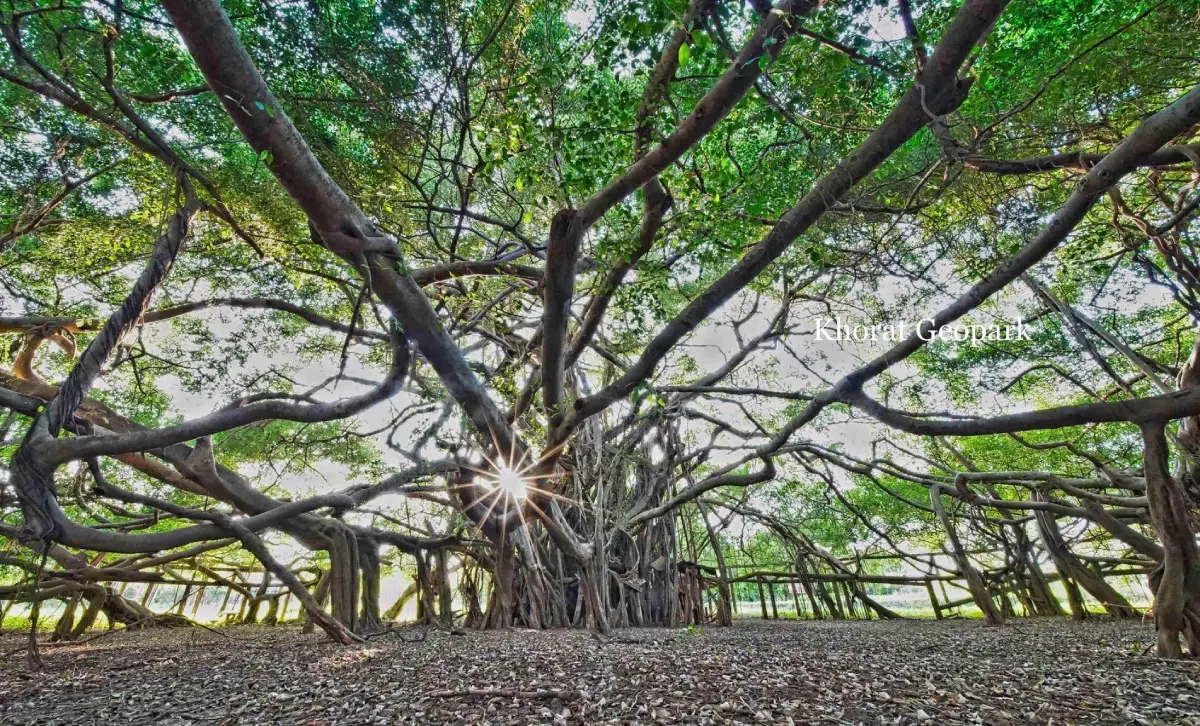
Sai Ngam in Nakhon Ratchasima is one of the most distinctive natural attractions in Phimai District. Located at Sai Ngam Junction, Sai Ngam Village, Chonlaprathan Road, Nai Mueang Subdistrict, Phimai District, Nakhon Ratchasima Province, the site lies beside the Mun River near Phimai Dam. It is best known for a vast living canopy of more than 350-year-old banyan trees, locally known as sai yoi, whose branches and aerial roots have spread across more than 25,000 square feet. Sai Ngam is not just a shaded riverside park; it is a living natural landscape, a local recreation area, a place for ecological observation, and a memorable symbol of Phimai beyond its famous Khmer sanctuary.
The charm of Sai Ngam lies in the atmosphere beneath the banyan canopy. As visitors enter the area, large branches stretch overhead while countless aerial roots hang down like natural curtains. Some roots reach the ground and grow into new trunks, while others intertwine into green tunnels and sculptural formations. Sunlight filters through the leaves and creates soft patterns on the walking paths, giving the place a cool, calm, and almost timeless feeling. This makes Sai Ngam ideal for slow walks, photography, quiet rest, family visits, and riverside relaxation.
The banyan trees at Sai Ngam are remarkable because of the way they grow. A banyan can produce aerial roots from its branches. When these roots reach the soil, they gradually strengthen and become supporting trunks. Over a long period, one mother tree can expand into a large network of branches, roots, and new trunks. What visitors see today is the result of centuries of natural growth. Instead of standing as a single tree, Sai Ngam has grown into a small living forest formed by one expanding root-and-branch system.
Sai Ngam became widely known after Queen Saovabha Phongsri, Queen of King Rama V, visited Phimai on January 21, 1911, and bestowed the name “Sai Ngam” on the site. The name means “beautiful banyan,” a simple but fitting description of the landscape. The royal naming gave the place cultural and historical recognition, while the natural form of the banyan made it a beloved destination for local people and travelers.
The importance of Sai Ngam can be understood through nature, history, and community life. As a natural site, it demonstrates the growth pattern of banyan trees and aerial roots in a way that visitors can observe closely. As a historical place, it is associated with a royal visit to Phimai in the early 20th century. As a community space, it has long served as a riverside rest area where local restaurants, souvenir shops, food culture, and everyday recreation are connected with tourism in Phimai.
The location beside the Mun River and near Phimai Dam gives Sai Ngam a moist and shaded environment. The river adds a cooling effect to the area, making it especially pleasant after visiting Phimai Historical Park or Phimai National Museum. Many travelers plan Sai Ngam as the relaxing final stop of a Phimai itinerary: first exploring the ancient Khmer sanctuary, then visiting the museum, and finally resting under the banyan trees while enjoying local food such as Phimai-style fried noodles.
Walking deeper into Sai Ngam, visitors can follow paths through the dense banyan roots. The walkways allow people to view the roots and branches closely while helping protect the living root system. Popular photo spots include the hanging root curtains, the low sweeping branches, the natural green tunnels, riverside viewpoints, and the areas where the banyan canopy appears like a roof made entirely by nature. These scenes make Sai Ngam attractive to casual tourists, families, photographers, and anyone looking for a peaceful natural setting.
In addition to the banyan grove, Sai Ngam includes the Shrine of Chao Mae Sai Ngam, a sacred point respected by local residents and visitors. The shrine reflects the relationship between nature and local belief in Thai communities. Ancient trees, especially those with unusual shapes and long life, are often regarded with reverence. A visit to Sai Ngam therefore offers more than a botanical experience. It also introduces visitors to the cultural belief that trees, water, and sacred spaces can be connected in local life.
The site also includes the Shrine of Phra Suphankanlaya and Ruean Wibullak, a riverside wooden structure that adds another layer of interest to the visit. Travelers can walk between shrines, pause at riverside viewpoints, sit in shaded areas, and continue along the nature paths. These elements make Sai Ngam more than a simple tree-viewing site. It is a riverside leisure area with spiritual, natural, and community components.
Popular activities at Sai Ngam include walking under the banyan canopy, photographing the root tunnels, paying respect at the local shrines, resting beside the Mun River, releasing fish or turtles, eating local food, and buying souvenirs from nearby shops. The best way to experience the site is not to rush. Its beauty is found in small details: roots hanging in layers, branches twisting across the paths, filtered light under the leaves, and the quiet connection between people, trees, and water.
The food most closely associated with Sai Ngam is pad mee Phimai, also known as Phimai-style fried noodles or Korat-style fried noodles. This local dish uses chewy rice noodles stir-fried with a balanced sauce that is slightly sweet, sour, salty, and mildly spicy. It is often eaten with som tam, grilled chicken, grilled fish, or northeastern Thai dishes. Eating pad mee Phimai near the banyan grove is part of the Sai Ngam experience because it connects the natural setting with the food identity of the district.
Pad mee Phimai is simple but deeply local. The texture of the noodles and the strong but balanced seasoning make it accessible to both Thai and foreign travelers. When eaten under the shade of the banyan trees or near the riverside, the dish becomes more than a meal. It becomes part of the way visitors remember Phimai: ancient ruins, riverside shade, local shrines, community restaurants, and a plate of noodles that carries the flavor of the town.
Sai Ngam is suitable for family travel because the area is not difficult to walk through, offers plenty of shade, and provides activities for different ages. Children can learn how aerial roots grow and how one tree can spread into a wide natural network. Older visitors can rest in shaded areas and enjoy food nearby. Photographers can capture unusual root patterns and soft natural light. The site is also useful for educational travel because it shows ecology in a direct and visible way.
For travelers interested in history and culture, Sai Ngam should be combined with Phimai Historical Park, Phimai National Museum, Phimai Victory Gate, Meru Brahmathat, Wat Doem, and Thung Samrit Heroic Deeds Memorial. Together, these places explain Phimai through many layers: ancient Khmer civilization, old city routes, the Mun River landscape, local food, and early Rattanakosin historical memory. Sai Ngam works as the natural rest stop that balances the historical and archaeological sites of the town.
Another strength of Sai Ngam is its closeness to central Phimai. From Phimai Historical Park, visitors can reach Sai Ngam within a short drive. This makes it suitable even for travelers with limited time. A practical one-day plan is to visit Phimai Historical Park in the morning, continue to Phimai National Museum, then go to Sai Ngam for lunch or an afternoon rest. This route gives visitors a balanced introduction to Phimai through archaeology, history, food, and nature.
Getting There from central Phimai is straightforward. Take Highway 206 or the local road toward Tha Songkran Bridge. Before crossing the bridge into Phimai town, there is a junction leading toward Phimai Dam and Sai Ngam. The distance from central Phimai is about 1–2 km. From Nakhon Ratchasima city, take Highway 2, also known as Mittraphap Road, toward Phimai District, then continue onto Highway 206 and follow local signs to Phimai Dam and Sai Ngam. Private car is the most convenient option because it allows visitors to combine Sai Ngam with other attractions around Phimai.
Travelers using public transport can take a Korat–Phimai bus from Nakhon Ratchasima Bus Terminal and get off in Phimai town. From there, a local vehicle, hired transport, or ride-hailing service can be used to reach Sai Ngam. Although the site is close to town, travelers should check return transportation in advance, especially in the late afternoon. Sai Ngam closes at 18.00, and the surrounding area becomes quieter after food stalls and shops begin to close.
The best time to visit Sai Ngam is from morning to late afternoon. Morning light is soft and the air is usually more comfortable for walking and photography. Late afternoon is suitable for relaxing by the river, eating local food, and enjoying the shade. Visitors should be careful during heavy rain because some walking areas may become slippery, and the dense root network requires attention while walking.
There is no admission fee to visit Sai Ngam, making it a practical and affordable attraction. However, visitors should help protect the site. They should not carve or write on the trees, climb on the banyan branches, pull aerial roots, damage young roots, or leave rubbish. Some roots are still alive and support the ongoing growth of the banyan system. Protecting the roots means protecting the identity of Sai Ngam and the natural heritage of Phimai.
For photography, visitors should choose angles that do not disturb others or step on sensitive root areas. Recommended viewpoints include the root tunnels, the walkways beneath the canopy, riverside corners, the Sai Ngam sign, and the shaded paths near the shrines. Morning or late-afternoon light is usually best. On lightly cloudy days, the soft light makes it easier to photograph under the banyan canopy without harsh shadows.
Sai Ngam is also a strong place for communicating nature conservation. Visitors can clearly see the relationship between a large tree, aerial roots, soil, water, and human use of space. The banyan took centuries to form this landscape, but careless tourism can damage it quickly. For this reason, visiting Sai Ngam should be done with respect for nature and awareness of the living root system.
Culturally, Sai Ngam is an example of a destination where nature and community life are not separate. The banyan tree is the main attraction, but the local shrines, pad mee Phimai, riverside food stalls, souvenir shops, and community atmosphere all help create the full experience. Travelers should not see Sai Ngam only as a large tree. Its beauty comes from the long relationship between the tree, the river, and the people of Phimai.
Compared with other attractions in Nakhon Ratchasima, Sai Ngam is different from Khao Yai, Phimai Historical Park, and historic sites in Korat city. It is not a mountain landscape, not a stone sanctuary, and not a monument. It is a compact natural attraction created by the growth of a single tree system. Its beauty lies in details: roots, branches, shade, filtered light, riverside calm, and the feeling of walking beneath a living natural roof.
For foreign travelers, Sai Ngam is easy to appreciate because the banyan canopy is visually powerful. Even without long explanation, visitors can immediately understand that the place is unusual. When combined with its royal naming, 350-year history, riverside setting, local food, and proximity to Phimai Historical Park, Sai Ngam becomes a highly memorable stop for travelers who want to experience the local side of Nakhon Ratchasima.
In summary, Sai Ngam in Nakhon Ratchasima is a natural attraction with strong landscape, historical, spiritual, and community value. Its more than 350-year-old banyan trees form a vast shaded canopy that creates a rare atmosphere in Phimai. Walking through the root tunnels, paying respect at the local shrine, resting beside the Mun River, and tasting pad mee Phimai all make the visit complete. For anyone who wants to experience Phimai through history, culture, food, and nature, Sai Ngam is an essential stop.
| Name | Sai Ngam / Sai Ngam Park, Phimai |
| Location | Sai Ngam Junction, Sai Ngam Village, Chonlaprathan Road, Nai Mueang Subdistrict, Phimai District, Nakhon Ratchasima Province |
| Address | Sai Ngam Junction, Sai Ngam Village, Chonlaprathan Road, Nai Mueang Subdistrict, Phimai District, Nakhon Ratchasima 30110, Thailand |
| Highlights | A more than 350-year-old banyan tree system with aerial roots spreading across more than 25,000 square feet beside the Mun River near Phimai Dam |
| History | The site became famous after Queen Saovabha Phongsri, Queen of King Rama V, visited Phimai on January 21, 1911, and bestowed the name “Sai Ngam” on the place |
| Name Origin | “Sai Ngam” means “beautiful banyan,” referring to the graceful banyan branches and aerial roots that create a large shaded natural canopy |
| Distinctive Features | A more than 350-year-old mother banyan tree whose aerial roots have grown into many new trunks, forming root tunnels, shaded walkways, riverside viewpoints, and natural photo spots |
| Main Areas / Zones | Banyan canopy and aerial root zone Nature walkways beneath the banyan trees Shrine of Chao Mae Sai Ngam Shrine of Phra Suphankanlaya Ruean Wibullak riverside structure Mun River resting and viewpoint area Bridge and riverside walking route Food, pad mee Phimai, and souvenir zone |
| Caretaker | Phimai Subdistrict Municipality and related local agencies |
| Travel Information | From central Phimai, take Highway 206 or the local road toward Tha Songkran Bridge. Before crossing the bridge, follow the junction toward Phimai Dam and Sai Ngam. The site is about 1–2 km from central Phimai. From Nakhon Ratchasima city, take Mittraphap Road toward Phimai, then continue on Highway 206 and follow local signs. |
| Current Status | Open to visitors as a natural attraction and riverside recreation site in Phimai District |
| Open Days | Daily |
| Opening Hours | 08.00 – 18.00 |
| Fees | No Admission Fee |
| Facilities | Nature walkways, seating areas, pavilion, riverside viewpoint, food stalls, souvenir shops, fish-release area, shrine area, and nearby parking |
| Main Contact Number | Phimai Subdistrict Municipality Tel. 044-002323 |
| Nearby Tourist Attractions | 1. Phimai Dam, about 1 km 2. Phimai Historical Park, about 2 km 3. Phimai National Museum, about 2 km 4. Phimai Victory Gate, about 2 km 5. Wat Doem Phimai, about 2 km 6. Thung Samrit Heroic Deeds Memorial, about 10 km |
| Nearby Restaurants | 1. Khun Samruam Pad Mee Phimai Sai Ngam, about 0.1 km, Tel. 082-156-7543, 097-462-2649 2. Rim Khuean Sai Ngam Restaurant, about 0.2 km, Tel. 099-469-5192, 093-515-2199 3. Kuai Tiao Tom Yum Khluk Khlik Lime And Sweet Egg, about 0.6 km, Tel. 061-162-1380 4. Kiang Mool Phimai, about 3 km, Tel. 044-012-179 5. Phot Roasted Duck, about 3 km, Tel. 044-928129, 098-162-3282 6. Thiw Phai Roasted Duck Phimai, about 3 km, Tel. 044-287500, 081-878-1466 |
| Nearby Accommodations | 1. Phimai Residence, about 2 km, Tel. 097-149-9992 2. Rabbit Hotel Phimai, about 3 km, Tel. 081-202-2250 3. Phimai Paradise Hotel, about 3 km, Tel. 044-287565, 044-471575 4. Baan Lita Phimai, about 3 km, Tel. 088-595-2542 5. Kord Phimai Resort, about 5 km, Tel. 087-960-1177 |
Frequently Asked Questions (FAQ)
Q: Where is Sai Ngam located?
A: Sai Ngam is located at Sai Ngam Junction, Sai Ngam Village, Chonlaprathan Road, Nai Mueang Subdistrict, Phimai District, Nakhon Ratchasima Province, near Phimai Dam and the Mun River.
Q: Why is Sai Ngam important?
A: Sai Ngam is an important natural attraction in Phimai, known for its more than 350-year-old banyan trees whose branches and aerial roots cover a wide area. The site was named “Sai Ngam” after a royal visit in 1911.
Q: What are the opening hours of Sai Ngam?
A: Sai Ngam is open daily from 08.00 to 18.00.
Q: Is there an admission fee?
A: No. Visitors can enter Sai Ngam, walk under the banyan canopy, take photos, pay respect at the shrine, and relax in the area without an admission fee.
Q: What areas can visitors see inside Sai Ngam?
A: Visitors can see the banyan root tunnels, nature walkways, Shrine of Chao Mae Sai Ngam, Shrine of Phra Suphankanlaya, Ruean Wibullak, riverside viewpoint, and food zone serving pad mee Phimai.
Q: What food should visitors try at Sai Ngam?
A: The recommended local dish is pad mee Phimai, also known as Korat-style fried noodles, often eaten with som tam, grilled chicken, grilled fish, and northeastern Thai dishes.
Q: How can travelers get to Sai Ngam from central Phimai?
A: From central Phimai, take Highway 206 or the road toward Tha Songkran Bridge. Before crossing the bridge, follow the junction toward Phimai Dam and Sai Ngam. The distance is about 1–2 km.
Q: What nearby attractions can be visited with Sai Ngam?
A: Nearby attractions include Phimai Historical Park, Phimai National Museum, Phimai Dam, Phimai Victory Gate, Wat Doem, and Thung Samrit Heroic Deeds Memorial.
 Category: ●Art, Culture and Heritage
 Group: ●Landmarks and Memorials
Last Update : 2 MonthAgo
 Last Update : 2 MonthAgo
 Click to Access the Navigation Map GPS
 Historical Sites and Monuments(20)
Landmarks and Memorials(5)
Historical Sites and Monuments(20)
Landmarks and Memorials(5)
 Art, Craft Centres, Tradition(7)
 Museums(6)
 Art Gallery(1)
 Educational Places
 Educational Gardens, Farm(4)
 Places of Worship
 Temple(29)
 Mosque(1)
 Other Sacred Sites(6)
 Research and Development
 Royal Project(3)
 Suburban Living
 Village, Community(6)
 Local Market(4)
 Floating Market(1)
 Nature and Wildlife
 National Parks and Marine Reserves(3)
 Mountain (Doi)(5)
 Dam, Reservoir, Lake(8)
 Waterfalls(9)
 Hot Springs(1)
 Caves(2)
 Flower Field(1)
 River, Canal(8)
 Bays and Beaches(2)
 Other natural attractions(3)
 Entertainment and Agricultural
 Zoos and Aquariums(1)
 Animal camps and shows(1)
 Farms, Parks and Ecotourism(21)
 Waterpark(2)
 Outdoor and Adventure Activities(6)
 Shopping
 Shopping and Night Market(2)
 Travel Articles, Recipes
 Travel Review, Food Review(5)


