
lovethailand home >Northeastern Travel Attractions >Nakhon Phanom Travel Attractions >Muang Nakhon Phanom >Nong Yat > Ban Na Chok (Ban Lung Ho)
TL;DR: Ban Na Chok (Ban Lung Ho) is located at Ban Na Chok, Nong Yat Subdistrict, Mueang Nakhon Phanom District, Nakhon Phanom Province, open Daily, hours 08.00 – 17.00.
Ban Na Chok (Ban Lung Ho)
Open Days: Daily
Opening Hours: 08.00 – 17.00
Ban Na Chok, commonly known as Uncle Ho’s House in Nakhon Phanom, is a historical destination of exceptional importance to both Thailand and Vietnam. Located in Nong Yat Subdistrict, Mueang Nakhon Phanom District, the area includes a wooden house reconstructed in the form of the residence once used by Ho Chi Minh, a traditional garden, a rice granary, displays about his life and revolutionary activities, the President Ho Chi Minh Memorial, and the Thai–Vietnamese Friendship Village. Together, these places form a cultural route exploring political history, the Vietnamese-Thai community, rural life, migration, and the enduring relationship between the people of Thailand and Vietnam.
The historical areas are open daily from 08.00 to 17.00 and there is no admission fee. Uncle Ho’s old house and the President Ho Chi Minh Memorial are closely related but separate visitor sites within the same village. The old house offers an intimate garden setting focused on everyday life during Ho Chi Minh’s stay in Ban Na Chok. The memorial is a much larger complex developed later to present his biography, his role in Vietnam’s independence movement, and the friendship between Thailand and Vietnam at both community and national levels.
Ban Na Chok lies approximately 5–8 kilometers from central Nakhon Phanom, depending on the starting point. The village is reached from Highway 22 on the Nakhon Phanom–Sakon Nakhon route, near kilometer markers 237–238. The surrounding landscape includes agricultural land, local houses, small restaurants, and neighborhoods associated with Thai citizens of Vietnamese descent. Although the journey from the city is short, the atmosphere is noticeably more rural and peaceful than the busy Mekong riverfront district.
Ban Na Chok is an old settlement shaped by several periods of Vietnamese migration into northeastern Siam and later Thailand. Large numbers of Vietnamese families moved through Laos and across the Mekong during the years of French colonial expansion and the conflicts that followed. They established farms, small businesses, and family networks while maintaining language, food, religious traditions, and contact with relatives across the border. The village therefore developed a distinctive identity combining Vietnamese, Thai, and northeastern cultural elements.
The name “Uncle Ho’s House” comes from the respectful and affectionate way Vietnamese people refer to Ho Chi Minh. “Uncle Ho” is not simply an informal nickname. It expresses an image of a national leader remembered for his modest lifestyle, closeness to ordinary people, and lifelong commitment to Vietnamese independence. He was born Nguyễn Sinh Cung and used several names during his political life, including Nguyễn Ái Quốc, meaning “Nguyễn the Patriot,” before adopting the name Ho Chi Minh.
Ho Chi Minh became the leader of Vietnam’s independence struggle and served as president of the Democratic Republic of Vietnam, the government of North Vietnam at that time. The Socialist Republic of Vietnam was established after national reunification in 1976, several years after his death. His political life was connected with anti-colonial resistance, the development of overseas Vietnamese networks, political education, and the preparation of activists who would return to work inside French Indochina.
Many tourism descriptions and community narratives use the period from 1924 to 1931 to describe Ho Chi Minh’s wider association with Vietnamese networks in Thailand, creating the familiar account that he lived at Ban Na Chok for about 7 years. Documentary records provide a more specific chronology. Ho Chi Minh’s own report states that he arrived in Siam in July 1928 and worked there until November 1929. During this period, he spent several months at Ban Na Chok while also traveling among Vietnamese communities in other northeastern provinces. Understanding both timelines helps distinguish broad community memory from the documented period of his political mission in Siam.
Nguyễn Ái Quốc entered Siam in 1928 during the reign of King Prajadhipok, Rama VII. He traveled by sea from Europe through Singapore, continued to Bangkok, and then moved toward northeastern Siam. His mission was to work with overseas Vietnamese communities, develop educational and political networks, train activists, and maintain connections with movements in Laos and Vietnam, which remained under French colonial control.
Northeastern Siam was strategically important because Vietnamese communities were established in Udon Thani, Nong Khai, Sakon Nakhon, Nakhon Phanom, and other provinces. Roads and village paths led toward the Mekong, allowing travelers to cross into Laos and continue through the mountains toward central Vietnam. Nakhon Phanom faced Thakhek in Khammouane Province and had extensive Vietnamese family networks, making Ban Na Chok a practical place for accommodation, communication, training, and preparation for journeys into Indochina.
While living at Ban Na Chok, Ho Chi Minh adopted a simple routine that allowed him to blend into village life. He stayed in a modest single-storey wooden house, used only essential furniture, cultivated vegetables, planted fruit trees, and carried out written work within the same domestic space. The image of a future national leader gardening, preparing food, writing, and talking with villagers gives the house a deeply human quality that differs from a conventional political museum.
This simple lifestyle reflected an emphasis on self-reliance. Ho Chi Minh encouraged colleagues and Vietnamese families to grow vegetables, keep animals, use local resources carefully, and avoid unnecessary expenditure. Agriculture provided food, supported the community, and ensured that political activity remained connected to everyday life. The garden consequently contained coconut, starfruit, areca palm, betel, banana, tea, vegetables, medicinal plants, and other useful species commonly found around rural homes.
The coconut and starfruit trees at the house are remembered as trees planted by Ho Chi Minh himself. Their value extends beyond botany. They operate as living historical evidence connecting visitors with events almost a century ago. Having survived through several generations, the trees communicate the passage of time and the physical labor of the person who once lived there more directly than many objects displayed behind glass.
Areca palms and betel vines reflect a custom shared across Thailand, Laos, and Vietnam. Banana plants supplied fruit, leaves used for wrapping, and other household materials. Tea and medicinal plants represented practical knowledge concerning food and basic health care. The garden was therefore not designed merely for decoration. It was a productive domestic space providing food, shade, medicine, and materials for daily living.
Ho Chi Minh also placed considerable importance on education among overseas Vietnamese communities. He encouraged villages to teach the Vietnamese language to children, establish reading groups, and explain political developments in language ordinary people could understand. Maintaining literacy enabled the children of migrants to communicate with relatives, read news, and understand the history of their homeland. Community education became both a method of preserving identity and a means of developing future participants in the independence movement.
The house did not function as a grand headquarters or military camp. It was a small and discreet meeting point supported by trust among local families. Activists could arrive to receive information, study ideas, prepare for travel, and return to work in other areas. Such a decentralized arrangement attracted less attention and reduced the risk of surveillance by French colonial intelligence operating in towns along the Mekong frontier.
Good relations with local Thai residents were essential to the security of the Vietnamese community. Ho Chi Minh emphasized respect for local law, peaceful relations with neighbors, and participation in communal life. Many Thai villagers consequently regarded the Vietnamese settlers as neighbors rather than an isolated political group. Relationships developed through friendship, marriage, trade, and mutual assistance, creating ties that remain visible in Nakhon Phanom today.
Ho Chi Minh did not remain at Ban Na Chok throughout his entire mission in Siam. He also traveled to Ban Nong On in Udon Thani, Vietnamese communities in Nong Khai, and other settlements along the Mekong. These journeys involved political education, school development, communication with local organizers, and the preparation of routes back through Laos into Vietnam. Ban Na Chok should therefore be understood as one important node within a larger regional network.
In early 1930, Ho Chi Minh traveled to Hong Kong to coordinate the unification of separate Vietnamese communist organizations. The process contributed to the establishment of the Communist Party of Vietnam. Ban Na Chok belongs to the period immediately before this development, when he was building connections, training people, and working with overseas Vietnamese communities whose members would later participate in political change inside their homeland.
From the perspective of Vietnamese history, the small wooden house in Nakhon Phanom therefore holds significance far beyond its physical size. The work conducted in and around the house involved education, communication, organization, and trust rather than dramatic public declarations. It demonstrates that national history can be shaped not only in capitals, battlefields, and conference halls, but also in an ordinary rural home within a border village.
After Ho Chi Minh left Siam, the Ban Na Chok community continued its daily life while preserving memories of his stay. Stories were passed through families and village elders, supported by photographs, household objects, and trees. As Ho Chi Minh’s historical importance grew after Vietnamese independence and the later wars, Vietnamese government representatives, historians, students, and ordinary citizens began traveling to Ban Na Chok to visit a place associated with his formative political years.
The house seen today is not composed entirely of the original wooden structure. The earlier building deteriorated and was removed before a new house was constructed according to the former layout and appearance. The conservation method recreates the dimensions, floor plan, atmosphere, furniture, and domestic objects of the earlier residence. Clearly distinguishing the reconstructed building from the lost original allows visitors to understand the site honestly without diminishing the cultural value of the community memory preserved there.
The house is a simple single-storey wooden residence combining characteristics of rural Thai buildings with spatial arrangements familiar to Vietnamese families. A sloping roof drains heavy rain, extended eaves provide protection from sun and weather, and wooden walls with open windows encourage ventilation. Decorative elements are minimal, while the materials and furniture emphasize practical use. The modest design suited residents who needed flexibility and did not wish to attract outside attention.
The interior is divided into 2 bedrooms and a central hall. The bedrooms contain wooden beds, shelving, clothing, and personal objects arranged to evoke the period. The rooms are small and activities were not separated into complex functional zones. Resting, reading, writing, and meeting colleagues all took place within a compact domestic environment, illustrating the limitations and simplicity of rural life in the late 1920s.
The central hall displays a table, a long wooden bench, household containers, a teapot, brass trays, a clock, and other objects recreating everyday life. Photographs, paintings, and texts in Thai and Vietnamese present major events in Ho Chi Minh’s biography. Some visual material was provided through institutions in Vietnam, enabling the small house to function as both a reconstructed residence and a biographical exhibition.
The writing desk encourages visitors to imagine the importance of correspondence and written communication during a period of limited telecommunications. Letters, reports, educational texts, and instructions had to travel through trusted people and discreet routes. Work performed at a small table in a village home could consequently influence political organization across an area extending hundreds of kilometers.
A rice granary and domestic working area stand behind the house, representing the household food system. Granaries protected crops from moisture and animals, ensuring that families had rice throughout the year. The arrangement of residence, garden, and storage within the same compound illustrates the self-sufficient character of an agricultural community. Visitors therefore learn about rural knowledge as well as political history.
The garden creates a shaded environment that makes the visit different from walking through a large indoor museum. A small path leads through trees toward the house, gradually revealing plants, tools, and domestic spaces. Morning and late afternoon are particularly pleasant, when temperatures are lower and sunlight filters through the foliage.
Uncle Ho’s House is maintained by the family and community connected with the property. Kornkanok Wongprachasuk serves as the caretaker and provides historical explanations to visiting groups. A guided account adds details that exhibition panels cannot fully communicate, including the location of the former structure, stories associated with individual trees, the identities of people in photographs, and the memories preserved within the family.
School groups, university students, researchers, tour groups, and international visitors should contact the house before traveling so that a guide can be arranged. Independent visits are possible during normal hours, but an explanation from the caretaker creates a clearer connection between the old house, the memorial complex, and the wider Vietnamese-Thai community. The contact number for Uncle Ho’s House is +66 42 522 430.
A short distance from the historic house stands the President Ho Chi Minh Memorial. The large complex was officially inaugurated on May 19, 2016, marking the 126th anniversary of Ho Chi Minh’s birth. Developed through cooperation among organizations and people in Thailand and Vietnam, it is among the largest memorial sites dedicated to Ho Chi Minh outside Vietnam and has become an internationally significant historical attraction in Nakhon Phanom.
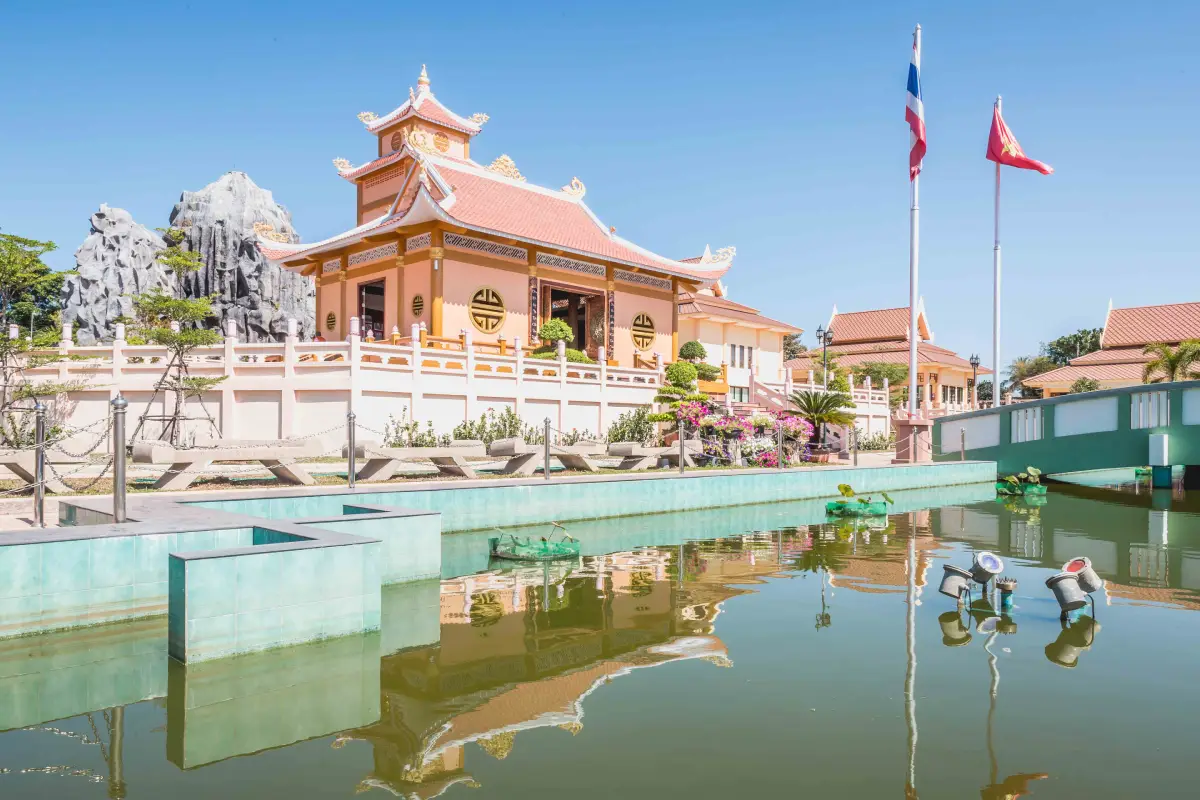
The memorial’s architecture draws strongly from Vietnamese forms. Its warm-colored buildings have red-tiled roofs, curved eaves, and gold decorative details. A monumental entrance gate is decorated with dragons, lotus imagery, and inscriptions in Thai and Vietnamese. The flags of the 2 countries symbolize both state relations and people-to-people friendship, while the broad forecourt accommodates official delegations, commemorative ceremonies, and cultural events.
Inside the principal building are spaces dedicated to Ho Chi Minh, with statues or memorial images, photographs, documents, and displays explaining his life, travels, and independence struggle. The exhibition connects his time in Siam with later events in Vietnam. Its interpretation is not limited to warfare but also emphasizes independence, personal sacrifice, education, community organization, and the relationship between Vietnamese migrants and Thai society.
The surrounding complex contains a reflecting pool, fountain, formal gardens, shaded areas, and photographic viewpoints. The orderly landscape is different from the more natural domestic garden at Uncle Ho’s House. Visiting both places therefore creates 2 complementary experiences: the old house presents personal life and community memory, while the memorial represents national commemoration and international friendship.
Part of the memorial includes a reconstructed wooden house and household displays that help explain the historical lifestyle. Visitors should distinguish this exhibition structure from the older community-maintained house nearby. Seeing both sites reveals 2 approaches to preserving memory. One developed through family care within a garden compound, while the other was created through formal cooperation between governments, institutions, and Vietnamese-Thai organizations.
The Thai–Vietnamese Friendship Village forms another component of the Ban Na Chok cultural route. It presents Vietnamese-Thai heritage through food, language, clothing, crafts, agricultural products, and community enterprises. The area demonstrates that Thailand–Vietnam relations did not begin only with modern diplomacy. Their foundation also lies in migrant families who lived, worked, married, and built friendships with Thai neighbors over several generations.
The opening of the memorial in 2016 transformed Ban Na Chok from a primarily community-based heritage site into a destination receiving official delegations and international visitors. Vietnamese leaders, diplomats, Thai officials, Vietnamese-Thai associations, students, and travelers use the memorial to study history and reinforce bilateral friendship. A visit by the Thai prime minister in February 2024 further emphasized the complex’s role as a cultural bridge and an important tourism asset.
Each May, the village and associated organizations hold commemorative activities around Ho Chi Minh’s birthday on May 19. Programs may include wreath-laying ceremonies, speeches, cultural performances, educational activities, and meetings between Thai and Vietnamese representatives. Birthday and Thai–Vietnamese friendship events continued to be organized in 2026, confirming that the complex remains active and open.
The memorial is managed through cooperation among its local committee, the Vietnamese-Thai Association of Nakhon Phanom, Ban Na Chok community organizations, and local authorities. The older house is maintained separately by the family and its caretaker, Kornkanok Wongprachasuk. Visitors therefore encounter both a community heritage model and a formal public memorial within the same route. The memorial can be contacted at +66 81 975 1152.
A logical visit begins at Uncle Ho’s historic house to understand his domestic life in Ban Na Chok. Visitors can examine the bedrooms, hall, furniture, garden, historical trees, and granary before continuing to the memorial complex for a broader account of his biography, the independence movement, and Thailand–Vietnam relations. The experience can conclude with a walk through the village, local shopping, or a meal at a Vietnamese or northeastern Thai restaurant.
The principal areas of the historic house include the entrance and garden path, reconstructed wooden residence, 2 bedrooms, central exhibition hall, writing desk, household objects, historical trees, garden, rice granary, and interpretation area. The memorial complex includes the monumental gateway, flag court, principal memorial hall, exhibition rooms, Ho Chi Minh statue, reconstructed house, pond, fountain, gardens, community retail spaces, and activity buildings of the Thai–Vietnamese Friendship Village.
Visitors should allow at least 1.30–2 hours to see both the old house and the memorial complex. A visit to the historic house alone may take 30–45 minutes, while the memorial generally requires 45–60 minutes. Guided explanations and careful reading of all exhibition material will require more time. Travelers interested in Southeast Asian political history should plan an unhurried visit because the site connects colonialism, migration, political organization, and the wider conflicts of Indochina.
The destination is appropriate for families and educational groups. Children can learn about historic houses, gardening, household life, and cultural diversity, while older students can examine the relationship between local communities and regional political events. Schools and universities may use Ban Na Chok as a case study in history, political science, migration studies, ethnic relations, community tourism, and the conservation of heritage linked to prominent individuals.
Visitors should remain respectful, avoid touching or moving household objects, refrain from climbing trees, and not enter private family areas without permission. The old house is small, so large groups should enter in manageable numbers. At the memorial, flags, statues, and ceremonial areas should be treated appropriately. Visitors should avoid disruptive behavior or photographs that diminish the dignity of the site.
Photography is generally possible around the house, garden, and memorial buildings, but permission should be requested before photographing inside certain rooms or using professional equipment. Community residents should not be photographed without consent. Drone use requires compliance with Thai aviation regulations and prior approval from the site management because Ban Na Chok is a residential village with private properties surrounding the attractions.
Facilities at the memorial include parking, restrooms, shaded seating, gardens, souvenir outlets, and community product shops. Parking at the older house is limited and normally uses space opposite the entrance or along the roadside. Groups traveling by coach should contact the caretaker in advance to arrange parking and visitor flow. Some paths are outdoors, so elderly visitors should wear supportive footwear and avoid the hottest part of the day.
Admission is free. Visitors may make voluntary donations supporting the maintenance of the house, exhibitions, and community activities. Separate charges may apply to services such as Vietnamese costume rental, private guiding, food, drinks, or local products. Availability varies according to the day, and groups should confirm special services before arrival.
The most comfortable visiting periods are from 08.00 to 10.30 and from 15.00 to 17.00, when temperatures are lower and the light is suitable for photography. The memorial has broad open courtyards exposed to direct sunlight. Although indoor areas provide shade, walking between zones can be hot, so visitors should carry drinking water, a hat, or an umbrella.
The cool season from November to February is particularly suitable for exploring Ban Na Chok. Mornings can be pleasantly cool and the gardens are comfortable for walking. May is associated with Ho Chi Minh’s birthday commemorations and may attract larger groups. During the rainy season, vegetation is especially green, but paths may be wet. In the hot season, outdoor walking around midday should be minimized.
Roadside and village food options include noodle shops, Vietnamese dishes, northeastern Thai restaurants, and rural cafés. Nakhon Phanom’s cuisine clearly reflects Vietnamese heritage through dishes such as nem nuong, Vietnamese rice noodles, steamed rice-skin dumplings, Vietnamese-style crepes, pork sausage, and filled bread. Travelers can enrich the visit by eating in Ban Na Chok rather than returning immediately to central Nakhon Phanom.
Community products include processed food, traditional leaf cakes, dried tea, vegetables, fruit, hammocks, and handicrafts. Purchasing directly from village producers distributes tourism income among local families and supports long-term conservation. International visitors can also learn about food vocabulary, preparation methods, and the migration stories preserved within Vietnamese family recipes.
Getting There from central Nakhon Phanom is straightforward. Follow Highway 22 toward Sakon Nakhon. Near kilometer markers 237–238, turn into Ban Na Chok according to signs for Uncle Ho’s House or the President Ho Chi Minh Memorial. Continue along the paved village road for a short distance. Cars and passenger vans can reach the sites without difficulty.
Navigation applications may display “Uncle Ho Chi Minh House” and “President Ho Chi Minh Memorial” as separate destinations. The old house is located at 48 Moo 5, while the larger memorial is approximately 300 meters to 1 kilometer away depending on the selected road. Visiting both locations provides the complete historical context.
From Nakhon Phanom Airport, travelers can use a rental car, taxi, or local ride service. The journey is approximately 10–15 kilometers and usually takes 15–25 minutes depending on traffic. Because the airport is relatively close to Nong Yat Subdistrict, Ban Na Chok can be the first destination after arrival or the final stop before departure.
From Nakhon Phanom Bus Terminal, local taxis and rental vehicles provide the most convenient access. Scheduled public transport into the village is limited. A private vehicle is especially useful when combining Ban Na Chok with several attractions. Cyclists can travel from the city but should consider weather, traffic on Highway 22, and appropriate safety equipment.
A half-day itinerary can begin at Uncle Ho’s House in the morning, followed by the President Ho Chi Minh Memorial and the Thai–Vietnamese Friendship Village. After lunch in Ban Na Chok, continue to the Mekong freshwater fish museum and the Chakri Dynasty Commemorative Hall before returning to the city. This route combines political history, community culture, and natural education.
A full-day route can continue to the Phaya Si Sattanakharat Naga Monument, the Mekong promenade, the Vietnamese Memorial Clock Tower, Wat Okat Si Bua Ban, the Former Nakhon Phanom Governor’s Residence, and the Co-Cathedral of Saint Anne, Nong Saeng. Together, these places demonstrate how Buddhist, Catholic, Vietnamese, Thai, Lao, and Chinese heritage coexist within Nakhon Phanom.
Travelers interested in international relations can continue to the Third Thai–Lao Friendship Bridge, approximately 15 kilometers from Ban Na Chok. The bridge connects Nakhon Phanom with Thakhek in Khammouane Province and forms part of a transport route leading toward central Vietnam. Traveling from Uncle Ho’s House to the bridge creates a clear connection between historical cross-border movement and present-day regional infrastructure.
With 2 days available, visitors can devote the first day to Ban Na Chok and Nakhon Phanom city, then travel south on the second day to Wat Phra That Phanom, Renu Nakhon, or Phu Thai cultural communities. Such a route reveals that Nakhon Phanom is more than a Mekong riverfront city. Its districts contain distinct languages, clothing, foods, religious traditions, and migration histories.
Restaurants close to Ban Na Chok include Na Chok Kung Phao, rural cafés, Vietnamese food outlets, and northeastern Thai restaurants in Nong Yat. Many are small local businesses outside the main tourist district. Travelers should telephone before visiting to confirm opening days, service hours, and group capacity because some restaurants may close on selected days or finish service when ingredients are sold out.
Accommodation is available along Highway 22, in Nong Yat Subdistrict, near the airport, and in central Nakhon Phanom. Garden resorts and roadside hotels are convenient for morning visits to Ban Na Chok, while city hotels are better for travelers who want evening walks along the Mekong and access to the walking street. Driving time between the village and central accommodation is generally short.
Ban Na Chok is particularly valuable for understanding cross-border history. The story does not fit neatly within the boundaries of Thailand, Laos, or Vietnam. People traveled through river and mountain routes before modern immigration systems existed, while families maintained relatives in several territories. Political events in Vietnam directly influenced settlement patterns in Nakhon Phanom, showing how the history of one country can be preserved inside a village in another.
The site also clarifies the difference between exile, residence, and political organization. Ho Chi Minh entered Siam through overseas Vietnamese networks and lived under the authority of the Thai kingdom. He did not arrive as a president, but as an activist working discreetly and using alternative identities during travel. The modest house therefore represents a period before state power and before the name Ho Chi Minh became internationally famous.
The preservation of the house by a local family and the later creation of the memorial through bilateral cooperation demonstrate the evolution of public memory. A family story became a provincial attraction, while a privately maintained residence was joined by an international ceremonial complex. Both forms are important: the old house retains intimacy and connection with ordinary life, while the memorial organizes historical information and accommodates large numbers of visitors.
For Vietnamese visitors, Ban Na Chok is a place associated with a leader honored as the founder of national independence. For Thai visitors, it records the country’s role as a place where migrants and political exiles found shelter and developed communities. For international travelers, it offers an accessible introduction to colonial history, the formation of modern states, and people-to-people relationships in the Mekong region.
Uncle Ho’s House does not depend on luxury or entertainment. Its power comes from quiet surroundings and modest details: a wooden table, a bed, household containers, a rice granary, and coconut trees. These elements demonstrate that large historical changes often begin through patient work conducted under severe limitations. A small garden home can therefore connect ordinary domestic life with a struggle that reshaped the future of a nation.
Visitors should also recognize the role of Ban Na Chok residents rather than treating the village merely as a background to a famous individual. Local families provided shelter, maintained security, cared for the trees, preserved stories, and developed the site for future generations. The survival of the heritage area results from cooperation among families, community organizations, Thai authorities, and Vietnamese partners.
Today, Ban Na Chok, Uncle Ho’s House, the President Ho Chi Minh Memorial, and the Thai–Vietnamese Friendship Village remain open and active. Commemorative events continue, the garden and house are maintained, and local food and community products add depth to the visitor experience. Travelers who explore every part of the route gain historical knowledge, a clearer understanding of cultural diversity, and a powerful example of friendship that developed from relationships among ordinary people into cooperation between 2 countries.
| Name | Ban Na Chok, Uncle Ho’s House And President Ho Chi Minh Memorial |
| Thai Name | บ้านนาจอก บ้านลุงโฮ และอนุสรณ์สถานประธานโฮจิมินห์ |
| Type | Historic House, Community Museum, Memorial Site And Thai–Vietnamese Friendship Attraction |
| Location | Ban Na Chok, Nong Yat Subdistrict, Mueang Nakhon Phanom District, Nakhon Phanom Province |
| Historic House Address | 48 Moo 5, Ban Na Chok, Nong Yat, Mueang Nakhon Phanom, Nakhon Phanom 48000, Thailand |
| Highlights | Reconstructed Wooden Residence, Historical Garden, Coconut And Starfruit Trees, Rice Granary, Household Displays, Vietnamese-Style Memorial And Thai–Vietnamese Friendship Village |
| Historical Significance | Ho Chi Minh, then known as Nguyễn Ái Quốc, worked in Siam from July 1928 to November 1929 and spent several months at Ban Na Chok while organizing overseas Vietnamese networks connected with the independence movement. |
| The 1924–1931 Timeline | Tourism accounts and community memory often use 1924–1931 as a broad period describing Ho Chi Minh’s association with Vietnamese networks in Thailand. Documentary travel records place his mission in Siam in 1928–1929. |
| Memorial Inauguration | The President Ho Chi Minh Memorial was officially inaugurated on May 19, 2016, marking the 126th anniversary of his birth. |
| Cultural Importance | The site records Vietnamese independence activities in Siam, preserves the heritage of the Vietnamese-Thai community, and symbolizes friendship between Thailand and Vietnam. |
| House Design | A single-storey wooden house reconstructed according to the former layout, containing 2 bedrooms, a central hall, writing desk, wooden beds, shelving, household objects, photographs, and biographical information. |
| Important Plants | Coconut and starfruit trees associated with Ho Chi Minh, together with areca palm, betel, banana, tea, vegetables, and traditional garden plants. |
| Historic House Zones | 1. Entrance And Garden Path 2. Reconstructed Wooden House 3. Two Bedrooms And Central Exhibition Hall 4. Writing Desk, Furniture And Household Objects 5. Historical Trees And Traditional Garden 6. Rice Granary And Domestic Working Area |
| Memorial Zones | 1. Monumental Gateway And Thai–Vietnamese Flag Court 2. President Ho Chi Minh Memorial Hall 3. Biographical And Historical Exhibition Rooms 4. Ho Chi Minh Statue And Commemorative Area 5. Reconstructed Wooden House 6. Pond, Fountain And Gardens 7. Community Shops And Product Area 8. Thai–Vietnamese Friendship Village Activity Buildings |
| Historic House Caretaker | Kornkanok Wongprachasuk, caretaker and local historical interpreter |
| Memorial Management | The Memorial Committee, Vietnamese-Thai Association of Nakhon Phanom, Ban Na Chok community, and local authorities |
| Current Status | Open and active, with continuing Ho Chi Minh birthday commemorations and Thailand–Vietnam friendship activities |
| Open Days | Daily |
| Opening Hours | 08.00 – 17.00 |
| Admission Fee | Free admission. Voluntary donations are accepted to support maintenance. |
| Facilities | Parking, Restrooms, Shaded Seating, Gardens, Souvenir Shops, Community Product Outlets And Group Visitor Areas. Parking at the historic house is limited. |
| Recommended Visit Duration | Approximately 1.30–2 Hours For The Historic House, Memorial And Thai–Vietnamese Friendship Village |
| Travel Information | From central Nakhon Phanom, follow Highway 22 toward Sakon Nakhon. Near kilometer markers 237–238, turn into Ban Na Chok following signs for Uncle Ho’s House and the President Ho Chi Minh Memorial. |
| Main Contact Numbers | Uncle Ho’s House: +66 42 522 430 President Ho Chi Minh Memorial: +66 81 975 1152 |
| Nearby Tourist Attractions | 1. Mekong Freshwater Fish Museum 2 km 2. Chakri Dynasty Commemorative Hall 3 km 3. Phaya Si Sattanakharat Naga Monument And Mekong Promenade 6 km 4. Co-Cathedral Of Saint Anne, Nong Saeng 9 km 5. Third Thai–Lao Friendship Bridge 15 km |
| Nearby Restaurants | 1. Na Chok Kung Phao 1 km, Tel. +66 61 651 4289 2. Anna & The Natt Cuisine Cafe 2 km, Tel. +66 65 328 9929 3. Ocharot Nong Yat 3 km, Tel. +66 64 297 9626 4. The Ga8den 4 km, Tel. +66 95 235 4553 5. 3 Or Isan Restaurant 4 km, Tel. +66 62 112 5918 |
| Nearby Accommodations | 1. Thai Lao Resort & Spa 4 km, Tel. +66 93 321 2577 2. The Loft Boutique Nakhon Phanom 5 km, Tel. +66 42 530 666 3. U Home Hotel 7 km, Tel. +66 42 514 789 4. 41 Studio 7 km, Tel. +66 81 592 8464, +66 42 514 141 5. The P Hometel 8 km, Tel. +66 82 829 1655 |
Frequently Asked Questions (FAQ)
Q: Where is Ban Na Chok and Uncle Ho’s House located?
A: Uncle Ho’s House is located at 48 Moo 5, Ban Na Chok, Nong Yat Subdistrict, Mueang Nakhon Phanom District. The President Ho Chi Minh Memorial is located nearby within the same village.
Q: What are the opening hours and is there an admission fee?
A: The sites are open daily from 08.00 to 17.00. Admission is free, although voluntary donations supporting maintenance are welcome.
Q: Did Ho Chi Minh live at Ban Na Chok for 7 years?
A: Community memory and tourism accounts commonly use the broad period 1924–1931. Documentary records state that Ho Chi Minh worked in Siam from July 1928 to November 1929 and spent several months at Ban Na Chok.
Q: Is the house seen today the original residence?
A: The former wooden building deteriorated and was removed. The present house was constructed according to the earlier design and layout and contains reconstructed furniture, household objects, photographs, and historical displays.
Q: Are Uncle Ho’s House and the President Ho Chi Minh Memorial the same place?
A: They are related but separate sites. The old house is a small community-maintained garden residence, while the memorial is a large museum and ceremonial complex inaugurated in 2016.
Q: What can visitors see at Ban Na Chok?
A: Visitors can see the wooden house, bedrooms, hall, furniture, writing desk, garden, coconut and starfruit trees, rice granary, memorial hall, historical exhibitions, Ho Chi Minh statue, formal gardens, and Thai–Vietnamese Friendship Village.
Q: How much time should visitors spend at the site?
A: Allow approximately 1.30–2 hours to visit the historic house, memorial complex, and friendship village. Guided explanations and detailed exhibition reading require additional time.
Q: How do travelers reach Ban Na Chok from central Nakhon Phanom?
A: Follow Highway 22 toward Sakon Nakhon. Near kilometer markers 237–238, turn into Ban Na Chok according to signs for Uncle Ho’s House or the President Ho Chi Minh Memorial. The village is approximately 5–8 kilometers from the city center.
 Category: ●Suburban Living
 Group: ●Village, Community
Last Update : 1 MonthAgo
 Last Update : 1 MonthAgo
 Click to Access the Navigation Map GPS
Ban Na Chok (Ban Lung Ho) Map
Recommend

 Art, Culture and Heritage
 Historical Sites and Monuments(3)
 Landmarks and Memorials(2)
 Art, Craft Centres, Tradition(3)
 Museums(3)
 Educational Places
 Library(1)
 Places of Worship
 Temple(23)
 Church(1)
 Other Sacred Sites(11)
Village, Community(5)
Other Sacred Sites(11)
Village, Community(5)
 Nature and Wildlife
 National Parks and Marine Reserves(1)
 Dam, Reservoir, Lake(5)
 Waterfalls(2)
 River, Canal(3)
 Bays and Beaches(3)
 Other natural attractions(2)
 Entertainment and Agricultural
 Zoos and Aquariums(1)
 Farms, Parks and Ecotourism(2)
 Shopping
 Shopping and Night Market(1)


