
lovethailand home >North Travel Attractions >Uthai Thani Travel Attractions >Nong Chang >Khao Kwang Thong > Wat Tham Rattanakhiri
TL;DR: Wat Tham Rattanakhiri is located at Khao Kwang Thong Subdistrict, Nong Chang District, Uthai Thani Province, open Daily, hours Best Visited During Daylight Hours.
Wat Tham Rattanakhiri

Open Days: Daily
Opening Hours: Best Visited During Daylight Hours
Wat Tham Rattanakhiri in Uthai Thani Province, also known locally as Wat Khao Kwang Thong, is a peaceful cave temple located in Khao Kwang Thong Subdistrict, Nong Chang District, Uthai Thani Province. Set on a solitary limestone hill surrounded by rice fields, forest, and rural scenery, the temple offers a distinctive experience that combines Buddhist faith, natural beauty, cave exploration, meditation, and a quiet local atmosphere. For foreign travelers looking for a less crowded cultural and spiritual destination in Uthai Thani, Wat Tham Rattanakhiri is a rewarding place to visit.
The temple is memorable from the moment visitors approach it. Unlike temples built on flat ground, Wat Tham Rattanakhiri rises from a hill that stands alone in the open countryside. The surrounding landscape of green rice fields, trees, and limestone formations gives the temple a secluded and contemplative character. Visitors who come here can pay respect to Buddha images, walk up the hill, explore the cave area, enjoy the viewpoint, and experience the calm rhythm of a rural Thai temple.
Wat Tham Rattanakhiri is located along Rural Road 4043 in Khao Kwang Thong Subdistrict, Nong Chang District, Uthai Thani 61110. The area lies within a wider landscape of hills, caves, forests, and agricultural land. Many travelers pass through this region while heading toward Hup Pa Tat, one of Uthai Thani’s best-known natural attractions, and discover that Wat Tham Rattanakhiri is another worthwhile stop in the same travel route.
The first attraction of Wat Tham Rattanakhiri is its setting on a solitary hill. From a distance, the limestone hill appears to rise dramatically from the flat fields. This creates a strong visual identity and gives the temple a feeling of retreat. As visitors get closer, the hill slowly becomes the center of the landscape, leading them toward the sacred area. The temple is therefore both a Buddhist site and a scenic viewpoint surrounded by nature.
The name “Rattanakhiri” suggests a precious or jewel-like mountain, which suits the temple’s location on a hill with natural caves. The temple is also known as Wat Khao Kwang Thong, reflecting the name of the local area. These names show how closely the temple is connected with the mountain, cave, and landscape that define the site. For Thai visitors, the name carries a sense of sacred geography; for foreign visitors, it helps explain why the hill is central to the temple’s identity.
The history of Wat Tham Rattanakhiri records that the temple was initiated in B.E. 2510 by Prat Khan Kasikon together with local villagers. It was officially permitted to be established as a temple in B.E. 2522. The temple developed around the natural hill and cave known as Rattanakhiri. It has also served as a place for Buddhist education, with Phra Pariyatti Dhamma studies beginning in B.E. 2517. This shows that Wat Tham Rattanakhiri has long been more than a scenic hill temple; it has also been part of the religious and educational life of the local community.
Historical temple information records Phra Athikan Boonruang as the abbot from B.E. 2522 onward. Later monastic records identify Phra Khru Uthai Bunnyaphiwat, or Boonruang Katapunyo, as an important monastic figure connected with Wat Tham Rattanakhiri and the Khao Kwang Thong ecclesiastical area. The role of the abbot and temple caretaker is essential in maintaining the temple grounds, preserving the cave and sacred spaces, supporting Buddhist activities, and keeping the temple connected with local villagers.
Wat Tham Rattanakhiri is different from ordinary lowland temples because its sacred spaces are connected with the hill and cave. Visitors may need to walk uphill for part of the visit. Although the slope can be slightly demanding, the route is shaded and surrounded by trees and natural scenery. The climb becomes part of the experience, allowing visitors to slow down, breathe more deeply, and prepare mentally before entering the temple’s sacred areas.
From the upper temple area, visitors can see open views of rice fields, small villages, and natural greenery. During the rainy season, the fields become vivid green, while the morning and late afternoon light create beautiful contrasts between the hill, temple structures, and surrounding countryside. This makes the temple especially appealing to travelers who enjoy photography, slow travel, and quiet destinations.
The Buddhist structures at Wat Tham Rattanakhiri reflect adapted Thai religious architecture. The main worship area includes Buddha images and sacred spaces where visitors can make merit and pay respect. The principal Buddha image is in the posture of subduing Mara, a significant Buddhist posture representing the Buddha’s victory over temptation before enlightenment. This image is a reminder of perseverance, inner discipline, and the ability to overcome disturbance in the mind.
The posture of subduing Mara has deep meaning in Thai Buddhism. The Buddha is shown touching the earth with one hand, calling the Earth Goddess to witness his accumulated merit. For visitors, this posture represents calm strength, determination, and spiritual victory. Paying respect to the Buddha image at Wat Tham Rattanakhiri can therefore be both a religious act and a moment of personal reflection.
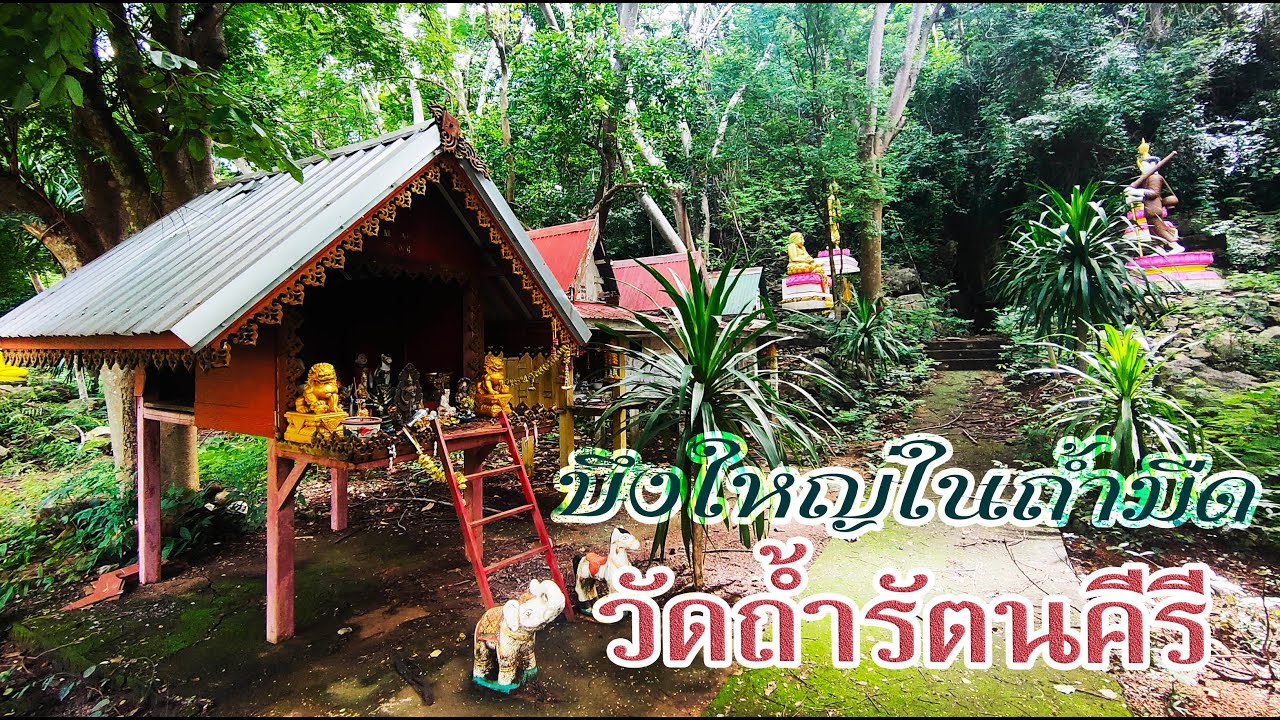
The natural cave is one of the most distinctive features of Wat Tham Rattanakhiri. Inside the cave are Buddha images, worship tables, offerings, robes, and sacred objects placed by monks and local devotees. The cave atmosphere is cool, quiet, and separated from the outside world. This makes it suitable for meditation, chanting, and silent reflection. Even during the daytime, the cave offers a sense of stillness that many visitors find calming.
The cave area known locally as Tham Khao Kwang Thong has two entrances, and some passages connect through the limestone formation. Travelers who enjoy cave landscapes will find this part of the temple interesting, but they should explore carefully. Comfortable shoes are recommended, and visitors should avoid entering dark or narrow areas alone. The cave is both a natural formation and a sacred space, so it should be treated with respect.
The temple also has religious structures such as a small vihara, pavilion areas, and a stupa that serve as places for worship and community ceremonies. These areas support merit-making, chanting, religious gatherings, and seasonal Buddhist events. Wat Tham Rattanakhiri therefore functions as a cave temple, hill temple, meditation site, and community temple at the same time.
Religious activities at Wat Tham Rattanakhiri are closely connected with local Buddhist life. Villagers come to make merit, offer food to monks, listen to sermons, chant, and participate in important Buddhist holy days such as Makha Bucha Day, Visakha Bucha Day, Asalha Bucha Day, Buddhist Lent, and the end of Buddhist Lent. These activities show how the temple continues to serve as a spiritual center for the Khao Kwang Thong community.
The Buddhist Lent and end-of-Lent periods are especially meaningful. Local people gather to make merit, offer robes, listen to Dhamma teachings, and support the monks. For foreign travelers who visit during these occasions, the temple provides an opportunity to observe Thai Buddhist traditions in an authentic community setting. Visitors should dress respectfully and follow the behavior of local worshippers when joining or observing ceremonies.
During other Buddhist festivals, the temple also becomes a gathering place for prayer, merit-making, and community activity. Such events may include food offerings, chanting, sermons, and local cultural practices. These traditions help maintain the bond between the temple and villagers while giving travelers a chance to understand the living culture of rural Uthai Thani.
The landscape around Wat Tham Rattanakhiri is another important reason to visit. From higher points, the view opens over fields, forest, hills, and small settlements. The sound of birds, the wind through the trees, and the quietness of the temple create a peaceful atmosphere. This makes the temple a good destination for travelers who want to step away from busy routes and spend time in a calm natural environment.
Wat Tham Rattanakhiri is also a rewarding place for photography. The site combines a limestone hill, cave entrance, Buddha images, temple buildings, rice fields, rural roads, and natural viewpoints. Morning light gives the area a soft and fresh feeling, while late afternoon light adds warmth to the hill and fields. Visitors should photograph respectfully, especially around sacred images, monks, and people who are praying.
A visit to Wat Tham Rattanakhiri should allow at least 1 to 2 hours. This gives enough time to walk uphill, pay respect to the Buddha images, explore the cave area, rest at the viewpoint, and enjoy the atmosphere without rushing. If combined with Hup Pa Tat or other natural attractions nearby, it is best to start early in the day to avoid the midday heat and allow enough time for travel between places.
Getting There is easiest by private car or rental car. From Uthai Thani town, travel toward Nong Chang District and continue into Khao Kwang Thong Subdistrict along Rural Road 4043. The temple is also within reach of the Hup Pa Tat travel route in Lan Sak District. Travelers should check the route before departure, as navigation systems may sometimes lead travelers to nearby hill or cave areas depending on the selected destination.
Travelers without private transport can first travel to Nong Chang District and then hire a local vehicle to reach the temple. Return arrangements should be made in advance because public transport around the temple and nearby natural attractions is limited. For families or small groups, using a private car is the most convenient option, especially if continuing to Hup Pa Tat, Khao Pla Ra, or other attractions in Uthai Thani.
Wat Tham Rattanakhiri can be combined with Hup Pa Tat, Khao Pla Ra, Wat Tham Khao Wong, Wat Nong Khun Chat, Old Uthai Thani Town, and Wat Chantharam or Wat Tha Sung. This route allows travelers to experience cave temples, hill landscapes, forest attractions, archaeology, and Buddhist art within the same province. It is ideal for visitors who want a deeper and more varied Uthai Thani itinerary.
Visitors should prepare comfortable walking shoes, drinking water, and modest clothing suitable for both temple visits and uphill walking. They should avoid littering, writing on cave walls, touching sacred objects unnecessarily, or making loud noise in meditation areas. Responsible travel helps protect both the sacred atmosphere of the temple and the natural condition of the cave and hill.
Wat Tham Rattanakhiri is a place where faith, nature, and local culture meet. Visitors can pay respect to Buddha images, walk through a hill temple landscape, enter a natural cave, enjoy views over the countryside, and learn about the connection between the temple and the Khao Kwang Thong community. It is a suitable destination for travelers seeking quietness, spiritual reflection, and a more local side of Uthai Thani.
| Name | Wat Tham Rattanakhiri, Uthai Thani |
| Alternative Name | Wat Khao Kwang Thong |
| Location | Khao Kwang Thong Subdistrict, Nong Chang District, Uthai Thani Province |
| Address | Rural Road 4043, Khao Kwang Thong Subdistrict, Nong Chang District, Uthai Thani 61110, Thailand |
| Highlights | Cave temple on a solitary limestone hill surrounded by rice fields, Buddha images, natural cave, uphill walking route, and scenic countryside viewpoints |
| History | Initiated in B.E. 2510 by Prat Khan Kasikon and local villagers; officially established as a temple in B.E. 2522; Buddhist studies began in B.E. 2517 |
| Name Origin | The name relates to Rattanakhiri Hill and the natural cave that define the temple site; the local name Wat Khao Kwang Thong comes from the Khao Kwang Thong area |
| Distinctive Features | Hill temple with a natural cave, meditation atmosphere, sacred spaces, walking path, and views of rice fields, forest, and limestone hills |
| Sacred Objects | Buddha image in the posture of subduing Mara, Buddha images inside the cave, worship tables, and sacred spaces on the hill |
| Rituals And Local Beliefs | Merit-making, almsgiving, chanting, listening to sermons, Buddhist Lent ceremonies, end-of-Lent ceremonies, Makha Bucha Day, Visakha Bucha Day, and Asalha Bucha Day activities |
| Main Areas / Zones | Foothill area, uphill walking path, ordination hall, Buddha image worship area, natural cave, pavilion, stupa, and viewpoint on the hill |
| Abbot / Caretaker | Phra Khru Uthai Bunnyaphiwat (Boonruang Katapunyo) |
| Main Contact Number | 08 1888 5195 |
| Travel Information | From Uthai Thani town, travel toward Nong Chang District and continue into Khao Kwang Thong Subdistrict via Rural Road 4043. Best reached by private car, rental car, or local hired vehicle from Nong Chang |
| Current Status | Active Buddhist temple open for worship, merit-making, cave visits, and cultural travel |
| Open Days | Daily |
| Opening Hours | Best visited during daylight hours |
| Facilities | Parking area, worship areas, uphill walking route, resting pavilions, viewpoint, and meditation areas inside the cave |
| Visitor Precautions | Wear comfortable shoes, be careful on slopes and cave floors, avoid entering dark cave areas alone, and do not write on or damage cave walls |
| Nearby Tourist Attractions | 1. Hup Pa Tat, about 9 km 2. Khao Pla Ra, about 14 km 3. Wat Tham Khao Wong, about 22 km 4. Wat Nong Khun Chat, about 18 km 5. Old Uthai Thani Town, about 22 km 6. Wat Chantharam or Wat Tha Sung, about 48 km |
| Nearby Restaurants | 1. Kwak Restaurant, about 2 km, Tel. 093-623-8632 2. My Merchain@Hup Pa Tat, about 8 km 3. At The Mountain Cafe, Restaurant And Accommodation, about 9 km, Tel. 087-784-2525, 099-951-6653 4. Hup Pa Tad Bike Camp, about 10 km, Tel. 081-902-7175 5. Krua Lung Yan Lan Sak, about 13 km |
| Nearby Accommodations | 1. At The Mountain Cafe, Restaurant And Accommodation, about 9 km, Tel. 087-784-2525, 099-951-6653 2. Hup Pa Tat Homestay, about 10 km, Tel. 081-886-3841 3. Grandma Homestay, about 10 km, Tel. 086-202-7554 4. Nam Hom Resort, about 18 km 5. Cheng Resort, about 21 km, Tel. 093-050-5282, 081-745-9552 |
Frequently Asked Questions (FAQ)
Q: Where is Wat Tham Rattanakhiri located?
A: Wat Tham Rattanakhiri is located in Khao Kwang Thong Subdistrict, Nong Chang District, Uthai Thani Province, along Rural Road 4043. It is also known locally as Wat Khao Kwang Thong.
Q: What makes Wat Tham Rattanakhiri special?
A: The temple is set on a solitary limestone hill surrounded by rice fields and forest. It has a natural cave, Buddha images, worship areas, an uphill walking route, and scenic viewpoints.
Q: Is Wat Tham Rattanakhiri the same as Wat Khao Kwang Thong?
A: Yes. Wat Tham Rattanakhiri is also locally known as Wat Khao Kwang Thong because it is located in the Khao Kwang Thong area.
Q: Can visitors enter the cave at Wat Tham Rattanakhiri?
A: Yes. The temple has a natural cave with Buddha images and worship areas. Visitors should walk carefully, wear suitable shoes, and respect the cave as both a natural and sacred space.
Q: How can travelers get to Wat Tham Rattanakhiri?
A: From Uthai Thani town, travel toward Nong Chang District and continue into Khao Kwang Thong Subdistrict via Rural Road 4043. A private car, rental car, or local hired vehicle is the most convenient option.
Q: What type of visit is Wat Tham Rattanakhiri suitable for?
A: It is suitable for Buddhist worship, cave visits, meditation, hill walking, nature photography, and quiet cultural travel in rural Uthai Thani.
Q: What nearby places can be visited with Wat Tham Rattanakhiri?
A: Nearby places include Hup Pa Tat, Khao Pla Ra, Wat Tham Khao Wong, Wat Nong Khun Chat, Old Uthai Thani Town, and Wat Chantharam or Wat Tha Sung.
Q: What should visitors prepare before visiting Wat Tham Rattanakhiri?
A: Visitors should wear modest clothing, comfortable walking shoes, bring drinking water, be careful on slopes and cave floors, and keep quiet inside sacred and meditation areas.
 Category: ●Places of Worship
 Group: ●Temple
Last Update : 5 MonthAgo
 Last Update : 5 MonthAgo
 Click to Access the Navigation Map GPS
Wat Tham Rattanakhiri Map
Recommend

 Art, Culture and Heritage
 Historical Sites and Monuments(3)
 Landmarks and Memorials(1)
 Art, Craft Centres, Tradition(5)
 Museums(1)
 University
 Public university(1)
Temple(31)
 Other Sacred Sites(3)
 Suburban Living
 Village, Community(4)
 Local Market(1)
 Nature and Wildlife
 National Parks and Marine Reserves(2)
 Mountain (Doi)(7)
 Dam, Reservoir, Lake(5)
 Waterfalls(5)
 Hot Springs(1)
 Caves(9)
 Flower Field(2)
 River, Canal(2)
 Islands(1)
 Other natural attractions(1)
 Entertainment and Agricultural
 Farms, Parks and Ecotourism(2)
 Shopping
 Shopping and Night Market(1)
 Travel Articles, Recipes
 Travel Review, Food Review(1)


