
 Home
Home North(
 Chiang Mai(


Songkran Rice Offering Tradition
Rating: 3.8/5 (5 votes)
 Search By
  Map
Map
 Have Map
  No Map
Samut Prakan attractions
Attractions in Thailand
Open Days: During Songkran, from April 13–15 every year
Opening Hours: Traditionally begins in the early morning of each day and is closely tied to temple-offering visits in the community
The Songkran Rice Offering Tradition is one of the most distinctive Thai-Mon customs of Phra Pradaeng, Samut Prakan. Observed during Songkran from April 13–15 every year, this tradition is far more than preparing food for monks. It reflects a community-based ritual of merit-making, ceremonial offering, and social connection that reveals the deeper cultural structure of old Phra Pradaeng Songkran.
In cultural terms, the tradition preserves a way of making merit that differs from ordinary food offering practices. The rice and side dishes are prepared with ritual care, placed in small clay pots and banana-leaf containers rather than regular bowls, and arranged with flowers, incense, and candles. This creates an atmosphere closer to ceremonial offering than everyday almsgiving, reflecting older beliefs associated with Songkran and sacred presentation.
The importance of the tradition is linked to Thai-Mon interpretations of Songkran as a festival that should begin with merit, offering, and collective community effort. In Phra Pradaeng, Songkran did not begin only with festive activity. It began before dawn with cooking, arranging offerings, and sending them to local temples. This gave the festival a sacred and highly structured opening rooted in shared responsibility.
In each village, one household would be assigned the honor and duty of cooking the Songkran rice. If the host family was financially comfortable, it might cover all expenses. If not, community members would contribute through small donations to help purchase fresh ingredients and cooking supplies. This system clearly shows that the tradition was never only personal merit-making. It was a village-level cultural act supported by collective cooperation.
On the Songkran day itself, the host family would build a small ceremonial spirit-shrine-like structure in front of the house using 4 posts and a raised platform for offerings. In Mon language, this structure was called Hoi Songkran, meaning the Songkran house. It served as the ritual center of the household and the point from which the ceremonial food preparation and offering process began.
The preparation of the rice itself was highly refined. Traditionally, the rice would be pounded until white 7 times, carefully cleaned of husks and impurities, then washed 7 times before cooking. It was cooked slightly firmer than usual and later cooled with water so that the grains would remain separate. This careful method reflected the idea that Songkran rice was not ordinary food, but ritual food that had to be clean, beautiful, and worthy of offering.
Another pot of water would be boiled and later cooled to prepare jasmine-scented water. Once the water had cooled, jasmine flowers were added, and the fragrant water became part of the final preparation of the Songkran rice. The rice was then placed in small clay pots. Side dishes were usually savory items such as salted eggs, dried fish, salted meat, pickled mustard greens, or local salads, while sweets often included black beans boiled in sugar. Fruits such as bananas and watermelon were also commonly included.
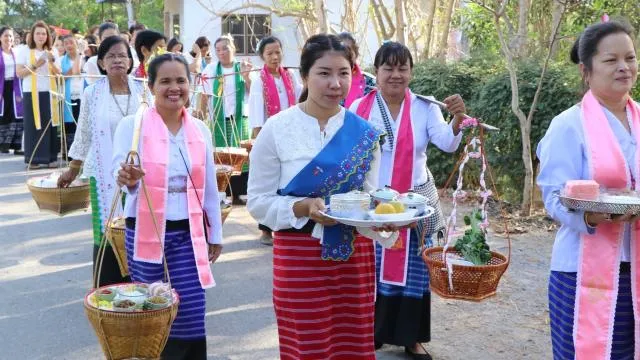
One of the most charming aspects of this tradition is its timing. Cooking began around 03:00–04:00 in the morning so that by around 05:00 young women from the village could come and receive the prepared Songkran rice trays to deliver to temples. The early hour was not a minor detail. It shaped the atmosphere of the entire custom, turning Songkran morning in Phra Pradaeng into a scene of movement, preparation, and devotion before sunrise.
Socially, the tradition carried another important meaning. The young women usually traveled in groups and often chose temples farther from their own homes rather than nearby ones. In the past, opportunities for young men and women from different subdistricts to meet were rare, so Songkran offering routes created one of the few acceptable social occasions for such encounters. This gave the tradition a second layer of meaning beyond merit-making.
After the rice had been offered, the return journey often connected directly with another famous local tradition: young men waiting to respectfully pour water on young women. This is why the Songkran Rice Offering Tradition cannot be fully separated from the broader Songkran customs of Phra Pradaeng. The offering represented the religious beginning of the day, while the gentle water-pouring custom reflected the social continuation of the same festive world.
Viewed as a whole, the tradition performed 3 functions at once. It linked the community to the temple through food offering, strengthened social cooperation through shared preparation, and created a structured context for interaction among young people. Few traditions show so clearly how merit, order, social life, and local identity could all come together in one ritual sequence.
For cultural travelers, this tradition is especially valuable because it reveals a slower, more intimate side of Songkran. Instead of loud celebration alone, it shows the festival beginning with rice, clay pots, banana-leaf trays, village cooperation, and the sight of young women carrying offerings through the streets toward local temples. This is one of the clearest windows into the older Songkran culture of Phra Pradaeng.
Getting There if you want to understand the cultural setting of this tradition is easy from Bangkok. Visitors can reach central Phra Pradaeng via Suk Sawat Road, the Bhumibol bridges, or cross-river ferry routes. Key temples and old community areas linked with the tradition include Wat Songtham Worawihan, Wat Prodket Chettharam, and nearby Thai-Mon neighborhoods in the market zone of Phra Pradaeng.
| Name | Songkran Rice Offering Tradition |
| Main Cultural Area | Thai-Mon communities in Phra Pradaeng District, Samut Prakan |
| Festival Period | During Songkran, from April 13–15 every year |
| Highlights | Pre-dawn Songkran rice cooking, Hoi Songkran shrine, clay pots and banana-leaf trays, young women carrying rice offerings to temples, links with the water-pouring tradition |
| Importance | A Thai-Mon tradition of Phra Pradaeng combining merit-making, ceremonial offering, and community cooperation within Songkran culture |
| Distinctive Features | Rice placed in clay pots, side dishes in banana-leaf trays, offerings arranged according to the number of temples to be visited |
| Main Rituals | Building the Hoi Songkran shrine, cooking rice before dawn, arranging savory and sweet offerings, groups of young women delivering the food to temples |
| Key Related Places | Wat Songtham Worawihan, Wat Prodket Chettharam, and temples in the Phra Pradaeng market area |
| Main Contact Number | Phra Pradaeng Municipality +66 2 462 5028 ext. 111, Wat Songtham Worawihan +66 2 463 5433, Wat Prodket Chettharam +66 2 462 5484 |
| Nearby Tourist Attractions | 1. Wat Songtham Worawihan 1 km 2. Wat Prodket Chettharam Royal Monastery 2 km 3. Pom Plaeng Faifa Historical Park 2 km 4. Sri Nakhon Khuean Khan Park and Botanical Garden 8 km 5. Bang Nam Phueng Floating Market 10 km |
| Nearby Restaurants | 1. Ba Zhang Aroi Tee Sud 1 km Tel. +66 2 462 6982 2. Charoen Phung (Khrua Phi Tae) Phra Pradaeng Market 1 km Tel. +66 82 939 6115 3. Sing Hai Hong Coffee & Restaurant Phra Pradaeng 2 km 4. Pobrak Na Bang Nam Phueng 9 km Tel. +66 81 847 6300 5. Bangkok Tree House Cafe & Restaurant 10 km Tel. +66 82 995 1150, +66 85 845 7666 |
| Nearby Accommodations | 1. 14 Residence 3 km Tel. +66 2 817 2277 2. Bangkok Tree House 10 km Tel. +66 82 995 1150, +66 85 845 7666 3. Coconut Lane Bangkok 10 km Tel. +66 65 641 5898 4. Baan Makham Bang Nam Phueng 11 km Tel. +66 98 828 0983 5. Phuengnang Homestay 12 km |
Frequently Asked Questions (FAQ)
Q: When is the Songkran Rice Offering Tradition held?
A: It is observed during Songkran from April 13–15 every year.
Q: How is this different from general merit-making?
A: It involves specially prepared Songkran rice, clay pots, banana-leaf offering trays, and a structured village-based ritual process.
Q: What is Hoi Songkran?
A: It is the ceremonial shrine-like structure built in front of the host house where offerings are placed as part of the Songkran rice ritual.
Q: Who carries the offerings to the temples?
A: Traditionally, young women from the village receive the prepared rice trays before dawn and carry them in groups to the temples.
Q: Why did young women often choose distant temples?
A: In the past, festival occasions were among the few opportunities for young people from different subdistricts to meet and speak to one another.
Q: How is this related to the water-pouring custom?
A: After the rice offerings were delivered, the return journey often became the moment when young men respectfully poured water on young women according to local custom.
Q: Can this tradition still be seen in its original form today?
A: Its fully traditional form is now less common, but it remains an important part of the cultural memory and Songkran identity of Phra Pradaeng.
 Category:
  Group:
  Tag: ●Songkran Rice Offering Tradition●ประเพณีการส่งข้าวสงกรานต์ ●ส่งข้าวสงกรานต์ พระประแดง ●สงกรานต์พระประแดง ส่งข้าว ●ข้าวสงกรานต์ ไทยรามัญ ●ฮอยสงกรานต์ ●ประเพณีมอญ พระประแดง ●วัฒนธรรมสงกรานต์ พระประแดง ●ส่งข้าวสงกรานต์ สมุทรปราการ ●ประเพณีไทยรามัญ สงกรานต์ ●เทศกาลสงกรานต์ พระประแดง Last Update: 2 DayAgo
Comment
 Nearby Attractions
| Keyword (Advance) |
 Region
|
 Muang Samut Prakan(
 Copyright 2012,