
 Home
Home North(
 Chiang Mai(


Procession and Wrapping Ceremony of Phra Samut Chedi
Rating: 4/5 (4 votes)
 Search By
  Map
Map
 Have Map
  No Map
Samut Prakan attractions
Attractions in Thailand
Open Days: Begins on the 5th waning day of the 11th lunar month each year
Opening Hours: Traditionally 7 days and 7 nights, and in later years often extended to around 10 days and 10 nights when combined with the Red Cross fair
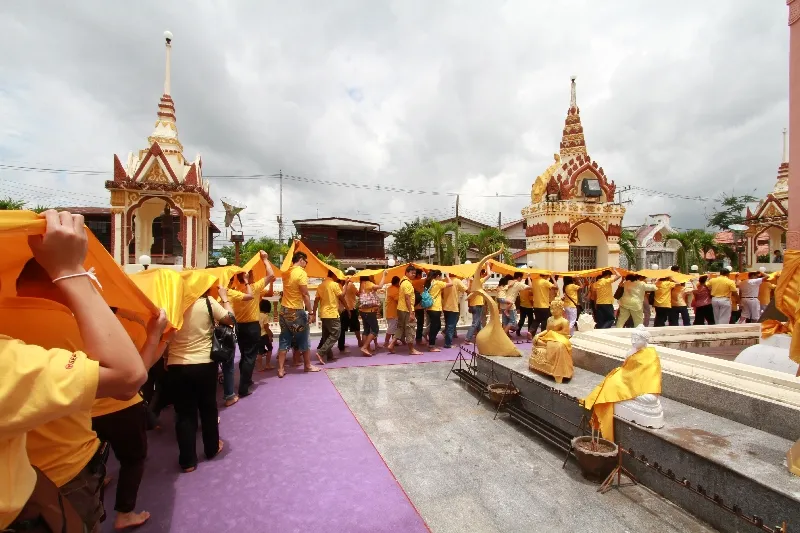
The Red Cloth Procession and Wrapping Ceremony of Phra Samut Chedi is one of the most important annual traditions in Samut Prakan and one of the province’s clearest cultural symbols. The heart of the event is the ceremonial procession of a large red cloth that is later wrapped around Phra Samut Chedi, the province’s most revered sacred monument. This is not merely a local temple fair. It is a ritual of devotion, identity, and collective memory that has long shaped how local people understand their province.
The importance of the ceremony lies in its connection to Phra Samut Chedi itself. The pagoda was conceived under King Rama II, who also bestowed its name, and the construction was completed during the reign of King Rama III. Locals have long called it the “Pagoda in the Water” because of its historic relationship with the river landscape. Over time, the monument became not only a sacred Buddhist site, but also the visual and emotional emblem of Samut Prakan.
Inside the pagoda are enshrined 12 relics of the Buddha, along with sacred images and religious objects of great importance. This makes the annual festival far more than a festive fairground event. At its core, it remains a major act of worship in which local people and visiting devotees come together to honor the monument and renew their connection to it.
The preparation for the ceremony begins before the main wrapping day. On the 2nd waning day of the 11th lunar month, Buddhist devotees gather to help sew the large red cloth that will be used to wrap the pagoda. This communal act of sewing is meaningful in itself, because it allows ordinary people to take direct part in preparing the most important ritual object of the festival.
Then, on the 5th waning day of the 11th lunar month, the red cloth is ceremonially placed on a decorated pavilion-like platform and carried in procession through the town. Schools, government offices, private organizations, and members of the public often take part, creating a large and visually impressive parade. The cloth is then transferred to a boat procession on the Chao Phraya River and carried toward Phra Pradaeng, where people in that district also have the chance to participate in the shared merit of the event before it returns to Phra Samut Chedi.
This combination of land and river procession is one of the most distinctive features of the festival. Once the red cloth returns to the pagoda, it is taken in ritual circumambulation around the monument and then lifted up to wrap the bell-shaped upper section of the pagoda. This moment is widely regarded as the emotional and ceremonial peak of the entire festival.
In earlier times, boats could travel all the way around the pagoda, and the atmosphere was even more animated with traditional boat songs and lively participation from young men and women. Although changes in the physical landscape have reduced that riverside movement, the essential beauty and power of the ceremony remain fully intact, and the red cloth wrapping still stands as the defining image of the annual festival.
After the wrapping ceremony, the event continues into its celebratory phase, with entertainment, local stalls, temple-fair activity, and community gatherings over multiple days. The older format lasted 7 days and 7 nights, but later the festival expanded when Red Cross activities were incorporated, creating a larger provincial fair that now draws wide public interest.
Even with all the entertainment, the spiritual core of the festival remains strong. For many visitors, no trip to the event feels complete without going up to pay respect to the pagoda and apply gold leaf. This devotional act keeps the event grounded in faith rather than allowing it to become only a fairground spectacle.
Another important moment comes on the night of the 7th waning day, when activities traditionally continue through the night, followed by a rowing race on the morning of the 8th waning day. This combination of sacred ritual, festive performance, and riverside sport reflects the layered identity of Samut Prakan as a province shaped by both faith and waterway culture.
For travelers, this festival is one of the best opportunities to understand Samut Prakan beyond its modern industrial image. It reveals a province with deep historical memory, strong religious continuity, and a local culture that still gathers around a living monument. The festival offers a rare blend of ceremonial grandeur, real community participation, and classic Thai temple-fair atmosphere.
Getting There from Bangkok is straightforward via Suk Sawat Road toward Phra Samut Chedi District. During the festival period, extra travel time is recommended, especially on the day of the red cloth procession and on busy evening program days, since the area becomes one of the most active annual gathering points in the province.
| Name | Red Cloth Procession and Wrapping Ceremony of Phra Samut Chedi |
| Main Venue | Phra Samut Chedi, Pak Khlong Bang Pla Kot, Phra Samut Chedi District, Samut Prakan |
| Address | 114 Moo 3, Pak Khlong Bang Pla Kot, Phra Samut Chedi, Samut Prakan 10290, Thailand |
| Highlights | Red cloth procession, wrapping ceremony around Phra Samut Chedi, river procession on the Chao Phraya, temple fair, gold-leaf worship, rowing race |
| History | Conceived under King Rama II and completed during the reign of King Rama III |
| Name Origin | Named “Phra Samut Chedi” by King Rama II, while locals have long called it the “Pagoda in the Water” |
| Distinctive Features | A major sacred monument of Samut Prakan containing 12 relics of the Buddha and serving as the province’s most important symbolic landmark |
| Travel Information | Accessible from Bangkok via Suk Sawat Road, with extra travel time recommended during the annual festival period |
| Current Status | Still actively held every year, with an expanded program in the later format |
| Open Days | Begins on the 5th waning day of the 11th lunar month each year |
| Opening Hours | Traditionally 7 days and 7 nights, and later often around 10 days and 10 nights |
| Main Contact Number | Phra Samut Chedi Subdistrict Municipality +66 2 405 3780-84, Wat Phra Samut Chedi +66 2 425 0884 |
| Official Website / Official Page | Phra Samut Chedi Subdistrict Municipality, Tourism Authority of Thailand, Samut Prakan Province |
| Nearby Tourist Attractions | 1. Pom Plaeng Faifa 3 km 2. Wat Khu Sang 4 km 3. Phra Chulachomklao Fort 13 km 4. Bang Pu Recreation Center 19 km 5. Ancient City 24 km |
| Nearby Restaurants | 1. The Dishes Riverside Phra Samut Chedi 6 km Tel. +66 93 250 5562 2. Tao Thong Restaurant Phra Samut Chedi 11 km 3. Pu Sod Phra Samut Chedi 8 km 4. Sing Hai Hong 12 km 5. Khrua Plai Thang 11 km |
| Nearby Accommodations | 1. Baankhunsamutjeen Homestay 20 km Tel. +66 85 020 0024 2. Wangyai Homestay 20 km Tel. +66 80 451 3074 3. Phattra Farmstay 22 km Tel. +66 94 493 4496 4. Baan Phi Phophiang Nongphiangpho Homestay 20 km Tel. +66 82 343 9110 5. Phuengnang Homestay 26 km Tel. +66 2 461 3810 |
Frequently Asked Questions (FAQ)
Q: When is the Phra Samut Chedi red cloth wrapping festival held?
A: It begins on the 5th waning day of the 11th lunar month each year, with the traditional format lasting 7 days and 7 nights and the later format often lasting around 10 days and 10 nights.
Q: What is the most important part of the festival?
A: The central highlight is the red cloth procession and the ceremonial wrapping of Phra Samut Chedi.
Q: Why is Phra Samut Chedi important?
A: It is the most important sacred landmark of Samut Prakan and enshrines 12 relics of the Buddha.
Q: Why do people call it the “Pagoda in the Water”?
A: Because of its long-standing visual and cultural association with the river landscape, which gave rise to the local name.
Q: Are there activities besides the cloth-wrapping ceremony?
A: Yes. The festival also includes temple-fair entertainment, stalls, worship, gold-leaf offering, and a rowing race on the morning of the 8th waning day.
Q: Which day is best for first-time visitors?
A: The red cloth procession day is ideal if you want to see the core ritual, while the following evenings are better for enjoying the fair atmosphere.
Q: Is it easy to get there from Bangkok?
A: Yes. It is accessible by road via Suk Sawat Road, though visitors should allow extra time during the festival because the area becomes very crowded.
 Category:
  Group:
  Tag: ●Procession and Wrapping Ceremony of Phra Samut Chedi●phra samut chedi festival ●red cloth wrapping ceremony phra samut chedi ●phra samut chedi samut prakan ●phra samut chedi fair ●pagoda in the water thailand ●samut prakan cultural festival ●phra samut chedi red cloth procession ●annual festival phra samut chedi ●things to do samut prakan festival ●phra samut chedi tradition Last Update: 2 DayAgo
Comment
 Nearby Attractions
| Keyword (Advance) |
 Region
|
 Muang Samut Prakan(
 Copyright 2012,