
 Home
Home North(
 Chiang Mai(


Bang Phli District Cultural Center
Rating: 3.7/5 (6 votes)
 Search By
  Map
Map
 Have Map
  No Map
Samut Prakan attractions
Attractions in Thailand
Open Days: Monday–Friday
Opening Hours: 08:30 AM – 04:00 PM
Bang Phli District Cultural Center in Samut Prakan is a highly valuable local learning destination for visitors who want to understand Bang Phli through its traditional way of life, community culture, and the long coexistence of different ethnic groups. For practical trip planning, the museum is located inside Bangpleeratbamrung School, open Monday to Friday from 08:30 AM to 04:00 PM, and admission is free. It is especially suitable for cultural travelers who want real historical context, a quiet atmosphere, and exhibitions that connect Thai, Mon, Lao, Chinese, and Muslim communities within the history of Bang Phli.
The importance of this cultural center does not lie in the size of the building, but in the richness of the stories preserved inside. It functions as a local folk museum for Bang Phli, taking visitors back to a time when community life was deeply connected to canals, floating markets, boats, trade, and local rituals. The exhibitions make it clear that Bang Phli is not just an old district in Samut Prakan, but a place shaped by long-term cultural exchange among many groups of people, resulting in a distinctive local identity.
The center is located inside Bangpleeratbamrung School at 154 Moo 8, Bang Phli Yai, Bang Phli District, Samut Prakan. Because it is housed within a school, the atmosphere feels different from museums in major tourist centers. It has the character of a true community learning space rather than a destination built mainly for tourism. This gives the museum strong educational value and makes the visit feel closely connected to the local memory of Bang Phli.
The upper floor is the core of the museum. This is where visitors find exhibitions on local wisdom and earlier cultural life, especially the interaction among Thai, Mon, Lao, Chinese, and Muslim communities. These displays help explain that Bang Phli’s identity was not formed by a single group, but by long periods of coexistence, trade, adaptation, and shared tradition. That gives the museum unusual depth for a local cultural center.
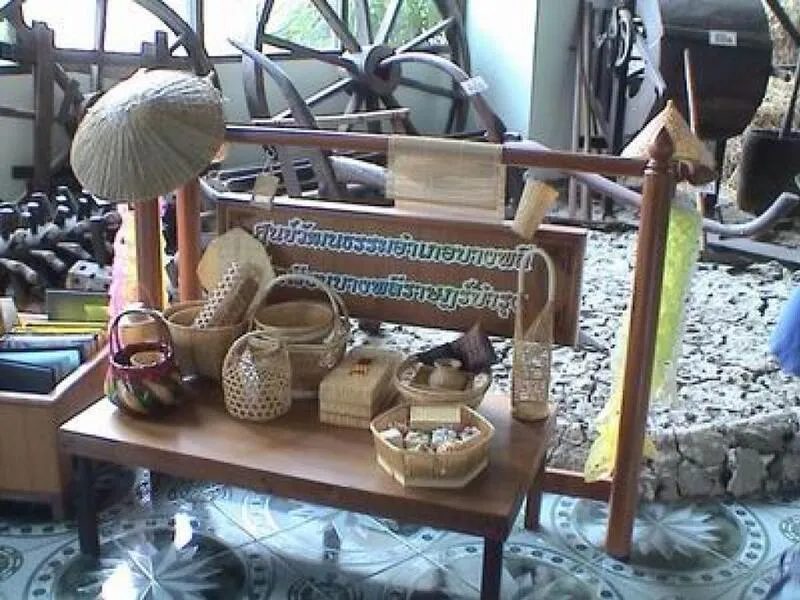
The exhibits include everyday tools, household items, fishing equipment, musical instruments, and old currency. Although these may appear ordinary at first glance, they become highly meaningful when viewed in the context of village life. Visitors can see how canals, markets, and water transport once shaped the rhythm of Bang Phli, and why many local traditions are still closely tied to boats, waterways, and communal participation.
One particularly important theme is the floating market and trade between communities. Bang Phli once thrived through local commerce along waterways, and trade here was not only economic. It was also a space of contact where people from different cultural backgrounds exchanged language, customs, beliefs, and knowledge. As a result, objects such as boats, coins, and trading tools tell a much larger story about the social structure of the district.
Another major focus is the famous Rap Bua tradition, one of the best-known cultural events associated with Bang Phli. By including this tradition and the ceremonial boat procession in the displays, the museum helps visitors understand that Rap Bua is not simply an annual celebration, but a ritual that reflects faith, community relations, and the central role of waterways in local life. For those who have never attended the festival, the museum provides an excellent introduction to its meaning.
The displays of fishing tools and livelihood equipment are equally important because they show how earlier residents of Bang Phli depended on natural resources and local skills. Fishing, boat use, rice farming, and the making or use of traditional tools were not just occupations. They were bodies of knowledge built up over generations and adapted to the district’s landscape and seasonal rhythms. Preserving these objects therefore means preserving the practical wisdom that once formed the foundation of the community.
The ground floor presents model scenes of village life, adding another dimension to the visit. These models help visitors understand how homes, tools, and daily activities fit together in real life. This is especially useful for students, families, and younger visitors who may not be familiar with older forms of community living. The models make the museum easier to understand and help connect individual objects with their social context.
In terms of visitor experience, the Bang Phli District Cultural Center feels warm, direct, and community-based rather than highly theatrical or technology-driven. It does not rely on multimedia spectacle. Its strength comes from authentic objects, clear storytelling, and the fact that the exhibitions remain deeply rooted in the actual life of the surrounding district. After leaving the building, visitors often see Bang Phli with a greater sense of depth than before.
For people interested in local history, the center is especially important because it preserves stories that larger museums often overlook. Understanding Bang Phli through this museum means learning not only about famous traditions, but also about ordinary residents, trade between settlements, and the social fabric that connected different communities over time. That makes it one of the most valuable local museums in Samut Prakan for understanding community identity.
The center is also very suitable for educational visits. The exhibitions combine social history, culture, economy, ritual, and local knowledge in one place, making it useful for students and researchers as well as for families. Group visits are possible, but according to the museum’s conditions, a formal letter should be submitted to the chair of the Bang Phli District Cultural Center at least 1 week in advance.
From a travel planning perspective, the museum also works very well as part of a wider Bang Phli itinerary. It is close to Wat Bang Phli Yai Nai, the Bang Phli Floating Market, and other local landmarks. Visiting the cultural center first gives travelers better background knowledge, so that when they continue to the temple or the market, they understand the district in a more meaningful way rather than seeing it only as a sightseeing stop.
Another major advantage is free admission. This makes the cultural center especially worthwhile for students, researchers, families, and travelers who want to add an educational activity to their Samut Prakan trip without increasing their budget. It may not be a mainstream tourist attraction on the same scale as some larger museums, but in terms of local heritage and real community value, it is one of the most rewarding places to visit in Bang Phli.
Overall, the Bang Phli District Cultural Center is ideal for visitors who want more than a quick photo stop or a short market walk. It brings together local wisdom, village life, the Rap Bua tradition, floating market culture, the coexistence of many ethnic communities, and the practical tools of everyday life in one place. A visit here offers both knowledge and a deeper social understanding of Bang Phli as a historic community with strong cultural continuity.
Getting There By public transport, visitors can travel from Samrong and continue by a Bang Phli–Wat route bus, or from Bang Na by blue local songthaew into Bang Phli. By private car, simply head to Bangpleeratbamrung School in Bang Phli Yai and continue into the exhibition area inside the school grounds during opening hours.
| Name | Bang Phli District Cultural Center |
| Location | Inside Bangpleeratbamrung School, Bang Phli Yai, Bang Phli District, Samut Prakan |
| Address | 154 Moo 8, Bang Phli Yai, Bang Phli District, Samut Prakan 10540 |
| Highlights | A local folk museum of Bang Phli featuring village life, floating market culture, Rap Bua tradition, fishing tools, musical instruments, currency, and multicultural exchange |
| History | Established as a local cultural learning space inside Bangpleeratbamrung School, with the Thai museum database listing its founding year as 1997 |
| Name Origin | Named after its role as the district cultural center preserving and presenting the heritage of Bang Phli communities |
| Distinctive Features | Upper floor exhibitions on local wisdom and cultural exchange, with ground floor model scenes of traditional village life |
| Travel Information | From Samrong, continue by Bang Phli–Wat route bus; from Bang Na, take a blue local songthaew into Bang Phli; by car, head to Bangpleeratbamrung School |
| Current Status | Open to visitors during official operating days and hours |
| Open Days | Monday–Friday |
| Opening Hours | 08:30 AM – 04:00 PM |
| Fees | Free Admission |
| Facilities | Indoor exhibition area, parking within school grounds as available, and advance coordination for group visits |
| Main Areas / Zones | Upper floor displays local wisdom, floating market life, Rap Bua tradition, fishing tools, and currency / Lower floor presents model scenes of village life |
| Main Contact Number | 02-751-1504-7, 02-751-1507 |
| Official Website / Official Page | bp-school.ac.th / Thai museum database, Princess Maha Chakri Sirindhorn Anthropology Centre |
| Nearby Tourist Attractions | 1. Wat Bang Phli Yai Nai 1 km 2. Bang Phli Floating Market 1 km 3. Wat Bang Phli Yai Klang 2 km 4. Bang Phli Municipality Sports Center 3 km 5. Mega Bangna 11 km |
| Nearby Restaurants | 1. Na Bang Phli ณ บางพลีณ บางพลี 1 km Tel. 081-915-1536 2. Chef Daeng Wat Bang Phli Yai Klang 1 km Tel. 081-859-0975 3. Mae Thong Yuen Ayutthaya Boat Noodles, Wat Bang Phli Yai Nai 1 km Tel. 090-895-3416 4. ooozy Bubble Milk Tea in front of Bangpleeratbamrung School 0.1 km Tel. 097-220-0132, 081-770-0500 5. Krua Than Nam Yen 4 km Tel. 086-896-2663 |
| Nearby Accommodations | 1. Blue Sky Residence Airport 6 km Tel. 061-784-9225, 098-361-6359 2. Letana Hotel 7 km Tel. 061-778-8662, 080-159-3619 3. At Ease Residence Suvarnabhumi 8 km Tel. 083-262-3399 4. Sananwan Palace 8 km Tel. 02-174-6868 5. Amaranth Suvarnabhumi Hotel 12 km Tel. 02-315-9393 |
Frequently Asked Questions (FAQ)
Q: What days is the Bang Phli District Cultural Center open?
A: It is open Monday to Friday and closed on Saturdays, Sundays, and public holidays.
Q: Is there an admission fee?
A: No. Admission is free.
Q: What are the main highlights inside the cultural center?
A: Highlights include exhibitions on local wisdom, multicultural community life, floating markets, the Rap Bua tradition, fishing tools, musical instruments, old currency, and model scenes of village life.
Q: What should group visitors do before visiting?
A: Group visitors should submit a formal letter to the chair of the Bang Phli District Cultural Center at least 1 week in advance.
Q: How can I get to the cultural center?
A: You can travel from Samrong by a Bang Phli–Wat route bus, from Bang Na by blue local songthaew, or by private car to Bangpleeratbamrung School.
Q: Who is this place suitable for?
A: It is suitable for students, families, local history enthusiasts, researchers, and travelers who want a deeper understanding of Bang Phli’s community culture.
 Tel: 027511504-7
 Bang Phli District Cultural Center Map
 Category:
  Group:
  Tag: ●Bang Phli District Cultural Center●bang phli district cultural center ●bang phli cultural center samut prakan ●folk museum bang phli ●things to do in bang phli ●samut prakan cultural museum ●rap bua tradition bang phli ●bang phli floating market museum ●local culture museum samut prakan ●community museum bang phli ●museums in samut prakan Last Update: 2 DayAgo
Comment
 Nearby Attractions
| Keyword (Advance) |
 Facebook Fanpage
 Region
 Historical Sites and Monuments(
 Landmarks and Memorials(
 Art, Craft Centres, Tradition(
 Historical Houses and The Ancient City(
 University
 Places of Worship
 Temple(
 Mosque(
 Other religious and spiritural sites(
 Suburban Living
 Local Market(
 Floating Market(
 Nature and Wildlife
 River, Canal(
 Bays and Beaches(
 Entertainment and Agricultural
 Zoos and Aquariums(
 Animal camps and shows(
 Farm, Parks, Gardens and Ecotourism(
 Outdoor and Adventure Activities(
 Copyright 2012,