

 Home
Home Chiang Mai(





Wat Ban Nong
Rating: 3.3/5 (8 votes)
 Search By
  Map
Map 
 Have Map
  No Map
Lampang attractions
Attractions in Thailand
Operating day: Daily
Operating time: 08.00 - 17.00
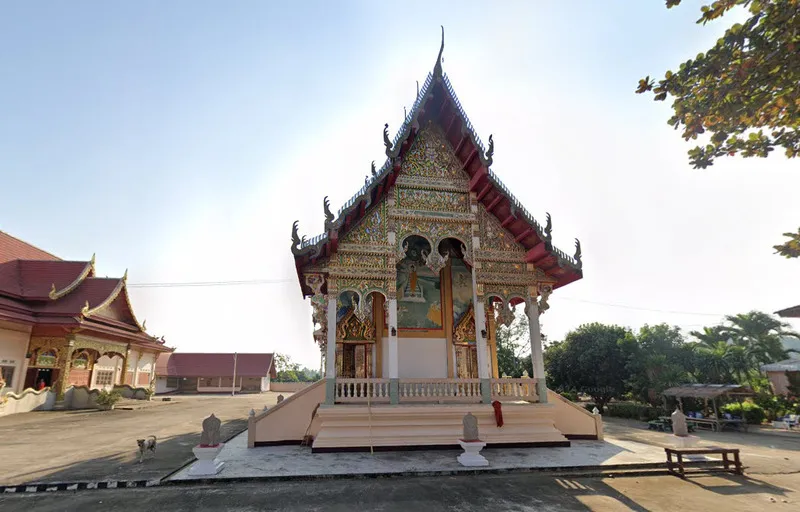
Wat Ban Nong is located at 215 Moo 4, Ban Nong Village, Nam Jo Subdistrict, Mae Tha District, Lampang Province, 52150. The temple sits on the eastern side of the village, which holds deep historical and cultural significance tied to the origins of the local community.
Originally, the area was known as Ban Pa Lao, which later evolved linguistically into Ban Lao. The first settlement of Ban Nong began in this location before the villagers migrated to join a group of people known as the Lua, who had descended from northern Thailand. They established a new community by the banks of the Chang River, near a hill called Mon Doi Kaew, under the leadership of Phaya Lua Chan.
Today, this area is referred to as Wang Lua, situated south of the current village. Some descendants of the Lua community remain in the area and carry on surnames such as Kolua.
Later, a rival leader named Phaya Na Wiang, who had founded a settlement at Ko Kha, also by the Chang River, learned about the Lua settlement and launched an attack. Armed with spears and swords, a fierce battle took place in the eastern rice fields of the village. The battlefield later became known as Thung Phaya or Thung Phanan.
Phaya Na Wiang was wounded in the leg during the battle and fled to a stream later named Huai Phae (or Huai Phan). Severely injured, he crawled across the eastern fields, now known as Thung Na Phra Kan, until he was eventually located and killed by Phaya Lua’s men in Ban Matan, now Ban Pa Tan. His body was buried on a hill near those rice fields, which came to be called Doi Phra or Doi Phra Kan.
Today, the people of Ban Pa Tan and surrounding villages have built a chedi, pavilion, and Buddha image on this sacred hill. Every year, on the 8th day of the waxing moon of the 9th lunar month, a local festival is held to commemorate these historic events.
To celebrate his victory, Phaya Lua held a feast using fermented rice wine called Nam Jo (a Northern Thai term). Some of this Nam Jo was discarded in a thicket west of the village. Finding the area suitable for settlement, they established a new community there and named it Ban Nam Jo.
Worried about an important village artifact a golden gong (Khong Kham) falling into enemy hands, Phaya Lua instructed his men to hide it in a large, deep pond near the Chang River, close to Mon Yang. The pond has since been known as Nong Khong Kham or Nong Pong.
Following this event, the village adopted the new name Ban Nong Khong Kham. Later, during the era of Doi Kaew, the village became spiritually significant with reports of divine guardians and spirits manifesting through mediums to protect the area. Elders in the village eventually shortened the name to Ban Nong Kaew.
In 1955 (B.E. 2498), Phra Khru Rattanasophon, the ecclesiastical head of Mae Tha District, issued an order through Phra Sao Suko, the Nam Jo subdistrict ecclesiastical head, to notify Phra Tamnan Chiyo, the acting abbot, and Mr. Thiam Jawana, the then village headman. For reasons unknown, the term “Kaew” was removed from the name, leaving it as Ban Nong the name that remains today.
Wat Ban Nong, thus, stands not only as a religious center but also as a witness to a long and colorful history filled with legends, migrations, battles, and spiritual traditions that continue to shape the identity of the community.
 Mobile: 0895580711
 Wat Ban Nong Map
 Category:
  Group:
  Tag: ●Wat Ban NongLast Update: 8 MonthAgo
Comment
 Nearby Attractions
| Keyword (Advance) |
 Facebook Fanpage
 Region
 Art, Culture and Heritage
 Historical Sites and Monuments(
 Landmarks and Memorials(
 Art, Craft Centres, Tradition(
 Museums(
 Historical Houses and The Ancient City(
 University
 Other religious and spiritural sites(
 Research and Development
 Royal Project(
 Suburban Living
 Village, Community(
 Local Market(
 Nature and Wildlife
 National Parks and Marine Reserves(
 Mountain (Doi)(
 Dam, Reservoir, Lake(
 Waterfalls(
 Hot Springs(
 Caves(
 Flower Field(
 River, Canal(
 Bays and Beaches(
 Other natural attractions(
 Entertainment and Agricultural
 Animal camps and shows(
 Farm, Parks, Gardens and Ecotourism(
 Outdoor and Adventure Activities(
 Shopping
 Shopping and Night Market(
 Spas and Wellness
 Spas and Wellness(
 Copyright 2012,