
lovethailand home >North Travel Attractions >Lampang Travel Attractions >Muang Pan >Chae Son > Wat Si Luang Chae Son
TL;DR: Wat Si Luang Chae Son is located at Ban Luang, Moo 5, Chae Son Subdistrict, Mueang Pan District, Lampang Province, open Daily, hours 08.00 – 17.00.

Wat Si Luang Chae Son
Open Days: Daily
Opening Hours: 08.00 – 17.00
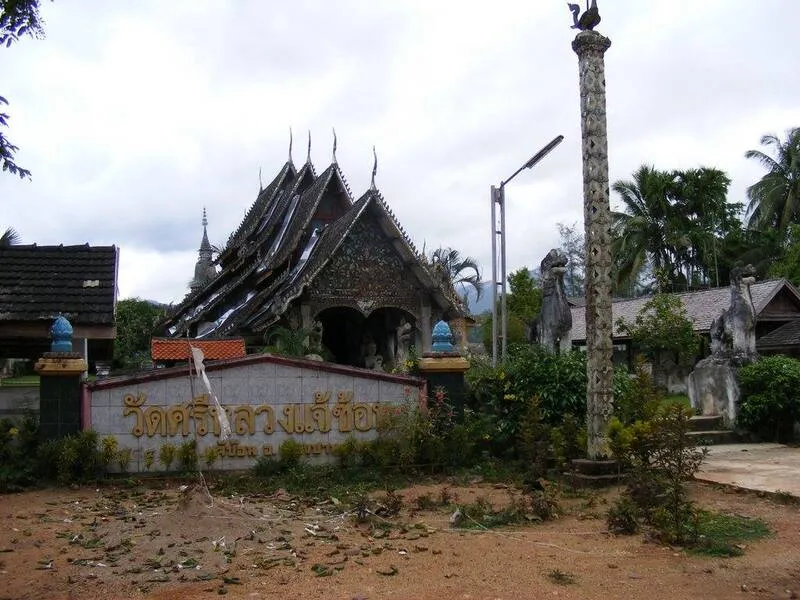
Wat Si Luang Chae Son is located at No. 246, Moo 5, Ban Luang, Chae Son Subdistrict, Mueang Pan District, Lampang Province 52240. It is a local Buddhist temple under the Mahanikaya order, with Phra Athikan Sao Kham Dhammanando serving as abbot. The temple is an important historic and cultural site of Chae Son, known for its ancient Lanna-Burmese style viharn, bell-shaped twelve-indented chedi, Chiang Saen-style principal Buddha image, old teak preaching pulpit, gilded interior decoration, and a long history connected with the revival of an abandoned sacred site.
The story of Wat Si Luang Chae Son begins with an old abandoned chedi standing in a forested area. Later, Khru Ba Chao Wachira Panya came to practice dhutanga meditation and stayed at the site. Seeing the sacred potential of the abandoned chedi, he decided to restore the area as a living temple. Together with Saen Mueang Lue Lok and local devotees, he requested permission from the ruler of Lampang to build a viharn. This makes the temple a strong example of how faith, local leadership, and community effort could revive a forgotten sacred place.
According to a palm-leaf manuscript recorded by Nan Yot Tana and translated by Phra Khru Phiphat Woradet, the revival of the temple was not a simple local construction project. After permission was granted, the group invited Khru Ba Ya Wichai of Wat Ban Tham in Mueang Pan District to serve as the master builder. Khru Ba Ya Wichai then advised them to ask Khru Ba Chao A Sing Wi Tak of Wat Phra Yuen in Lamphun Province to draw the plan. Once the plan was completed, Khru Ba Ya Wichai supervised the construction. The viharn construction began on Friday, the full moon day of the northern sixth lunar month, Chula Sakarat 1219, corresponding to 1857 CE.
At that time, the temple was known as Wat Pa Phai, or the Bamboo Forest Temple. The name reflected the natural condition of the old site, which was associated with forest and bamboo surroundings. Later, the temple became known as Wat Si Luang Chae Son, a name that connects the temple with the Chae Son community and gives it a more formal religious identity. The change of name also reflects the transformation of the place from a restored forest temple into an important community and historic temple.
The temple layout is one of its most attractive features. The viharn and chedi were placed on raised ground higher than the surrounding area. This makes both structures visually prominent and allows them to stand out within the temple compound. In Lanna temple planning, placing important religious buildings on elevated ground gives the site a stronger sacred presence. Visitors approaching the temple can immediately see the importance of the viharn and chedi as the spiritual center of the site.
The viharn of Wat Si Luang Chae Son is built in Lanna architectural style and aligned on an east–west axis. Its original roof form is believed to have had a front-three-back-two structure, meaning the front roof tiers descended in three layers and the rear in two layers, with roof planes sloping on both sides. Later, an additional front porch roof was added to protect the stairway from sunlight and rain. This change shows that the building continued to serve real community use while preserving its historical character.
The viharn was built with brick and plaster. In earlier times, it was more like an open hall, but later brick walls and window openings were added. At the stairway to the viharn, stucco sculptures of mythical animals decorate the entrance. These features add symbolic beauty to the approach to the hall and show the local artistic imagination of the temple. Visitors should take time to observe the stairway, roof line, entrance, and wall details because they reveal both practical adaptation and artistic intention.
Inside the viharn is a principal Buddha image in Chiang Saen style. This image is the spiritual focus of the temple and the main object of worship for local residents and visitors. Chiang Saen-style Buddha images are known for their calm expression, strong form, and dignified presence. Paying respect to the principal image is an essential part of a visit to Wat Si Luang Chae Son.
Above the principal Buddha image is a lotus-shaped ceiling decoration, lacquered and gilded, arranged in 42 framed panels. The lotus is an important Buddhist symbol representing purity, awakening, and liberation. Placing lotus forms above the Buddha image gives the interior a deeper spiritual meaning and reinforces the sacred atmosphere of the viharn.
The interior is further decorated with gilded lai kham patterns on columns, beams, and other structural elements. Lai kham is a decorative technique widely used by Lanna artisans to create a refined and sacred atmosphere inside temples. These golden patterns are not merely ornamental. They transform the interior into a contemplative space and show the craftsmanship of northern Thai temple art.
The old teak preaching pulpit is another important object inside the viharn. A preaching pulpit was used by monks to teach the Dhamma to villagers during Buddhist holy days, merit-making ceremonies, and important festivals. Its presence shows that the temple was not only a place of worship but also a center of Buddhist teaching. The old teak pulpit therefore preserves the memory of sermons, learning, and religious life in the Chae Son community.
Behind the viharn stands a bell-shaped twelve-indented chedi covered with thong changko-style gilded metalwork. The chedi combines Lanna and Burmese artistic influences, giving the temple a distinctive architectural identity. The combination of Lanna and Burmese elements reflects Lampang’s wider cultural setting, where local art, trade routes, and cross-cultural craftsmanship shaped temple architecture over time.
Wat Si Luang Chae Son is sometimes compared with temples such as Wat Nong Bua in Tha Wang Pha District and Wat Phumin in Nan Province because of similarities in building form. This comparison makes the temple especially interesting for visitors who study Lanna architecture and regional Buddhist art. It shows how architectural ideas and craftsmen’s knowledge traveled across northern Thailand.
The temple has undergone several major restorations. In 1966, villagers helped replace the old wooden shingle roof with concrete tiles and altered the wall design by changing the earlier wall form into more solid walls with light and ventilation openings. In 1972, another restoration was led by a local ascetic known as Ruesi Ton Kin Mak together with villagers. During 1984–1985, the chedi was restored by removing trees growing on the structure and replastering it to return the chedi to a more complete condition.
In 2010, the Fine Arts Department carried out a major restoration of both the viharn and the chedi with official support. This was an important conservation milestone because it helped preserve the temple as a historic site through more systematic methods. The restoration protected the architecture, structural elements, and artistic features of the temple while allowing it to continue functioning as a living place of worship.
Wat Si Luang Chae Son was officially registered as a historic site by the Fine Arts Department and announced in the Royal Gazette, Volume 117, Special Section 103, dated 6 October 2000. It is listed as historic site number 15, covering an area of 2 rai, 2 ngan, and 33.01 square wah. This registration confirms the temple’s importance as a cultural heritage site of Lampang Province.
The temple is also associated with the annual 8 Peng relic-bathing tradition. This ceremony brings local residents, devotees, and visitors together to make merit and bathe the sacred chedi. The tradition shows that Wat Si Luang Chae Son is not merely a historic monument but a living religious center. It continues to connect the community through ritual, faith, and shared cultural memory.
Getting There is convenient by private car or rental car. If traveling from Chae Son National Park, drive toward Mueang Pan District, then turn right into Ban Chae Son. Continue past the local market, and the temple will be on the right-hand side. Travelers coming from Lampang city should head toward Mueang Pan District and continue to Chae Son Subdistrict. The temple is well suited to a combined itinerary with Chae Son National Park, Chae Son Hot Springs, Chae Son Waterfall, Ban Pa Miang, and other nature attractions in the area.
The best time to visit is in the morning or late afternoon, when the light is soft and the weather is more comfortable for walking around the temple. The cool season is especially pleasant for combining the temple with natural attractions in Chae Son. During the rainy season, visitors should drive carefully and wear suitable footwear because some areas may be wet or slippery.
Visitors should dress modestly, speak quietly, avoid touching old surfaces, gilded patterns, columns, walls, or historic structures unnecessarily, and refrain from climbing on the chedi or other old buildings. Photography should be done respectfully without disturbing worshippers or ceremonies. Since the temple is both an active religious site and a registered historic monument, respectful behavior helps preserve its dignity and cultural value.
Overall, Wat Si Luang Chae Son is one of the most valuable historic temples in Mueang Pan District. From an abandoned forest chedi to a restored temple built through the devotion of monks, local leaders, and villagers, the site preserves a powerful story of faith and conservation. Its Lanna-Burmese viharn, Chiang Saen-style Buddha image, old teak pulpit, gilded interior decoration, twelve-indented chedi, and registered historic status make it an essential cultural stop for travelers who want to understand Lampang beyond its natural attractions.
| Name | Wat Si Luang Chae Son |
| Location | Ban Luang, Moo 5, Chae Son Subdistrict, Mueang Pan District, Lampang Province |
| Address | No. 246, Moo 5, Ban Luang, Chae Son Subdistrict, Mueang Pan District, Lampang 52240, Thailand |
| Temple Type | Local Buddhist Temple, Mahanikaya Order |
| Former Name | Wat Pa Phai |
| Highlights | Lanna-Burmese viharn, twelve-indented bell-shaped chedi, Chiang Saen-style principal Buddha image, old teak preaching pulpit, and registered historic-site area |
| History | The viharn construction began on Friday, the full moon day of the northern sixth lunar month, Chula Sakarat 1219, corresponding to 1857 CE, after the abandoned chedi site was revived by Khru Ba Chao Wachira Panya and local devotees |
| Important Figures | Khru Ba Chao Wachira Panya, Saen Mueang Lue Lok, Khru Ba Chao A Sing Wi Tak of Wat Phra Yuen in Lamphun, and Khru Ba Ya Wichai of Wat Ban Tham in Mueang Pan District |
| Distinctive Features Of The Viharn | Brick-and-plaster viharn aligned east–west, formerly an open hall, later enclosed with walls and window openings; the stairway is decorated with stucco mythical animal sculptures |
| Main Areas / Zones | Viharn, Chiang Saen-style principal Buddha image, old teak preaching pulpit, twelve-indented bell-shaped chedi, lai kham decoration, lotus ceiling panels, and registered historic-site area |
| Restoration | Major restorations took place in 1966, 1972, 1984–1985, and 2010, with the 2010 restoration supported by the Fine Arts Department |
| Historic Site Status | Registered by the Fine Arts Department in the Royal Gazette, Volume 117, Special Section 103, dated 6 October 2000; historic site number 15, area 2 rai, 2 ngan, 33.01 square wah |
| Important Tradition | 8 Peng relic-bathing tradition at Wat Si Luang Chae Son |
| Travel Information | From Chae Son National Park, drive toward Mueang Pan District, turn right into Ban Chae Son, continue past the market, and the temple will be on the right-hand side |
| Current Status | Active Buddhist temple, registered historic site, and cultural attraction in Chae Son Subdistrict, Mueang Pan District, Lampang Province |
| Open Days | Daily |
| Opening Hours | 08.00 – 17.00 |
| Fees | Free Admission |
| Abbot / Caretaker | Phra Athikan Sao Kham Dhammanando |
| Nearby Tourist Attractions | 1. Chae Son National Park, about 7 km, Tel. 089-851-3355 2. Chae Son Hot Springs, about 7 km 3. Chae Son Waterfall, about 8 km 4. Ban Pa Miang, about 17 km 5. Mae Khun Waterfall, about 22 km |
| Nearby Restaurants | 1. 259 Chae Son Cafe & Bistro, about 4 km, Tel. 093-102-2441, 093-141-5252 2. Chae Son National Park Welfare Restaurant, about 7 km 3. Chae Son Fresh Coffee, about 7 km 4. Hom Doi Coffee & Art Gallery, about 13 km 5. Ban Pa Miang Community Restaurants, about 17 km |
| Nearby Accommodations | 1. Rai Ya Chae Son Resort, about 5 km, Tel. 054-263-048 2. Chae Son Hill Resort, about 7 km, Tel. 081-289-3503, 086-183-5932 3. Chae Son National Park Accommodation, about 7 km, Tel. 089-851-3355 4. Sherpa Chae Son, about 8 km, Tel. 081-984-1767 5. Ban Pa Miang Homestays, about 17 km |
Frequently Asked Questions (FAQ)
Q: Where is Wat Si Luang Chae Son located?
A: Wat Si Luang Chae Son is located at No. 246, Moo 5, Ban Luang, Chae Son Subdistrict, Mueang Pan District, Lampang Province 52240.
Q: What was the former name of Wat Si Luang Chae Son?
A: The temple was formerly known as Wat Pa Phai.
Q: When was the viharn of Wat Si Luang Chae Son built?
A: The viharn construction began on Friday, the full moon day of the northern sixth lunar month, Chula Sakarat 1219, corresponding to 1857 CE.
Q: What are the highlights of Wat Si Luang Chae Son?
A: Highlights include the Lanna-Burmese viharn, twelve-indented bell-shaped chedi, Chiang Saen-style principal Buddha image, old teak preaching pulpit, and gilded lai kham decoration.
Q: Is Wat Si Luang Chae Son a registered historic site?
A: Yes. It was registered by the Fine Arts Department and announced in the Royal Gazette on 6 October 2000.
Q: Who is the abbot of Wat Si Luang Chae Son?
A: The abbot is Phra Athikan Sao Kham Dhammanando.
Q: How can travelers get to Wat Si Luang Chae Son?
A: From Chae Son National Park, drive toward Mueang Pan District, turn right into Ban Chae Son, continue past the market, and the temple will be on the right-hand side.
Q: What nearby attractions can be combined with this temple?
A: Nearby attractions include Chae Son National Park, Chae Son Hot Springs, Chae Son Waterfall, Ban Pa Miang, and Mae Khun Waterfall.
Mobile : 0899980753
 Mobile : 0899980753
 Category: ●Places of Worship
 Group: ●Temple
Last Update : 3 MonthAgo
 Last Update : 3 MonthAgo
 Click to Access the Navigation Map GPS
Wat Si Luang Chae Son Map
Recommend

 Art, Culture and Heritage
 Historical Sites and Monuments(2)
 Landmarks and Memorials(5)
 Art, Craft Centres, Tradition(10)
 Museums(4)
 Historic Homes and Cities(1)
Temple(86)
Historic Homes and Cities(1)
Temple(86)
 Other Sacred Sites(9)
 Research and Development
 Royal Project(2)
 Suburban Living
 Village, Community(3)
 Local Market(2)
 Nature and Wildlife
 National Parks and Marine Reserves(5)
 Mountain (Doi)(4)
 Dam, Reservoir, Lake(11)
 Waterfalls(15)
 Hot Springs(1)
 Caves(12)
 Flower Field(1)
 River, Canal(1)
 Bays and Beaches(1)
 Other natural attractions(4)
 Entertainment and Agricultural
 Animal camps and shows(1)
 Farms, Parks and Ecotourism(2)
 Outdoor and Adventure Activities(2)
 Shopping
 Shopping and Night Market(2)
 Spas and Wellness
 Spas and Wellness(1)


