
lovethailand home >North Travel Attractions >Sukhothai Travel Attractions >Si Sat Chana Lai >Si Sat Chana Lai > Wat Nang Phaya
TL;DR: Wat Nang Phaya is located at Si Satchanalai Historical Park, Si Satchanalai District, Sukhothai Province, open Daily, hours 08.00 – 17.00.
Wat Nang Phaya
Open Days: Daily
Opening Hours: 08.00 – 17.00
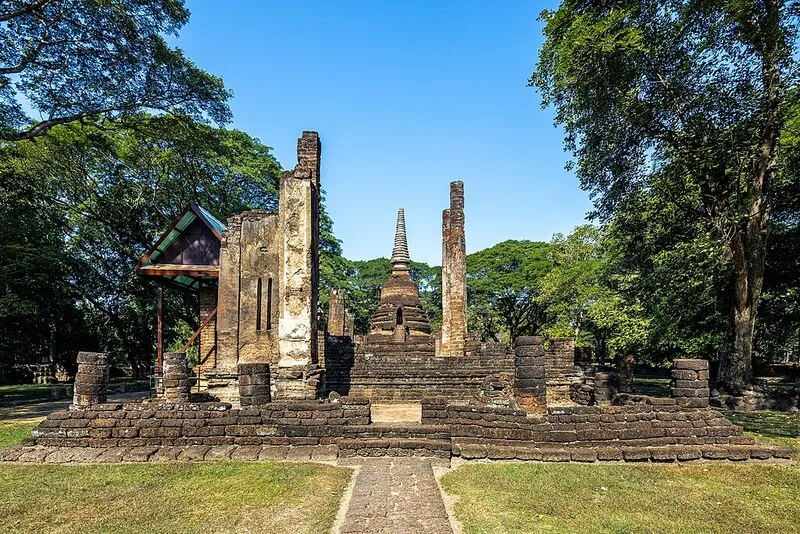
Wat Nang Phaya is one of the most important ancient monuments in Si Satchanalai Historical Park, Sukhothai Province. Located on the eastern side inside the walled ancient city of Si Satchanalai, the temple lies on the same axis as Wat Suan Kaeo Utthayan Yai and Wat Chedi Chet Thaeo. It is especially admired for the stucco decoration that remains on the northwest wall of its viharn. Although centuries have passed, the surviving stucco patterns still reveal the refinement of ancient craftsmanship and make Wat Nang Phaya one of the most artistically significant sites in Si Satchanalai.
Wat Nang Phaya is an ideal place for travelers who want to understand the artistic side of Si Satchanalai in greater depth. The temple is not only important because of its large Sri Lankan-style principal chedi or its ancient viharn layout, but also because it preserves rare decorative evidence from the early Ayutthaya period within the historic city. Its art combines influences from Sukhothai, early Ayutthaya, Lanna, and Chinese-inspired decorative traditions, resulting in a unique visual language that reflects the cultural richness of Si Satchanalai.
The temple’s location inside the ancient city is significant. Wat Nang Phaya is close to major monuments such as Wat Chedi Chet Thaeo, Wat Suan Kaeo Utthayan Yai, and Wat Chang Lom, showing that this area was an important sacred zone of the city. The alignment of major temples reflects careful urban planning and suggests a strong relationship between Buddhism, political authority, ritual space, and the organization of the ancient city.
The history of Wat Nang Phaya is also connected with a local legend. According to a story mentioned in King Rama VI’s royal travel writing “Travel to Mueang Phra Ruang,” a local man named Nai Thian told the king that he had read from a damaged manuscript that the temple was founded by Nang Phasuthewi, a daughter of the King of China who later became a consort of Phra Ruang of Sukhothai. The story is a local legend rather than an archaeologically confirmed account, but it shows how the temple has long been remembered as a place associated with royal women, high status, and the grandeur of ancient Si Satchanalai.
From the perspective of archaeology and art history, Wat Nang Phaya is an important example of Ayutthaya-influenced art in Si Satchanalai. The temple is dated to around the early 21st Buddhist century, after Sukhothai had come under Ayutthaya’s political authority during the reign of King Borommatrailokkanat. This makes the temple a valuable witness to a transitional period when Sukhothai artistic traditions continued while Ayutthaya forms became increasingly visible.
The principal chedi of Wat Nang Phaya is a large Sri Lankan-style chedi built mainly of laterite. It is surrounded by niches around the main structure, creating a dignified and sacred focal point for the temple. The Sri Lankan-style form reflects the importance of Theravada Buddhism and the wider religious connections that shaped the Buddhist world of Sukhothai and Si Satchanalai.
The viharn of Wat Nang Phaya follows a 7-bay layout, a form known in Sukhothai and northern Thai architectural contexts. The viharn has solid walls with light openings and rows of interior columns. This spatial design creates a clear sequence from the front of the temple toward the principal chedi at the rear. The arrangement reflects the way ancient Buddhist architecture guided worshippers through sacred space.
The most celebrated feature of Wat Nang Phaya is the northwest wall of the viharn, where beautiful stucco decoration still survives. The motifs include floral and foliage patterns, deva figures in the wai gesture, lion-leg patterns, pracham yam motifs, rak roi patterns, and lively semi-human, semi-monkey figures. Although parts of the decoration have been lost over time, the surviving details still demonstrate fine artistic skill, movement, rhythm, and imagination.
The stucco decoration at Wat Nang Phaya is more than architectural ornament. It is a visual language expressing Buddhist devotion, abundance, elegance, and artistic creativity. Floral patterns suggest fertility and growth, deva figures represent acts of worship, and decorative geometric motifs reveal a disciplined system of Thai ornament. The animated semi-human, semi-monkey figures add movement and narrative energy to the wall, showing that ancient craftsmen could combine sacred meaning with visual liveliness.
In the past, the stucco decoration would have been more complete than it is today. Because the remaining wall is fragile, a protective roof has been installed to help reduce damage from sun, rain, and environmental exposure. This conservation measure is important because stucco is more vulnerable than brick or laterite. Without continuous protection, these rare artistic details could disappear permanently.
The columns inside the viharn also contain interesting evidence of decorative work. Some still show traces of stucco patterns and unglazed Sangkhalok ceramic pieces used as ornament. This connection between religious architecture and ceramics is especially meaningful in Si Satchanalai, which was one of the most important Sangkhalok production centers in the Sukhothai world. The temple therefore links Buddhist devotion, craft production, and local economy in one site.
The artistic influence of Wat Nang Phaya continues into the present through local handicrafts. The stucco patterns on the temple wall have inspired artisans in Si Satchanalai to adapt them into silver and gold jewelry, especially the well-known “Si Satchanalai ancient gold” designs. Visiting the temple therefore helps travelers understand not only an ancient monument, but also the origin of a living craft tradition that continues to support the local community.
The temple’s artistic character shows a fascinating blend of cultural influences. Sukhothai art contributes grace and balance; early Ayutthaya art appears in the solid-walled viharn and structured stucco ornament; Lanna influence can be seen in some decorative rhythms; and Chinese-inspired elements appear in the movement of certain foliage patterns. This mixture demonstrates that Si Satchanalai was a city open to artistic exchange and capable of transforming outside influences into a local style.
Today, Wat Nang Phaya is an abandoned ancient monument under the care of Si Satchanalai Historical Park, Fine Arts Department. It is not an active monastery and does not have a resident abbot. The historical park authority is responsible for conservation, visitor management, safety, and interpretation. Visitors should not touch the stucco decoration, climb the ruins, lean against ancient walls, or remove any material from the site.
A meaningful visit should begin by observing the overall layout of the temple. Notice the position of the viharn, the principal chedi, the remaining wall, and the relationship between the temple and nearby monuments. Then move slowly toward the stucco wall and examine the details from a respectful distance. Slow observation allows visitors to appreciate how each motif was shaped, arranged, and integrated into the sacred space.
The best time to visit Wat Nang Phaya is in the morning or late afternoon, when the weather is cooler and the light is suitable for viewing the ancient remains. The cool season from November to February is the most comfortable period for walking through the historical park. In November, travelers may also combine a visit with Sukhothai’s Loy Krathong and Candle Festival, making the trip especially rich in cultural atmosphere.
Getting There is most convenient by private car. From Sukhothai city, drive toward Si Satchanalai District, a distance of about 60 km, which usually takes around 1 hour. Then enter Si Satchanalai Historical Park, where signs guide visitors to the monuments. From Sawankhalok District, the journey is shorter. Once inside the park, visitors can walk or cycle between nearby sites such as Wat Chedi Chet Thaeo, Wat Suan Kaeo Utthayan Yai, and Wat Chang Lom.
Travelers without a private car can reach Sukhothai by bus, van, or flight to Sukhothai Airport, then continue by rental car, local transport, or guided service. Since the monuments are spread across the historical park, planning the route in advance is recommended. Cycling is one of the most pleasant ways to explore the old city atmosphere and move between the temples at a relaxed pace.
Wat Nang Phaya fits naturally into a Si Satchanalai itinerary. A recommended route begins at Wat Chang Lom, continues to Wat Chedi Chet Thaeo, then moves to Wat Nang Phaya to study the stucco decoration. After that, visitors can continue to Wat Suan Kaeo Utthayan Yai, Wat Khao Phanom Phloeng, Wat Phra Si Rattana Mahathat Ratchaworawihan, or the Sangkhalok kiln conservation sites. This route connects religion, architecture, city planning, and ceramic production in one cultural journey.
For photography, Wat Nang Phaya offers several beautiful angles: the principal chedi seen through the viharn columns, the surviving stucco wall, the rows of ancient columns, and the temple ruins framed by trees. Photography should be done carefully. Visitors should avoid flash near fragile surfaces, should not lean on the wall, and should never climb ancient bases or structures for a better viewpoint.
Wat Nang Phaya is also an important learning site for anyone interested in the World Heritage landscape of Sukhothai. Si Satchanalai Historical Park forms part of the Historic Town of Sukhothai and Associated Historic Towns. The temple shows that Si Satchanalai was not only a city of large stupas and walls, but also a place of delicate craftsmanship, refined decorative art, and living artistic inspiration.
The value of Wat Nang Phaya continues beyond the ancient past. Its stucco patterns remain a source of inspiration for goldsmiths, silversmiths, and local artisans in Si Satchanalai. Buying Si Satchanalai ancient gold or locally inspired jewelry after visiting the temple can help travelers connect their cultural experience with support for the local creative economy. The site therefore links ancient heritage with contemporary community life.
Visitors should dress respectfully and treat the site with care. Although Wat Nang Phaya is no longer an active monastery, it remains a sacred historical space and a national cultural heritage site. Do not touch the stucco, write on surfaces, climb the ruins, leave rubbish, or move any ancient material. Responsible travel helps preserve the temple’s fragile beauty for future generations.
In summary, Wat Nang Phaya in Sukhothai Province is one of the most important artistic monuments in Si Satchanalai Historical Park. Its highlights include the Sri Lankan-style principal chedi, the 7-bay viharn, masterful stucco decoration, floral and deva motifs, early Ayutthaya artistic influence, and its connection with Si Satchanalai ancient gold craftsmanship. The temple is not only a historic ruin, but also a bridge between ancient art and living local heritage.
| Name | Wat Nang Phaya |
| Location | Si Satchanalai Historical Park, Si Satchanalai District, Sukhothai Province |
| Address | Si Satchanalai Subdistrict, Si Satchanalai District, Sukhothai 64190, Thailand |
| Coordinates | Approximately 17.4286, 99.7889 |
| Highlights | Stucco decoration on the northwest wall of the viharn, Sri Lankan-style principal chedi, 7-bay viharn, decorated ancient columns, and its connection with Si Satchanalai ancient gold craftsmanship |
| History | Early Ayutthaya-period art, around the early 21st Buddhist century, within the ancient city of Si Satchanalai |
| Key Evidence | Sri Lankan-style principal chedi, solid-walled viharn with light openings, stucco decoration, floral motifs, deva figures, lion-leg patterns, pracham yam motifs, rak roi patterns, and traces of Sangkhalok ceramic decoration |
| Name Origin | Associated with the local legend of Nang Phasuthewi, daughter of the King of China and consort of Phra Ruang, as mentioned in “Travel to Mueang Phra Ruang” |
| Distinctive Features | One of the finest surviving stucco-decorated monuments in Si Satchanalai and a source of inspiration for Si Satchanalai ancient gold designs |
| Travel Information | About 60 km from Sukhothai city to Si Satchanalai District, usually around 1 hour by car; visitors can walk or cycle between nearby monuments inside the historical park |
| Current Status | Abandoned ancient monument under the care of Si Satchanalai Historical Park, Fine Arts Department |
| Open Days | Daily |
| Opening Hours | 08.00 – 17.00 |
| Facilities | Walking paths, parking areas, visitor service points, restrooms, and bicycle rental services within Si Satchanalai Historical Park |
| Main Areas / Zones | Principal chedi, 7-bay viharn, northwest stucco wall, ancient columns, viharn base, and nearby ancient monuments within the old city zone |
| Caretaker | Si Satchanalai Historical Park, Fine Arts Department |
| Main Contact Number | 055-950-714, 061-268-6383 |
| Official Website / Official Page | Si Satchanalai Historical Park, Fine Arts Department |
| Nearby Tourist Attractions | 1. Wat Chedi Chet Thaeo, about 0.4 km 2. Wat Chang Lom, about 0.6 km 3. Wat Suan Kaeo Utthayan Yai, about 0.6 km 4. Wat Khao Phanom Phloeng, about 1 km 5. Si Satchanalai Historical Park Visitor Center, about 1 km 6. Wat Phra Si Rattana Mahathat Ratchaworawihan, about 3 km 7. Sangkhalok Kiln Conservation Site No. 61 And 42, about 6 km |
| Nearby Restaurants | 1. ChomPrang, about 3 km, Tel. 063-465-6168, 083-229-9598 2. Thaowali, about 3 km 3. Jeedja Fresh Coffee, about 3 km 4. Kaeng Sak Beer Garden, about 4 km 5. Baan Klang Na Si Satchanalai Restaurant, about 6 km 6. Krua Ton Aoy Si Satchanalai, about 8 km, Tel. 087-208-5526, 098-156-9393 |
| Nearby Accommodations | 1. Sisatchanalai Heritage Resort, about 3 km, Tel. 055-615-423, 086-443-2799, 062-869-6988 2. Resort Ban Phra Ruang Phra Prang Si Satchanalai, about 4 km, Tel. 080-509-7345 3. Nong Or Blue House Resort, about 7 km 4. Downhill Resort, about 10 km 5. Chanalai Resort And Hotel, about 12 km, Tel. 055-672-555 |
Frequently Asked Questions (FAQ)
Q: Where is Wat Nang Phaya located?
A: Wat Nang Phaya is located on the eastern side inside the walled ancient city of Si Satchanalai, within Si Satchanalai Historical Park, Sukhothai Province.
Q: Is Wat Nang Phaya still an active monastery?
A: No. Wat Nang Phaya is an abandoned ancient monument under the care of Si Satchanalai Historical Park, Fine Arts Department, and does not have a resident abbot.
Q: What is the main highlight of Wat Nang Phaya?
A: The main highlight is the surviving stucco decoration on the northwest wall of the viharn, including floral motifs, deva figures, lion-leg patterns, pracham yam motifs, and rak roi patterns.
Q: How is Wat Nang Phaya related to Si Satchanalai ancient gold?
A: The stucco patterns at Wat Nang Phaya inspired local artisans to adapt similar motifs into silver and gold jewelry, especially the famous Si Satchanalai ancient gold designs.
Q: What are the opening hours of Wat Nang Phaya?
A: Si Satchanalai Historical Park is open daily from 08.00 to 17.00.
Q: How long should visitors spend at Wat Nang Phaya?
A: Visitors should allow about 45 minutes to 1 hour for Wat Nang Phaya alone, or at least half a day when visiting nearby temples such as Wat Chedi Chet Thaeo, Wat Chang Lom, and Wat Suan Kaeo Utthayan Yai.
Q: How can visitors travel from Sukhothai city to Wat Nang Phaya?
A: The easiest way is by private car from Sukhothai city to Si Satchanalai District, about 60 km or roughly 1 hour, then enter Si Satchanalai Historical Park.
Q: What nearby attractions can be visited with Wat Nang Phaya?
A: Nearby attractions include Wat Chedi Chet Thaeo, Wat Chang Lom, Wat Suan Kaeo Utthayan Yai, Wat Khao Phanom Phloeng, Wat Phra Si Rattana Mahathat Ratchaworawihan, and the Sangkhalok kiln conservation sites.
 Category: ●Places of Worship
 Group: ●Temple
Last Update : 5 MonthAgo
 Last Update : 5 MonthAgo
 Click to Access the Navigation Map GPS
Wat Nang Phaya Map
Recommend

 Art, Culture and Heritage
 Historical Sites and Monuments(4)
 Landmarks and Memorials(5)
 Art, Craft Centres, Tradition(11)
 Museums(5)
Temple(40)
Museums(5)
Temple(40)
 Other Sacred Sites(10)
 Suburban Living
 Village, Community(3)
 Nature and Wildlife
 National Parks and Marine Reserves(3)
 Mountain (Doi)(2)
 Dam, Reservoir, Lake(4)
 Waterfalls(8)
 Caves(4)
 River, Canal(2)
 Entertainment and Agricultural
 Farms, Parks and Ecotourism(3)
 Travel Articles, Recipes
 Travel Review, Food Review(1)


