

 Home
Home Chiang Mai(




Wat Trapang Thong Lang
Rating: 4.2/5 (5 votes)
 Search By
  Map
Map 
 Have Map
  No Map
Sukhothai attractions
Attractions in Thailand
Opening days: Daily
Opening hours: 08.00 - 17.00
Wat Trapang Thong Lang is located to the east of the Ramkhamhaeng National Museum and stands as an important historical site reflecting the flourishing art and architecture of the Sukhothai period. This temple belongs to the local community of Mueang Kao Subdistrict and still houses resident monks, keeping it alive as a center of religious and cultural life. The most distinctive feature of Wat Trapang Thong is its location on an island in the middle of a pond known as “Trapang Thong.” This island-centered design is a hallmark of Sukhothai-era temples. The surrounding water not only adds beauty and serenity but also symbolizes the sacred separation of the spiritual space from the mundane world, reflecting beliefs about creating temples as a dwelling place for the Buddha and other sacred entities.
At the center of the pond stands a bell-shaped stupa in the Lanna style, with a base made of laterite stone while the upper section and bell neck, though now partially ruined, still show the craftsmanship of the original construction. A large wooden bridge stretches to the island, allowing visitors to approach and pay respects. On the island, a newly constructed pavilion houses a Buddha footprint, serving as a key historical and religious feature. The temple is mentioned in Sukhothai Inscription No. 8 and the Sumankut Stone Inscription, which record that King Maha Thammaracha Lithai ordered the creation of the Buddha footprint in 1459 BE (1902 CE) according to Lankavatta designs. Originally placed on the western mountain of Sukhothai, now called Khao Phra Bat Yai, the footprint was intended to honor Buddhist faith and relics of the Buddha and became a center for the annual worship ceremony that continues to this day.
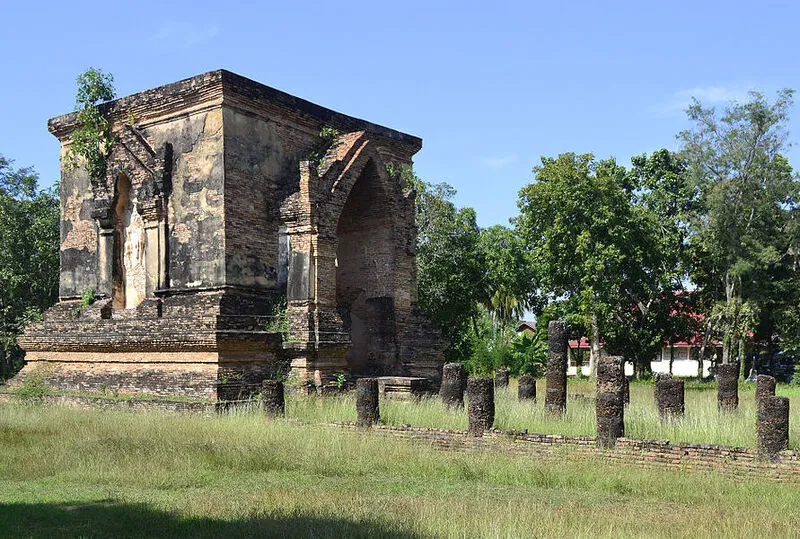
Surrounding the central stupa are eight smaller stupas arranged symbolically, reflecting the careful planning typical of Sukhothai religious architecture. The temple’s ordination hall, or bot, still retains relatively intact walls and roof structures. This preservation is largely due to restoration efforts nearly a century ago, when Phaya Ratchan Chai Chanyut (Krut), the governor of Sukhothai at the time, ordained as a novice monk and raised funds to rebuild the hall atop the foundations of the original Sukhothai-era bot. This blending of old and new architecture maintains the classical aesthetic while integrating it with the historic temple grounds.
Another significant feature of Wat Trapang Thong is the Sukhothai-era Buddha footprint, carved with 108 auspicious symbols. Originally placed on Khao Phra Bat Yai, it was relocated to the temple to allow the public easier access for veneration. The presence of this footprint makes the temple a focal point of faith, blending devotion, belief, and art seamlessly.
Today, Wat Trapang Thong serves not only as a key historical site within the old town community but also as a center for learning about Sukhothai culture and art for tourists and historians alike. Visitors can explore the central stupa, the wooden bridge, the pavilion housing the Buddha footprint, and the surrounding smaller stupas while enjoying the tranquil, natural environment of the pond. The presence of resident monks provides an opportunity for visitors to observe traditional Buddhist rituals, make offerings, and participate in the annual worship of the Buddha footprint, offering a profound understanding of Sukhothai culture and belief systems.
Wat Trapang Thong Lang exemplifies the Sukhothai artistic style and the influence of Lankavatta design, evident from the bell-shaped stupa in the pond to the intricately carved Buddha footprint. The bridge connecting to the island demonstrates a harmonious blend of nature and architecture, allowing visitors to experience the spiritual and aesthetic dimensions of the temple fully. The temple is not only a historical monument reflecting the artistic achievements of the Sukhothai period but also a living center of religious and cultural significance for the Mueang Kao community. Its island location, central Buddha footprint, surrounding stupas, and restored ordination hall make it a place where history, art, faith, and nature converge, providing an immersive experience for those interested in Thai history and Sukhothai culture.
 Wat Trapang Thong Lang Map
 Category:
  Group:
  Tag: ●Wat Trapang Thong Lang●wat trapang thong lang ●sukhothai temple ●ancient temple sukhothai ●bell-shaped stupa ●sukhothai buddha footprint ●trapang thong ●ramkhamhaeng national museum ●old town sukhothai ●sukhothai history ●sukhothai art ●sukhothai architecture ●local community ●sukhothai tourism ●thai culture ●thai religious site Last Update: 6 MonthAgo
Comment
 Nearby Attractions
| Keyword (Advance) |
 Region
|
 Muang Sukhothai(
 Copyright 2012,