
lovethailand home >North Travel Attractions >Phichit Travel Attractions >Muang Phichit >Dong Pa Kham > Wat Khao Rup Chang
TL;DR: Wat Khao Rup Chang is located at Dong Pa Kham Subdistrict, Mueang Phichit District, Phichit Province, open Daily, hours 06.00 – 18.00.
Wat Khao Rup Chang
Open Days: Daily
Opening Hours: 06.00 – 18.00
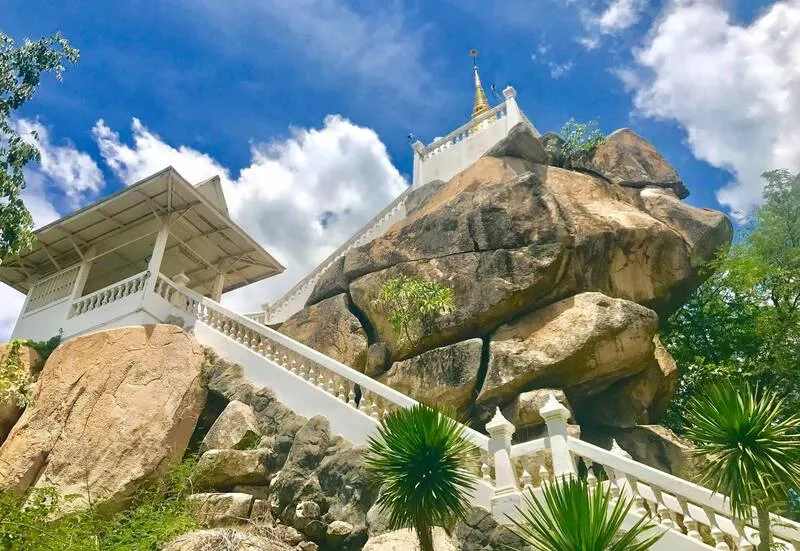
Wat Khao Rup Chang in Phichit Province is an old Buddhist temple located in Dong Pa Kham Subdistrict, Mueang Phichit District, along the Phichit – Taphan Hin route. About 15 kilometers from Phichit town, the temple is one of the province’s most distinctive cultural and scenic attractions. Its name means “the temple of the elephant-shaped hill,” referring to the white rock formations on the hill that appear to resemble an elephant. At the top of the hill stands a golden Lanka-style stupa, reached by a 136-step naga staircase. From the wide hilltop terrace, visitors can enjoy sweeping views over Phichit and toward Taphan Hin, making the temple both a sacred site and a memorable viewpoint.
The temple is historically important because it is associated with the Ayutthaya period. Tourism and local heritage records state that Wat Khao Rup Chang was established in 1701 together with Wat Pho Prathap Chang, during the reign of King Sanphet VIII, also known as King Suea. This connection gives the temple a deeper historical value beyond its scenic appearance. The choice of location also reflects how ancient communities often selected unusual natural formations and elevated landscapes as sacred spaces. A hill with white rocks resembling an elephant would have been visually powerful, spiritually meaningful, and easy to recognize from the surrounding lowland landscape.
The origin of the temple’s name is closely tied to its natural setting. The white rocks on the hill are layered in a way that creates the impression of an elephant, an animal deeply respected in Thai culture. Elephants are associated with strength, royal power, Buddhist symbolism, and auspiciousness. This natural shape became part of the temple’s identity and remains the first thing many visitors remember. In a province mostly known for flat agricultural land, the presence of this white rocky hill makes Wat Khao Rup Chang visually unique.
Climbing the 136-step naga staircase is one of the essential experiences of visiting Wat Khao Rup Chang. The staircase is not only a practical route to the hilltop, but also a symbolic passage into a sacred area. In Thai Buddhist art, naga serpents are often protectors of sacred places and are closely connected with water, fertility, and Buddhist devotion. Walking up the naga staircase therefore feels like moving gradually from the ordinary world toward a higher spiritual space. Although the climb requires some effort, the view from the top rewards visitors with open sky, quiet wind, and a broad perspective over the surrounding area.
At the summit stands the temple’s most recognizable feature: a Lanka-style stupa covered with golden glazed tiles. The present stupa was restored from an older structure and surrounded by a protective fence for safety and order. Its golden surface contrasts beautifully with the white rocks and green vegetation around the hill. In the morning and late afternoon, when the sunlight falls across the tiles, the stupa becomes especially striking. For photographers, this is one of the best visual highlights of the temple.
The Lanka-style stupa reflects Buddhist architectural influence that spread through the region over many centuries. Such stupas are often connected with relic worship, Buddhist merit, and the creation of sacred landmarks. Although the present stupa has been restored, its location and older historical context preserve the sacred meaning of the site. Visitors should see Wat Khao Rup Chang as a layered historical place, where Ayutthaya-period memory, later restoration, local devotion, and contemporary tourism all exist together.
Besides the golden stupa on the hilltop, the temple also preserves an older Lanka-style stupa with an angular indented form. This old structure is believed to date from the Ayutthaya period. Its bell section is decorated in a fluted form resembling starfruit segments, while the upper section has been damaged over time. Rather than reducing its value, this aged condition makes the stupa an important historical witness. Seeing the older stupa together with the restored golden stupa helps visitors understand the continuity of Buddhist faith and temple conservation at Wat Khao Rup Chang.
Another important feature is the old four-sided mondop near the newer ordination hall. Inside the mondop is a bronze Buddha footprint, a sacred object highly respected by worshippers. In Thai Buddhist culture, a Buddha footprint symbolizes the presence and path of the Buddha. It is not simply a decorative object, but a focus for devotion and contemplation. This makes the mondop a meaningful place for visitors who may not be able to climb the hill but still want to pay respect at an important sacred point within the temple grounds.
The walls of the mondop contain mural paintings on the theme of Traiphum Phra Ruang, a traditional Thai Buddhist cosmology describing the three realms of existence. These murals are valuable as religious art and as visual teaching tools. In earlier times, murals helped explain moral lessons, karma, heaven, hell, and the Buddhist view of the universe to people who might not have learned through written texts. The paintings at Wat Khao Rup Chang therefore preserve not only artistic beauty, but also an older method of religious education.
For visitors interested in Thai culture, Wat Khao Rup Chang should be explored slowly. The hilltop stupa is the most famous feature, but the lower temple area also contains important cultural elements such as the mondop, the Buddha footprint, mural paintings, and old stupa remains. Together, these features make the temple more than a viewpoint. It is a place where natural landscape, Buddhist architecture, local belief, and historical memory are woven into one coherent experience.
The hilltop is also a popular viewpoint. From the open terrace, visitors can see the surrounding countryside, local roads, villages, fields, and the direction of Taphan Hin. The view is especially pleasant in the late afternoon when the weather is cooler and the golden stupa catches the evening light. For travelers who enjoy photography, the temple offers a combination of architecture, landscape, religious detail, and natural atmosphere.
Wat Khao Rup Chang is also suitable for quiet merit-making and meditation. The upper area provides a peaceful setting for reflection, while the lower temple grounds allow visitors to make offerings, pay respect, and rest under shaded spaces. Some visitors come mainly for the climb and the view; others come for religious devotion, historical interest, or photography. This flexibility makes the temple suitable for families, cultural travelers, pilgrims, and foreign visitors seeking a quieter side of Phichit.
The temple is also connected with Buddhist festival traditions. Local accounts mention merit-making activities during important Buddhist days, especially around Makha Bucha, when the hilltop and temple grounds become part of the religious atmosphere. Such traditions show how the natural geography of the temple is integrated into community religious life. The hill, the staircase, the stupa, and the temple grounds are not separate features; they work together as a sacred cultural landscape.
Travelers interested in history can combine Wat Khao Rup Chang with nearby sites such as Wat Pho Prathap Chang, Wat Hua Dong, Wat Tha Luang Royal Monastery, Bueng Si Fai, Wang Krot Old Market, and Hua Dong Railway Station. This route offers a balanced view of Phichit, including Ayutthaya-period history, sacred temples, local rail heritage, riverside culture, and quiet provincial scenery. For a half-day trip, the temple can be combined with Wat Hua Dong and nearby restaurants. For a full-day itinerary, visitors can continue to Phichit town or Taphan Hin.
Visitors should prepare comfortable walking shoes, drinking water, sun protection, and modest clothing suitable for a Buddhist temple. The 136-step climb is manageable for many visitors, but elderly travelers or those with knee problems should assess their condition before going up. The lower temple area still offers meaningful sacred spaces for those who prefer not to climb. During or after rain, visitors should take extra care on the stairs and around the rocky areas.
Respectful conduct is important. Visitors should speak quietly, avoid climbing on rocks or restricted areas, avoid touching old murals or sacred objects unnecessarily, and keep the temple clean. Photography is welcome in appropriate areas, but poses should remain respectful, especially around the stupa, mondop, Buddha footprint, and worship areas. Visiting carefully helps preserve the beauty and cultural value of the temple for future generations.
Getting There is convenient from Phichit town. Travelers can drive along the Phichit – Taphan Hin route toward Dong Pa Kham Subdistrict for about 15 kilometers. Private car or rental car is the easiest option. Train travelers can get off at Phichit Railway Station or Hua Dong Railway Station and continue by local transport. Because the temple lies close to the main route, it is a convenient stop between Phichit and Taphan Hin.
Overall, Wat Khao Rup Chang is one of the most rewarding cultural attractions in Phichit Province. It combines Ayutthaya-period history, a Lanka-style stupa, white elephant-shaped rocks, a 136-step naga staircase, panoramic views, an old mondop, a bronze Buddha footprint, and Traiphum Phra Ruang murals. A visit here offers worship, cultural learning, photography, and peaceful nature in one trip. For foreign travelers seeking a quiet but meaningful temple experience in Thailand, Wat Khao Rup Chang is well worth including in a Phichit itinerary.
| Name | Wat Khao Rup Chang |
| Location | Dong Pa Kham Subdistrict, Mueang Phichit District, Phichit Province |
| Address | Village No. 1, Dong Pa Kham Subdistrict, Mueang Phichit District, Phichit 66170 |
| Highlights | Golden Lanka-style stupa on an elephant-shaped white rock hill, 136-step naga staircase, and panoramic views of Phichit and Taphan Hin |
| History | Established in 1701 during the Ayutthaya period, together with Wat Pho Prathap Chang; the temple also preserves an old Lanka-style stupa believed to date from the Ayutthaya period |
| Name Origin | The name comes from the white rock formations on the hill, which appear to resemble an elephant |
| Distinctive Features | Hilltop temple with white rocks, a golden stupa, viewpoint, naga staircase, old mondop, and historic Buddhist art |
| Key Sacred Objects | Hilltop Lanka-style stupa, old indented Lanka-style stupa, four-sided mondop, bronze Buddha footprint, and Traiphum Phra Ruang murals |
| Travel Information | Drive from Phichit town along the Phichit – Taphan Hin route to Dong Pa Kham Subdistrict, about 15 km; train travelers can continue from Phichit Railway Station or Hua Dong Railway Station by local transport |
| Current Status | Open as a Buddhist temple, cultural-historical attraction, and scenic viewpoint in Phichit Province |
| Open Days | Daily |
| Opening Hours | 06.00 – 18.00 |
| Fees | No admission fee |
| Facilities | Temple grounds, parking area, staircase to the hilltop, viewpoint, merit-making area, and worship area inside the mondop |
| Caretaker / Temple Contact | Wat Khao Rup Chang Temple Office |
| Main Contact Number | 083-210-5437 |
| Nearby Tourist Attractions | 1. Hua Dong Railway Station, about 3 km 2. Wat Hua Dong Phichit, about 3 km 3. Wat Pho Prathap Chang, about 9 km 4. Wang Krot Old Market, about 9 km 5. Wang Krot Railway Station, about 9 km 6. Bueng Si Fai, about 13 km 7. Wat Tha Luang Royal Monastery, about 15 km |
| Nearby Restaurants | 1. Pramern Chinese Restaurant, about 1 km, Tel. 087-840-3901 2. Ruea Noodle Mueang Chalawan, about 3 km 3. Thung Satang Hua Dong, about 5 km, Tel. 082-406-8165 4. Tiaw Pinto Tai Ha, Wang Krot Old Area, about 9 km, Tel. 082-603-5018 5. Pa Lang Traditional Noodle Shop, Wang Krot, about 9 km, Tel. 088-619-9548 6. Chim Hong Cafe, about 9 km, Tel. 097-216-2389 |
| Nearby Accommodations | 1. Ban Kiang Tawan Resort Phichit, about 7 km 2. The Moon 1988 Resort, about 11 km 3. New Hua Hin, about 11 km 4. Rose Inn Hotel Taphan Hin, about 12 km, Tel. 056-621-044, 091-024-5747, 093-140-8168 5. Rabeang Nam Resort, about 13 km, Tel. 081-859-4907 6. Fahluang Residence, about 13 km, Tel. 056-611780 |
Frequently Asked Questions (FAQ)
Q: Where is Wat Khao Rup Chang located?
A: Wat Khao Rup Chang is located in Dong Pa Kham Subdistrict, Mueang Phichit District, Phichit Province, along the Phichit – Taphan Hin route, about 15 km from Phichit town.
Q: What is Wat Khao Rup Chang famous for?
A: It is famous for its golden Lanka-style stupa on a white rock hill that resembles an elephant, a 136-step naga staircase, a viewpoint, an old mondop, a bronze Buddha footprint, and Traiphum Phra Ruang murals.
Q: How many steps lead to the hilltop of Wat Khao Rup Chang?
A: Visitors climb a 136-step naga staircase to reach the hilltop terrace and viewpoint.
Q: What are the opening hours of Wat Khao Rup Chang?
A: Wat Khao Rup Chang is open daily from 06.00 to 18.00.
Q: Is there an admission fee for Wat Khao Rup Chang?
A: No. Visitors can enter the temple, pay respect, climb to the viewpoint, and explore the temple grounds without an admission fee.
Q: Who should visit Wat Khao Rup Chang?
A: The temple is suitable for Buddhist pilgrims, cultural travelers, history lovers, photographers, viewpoint seekers, and visitors looking for a peaceful temple experience in Phichit.
Q: What nearby attractions can be visited with Wat Khao Rup Chang?
A: Nearby attractions include Wat Hua Dong, Wat Pho Prathap Chang, Wang Krot Old Market, Wang Krot Railway Station, Bueng Si Fai, and Wat Tha Luang Royal Monastery.
 Category: ●Places of Worship
 Group: ●Temple
Last Update : 5 MonthAgo
 Last Update : 5 MonthAgo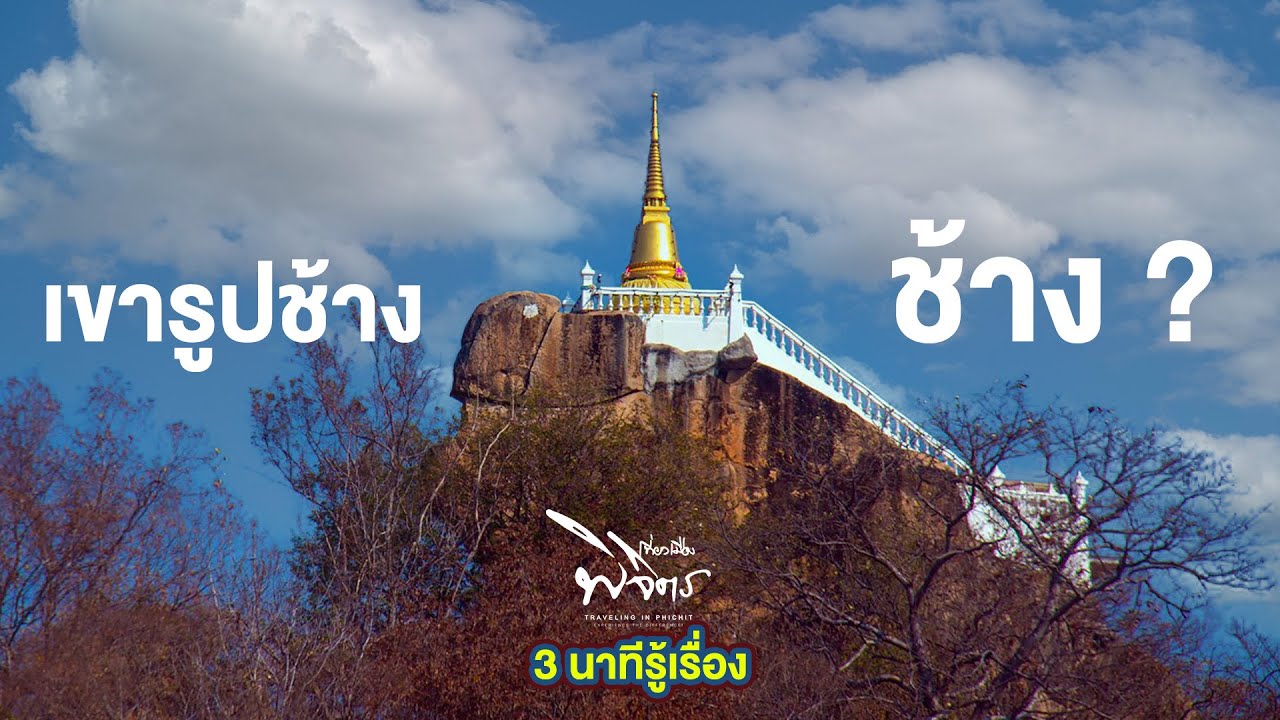
 Click to Access the Navigation Map GPS
Wat Khao Rup Chang Map
Recommend

 Art, Culture and Heritage
 Historical Sites and Monuments(1)
 Art, Craft Centres, Tradition(1)
 Museums(1)
Temple(32)
Museums(1)
Temple(32)
 Other Sacred Sites(5)
 Research and Development
 Royal Project(1)
 Suburban Living
 Floating Market(1)
 Nature and Wildlife
 National Parks and Marine Reserves(1)
 Dam, Reservoir, Lake(3)
 River, Canal(2)
 Other natural attractions(1)
 Entertainment and Agricultural
 Animal camps and shows(1)
 Farms, Parks and Ecotourism(4)
 Travel Articles, Recipes
 Travel Review, Food Review(1)


