

 Home
Home Chiang Mai(




























Wat Phra That Tluk Hin
Rating: 2.8/5 (19 votes)
 Search By
  Map
Map 
 Have Map
  No Map
Phichit attractions
Attractions in Thailand
Opening days: Daily
Opening hours: 08.00 - 17.00
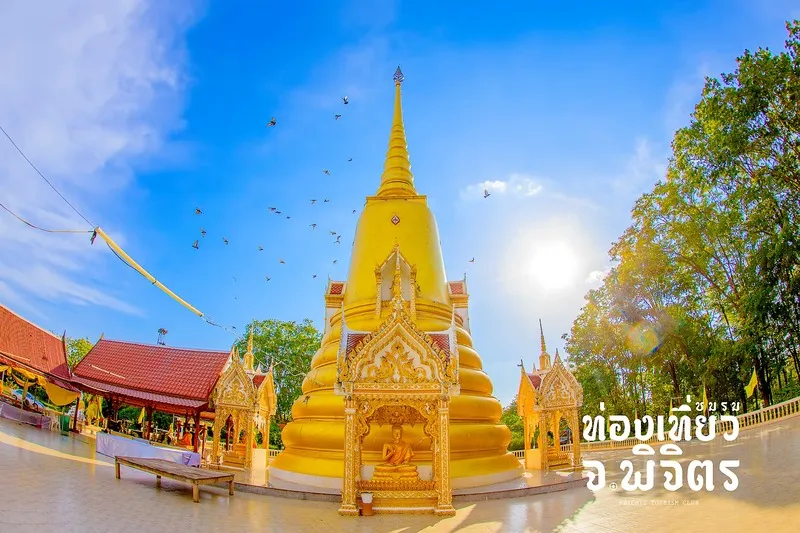
Wat Phra That Taluk Hin in Phichit Province is one of the significant religious sites for the local community and devout Buddhists. The history of this temple is closely tied to the construction of its main stupa, which was created with the dedication and faith of monks and villagers. The temple was officially registered, and the foundation stone was laid in mid-December 1996. Construction took one year, and the stupa was completed in early 1998. Subsequently, a ceremony was held to enshrine the sacred relics of the Buddha along with other sacred items, and the golden umbrella (Suvarnachat) was raised on March 9, 1998, which coincided with the 9th day of the waxing moon in the 4th lunar month. On the same day, a grand Buddhist consecration ceremony (Mahā Pūjā) was also performed to sanctify the stupa.
In 2000, a grand celebration was held to mark the completion of the stupa’s decoration. The celebration began on March 5, coinciding with the 1st day of the waxing moon in the 4th lunar month, and continued until March 14, lasting a total of ten days. During this period, monks performed intensive meditation retreats while laypeople participated in temporary ordination and practiced meditation, offering large-scale Sangha Dana to 500 monks. The ceremonies also included a grand Buddhist consecration and the offering of 84,000 forest robes (Pha Pa) for merit-making. The event highlighted the unity and faith of the community in their devotion to Buddhism.
The establishment of this stupa originated from the efforts of Luang Pho Sangwian Chintharo, the current abbot of Wat Phra That Taluk Hin. He was a disciple of Wat Ketum and came to reside at Taluk Hin in mid-1994, after being invited by villagers to continue the construction of a temple that had been stalled for three years. With determination and community support, he completed the temple and conducted the sacred ceremony of covering the interior with gold and embedding boundary stones. Luang Pho Sangwian then received the Buddha’s relics from Luang Pho Phra Kru Phawanaworakun, the abbot of Wat Ketum, which had been preserved by his own teacher, Phor Bandun Sing Borom Bodhisattva.
These sacred relics were originally intended to be enshrined in a stupa in the United States, but the plan could not be realized due to the passing of the teacher. He therefore entrusted the relics to Luang Pho Sangwian with the instruction that if an opportunity arose to construct a stupa anywhere, the relics should be enshrined together with sacred soil from important sites related to the life of the Buddha: the place of his birth, enlightenment, first teaching (Dhammacakkappavattana), and parinirvana. In addition, soil was collected from incense pots of major temples across Thailand, from the northern bedroom of His Majesty the King, and from city centers worldwide. These relics and soil had been preserved since 1968 by Wat Ketum for future enshrinement in a stupa.
When Luang Pho Sangwian had the opportunity to build the stupa at Taluk Hin, he invited disciples and local villagers to participate in the construction, which resulted in a magnificent and sacred stupa. Its distinctive architectural features and symbolic significance not only make it a spiritual center for Phichit residents but also a place of reverence for Buddhists from across the country.
The construction of Wat Phra That Taluk Hin’s stupa serves as a testament to the power of faith, uniting the community to create something enduring. It functions as a religious site, a meditation center, and a cultural learning place that embodies the profound devotion within Buddhism. Today, the stupa stands proudly as a spiritual anchor and an important cultural and tourist attraction in Phichit Province.
 Wat Phra That Tluk Hin Map
 Category:
  Group:
  Tag: ●Wat Phra That Tluk Hin●wat phra that taluk hin ●phra borom that chedi ●buddha relics ●luang pho sangwian chintharo ●phichit temple ●meditation center ●stupa celebration ●maha puja ceremony ●forest robe offering ●center of faith Last Update: 6 MonthAgo
Comment
 Nearby Attractions
| Keyword (Advance) |
 Facebook Fanpage
 Region
 Art, Culture and Heritage
 Historical Sites and Monuments(
 Art, Craft Centres, Tradition(
 Museums(
 Other religious and spiritural sites(
 Research and Development
 Royal Project(
 Suburban Living
 Floating Market(
 Nature and Wildlife
 National Parks and Marine Reserves(
 Dam, Reservoir, Lake(
 River, Canal(
 Other natural attractions(
 Entertainment and Agricultural
 Animal camps and shows(
 Farm, Parks, Gardens and Ecotourism(
 Copyright 2012,