
lovethailand home >Central Travel Attractions >Nonthaburi Travel Attractions >Muang Nonthaburi >Bang Khen > Museum and Training Center of Thai Traditional Med..
TL;DR: Museum and Training Center of Thai Traditional Medicine is located at Within the Ministry of Public Health compound, Talat Khwan Subdistrict, Mueang Nonthaburi District, Nonthaburi, open Monday - Friday, hours 08.30 – 16.30.
Museum and Training Center of Thai Traditional Medicine
Open Days: Monday - Friday
Opening Hours: 08.30 – 16.30
The Museum and Training Center of Thai Traditional Medicine, Nonthaburi Province is an important learning center under the Department of Thai Traditional and Alternative Medicine, Ministry of Public Health. It is located on Tiwanon Road within the Ministry of Public Health complex in Mueang Nonthaburi District, Nonthaburi Province. What makes this place stand out is that it functions as far more than an ordinary museum. It does not merely collect and display knowledge of Thai traditional medicine, but also connects history, local wisdom, medicinal herbs, Thai massage, Thai food, and holistic health care with their practical role in daily life. Visitors therefore gain not only historical knowledge, but also a broader understanding of Thai traditional medicine as a way of life, a belief system, a cultural inheritance, and an intellectual tradition that continues into the present day.
If you are wondering whether the Thai traditional medicine museum in Nonthaburi is worth visiting, the answer is yes. It is especially suitable for those interested in the history of Thai medicine, students of herbal medicine and Thai massage, cultural travelers, and anyone who wants to see how Thai wisdom has been adapted into a structured health system. Inside the building, the exhibitions range from foundational beliefs and philosophical roots to the development of Thai traditional medicine through different historical periods. There are also service and activity areas that demonstrate how this knowledge is applied in real life, including a health food restaurant, a natural products shop, Thai traditional medicine service rooms, and extensive herbal gardens surrounding the building.
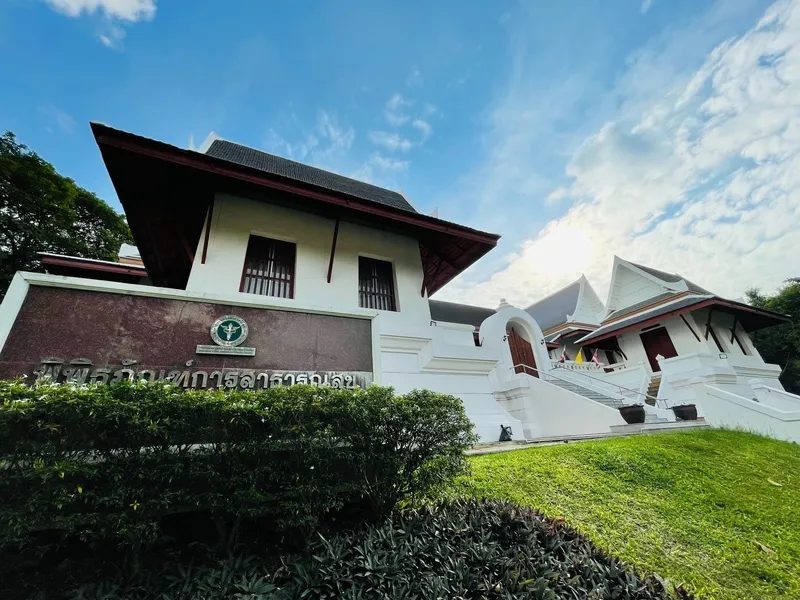
The museum building itself consists of 9 traditional Thai masonry-style structures designed by Professor Dr. Pinyo Suwankiri, National Artist in Visual Arts. The design gives the complex a distinctive identity from the first glance. Although it stands within a modern government compound, it conveys the grace and harmony of Thai architectural aesthetics. The beauty of the building is not merely external. It also reflects the museum’s central idea that Thai traditional medicine cannot be separated from the roots of Thai culture, but has grown alongside religion, community life, traditional beliefs, and local wisdom.
The building is divided into 3 levels: the basement, the first floor, and the second floor. The second floor is the heart of the museum, housing the permanent exhibition galleries on the origins and evolution of Thai traditional medicine. On this level, 7 exhibition rooms guide visitors step by step toward an understanding that Thai traditional medicine is not limited to herbal remedies or massage alone. It also embraces worldviews, systems of thought, and the lifestyles of people in different regions of Thailand.
Room 1 is the Hall of Bhaisajyaguru Vaiduryaprabha, which presents the relationship between Buddhism and Thai traditional medicine, a concept sometimes described as Buddhist medical philosophy. This room helps visitors understand that healing in traditional Thai society was never only about the body. It was also connected with the mind, faith, and the idea of maintaining balance in life. Beginning the museum journey in this room is meaningful because it lays the foundation for understanding that Thai traditional medicine emerged from a deep and comprehensive system of thought, far beyond the treatment of physical illness alone.
Room 2 is the Hall of Teachers of Thai Traditional Medicine, which reflects the teacher-honoring ceremony and the Thai belief in respecting one’s lineage of knowledge. This room is particularly important for anyone wishing to understand why Thai traditional medicine places such value on teachers, masters, and the ceremonial transmission of knowledge. In the past, medical knowledge was not seen as something that could simply be read from a book and applied immediately. It was a discipline that required training, respect, discipline, and moral conduct. This part of the museum therefore adds a strong cultural dimension to the visitor experience.
Room 3 is the Gallery of the Evolution of Thai Traditional Medicine from the Past to the Present, one of the most compelling parts of the museum. It traces the development of Thai traditional medicine from the pre-Sukhothai period through Ayutthaya, Thonburi, and the Rattanakosin era, from the reign of King Rama I to the present reign. This room helps visitors see the historical journey of Thai medical knowledge in a clear sequence. Thai medicine was never static. It adapted, shifted in role, and was revitalized in different periods. In some eras, it was rooted in folk wisdom. In others, it was compiled into formal texts. Later, it was incorporated into the national public health system. This makes the room especially valuable for those who wish to understand the larger historical context of Thai traditional medicine in Thai history.
Room 4 is the Hall of Thai Wisdom, which presents the knowledge of folk healers from all 4 regions of Thailand. This gallery clearly demonstrates the diversity of local healing traditions. Although all of them are grouped under the broad label of Thai traditional medicine, each region has its own methods, herbal uses, medicinal formulas, and ways of caring for health according to local geography, natural resources, and lifestyle. This room is therefore especially valuable from a cultural perspective because it shows that Thai health knowledge is not a single uniform system, but rather a network of local wisdom traditions rooted in their own communities.
Room 5 is the Thai Massage Room, which presents the history of Thai massage along with various massage tools and equipment. This area is especially interesting for visitors who want to understand Thai massage as both a cultural heritage and a contemporary profession. It shows that massage is not simply a relaxation service, but a structured body of knowledge with its own principles concerning energy lines, pressure techniques, stretching, and restoring bodily balance. The display of tools and historical information also helps visitors understand why Thai massage has gained recognition both in Thailand and internationally.
Room 6 is the Thai Food Room, one of the exhibitions that broadens the visitor’s perspective in a particularly effective way. It demonstrates that Thai traditional medicine is closely tied to everyday eating habits. The room presents the food culture of the 4 regions of Thailand according to the seasons and the body’s elemental balance. It shows that the way Thai people traditionally chose their food was deeply connected with health and well-being. Food was never only about taste. It was also a means of maintaining bodily balance according to traditional wisdom. This room is especially meaningful for modern readers and visitors interested in healthy eating, as it reveals that such ideas have long existed within Thai culture.
Room 7 is the Medicine Room, which presents the 4 main principles of preparing medicine, medicinal ingredients, and various categories of Thai herbal remedies. This is another important space that allows visitors to grasp the complexity of Thai traditional medicine in a very tangible way. It covers raw ingredients, methods of preparing medicine, understanding the properties of different plants, and the systematic use of herbs in medicinal formulas. Seeing the materials and herbs in person turns names that many people may only know vaguely into something vivid and much easier to understand.
Beyond the museum galleries on the second floor, the first floor connects the exhibition world with practical contemporary use in an especially interesting way. It includes a health food restaurant and a natural products shop selling items such as herbal inhalers, balms, lozenges, soaps, and shampoos. Visitors therefore do not simply walk through the exhibitions and leave. They can also select products related to herbal health and wellness to take home, making the visit more continuous, practical, and relevant to everyday life.
Within the same area there are also health service spaces, including the Thai Traditional Medicine Health Promotion Center, Thai traditional medical treatment rooms, herbal steam rooms, and massage rooms. These facilities make it clear that this place is not merely a museum in the static sense, but a center that combines education, service, and professional development. Anyone interested in this field can immediately see that the knowledge displayed in the museum is still alive and continues to be applied in Thailand’s health care system.
Massage services in the complex require membership registration in advance. Available services include therapeutic massage, health massage, foot massage, herbal compress treatment, and herbal steam therapy. Published service fees include 200 baht for therapeutic and health massage, 150 baht for foot massage, 150 baht for herbal compress treatment, and 100 baht for herbal steam therapy. These services provide another dimension to the place, showing that Thai traditional medicine here can be experienced not only as an exhibition subject but also through practical wellness services.
The basement contains meeting rooms, a library, and a book center for various development projects. This expands the role of the site from a museum to a comprehensive knowledge hub. Those who wish to pursue deeper academic study or conduct serious research on Thai traditional medicine can view this site as both an educational attraction and a starting point for further learning.
One of the most distinctive highlights outside the main building is Khao Mo, a landscaped artificial hill modeled after that of Wat Pho. On this hill, 25 life-sized statues of hermit stretching poses are displayed, accompanied by various medicinal herbs planted throughout the area. This section allows visitors to experience Thai wisdom in a more vivid and accessible form. Rather than viewing only text panels or illustrations, they can see the actual postures, the landscape arrangement, and the connection between physical health, herbs, and self-care.
Inside Khao Mo is the Hermit Cave, or the Cave of Thai Traditional Medicine Masters, an air-conditioned chamber containing Buddha images and hermit statues in various stretching postures. The atmosphere here differs from the indoor exhibition rooms, giving visitors the feeling of entering a world of traditional self-discipline and Thai healing wisdom. Around Khao Mo are many medicinal plants, some of which are equipped with an audio information system. When a button is pressed, the plant can provide spoken details about itself, adding an engaging interactive element and making herbal learning more enjoyable.
The entire area around the building is surrounded by herbal gardens containing thousands of plant species. This gives the site the character of a museum, a medicinal botanical garden, and a health learning center all at once. Visitors walking through the outdoor areas can enjoy a calm atmosphere and a broader dimension of learning beyond the museum galleries. These herbal gardens are highly valuable for the study of medicinal plants and reinforce the site’s role as a center where theoretical knowledge is connected to the real natural environment.
The grounds also include food stalls serving dishes made from herbal vegetables, shops selling pesticide-free produce, and herbal medicine shops. This makes the visit a more comprehensive experience. Visitors interested in health can tour the museum, learn about Thai seasonal food culture, and then continue by purchasing herbal products or healthy foods in the same place. This is one of the museum’s greatest strengths, setting it apart from many cultural attractions because of its direct connection to everyday living.
For those interested in further study on a professional level, the site also plays a role in training through the Institute of Thai Traditional Medicine Health Promotion. Students can apply for a variety of courses, including body massage and foot massage, and successful participants receive certificates endorsed by the Ministry of Public Health. This means the Museum and Training Center of Thai Traditional Medicine does more than preserve and present knowledge. It also helps develop skilled practitioners and supports real career pathways. It is therefore suitable for visitors, students, and people looking for professional opportunities in the field of alternative and traditional health care.
From the perspective of cultural tourism, the museum stands out because it can answer several common visitor questions at once, such as “Where is the Thai traditional medicine museum in Nonthaburi?” “Where can I visit a herb museum near Bangkok?” “What is an interesting place to learn about Thai massage in Nonthaburi?” or “What can I see at the Ministry of Public Health in Nonthaburi?” Because it is both a museum, a learning center, and a service space in one location, it is very suitable for a half-day or full-day visit, especially for students, people interested in Thai medicine, or families wanting to introduce children to something educational and meaningful beyond the usual shopping destinations.
What gives this place even greater meaning is the way it represents the revival of Thai wisdom within the contemporary public health system. As visitors move from the exhibition on Buddhist medical philosophy to the galleries on historical development, regional healing knowledge, Thai massage, Thai food, and medicine, they can clearly see that Thai traditional medicine belongs not only to the past. It is also a body of knowledge that has been reinterpreted and applied in the modern world in very concrete ways, including health services, education, research, products, and educational tourism.
In terms of institutional history, the museum building is closely associated with the development of Thai traditional medicine within the Ministry of Public Health. It has also been referred to as one of the important buildings supporting the mission of the Department of Thai Traditional and Alternative Medicine during the early period of the department’s establishment. For that reason, the building itself carries institutional significance. It is not merely a shell for exhibitions, but part of the history of integrating Thai traditional medicine more visibly into Thailand’s health system.
Visitors who appreciate Thai architecture are often particularly impressed by the atmosphere created by the 9 traditional masonry-style Thai buildings arranged in a graceful composition. The exterior feels dignified and serene, while the interior is filled with stories of life, belief, health, and Thai wisdom. Exploring the architecture and surrounding landscape is therefore not only an educational experience, but also an aesthetic one, especially for those interested in contemporary interpretations of Thai architectural design and the work of Professor Dr. Pinyo Suwankiri.
Getting There is relatively convenient for visitors coming from Bangkok or surrounding parts of Nonthaburi. The museum is located within the Ministry of Public Health compound on Tiwanon Road in Mueang Nonthaburi District. Those driving can access it easily via Tiwanon Road or nearby connecting roads such as Ngamwongwan Road. Earlier published information states that Bus No. 97 can be used to reach the museum. In addition, the Ministry of Public Health area is now in a zone that is easier to access from the MRT Purple Line, making a visit more convenient than in the past. Once there, visitors should allow at least 1.5 to 2 hours for the museum itself. Those who want to explore the exhibition rooms in detail, walk around Khao Mo and the herbal gardens, and stop for healthy food or products should plan for a half-day visit.
Visitors planning to enter the museum should note that advance coordination or an official request letter is required at least 1 week before the visit. Published opening times indicate that the museum is open Monday to Friday from 08.30 to 16.30 and closed on weekends. Advance planning is therefore important, especially for school groups, university groups, or study visits, as it helps ensure smoother coordination and a more effective experience.
As for admission fees, published information states that the entrance fee is 30 baht for Thai adults, 15 baht for children, 10 baht for students in uniform, and 150 baht for foreign visitors. These rates are very accessible considering the depth of knowledge available on site. This is especially true because the museum is not only a specialized institution, but also a place that helps visitors understand Thai holistic health wisdom in a broad and meaningful way.
Those wishing to ask for more details about museum visits, training programs, or related activities can contact the responsible units directly. Published contact numbers for the museum include 0 2590 2600 and 0 2590 2606, while some training-related inquiries are directed to 0 2591 0598-9. These details reinforce the fact that the site continues to operate as a real learning and service center rather than a purely static exhibition venue.
Overall, the Museum and Training Center of Thai Traditional Medicine in Nonthaburi is a place that brings together history, culture, local wisdom, and the practical application of Thai traditional medicine within a single site. Visitors can learn about religious and philosophical foundations, historical development, regional folk wisdom, Thai massage, seasonal Thai food, herbal medicine, medicinal preparation, and the modern application of traditional knowledge within Thailand’s health system. It is therefore one of the most distinctive cultural and wellness learning destinations in Nonthaburi.
For travelers looking for an educational attraction near Bangkok with a calm and green atmosphere, this place is a strong choice. It combines Thai architecture, herbal gardens, multi-dimensional exhibitions, and Thai health knowledge within a manageable distance from the capital. For professionals and researchers in tourism, culture, health, or education, it also offers a valuable case study showing how Thai wisdom can be preserved while also supporting public services, training, and wider social benefit.
From the perspective of today’s travelers who often search for attractions with practical visitor information, the Museum and Training Center of Thai Traditional Medicine stands out because it offers more than static displays. Visitors can experience the past, the present, and the continued development of Thai traditional medicine in Thai society. If you are planning an enriching trip in Nonthaburi or looking for a destination that connects Thai history with health and everyday life, this museum deserves a place on your itinerary.
| Name | The Museum and Training Center of Thai Traditional Medicine |
| Location | Within the Ministry of Public Health compound, Talat Khwan Subdistrict, Mueang Nonthaburi District, Nonthaburi |
| Address | Museum and Training Center of Thai Traditional Medicine Building, Department of Thai Traditional and Alternative Medicine, 88/23 Moo 4, Tiwanon Road, Talat Khwan Subdistrict, Mueang Nonthaburi District, Nonthaburi 11000 |
| Highlights | 9 traditional Thai masonry-style buildings, 7 Thai traditional medicine exhibition rooms, Khao Mo modeled after Wat Pho, 25 hermit stretching poses, and extensive herbal gardens with thousands of species |
| History | Developed as a learning and training center for Thai traditional medicine under the Ministry of Public Health, with a role linking museum work, public services, and education in Thai traditional medicine |
| Architect | Professor Dr. Pinyo Suwankiri, National Artist in Visual Arts |
| Distinctive Features | A museum, training center, Thai health service area, health food venue, herbal product shop, and herbal garden all in one place |
| Main Zones | Second floor with 7 exhibition rooms, first floor with health food and Thai traditional medicine services, basement with meeting rooms and library, and outdoor Khao Mo, Hermit Cave, and herbal gardens |
| Getting There | Accessible by car via Tiwanon Road within the Ministry of Public Health compound in Mueang Nonthaburi. Earlier published information states that Bus No. 97 can be used. Visitors should allow at least 1.5-2 hours for the visit. |
| Current Status | Open for visits with advance coordination |
| Open Days | Monday - Friday |
| Opening Hours | 08.30 – 16.30 |
| Admission Fee | Thai adults 30 baht, children 15 baht, students in uniform 10 baht, foreign visitors 150 baht |
| Facilities | Health food restaurant, herbal products shop, Thai traditional medicine treatment rooms, herbal steam rooms, massage rooms, library, meeting rooms, and herbal gardens |
| Main Contact Numbers | 0 2590 2600, 0 2590 2606 |
| Training Program Contact | 0 2591 0598-9 |
| 1. Nearby Attractions | 1) Makut Rommayasaran Park – 2 km 2) Pantip Plaza Ngamwongwan – 2 km 3) The Mall Ngamwongwan – 3 km 4) Nonthaburi Provincial Museum – 3 km 5) Wat Bua Khwan, Royal Monastery – 3 km |
| 2. Popular Restaurants Nearby | 1) Artisan Dining – 2 km. Tel. 064 264 6332 2) Nueaแท้ The Nine Center Tiwanon – 4 km. Tel. 061 889 7008 3) Chef Thanom The Nine Center Tiwanon – 4 km. Tel. 061 849 6622 4) Tanabe Izakaya The Nine Center Tiwanon – 4 km. Tel. 093 350 9444 5) The Annyeong BBQ The Nine Center Tiwanon – 4 km. Tel. 02 056 8334 |
| 3. Popular Accommodations Nearby | 1) Oakwood Suites Tiwanon Bangkok – 3 km. Tel. 02 149 9450 2) Mida Hotel Ngamwongwan – 3 km. Tel. 02 591 7227 3) Grand Richmond Stylish Convention Hotel – 4 km. Tel. 02 831 8888 4) Nonthaburi Palace Hotel – 5 km. Tel. 02 969 0160 5) Regent Ngamwongwan Hotel – 4 km. Tel. 02 952 7360 |
Frequently Asked Questions
Q: Where is the Museum and Training Center of Thai Traditional Medicine located?
A: It is located within the Ministry of Public Health compound on Tiwanon Road, Talat Khwan Subdistrict, Mueang Nonthaburi District, Nonthaburi Province.
Q: What days and hours is the museum open?
A: It is open Monday to Friday from 08.30 to 16.30, and advance coordination is recommended before visiting.
Q: Is an advance request letter required before visiting?
A: Published visitor information states that advance coordination or a formal request should be made at least 1 week before the visit, especially for group visits.
Q: What can visitors see inside the museum?
A: The museum includes 7 exhibition rooms covering Buddhist medical philosophy, teacher-honoring traditions, the evolution of Thai traditional medicine, regional healing wisdom from the 4 regions of Thailand, Thai massage, Thai food, and herbal medicine, as well as Khao Mo, the Hermit Cave, and herbal gardens.
Q: Is there an admission fee?
A: Published information states that the fee is 30 baht for Thai adults, 15 baht for children, 10 baht for students in uniform, and 150 baht for foreign visitors.
Q: Are Thai traditional health services available on site?
A: Yes. The complex includes Thai traditional medicine service areas such as massage rooms, herbal steam rooms, and the Thai Traditional Medicine Health Promotion Center. Some massage services require membership registration in advance.
Q: Who is this place especially suitable for?
A: It is well suited to visitors interested in the history of Thai medicine, students, those interested in herbs and Thai massage, and travelers looking for a cultural and health-oriented destination near Bangkok.
Q: Which phone numbers should I use for more information?
A: General inquiries can be made at 0 2590 2600 and 0 2590 2606. For some training-related information, the published number is 0 2591 0598-9.
Tel : 025902606, 025910598-9, 025902601
 Tel : 025902606, 025910598-9, 025902601
 Category: ●Educational Places
 Group: ●Museum for Study
Last Update : 7 MonthAgo
 Last Update : 7 MonthAgo
 Click to Access the Navigation Map GPS
Museum and Training Center of Thai Traditional Medicine Map
Recommend

 Art, Culture and Heritage
 Royal Palace(1)
 Art, Craft Centres, Tradition(2)
 Museums(3)
 Historic Homes and Cities(1)
 Art Gallery(1)
Museum for Study(2)
Art Gallery(1)
Museum for Study(2)
 Places of Worship
 Temple(52)
 Mosque(11)
 Other Sacred Sites(2)
 Suburban Living
 Village, Community(2)
 Floating Market(3)
 Nature and Wildlife
 National Parks and Marine Reserves(1)
 Flower Field(1)
 River, Canal(2)
 Islands(1)
 Entertainment and Agricultural
 Animal camps and shows(1)
 Farms, Parks and Ecotourism(8)
 Waterpark(1)
 Shopping
 Shopping and Night Market(1)
 Travel Articles, Recipes
 Travel Review, Food Review(1)


