
lovethailand home >North Travel Attractions >Nakhon Sawan Travel Attractions >Phayuha Khiri >Sa Thale > Ten Kam Ram Khiao
TL;DR: Ten Kam Ram Khiao. is a Thai folk performance rooted in the rice-farming way of life. It is especially associated with farming communities in the upper.
Ten Kam Ram Khiao
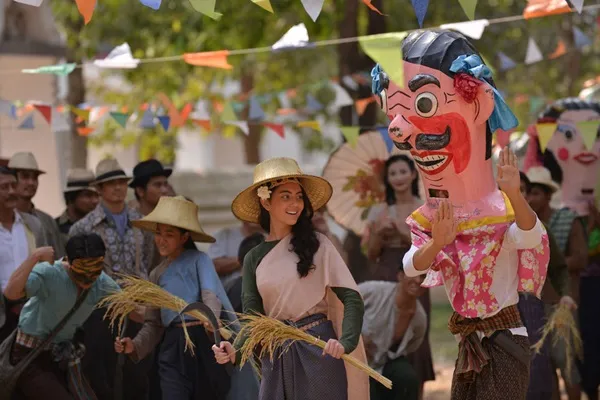
Performance Days: Traditionally Performed During The Rice Harvest Season Or During Breaks From Harvesting
Performance Hours: Depending On The Schedule Of Each Community Or Cultural Event
Ten Kam Ram Khiao is a Thai folk performance rooted in the rice-farming way of life. It is especially associated with farming communities in the upper Central region and Nakhon Sawan Province. The performance developed from the rice harvest season, communal labor, and the joyful singing of farmers who wanted to ease fatigue after working in the fields. Its main features are responsive singing between men and women, rhythmic movement, and the use of a sickle and rice sheaf as performance props.
The essence of Ten Kam Ram Khiao lies in transforming real farming tools and harvest scenes into a lively folk performance. One hand holds a rice sickle, while the other holds harvested rice stalks. Performers sing, dance, and tease one another in a friendly way. The performance does not focus on refined court-style dance; instead, it emphasizes natural movement, energy, humor, and the social warmth of village life.
Traditionally, performers are divided into 2 sides: male and female. Each side may have around 10 performers, or the performance may be arranged as 5–10 male-female pairs depending on the occasion. The male singers are often called pho phleng, while the female singers are called mae phleng. Both sides sing in response to each other using rhythmic, poetic, and playful lyrics.
Ten Kam Ram Khiao is closely related to the tradition of communal rice harvesting. In the past, villagers helped one another harvest rice through a system of shared labor. During breaks at midday or in the afternoon, they would sing, dance, and tease one another to relieve tiredness. This performance therefore did not begin as a staged show. It grew naturally from the real life of farmers working together in rice fields.
The lyrics often reflect rural life, love, humor, hard work, and relationships between men and women in the community. As a form of folk song, it allows performers to use wit and improvisation. Singers may adapt their words to the audience, situation, or atmosphere of the day, making every performance lively and different.
The movements are simple but charming. Performers move to the rhythm of the song, raise the sickle and rice sheaf, approach and retreat from each other, or move in circles according to the performance pattern. The most important elements are rhythm, unity, and enjoyment rather than highly formalized dance technique.
Costumes reflect the appearance of Thai farmers. Male performers often wear traditional farmer trousers, a dark mo hom shirt, a pha khao ma around the waist, and a woven hat. Female performers may wear a jong kraben or traditional skirt, a local blouse, and a farmer’s hat or ngob. These costumes help preserve the atmosphere of traditional agricultural life.
The main props are a rice sickle and harvested rice stalks. The sickle represents field labor, while the rice sheaf symbolizes harvest, abundance, and the reward of farmers’ work. When used in singing and dancing, these objects give the performance deeper meaning as a tribute to agricultural labor and the importance of rice in Thai society.
In the past, Ten Kam Ram Khiao was usually performed outdoors in rice fields, threshing areas, or resting spaces after harvesting. The audience might be nearby farmers or villagers. They could join by clapping, singing along, or cheering. This made the performance a true community activity rather than a formal stage show.
As society changed, farming became more mechanized and communal harvesting declined. As a result, Ten Kam Ram Khiao became less common in daily life. However, it continues to be preserved as a folk performing art and is now performed in schools, cultural events, local festivals, and activities that promote agricultural heritage.
In Nakhon Sawan Province, Ten Kam Ram Khiao is important as a cultural heritage connected with rice farming society in the upper Central region. It reflects the humor, poetic talent, and cooperative spirit of farming communities. Through this performance, audiences can see how ordinary agricultural labor once became music, movement, and shared joy.
The cultural value of Ten Kam Ram Khiao lies in its connection between art and everyday labor. The songs helped farmers relieve fatigue, the movements created enjoyment, the responsive singing built social relationships, and the group performance reflected cooperation in agricultural communities.
For younger generations, this folk performance offers a way to understand that rice is not only food but also a cultural foundation. It is connected with labor, seasons, community relationships, and Thai identity. Learning Ten Kam Ram Khiao is therefore a way to learn Thai social history through body movement, folk song, farming tools, and local language.
For cultural tourism, Ten Kam Ram Khiao is suitable for local festivals, simulated rice-harvesting events, community tourism programs, and Thai cultural learning activities. Visitors can experience folk song, farming gestures, rice culture, and the relationship between people and the harvest season.
Getting There to watch Ten Kam Ram Khiao depends on the cultural event where it is performed. Today, the performance is most often seen in schools, local cultural centers, community festivals, or rice-harvesting demonstration activities. Visitors should check announcements from local authorities, schools, temples, or community cultural groups before traveling.
Audiences should view the performance as a form of living cultural heritage, not merely as a nostalgic show. Behind Ten Kam Ram Khiao lies the history of farmers, communal labor, rice harvesting, and the small moments of joy that helped people endure hard work in the fields.
In summary, Ten Kam Ram Khiao is a beautiful folk performance in its simplicity. It combines responsive singing between men and women, sickles and rice sheaves, lively movement, and the atmosphere of the rice harvest season. It preserves farmers’ wisdom, rice culture, community unity, and the charm of Thai folk songs.
| Performance Name | Ten Kam Ram Khiao |
| Type | Thai folk performance and harvest-season folk song |
| Main Region | Upper Central Thailand and Nakhon Sawan Province, especially farming communities connected with rice culture |
| Performance Period | Rice harvest season or resting periods during harvesting |
| Number Of Performers | 2 groups of male and female performers, around 10 people per side, or about 5–10 male-female pairs depending on the performance format |
| Performance Style | Responsive singing between men and women, with lively dancing and gestures while holding a sickle and rice sheaf |
| Props | Rice sickle and harvested rice stalks or rice sheaf |
| Costume | Traditional farmer clothing such as mo hom shirts, farmer trousers, pha khao ma, jong kraben, local skirts, ngob, or woven hats |
| Cultural Importance | Reflects rice-farming life, communal harvesting, folk songs, teamwork, and Thai rice culture |
| Current Status | Preserved and performed in cultural events, schools, local festivals, and cultural tourism activities |
Frequently Asked Questions (FAQ)
Q: What Is Ten Kam Ram Khiao?
A: Ten Kam Ram Khiao is a Thai folk performance associated with the rice harvest season, featuring responsive singing between men and women while holding sickles and rice sheaves.
Q: When Is Ten Kam Ram Khiao Traditionally Performed?
A: It is traditionally performed during the rice harvest season or during breaks from harvesting to relieve fatigue and create joy among farmers.
Q: How Many Performers Are Usually In Ten Kam Ram Khiao?
A: It is usually performed by 2 groups of men and women, around 10 performers per side, or about 5–10 male-female pairs depending on the arrangement.
Q: Why Is It Called Ten Kam Ram Khiao?
A: The name comes from the combination of dancing and graceful movement while one hand holds a sickle and the other holds harvested rice stalks.
Q: What Costumes Are Used In The Performance?
A: Performers usually wear traditional farmer clothing such as mo hom shirts, farmer trousers, pha khao ma, local skirts, jong kraben, ngob, or woven hats.
Q: Why Is Ten Kam Ram Khiao Culturally Important?
A: It reflects rice-farming life, communal labor, folk song traditions, community unity, and the importance of rice in Thai culture.
Q: Is Ten Kam Ram Khiao Still Performed Today?
A: Yes. It is still preserved and performed in schools, local cultural events, traditional festivals, and cultural tourism activities.
 Category: ●Art, Culture and Heritage
 Group: ●Art, Craft Centres, Tradition
Last Update : 5 MonthAgo
 Last Update : 5 MonthAgo
Recommend

 Historical Sites and Monuments(3)
 Landmarks and Memorials(4)
Art, Craft Centres, Tradition(9)
Landmarks and Memorials(4)
Art, Craft Centres, Tradition(9)
 Museums(3)
 Educational Places
 Museum for Study(1)
 Places of Worship
 Temple(34)
 Other Sacred Sites(4)
 Research and Development
 Royal Project(1)
 Suburban Living
 Village, Community(4)
 Local Market(2)
 Floating Market(1)
 Nature and Wildlife
 National Parks and Marine Reserves(3)
 Mountain (Doi)(3)
 Dam, Reservoir, Lake(6)
 Waterfalls(3)
 Caves(8)
 River, Canal(6)
 Other natural attractions(3)
 Entertainment and Agricultural
 Zoos and Aquariums(2)
 Animal camps and shows(1)
 Farms, Parks and Ecotourism(6)
 Accommodation
 Hotel(1)
 Travel Articles, Recipes
 Travel Review, Food Review(3)


