
 Home
Home North(
 Chiang Mai(


Ancient Agricultural Tools Museum
Rating: 4.3/5 (4 votes)
 Search By
  Map
Map 
 Have Map
  No Map
Nakhon Pathom attractions
Attractions in Thailand
Open Days: Daily
Opening Hours: 08:00 - 17:00
Ancient Agricultural Tools Museum, Nakhon Pathom is a small yet culturally significant learning site in Nakhon Pathom Province. It serves as a place where traditional agricultural tools, once essential to rural Thai life, are preserved and displayed in a tangible and meaningful way. The museum is located within Wat Sukwatthanaram in Bang Rakam Subdistrict, Bang Len District, Nakhon Pathom. It is open to visitors every day and is suitable for history enthusiasts, students, families, and anyone interested in understanding how Thai farmers and villagers lived, worked, and relied on traditional wisdom before modern machinery existed.
The charm of this museum lies in its ability to take visitors back in time and immerse them in the world of traditional Thai agriculture through real objects. Rather than learning through text or images alone, visitors can observe the size, structure, materials, and intricate details of tools that were actually used in daily life. As you walk through the exhibits, you begin to understand that rice cultivation, transportation of crops, rice milling, winnowing, coconut sugar production, and water-based travel all required physical effort, time, skill, and knowledge passed down through generations within local communities.
Being located within Wat Sukwatthanaram gives the museum a unique atmosphere that differs greatly from urban museums. The temple grounds are peaceful, shaded, and reflect the slower rhythm of traditional Thai village life. As visitors step into the exhibition area, they do not only see old objects but also experience the connection between the temple, the community, and agricultural life. In the past, these elements were inseparable. Temples served as spiritual centers, community hubs, and places where collective memories were preserved, while agricultural tools represented the livelihoods that sustained entire communities over generations.
Although detailed historical records about the museum’s establishment are not widely documented, the nature of its exhibits clearly reflects its purpose: preserving “knowledge through real objects” for future generations. Many items on display are unique and strongly represent central Thai agricultural practices. These include tools related to rice farming, transportation equipment, coconut farming tools, and other traditional household implements that are rarely seen in actual use today. Collecting these items in one place gives the museum significant value as a historical archive of Thailand’s agricultural way of life.
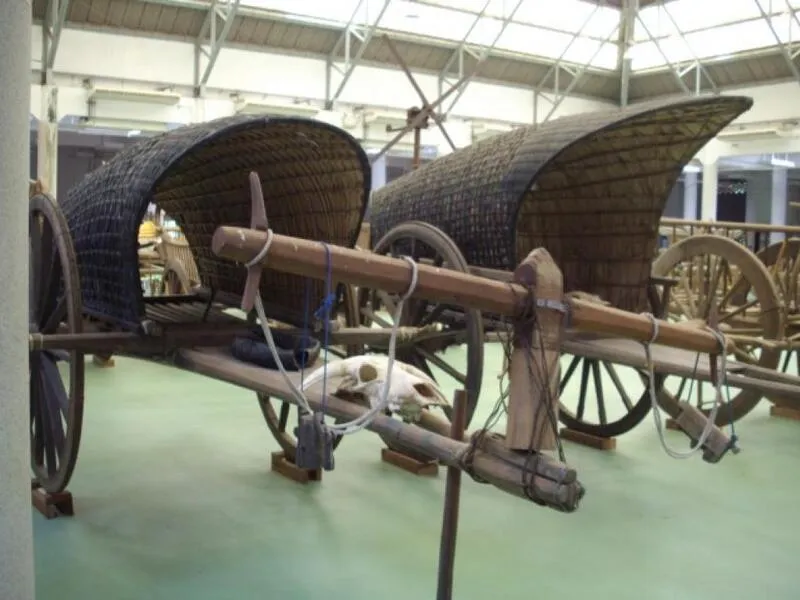
One of the most eye-catching exhibits is the ancient wooden cart (ox cart), which clearly represents how agricultural products were transported in the past. These carts were not only used to carry rice, hay, or farm goods, but they also reflect the economic structure of rural communities during a time when land transportation relied heavily on animals and human labor. The wooden construction, large wheels, axle system, and design adapted to dirt roads all demonstrate practical wisdom developed through real-life usage over generations.
Another important exhibit is the traditional rice milling tool, used to process rice before consumption. Seeing this equipment in person helps visitors immediately understand that eating rice in the past was far more complex than simply buying polished rice today. It involved multiple steps, including planting, harvesting, threshing, drying, and milling. This tool represents not only craftsmanship but also the labor within households and the broader food management system of agricultural communities.
Equally fascinating is the rice winnowing machine, used to separate rice grains from chaff after threshing. This tool highlights a period when rice farming required intense manual labor. Each step depended on skill and experience, especially in controlling movement and airflow to ensure clean grains. Seeing this machine in real life transforms historical knowledge into something tangible and helps visitors appreciate the physical effort farmers once endured.
Beyond rice-related tools, the museum also displays a bamboo container used for coconut sugar, which reflects the relationship between orchard life and the rural economy in central Thailand. This item shows that communities did not rely solely on rice farming but also engaged in coconut cultivation and sugar production. The use of bamboo demonstrates how natural materials were efficiently utilized, showcasing local wisdom and craftsmanship in food production.
Another key exhibit is the ancient wooden boat, which illustrates the importance of waterways as primary transportation routes in central Thailand. Areas such as Nakhon Pathom and Bang Len have long been connected by canals. Boats were essential not only for travel but also for transporting agricultural goods and connecting communities. This exhibit helps visitors understand how agricultural life was closely tied to geography and water systems.
Overall, the museum does not simply display “old objects” but tells the story of an entire “way of life.” It covers farming, processing, transportation, storage, and the sustainable use of natural resources. Each item represents a piece of a larger system that formed the foundation of Thai agricultural society for centuries.
Visiting this museum can also evoke personal memories. Many visitors may have heard stories from grandparents about carts, rice tools, or coconut sugar containers but never seen them in real life. Seeing these objects transforms abstract stories into tangible experiences and helps younger generations appreciate the value of seemingly ordinary items from the past.
From an educational perspective, this museum is ideal for experiential learning, especially in subjects related to local wisdom, rural economy, and agricultural technology evolution. Real objects provide a clearer understanding of how life has changed over time and encourage deeper questions about the transition from traditional methods to modern technology.
The exhibition area is simple and unpretentious, yet authentic. Visitors who appreciate cultural tourism often enjoy exploring each item in detail, as every piece carries its own story. For those with agricultural backgrounds, the experience can feel like revisiting their roots, while others may gain entirely new insights into rural Thai life.
In terms of tourism, the museum may not be a large-scale landmark or trendy check-in spot, but its strength lies in its authenticity. Travelers who prefer meaningful experiences over superficial attractions often find this place particularly rewarding, as it offers not only visual interest but also thoughtful reflection on Thailand’s past.
The museum also highlights the important role of temples in preserving community heritage. In Thailand, temples often serve as repositories of history, culture, and shared memory. By hosting this museum, Wat Sukwatthanaram plays a vital role in safeguarding local identity and making it accessible to the public.
On a broader level, the museum reminds visitors that agriculture was not just an occupation but the backbone of Thai society, economy, and culture. Each tool represents a time when people relied on cooperation, seasonal rhythms, and natural resources to sustain their lives.
For travel planning, this museum can easily be combined with nearby attractions in Bang Len District. The area offers traditional markets, temples, and community-based tourism spots, making it suitable for a half-day or full-day itinerary. Visitors can start with the museum to understand traditional agriculture, then continue exploring local markets and cultural sites for a richer experience.
Getting There The museum is located within Wat Sukwatthanaram in Bang Rakam Subdistrict, Bang Len District, Nakhon Pathom. Visitors traveling by car from Bangkok can take the Nakhon Pathom–Bang Len route or Highway 346 and continue into the local road network. Public transport users can travel to Bang Len District first, then take local transport to the temple.
Visitors are advised to dress respectfully, as the museum is located within a temple. It is also recommended to allocate sufficient time to explore the exhibits carefully, as the value of this museum lies in observing details and understanding the stories behind each item.
In conclusion, the Ancient Agricultural Tools Museum in Nakhon Pathom is a small yet meaningful destination that offers far more than expected. It not only preserves rare artifacts but also tells the story of Thailand’s agricultural society through real objects. For those seeking a cultural and educational travel experience beyond typical tourist attractions, this museum is a worthwhile destination.
| Place Summary | A local museum inside Wat Sukwatthanaram showcasing traditional agricultural tools used by rural communities in central Thailand |
| Highlights | Ancient carts, rice milling tools, winnowing machines, wooden boats, and bamboo coconut sugar containers |
| Location | Wat Sukwatthanaram, Bang Rakam Subdistrict, Bang Len District, Nakhon Pathom 73130 |
| Travel | Accessible by car from Bangkok via Highway 346 or Nakhon Pathom–Bang Len route |
| Nearby Attractions | Wat Lam Phaya Floating Market (12 km) Bang Luang Market (15 km) Baan Nok Market (17 km) Wat Bang Phra (24 km) Patom Organic Village (27 km) |
Frequently Asked Questions (FAQ)
Q: Where is the museum located?
A: It is located inside Wat Sukwatthanaram in Bang Len District, Nakhon Pathom.
Q: What can visitors see at the museum?
A: Visitors can see ancient agricultural tools such as carts, rice milling equipment, winnowing machines, boats, and coconut sugar containers.
Q: Who is this museum suitable for?
A: It is suitable for history enthusiasts, students, families, and cultural travelers.
Q: Is the museum open every day?
A: Yes, it is open daily.
Q: Why is this museum important?
A: It preserves traditional agricultural knowledge and helps people understand Thailand’s rural past.
 Ancient Agricultural Tools Museum Map
 Category:
  Group:
  Tag: ●Ancient Agricultural Tools Museum●ancient agricultural tools museum ●nakhon pathom attractions ●wat sukwatthanaram ●thai agriculture museum ●traditional farming tools thailand ●bang len travel guide ●cultural attractions nakhon pathom ●things to do nakhon pathom ●rural thailand museum ●thailand cultural travel
Last Update: 16 HourAgo
Tag: ●Ancient Agricultural Tools Museum●ancient agricultural tools museum ●nakhon pathom attractions ●wat sukwatthanaram ●thai agriculture museum ●traditional farming tools thailand ●bang len travel guide ●cultural attractions nakhon pathom ●things to do nakhon pathom ●rural thailand museum ●thailand cultural travel
Last Update: 16 HourAgo
Comment
 Nearby Attractions
| Keyword (Advance) |
 Facebook Fanpage
 Region
 Historical Sites and Monuments(
 Landmarks and Memorials(
 Royal Palace(
 Art, Craft Centres, Tradition(
 Art Gallery(
 Educational Places
 Educational Gardens, Farm(
 University
 Places of Worship
 Temple(
 Other religious and spiritural sites(
 Research and Development
 Royal Project(
 Suburban Living
 Village, Community(
 Local Market(
 Floating Market(
 Nature and Wildlife
 River, Canal(
 Other natural attractions(
 Entertainment and Agricultural
 Animal camps and shows(
 Stadium(
 Farm, Parks, Gardens and Ecotourism(
 Waterpark(
 Theater(
 Outdoor and Adventure Activities(
 Spas and Wellness
 Spas and Wellness(
 Copyright 2012,