
 Home
Home North(
 Chiang Mai(


Thai Farmer Life Museum
Rating: 4/5 (4 votes)
 Search By
  Map
Map 
 Have Map
  No Map
Nakhon Pathom attractions
Attractions in Thailand
Open Days: Daily (Advance contact is recommended)
Opening Hours: 08.00–17.00
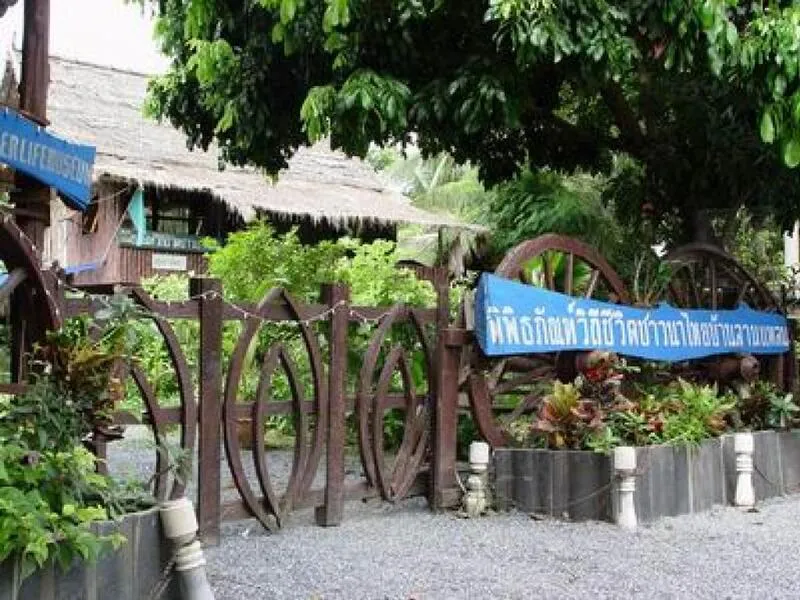
Thai Farmer Life Museum, Nakhon Pathom is a cultural learning site that turns the idea of the “Thai farmer” from a brief image in textbooks or a distant memory into something tangible, vivid, and deeply human. Visitors can closely observe the atmosphere, objects, and details of rural life that once shaped central Thailand. The museum is located at Ban Lan Laem in Wat Lamud Subdistrict, Nakhon Chai Si District, within the home compound of Ajarn Roengchai and Khun Pa Payom Chaemniyom, who have devoted themselves to preserving tools, household objects, and local wisdom related to traditional Thai rice farming for future generations.
What makes this place especially distinctive is that it was not created as a modern exhibition building cut off from its surroundings. Instead, it grew out of a real living space, which gives the museum an immediate sense of sincerity and authenticity. From the moment visitors arrive, it becomes clear that this is not simply a tourist attraction, but a home of memory, a home of agricultural labor, and a home of stories tied to rice fields, canals, handmade tools, and a genuinely self-sufficient way of life.
The museum was established in 1999 with the aim of preserving and passing on knowledge about Thailand’s farming heritage, especially the way of life of Thai farmers around 30–40 years ago. That was a period when rice cultivation still depended heavily on human labor, animal power, traditional tools, and a close understanding of the natural world. Ajarn Roengchai spent years preparing the site and planning the structure before the museum officially opened, choosing to build the main exhibition area as a traditional Thai tied-timber house so that the architecture itself would become part of the storytelling rather than merely a backdrop for display cases.
In cultural terms, the Thai Farmer Life Museum is far more than a place that stores old objects. What has been preserved here is not only material culture, but also a way of thinking and an entire system of life rooted in rural Thai communities. Every tool reflects the fact that Thai farmers relied not only on physical labor, but also on knowledge of seasons, water, soil, plants, animals, and the careful use of available resources. Seeing these objects within the context of a Thai house and a rural setting allows visitors to understand the lifestyle much more fully than by reading short labels in a conventional gallery.
The museum’s main building is a two-room traditional Thai tied-timber house. Its atmosphere is simple yet deeply charming, from the structure of the house itself to the underfloor space, staircase, and interior layout. Together, these features help visitors picture the daily life of a rural Thai household with unusual clarity. The upper floor displays domestic life, including sleeping areas, kitchen space, containers, utensils, and objects that reflect everyday routines. The underfloor area connects more directly with the world of work, where agricultural tools, fishing equipment, woodworking tools, and household items are grouped in a way that is both accessible and easy to understand.
One of the museum’s great strengths lies in the way it presents objects without separating them too sharply from real life. Visitors do not simply see a plow or a sickle in isolation. Instead, they gradually come to understand how such tools were used during each stage of the rice-growing cycle, at what time of year they were needed, and what kind of labor or skill they required. Viewing the collection in this way helps modern audiences realize that traditional rice cultivation was far more complex and delicate than many urban residents might imagine. Every step, from preparing the soil and transplanting seedlings to harvesting, threshing, and storing rice seed, depended on a rhythm of life inseparable from nature.
Looking more deeply, the museum also gives concrete form to the philosophy of the “Sufficiency Economy.” The core of traditional Thai farming life was the wise use of available resources: using nearby materials, making household items by hand, repairing old things, and producing primarily for living and eating. This way of life clearly reflects the royal philosophy of moderation, reasonableness, and resilience. As a result, visitors do not only look back at the past. They also begin to see that some older principles remain remarkably relevant today, especially at a time when many people are once again interested in sustainability and more balanced ways of living.
Another particularly interesting feature of the museum is the way it presents the “Thai farmer lifestyle” as a complete world rather than limiting the story to rice cultivation alone. The museum also covers food preparation, fishing, basketry, house construction, and domestic life. The fishing tools on display remind visitors that Thai farmers have long lived in close relationship with waterways. Rice fields did not provide only rice; they were also connected to fish, shrimp, crabs, and edible aquatic plants that became part of the household diet. This relationship helped rural communities in the past maintain a degree of self-reliance in both food and economy.
The house-building tools displayed here add yet another valuable dimension. They reveal that villagers in the past needed a much wider range of knowledge than the word “farmer” often suggests today. They had to understand timber, structural design, material selection, and how to build homes suited to Thailand’s tropical climate. Raised houses with good ventilation, space to store tools, and flexible areas for household work did not appear by accident. They were the result of practical wisdom accumulated over generations. Seeing woodworking tools and household items together in the same setting helps visitors understand that the world of Thai farmers was built on many interconnected skills.
Another highlight is that the museum does not stop at static displays. It also offers demonstrations that connect visitors directly to traditional ways of life. With advance arrangement, interested visitors can learn about traditional farming, sufficiency-based agriculture, the production of brown rice and hand-milled rice, cooking rice in clay pots, and the water hyacinth basketry for which Nakhon Chai Si is known. These activities add an important experiential layer to the visit. Rather than learning only through explanation, visitors can observe actual processes, notice fine details, and in some cases better appreciate the labor and skill behind everyday necessities.
The demonstration of brown rice and hand-milled rice production is especially valuable from an educational perspective because it helps visitors understand the long process that brings rice to the table. Younger generations, who are more familiar with packaged rice from supermarkets, may never have seen how rice is milled, sorted, stored, or processed in traditional ways. Learning these steps within the museum setting does more than provide information. It also encourages deeper respect for the labor of farmers.
Cooking rice in clay pots and using traditional kitchen utensils is another activity with more cultural meaning than many people might initially expect. It reveals that eating rice in Thai society was once inseparable from knowledge about fuel, vessels, heat control, and timing. Clay pots, clay pans, stoves, and related tools were once normal parts of a Thai kitchen. Demonstrations like these help visitors understand that simplicity in the past did not mean roughness or a lack of quality. Rather, it was a refined simplicity grounded in precise knowledge and lived experience.
The section devoted to water hyacinth basketry is another reason the museum feels alive. It is not merely a place where the past is stored; it also links the past to the present through community skills and income generation. Water hyacinth, which many people may think of only as an invasive plant, is transformed here into practical and beautiful woven handicrafts. This reflects both the intelligent use of available resources and the ability of local communities to adapt inherited wisdom to changing times. These woven products are not simply souvenirs. They are evidence that traditional knowledge can still be extended into the modern world in meaningful ways.
For those interested in social history, the museum is especially valuable because it tells the story of ordinary people’s lives, a subject that is often overshadowed by political history or the lives of famous individuals. In reality, the way of life of Thai farmers forms one of the foundations of the country, in terms of food, economy, culture, and community structure. Seeing real tools, real household items, and real spaces makes it easier to understand how much of Thailand’s past food security depended on the labor and wisdom of countless rural people.
In terms of atmosphere, the Thai Farmer Life Museum feels peaceful, welcoming, and very different from tourist sites built around spectacle. Travelers who enjoy quiet places with stories, traces of real life, and a chance to experience the Central Thai countryside in a form that has not been overly commercialized are likely to appreciate this museum. The simplicity of the pathways, the underfloor house space, the wooden materials, the greenery, and the handmade objects all create an emotional tone that turns a museum visit into more than a simple information-gathering activity. It becomes a moment of reflection on the value of life lived in close relationship with nature.
The museum is also suitable for a wide range of visitors, including cultural travelers, families who want children to learn about rice and rural communities, students, researchers, teachers, and international visitors who want to understand the foundations of Thai society beyond temples and more mainstream attractions. With advance arrangement, visits that include explanation or demonstrations can be especially rewarding, particularly for those who come with a genuine interest in learning.
Another reason the museum remains important today is that it serves as a bridge between local memory and outside visitors. Traditional knowledge often fades when younger generations leave rural communities or when agricultural life changes. A place that preserves objects, stories, and activities together therefore plays an important role in safeguarding local cultural heritage in a visible and tangible form rather than allowing it to survive only in documents or fading recollections.
From the perspective of high-quality cultural tourism, the Thai Farmer Life Museum also adds an important layer to the image of Nakhon Pathom. The province is not defined only by Phra Pathom Chedi, Sanam Chan Palace, or floating markets. It also contains meaningful learning spaces that tell the deeper story of Central Thailand’s agricultural society. Travelers planning a day trip or a multi-stop route through Nakhon Chai Si can include this museum as a rewarding stop, especially if they want to balance photogenic attractions with a place that offers substance, context, and cultural insight.
Getting There is easiest by private car, as the museum is located within a community setting and is essentially a home-based museum. The main access route is the Nakhon Chai Si–Don Tum Road around kilometer 14–15 in Wat Lamud Subdistrict, Nakhon Chai Si District. If you are traveling from Nakhon Pathom town or from Bangkok, it is best to use the museum name or the address 9/1 Moo 4, Ban Lan Laem as your destination reference. It is also advisable to call ahead before departure to confirm visiting arrangements, especially if you would like to see demonstrations or are traveling as a group.
Visitors who wish to rely on public transportation can first travel into Nakhon Chai Si District and then continue by local transport or a hired vehicle into Wat Lamud Subdistrict. In practical terms, however, this option is less convenient than driving. For visitors who want enough time to fully explore and learn from the museum, traveling by car is the more efficient choice and also makes it easier to continue to other attractions in Nakhon Chai Si or nearby Sam Phran.
For the best experience, visitors should allow enough time to explore without rushing and come with an open mind for learning. This is not a museum built around fast-paced entertainment. Instead, it gradually reveals its meaning through real objects, real surroundings, and the stories behind them. Visiting during cooler weather can make it more comfortable to walk around the underfloor exhibition space and surrounding area. Those who want more in-depth information or specific demonstrations should mention their interests when contacting the museum in advance so that arrangements can be made appropriately.
Overall, the Thai Farmer Life Museum in Nakhon Pathom is a highly valuable destination in terms of culture, education, and learning-based tourism. It gives the phrase “Thai farmer lifestyle” greater shape, atmosphere, and human depth. Visitors leave not only with information, but with a broader perspective on rice, farmers, rural communities, and the meaning of living with moderation and self-reliance. These are all essential foundations of Thai society and remain deeply worth remembering and passing on.
| Place Summary | A community museum that presents the traditional Thai farming way of life through a Thai house, agricultural tools, household objects, and hands-on cultural demonstrations. |
| Highlights | Traditional tied-timber Thai house, rice farming and fishing tools, brown rice and hand-milled rice demonstrations, clay-pot rice cooking, and water hyacinth basketry. |
| History / Period | Established in 1999 to preserve and interpret the Thai farmer lifestyle of around 30–40 years ago. |
| Address | 9/1 Moo 4, Ban Lan Laem, Nakhon Chai Si–Don Tum Road, Wat Lamud Subdistrict, Nakhon Chai Si District, Nakhon Pathom 73120 |
| Travel | Best reached by private car via the Nakhon Chai Si–Don Tum Road around kilometer 14–15 in Wat Lamud. Advance contact is recommended, especially for groups or visitors interested in demonstrations. |
| Open Days / Opening Hours | Daily / 08.00–17.00 (Advance contact is recommended) |
| Fees | No admission fee |
| Facilities | Exhibition space inside the Thai house and underfloor area, demonstration areas, and a local basketry learning zone. |
| Zones | 1. Upper Floor: displays of Thai household life 2. Underfloor Area: rice farming tools, fishing tools, and woodworking tools 3. Demonstration Area: basketry and traditional lifestyle activities |
| Nearby Attractions | 1. Wat Klang Bang Kaeo – about 10 km 2. Thai Human Imagery Museum – about 18 km 3. Jesada Technik Museum – about 20 km 4. Woodland Muangmai – about 22 km 5. Don Wai Floating Market – about 25 km |
| Nearby Restaurants | 1. Jae Nee Khao Tom, Wat Lamud Intersection – about 2 km – Tel. 083-929-1561 2. Pad Thai Siam 2562, Wat Lamud Intersection Branch – about 2 km – Tel. 099-282-8777 3. See Fah Nakhon Chai Si – about 8 km – Tel. 034-331-233 4. Ruen Tubtim Nakhon Chai Si – about 9 km – Tel. 081-700-5692 5. Thai Riverside Raft Restaurant, Nakhon Chai Si – about 9 km – Tel. 097-124-1112, 034-338-671 |
| Nearby Accommodations | 1. Bueng Sampathuan Nakhon Chai Si Resort – about 11 km – Tel. 064-014-4795 2. Baan Rak – about 12 km – Tel. 091-519-1429 3. Boat House Boutique Riverside – about 14 km – Tel. 064-595-5445 4. Woodland Muangmai – about 22 km – Tel. 084-994-6369 5. Suan Sampran – about 24 km – Tel. 034-322-588 |
| Main Contact | 085-186-4404 (Payom), 095-774-0724 |
Frequently Asked Questions (FAQ)
Q: Where is the Thai Farmer Life Museum located?
A: The museum is located at 9/1 Moo 4, Ban Lan Laem, Nakhon Chai Si–Don Tum Road, Wat Lamud Subdistrict, Nakhon Chai Si District, Nakhon Pathom.
Q: What days is the Thai Farmer Life Museum open?
A: It is open daily from 08.00 to 17.00, and advance contact is recommended before visiting.
Q: Is there an admission fee?
A: Verified information indicates that there is no admission fee.
Q: What can visitors see inside the museum?
A: Visitors can see a traditional tied-timber Thai house, rice farming tools, fishing tools, woodworking tools, household items, and spaces for demonstrations related to the Thai farmer way of life.
Q: What demonstrations are available?
A: With advance arrangement, visitors may learn about traditional farming, brown rice and hand-milled rice production, clay-pot rice cooking, and water hyacinth basketry.
Q: Who would enjoy visiting this museum?
A: The museum is suitable for cultural travelers, families, students, researchers, teachers, and international visitors interested in Thailand’s agricultural roots and the philosophy of sufficiency.
Q: What is the most convenient way to get there?
A: Traveling by private car is the most convenient option because the museum is located in a community area and advance coordination is recommended. Public transport visitors should first travel to Nakhon Chai Si District and continue by local transport.
Q: What makes this museum different from a typical museum?
A: Its main distinction is that it uses a real home and an authentic Thai house as the exhibition space, allowing visitors to see objects and tools within the context of real life rather than in a purely modern display setting.
 Tel: 034296086
 Mobile: 0819916084, 0851864404, 0871651681
 Thai Farmer Life Museum Map
 Category:
  Group:
  Tag: ●Thai Farmer Life Museum●thai farmer life museum ●thai farmer life museum nakhon pathom ●thai farmers way of life museum ●ban lan laem museum ●thai rural life museum ●traditional thai farmer lifestyle ●cultural attractions in nakhon pathom ●nakhon chai si museum ●thai farming heritage museum ●sufficiency economy learning center
Last Update: 6 HourAgo
Tag: ●Thai Farmer Life Museum●thai farmer life museum ●thai farmer life museum nakhon pathom ●thai farmers way of life museum ●ban lan laem museum ●thai rural life museum ●traditional thai farmer lifestyle ●cultural attractions in nakhon pathom ●nakhon chai si museum ●thai farming heritage museum ●sufficiency economy learning center
Last Update: 6 HourAgo
Comment
 Nearby Attractions
| Keyword (Advance) |
 Region
|
 Muang Nakhon Pathom(
 Copyright 2012,