
 Home
Home North(
 Chiang Mai(


Su Khwan Khao Tradition
Rating: 3/5 (6 votes)
 Search By
  Map
Map 
 Have Map
  No Map
Nakhon Nayok attractions
Attractions in Thailand
Open Days: The 3rd waxing day of the 3rd lunar month
Opening Hours: The ritual generally begins in the early morning
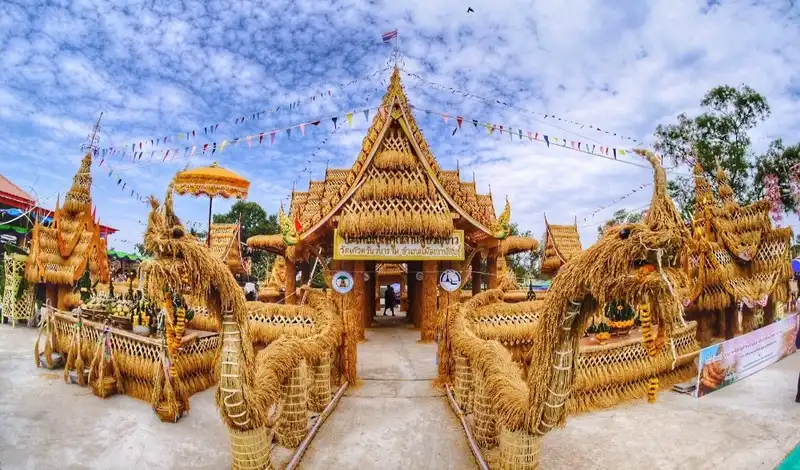
Su Khwan Khao Tradition, Nakhon Nayok Province is an important ritual of farming society performed after the harvest season to invite the spirit of Mae Phosop, or the rice spirit believed to have been left scattered across the fields, back into the granary, to honor Mae Phosop, and to bring auspiciousness for a more abundant harvest in the following year. This ritual reflects that rice in Thai life is not merely a staple food, but a sacred force that has sustained people and communities for a long time.
In the context of Nakhon Nayok Province, this tradition is still remembered and preserved in many areas, with different names depending on the community, such as “Su Khwan Khao Tradition,” “Bun Su Khwan Khao,” and “Riek Khwan Khao.” Although the names differ, the core meaning of the ritual remains the same: to invite the rice spirit or Mae Phosop back into the granary so that the stored rice remains complete, auspicious, and protective of the next farming season.
Belief in Mae Phosop is the heart of this tradition. Thai farmers believe that rice has a spirit and that sacred forces protect it. Once the harvest season arrives, some rice grains or stalks are inevitably left scattered across the fields. If these are left without ritual observance, the rice spirit may not fully return to the granary, which could result in an incomplete harvest in the following year. Farmers therefore perform the Su Khwan Khao ritual to formally invite Mae Phosop, who is believed to remain in the fields, back home.
In Nakhon Nayok Province, local information states that this ritual in general, including Bun Su Khwan Khao in Ban Noen Mai, Khok Kruat Subdistrict, and Riek Khwan Khao in Ban Tha Dan, is performed on the 3rd waxing day of the 3rd lunar month. This timing corresponds with the post-harvest period, when farmers have time to prepare the ceremony and when the agricultural cycle shifts from harvest toward hope for the next planting season.
The importance of the Su Khwan Khao ritual has several dimensions. In terms of belief, it is an act of honoring Mae Phosop and calling the rice spirit back into the granary. In agricultural terms, it is a prayer that the following year will be safe from pests, destructive animals, and various forms of damage, while also wishing for greater productivity. In psychological terms, the ritual also strengthens the morale of farmers, allowing them to feel that the exhaustion of the entire farming season is rewarded with abundance and auspiciousness.
What makes this tradition especially beautiful is the way it treats rice with gratitude. Farmers do not see rice merely as an economic crop, but as a giver of life. Everyone in the family and in the village has grown and survived through the rice produced from the fields. The Su Khwan Khao ritual is therefore like an act of thanking, apologizing to, and respectfully caring for the very thing that sustains life.
In general, the ritual begins in the early morning. The owner of the rice field, especially the woman of the household, usually performs the ceremony. In many places, the female owner of the field dresses in white to symbolize purity and auspiciousness. She then prepares the ritual items used to call the rice spirit, such as sticky rice sweets, taro, yam, eggs, a five-item offering set, bottled water, jewelry, powder, a comb, a mirror, and a shoulder cloth. The exact details may vary from one locality to another.
These items are wrapped in a white cloth and placed in a basket. In some places, a white cloth is used to cover the basket, while in some villages colorful cloth is tied to the carrying pole of the basket to make it more beautiful. The ritual performer then carries the basket out across the rice fields. The intention of this walk is not simply ritual movement, but a personal act of going out to invite Mae Phosop home, as though respectfully receiving an honored benefactor back to the household.
While walking through the fields, the ritual performer calls out to Mae Phosop. The essential meaning is to invite Mae Phosop or the rice spirit believed to have been left in the fields to return to the granary. In some villages, neighbors or community members call back in response all the way to the house, making the ritual not just a private act of one household, but something recognized and shared by the surrounding community as well.
Once back home, the basket containing the rice spirit is placed inside the granary. In some villages, simply placing the basket in the granary is considered the end of the ritual. In others, more elaborate steps follow, with a Brahmin or ritual specialist performing a ceremony to invite the spirit into the granary. A bai sri arrangement and offerings are placed inside the granary, and words of blessing for the rice spirit are recited according to local expressions or dialect. This stage helps make the ritual more sacred and complete.
In cultural terms, the words used in the rice-blessing ritual are highly valuable because they function at once as ritual language, local wisdom, and folk poetry. Although each village may use different wording, the meaning is usually similar: inviting the rice spirit to flow in, gather in, and remain in the granary, the storehouse, and the raised floor, without lingering in the fields, forests, canals, or anywhere else, while also blessing the rice to fill the granary and wishing the owners of the rice a peaceful and prosperous life.
This tradition is therefore not merely a post-harvest ceremony, but a clear expression that people and rice exist in a relationship of dependence and mutual respect. It reflects an agricultural worldview that regards nature with ethics, not as something from which benefits are simply extracted, but as something upon which humans depend through rice, water, the seasons, and the mercy of the sacred forces believed to protect the fields.
In the past, the Su Khwan Khao ritual was often a household or kinship-level activity. Today, however, many communities in Nakhon Nayok still preserve it in a communal form, such as performing the rice blessing together and combining it with merit-making and offerings to monks. This shows that the tradition has been able to adapt to modern society while still preserving its core meanings of strengthening farmers’ morale and expressing gratitude to Mae Phosop.
In addition, in the contemporary context there are also organized events that continue the Su Khwan Khao tradition together with other cultural activities in Nakhon Nayok, such as events at Wat Khiriwan cultural communities and the community area around Chao Pho Hin Tang Shrine. These efforts ensure that the ritual does not remain only in the memory of older generations, but continues to provide space for younger generations to learn, understand, and appreciate the value of rice culture in real life.
The atmosphere of the Su Khwan Khao ritual is especially charming because it takes place in the early morning after the harvest season. The rice fields are usually quiet, peaceful, and still bear visible traces of harvesting. As the ritual performer carries the basket along the field ridges, the image is simple yet deeply moving, reflecting faith, hope, and the villagers’ close bond with the rice fields very clearly.
For those interested in Thai culture, this tradition is especially fascinating because it expands the meaning of the word “rice” far beyond daily food. In the Su Khwan Khao ritual, rice is life, labor, endurance, faith, and the center of community culture. Seeing the ritual objects, the calling of the rice spirit from the fields, and the welcoming of the spirit into the granary makes it immediately clear that this is truly a ritual of gratitude.
Anyone wishing to learn about the Su Khwan Khao tradition in Nakhon Nayok should first understand that this is not a single permanent tourist attraction, but a tradition spread across many communities in the province. In some years, there may also be public events in cultural communities or specific heritage areas. Planning the journey should therefore involve following announcements in advance through cultural calendars, provincial public relations notices, or community announcements around the 3rd waxing day of the 3rd lunar month, so that the visit matches the actual ritual date.
Getting There If starting from Bangkok, you can travel to Nakhon Nayok Province via Rangsit–Nakhon Nayok Road or Highway 305, and then continue to the community hosting the ritual that year, such as areas in Mueang Nakhon Nayok District, Khok Kruat Subdistrict, Si Nawa Subdistrict, Hin Tang Subdistrict, or other places that officially announce the event. Traveling by private car is the most convenient option, because the ritual is not held at one single permanent site and may take place in agricultural community areas.
Visitors should dress politely, respect the place and the participants, avoid touching offerings or ritual objects without permission, and ask before taking photographs during important parts of the ceremony, especially during the blessing recitations or the moment when the rice spirit is invited into the granary. Participating respectfully in this way allows for a deeper and more appropriate cultural learning experience.
Overall, the Su Khwan Khao tradition in Nakhon Nayok Province is an important reflection of Thai farming society, which continues to value rice as the sustainer of life. This ritual brings together belief in Mae Phosop, gratitude toward nature, local wisdom, and community solidarity in a deeply connected way. It is therefore not merely an old tradition that deserves to be remembered, but a cultural heritage that still carries real meaning in contemporary life.
| Summary | The Su Khwan Khao tradition is a post-harvest ritual of farmers, performed to call back the spirit of Mae Phosop believed to have been left in the rice fields and to bring abundance to the following year’s harvest. |
| Highlights | Its highlights include walking to call Mae Phosop back from the fields, the use of ritual baskets and spirit-calling objects, the setting of a bai sri arrangement in the granary, and rice-blessing recitations that differ according to local traditions. |
| History / Period | It is an ancient farmers’ tradition preserved in Nakhon Nayok and is still continued today in both community ritual form and contemporary cultural events. |
| Location | It is found in several communities of Nakhon Nayok Province, such as Ban Noen Mai in Khok Kruat Subdistrict, Ban Tha Dan, Si Nawa Subdistrict, and cultural communities at Wat Khiriwan / Chao Pho Hin Tang Shrine in Mueang Nakhon Nayok District. |
| Getting There | Visitors should follow each year’s event schedule through cultural calendars, Nakhon Nayok provincial public relations announcements, or local community notices before traveling, because the ritual is not held at only one permanent venue but is spread across multiple communities in the province. |
| Open Days / Opening Hours | Traditionally performed on the 3rd waxing day of the 3rd lunar month / The ritual generally begins in the early morning |
| Current Status | The tradition is still preserved in Nakhon Nayok, and cultural continuation activities are still organized by community networks and cultural agencies today. |
Frequently Asked Questions (FAQ)
Q: What is the Su Khwan Khao tradition?
A: It is a post-harvest ritual of Thai farmers performed to invite back the spirit of Mae Phosop, or the rice spirit believed to have been left in the fields, into the granary and to bring abundance for the following year’s harvest.
Q: On which day is the Su Khwan Khao tradition performed in Nakhon Nayok?
A: Local information in Nakhon Nayok states that the general Su Khwan Khao tradition, including Bun Su Khwan Khao in Ban Noen Mai, Khok Kruat Subdistrict, and Riek Khwan Khao in Ban Tha Dan, is performed on the 3rd waxing day of the 3rd lunar month.
Q: Why must the rice spirit be called back after the harvest?
A: Because there is a belief that during harvesting and transporting rice, the rice spirit or Mae Phosop may be left scattered in the fields, so it must be invited back into the granary to keep the rice auspicious and ensure a good harvest in the following year.
Q: What items are used in the Su Khwan Khao ritual?
A: In general, the ritual includes sticky rice sweets, taro, yam, eggs, a five-item offering set, bottled water, jewelry, powder, a comb, a mirror, and a shoulder cloth, although the details may vary by locality.
Q: Does this tradition still exist today?
A: Yes. In Nakhon Nayok it is still preserved both at the village level and in the form of contemporary cultural activities organized by communities.
Q: What should I do if I want to visit and observe the ritual?
A: You should follow the schedule in advance through cultural calendars, Nakhon Nayok provincial public relations announcements, or local community notices, then attend dressed politely and with respect for the ritual, because it is a community belief ceremony rather than a general commercial performance.
 Category:
  Group:
  Tag: ●Su Khwan Khao Tradition●su khwan khao tradition ●rice blessing ceremony thailand ●nakhon nayok rice ritual ●mae phosop ritual ●calling rice spirit tradition ●thai rice harvest ritual ●central thailand tradition ●blessing the rice granary ●thai farming ceremony ●rice soul ceremony
Last Update: 2 DayAgo
Tag: ●Su Khwan Khao Tradition●su khwan khao tradition ●rice blessing ceremony thailand ●nakhon nayok rice ritual ●mae phosop ritual ●calling rice spirit tradition ●thai rice harvest ritual ●central thailand tradition ●blessing the rice granary ●thai farming ceremony ●rice soul ceremony
Last Update: 2 DayAgo
 Nearby Attractions
 Region
 Muang Nakhon Nayok(
 Copyright 2012,