
 Home
Home North(
 Chiang Mai(


Wat Sunthornphichitaram
Rating: 3.9/5 (8 votes)
 Search By
  Map
Map 
 Have Map
  No Map
Nakhon Nayok attractions
Attractions in Thailand
Open Days: Daily
Opening Hours: 08.00 - 17.00
Wat Sunthornphichitaram, which local people commonly call “Wat Bueng Phra Ajarn,” is a Mahanikaya Buddhist temple located in Phra Ajarn Subdistrict, Ongkharak District, Nakhon Nayok Province. This temple holds deep importance for the local community, serving as a spiritual center for villagers, a place for religious activities, and a site that preserves one of the area’s most distinctive local legends all in one place.
What makes Wat Sunthornphichitaram different from an ordinary community temple is the presence of a “story” that remains firmly embedded in local memory, especially the legend of Bueng Phra Ajarn. This has given the temple’s informal name strong cultural power, to the point that many people are even more familiar with the name Wat Bueng Phra Ajarn than with the official name Wat Sunthornphichitaram. This unique quality means that the temple is not simply an old monastery, but a place where faith, belief, and community history are closely intertwined.
Wat Sunthornphichitaram was established in 2460 BE, reflecting that the temple has existed for more than a century and has grown alongside the development of communities in Ongkharak District for generations. In the context of rural Thai society, a temple does not serve only as a place for Buddhist rituals. It also functions as a center of community gathering, a place of learning, and a space that helps maintain social bonds within the subdistrict.
The historical significance of the temple became even more evident when it was granted Wisungkhamasima on October 3, 2543 BE. This milestone reflects how the temple developed from a community monastery established to support local faith into a more formal religious center with stronger institutional standing, both in terms of physical structure, activities, and official Buddhist function.
However, what makes Wat Sunthornphichitaram most memorable is the “legend of Bueng Phra Ajarn,” a local story passed down through generations. According to the legend, a master monk with powerful spiritual knowledge transformed himself into a giant crocodile to help his disciples cross the swamp safely from dangerous local crocodiles. This tale is not merely a story of supernatural wonder, but a narrative that explains why the swamp came to be regarded as sacred and why the temple near it gained greater spiritual importance than a typical community temple.
According to the tradition, after transforming himself to help his disciples, a mistake occurred in the ritual because a bowl of holy water was overturned. As a result, the monk could not return to his original human form and was forced to remain in the body of a crocodile, continuing his meditation within the swamp. Villagers therefore began calling the place “Bueng Phra Ajarn,” meaning “the swamp of the master monk,” and that name eventually became the informal name of the temple as well. This story has played a major role in shaping the identity of the place and has given the temple strong spiritual significance in the eyes of devotees.
From a cultural perspective, this legend functions as more than a folk tale because it gives meaning to the surrounding landscape and connects people to the actual place. What might otherwise be simply a natural body of water is elevated into a sacred space through storytelling. Once the swamp is seen as sacred, the temple beside it naturally receives greater religious reverence as well. This is why Wat Sunthornphichitaram carries a stronger spiritual weight than many other community temples of similar age that do not have such a supporting legend.
Another reason why Wat Bueng Phra Ajarn is widely known is the belief surrounding the “water of Bueng Phra Ajarn,” which local people revere as sacred water, suitable for important rituals and deeply meaningful to the community. Water from this swamp is spoken of as auspicious water associated with the legend of the master monk and the spiritual power of the place. Although claims about healing properties or use in high-level state ceremonies should be presented carefully as local belief and oral tradition, it is undeniable that the swamp holds a special status in the shared consciousness of the community.
In terms of influential monks connected to the temple, one of the most respected names in the area is Phra Khru Methee Thammasathok, also known as Luang Pho Nu Kesaro, a former district ecclesiastical leader of Ongkharak. He is remembered as a compassionate monk who played an important role in the religious life of the locality. The association of Luang Pho Nu with Wat Sunthornphichitaram means that the temple is not important only because of legend, but also because it preserves a clear memory of Buddhist leadership within the community.
Later, during the era of Phra Khru Khunsan Sophit, or Luang Pho Thongbai Khunsaro, Wat Sunthornphichitaram underwent clear development and restoration. The temple became more orderly, more shaded, and more effective as a religious center for the community. Luang Pho Thongbai played a major role in making the temple more welcoming to both local residents and visitors from outside the area, while also helping the temple become a place for moral education for youth and the wider public. His period therefore represents another important stage in the temple’s modern development.
However, according to the most recent information, Luang Pho Thongbai should no longer be identified as the current abbot, as public records confirm that his royal cremation ceremony took place in 2568 BE. Therefore, the safest factual position is that the temple remains active and has verifiable contact channels, but the name of the current abbot should not be included in the article unless confirmed by a direct and reliable official source.
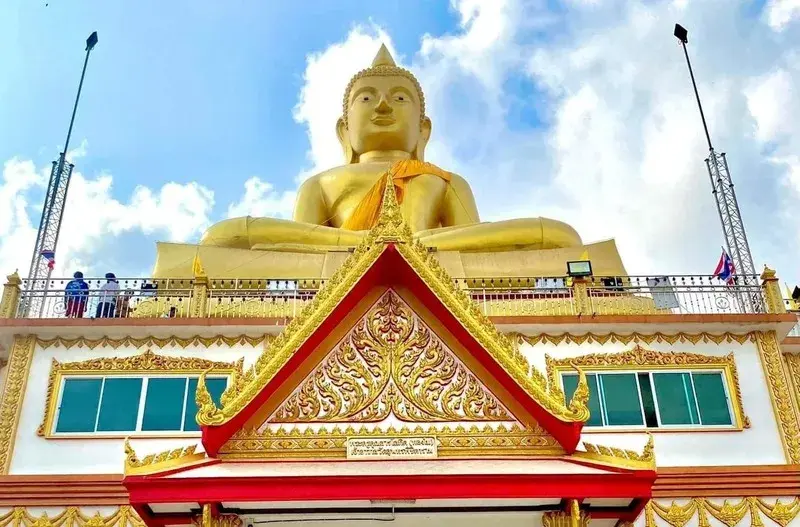
Another major highlight of the temple today is the construction of a large image of Luang Pho Phutthasothon, along with a replica for worship. This has become a clear landmark of the temple and a major focus of devotion for both local people and visitors from elsewhere. The importance of this image lies not only in its visual grandeur, but also in the fact that it symbolizes the cooperation between the temple and the community in creating a shared sacred space.
When entering the temple, visitors often notice the peaceful and shaded atmosphere, along with a number of worship points, including the large Luang Pho Sothon image, Buddha images for each day of the week, the bell tower, and areas associated with the legend of Bueng Phra Ajarn. This variety means that a visit to the temple is not limited to a quick act of worship, but gives people the opportunity to spend time walking through the grounds, absorbing the atmosphere, and gradually understanding the stories connected with the place.
For those interested in cultural tourism, Wat Sunthornphichitaram is especially attractive because it brings together several dimensions in one place: community history, local legend, sacred objects, and the continuing role of the temple in the everyday life of the people. Visitors do not simply experience a temple visit, but also see how a community gives meaning to its landscape through storytelling and the transmission of faith across generations.
This makes the temple suitable for those who wish to come and pray for blessings, those interested in local legend, and those who want to understand in depth the relationship between temple and community in Ongkharak District. The more time one spends exploring the grounds and listening to the stories of Bueng Phra Ajarn, the clearer it becomes that this temple is valuable not only as a religious site, but also as a place that preserves the spiritual identity of the locality in a very tangible way.
For those planning a visit, it is important to dress modestly, respect the temple, and allow a little more time than one might at an ordinary temple, because there are several interesting points to explore. If you plan to visit during ceremonies, merit-making events, or special activities, it is advisable to contact the temple in advance so your trip will be more convenient and you will not miss the time of the activities you wish to join.
Getting There Wat Sunthornphichitaram is quite convenient for visitors traveling by private car. The temple is located in Phra Ajarn Subdistrict, Ongkharak District, Nakhon Nayok Province, and it is easier to reach than temples located in mountain or waterfall zones of the province. Starting from Bangkok or Rangsit, the route to Ongkharak is fairly straightforward, and from there visitors can continue to the temple at 81 Moo 10, Phra Ajarn Subdistrict. This makes the temple suitable both for a half-day stop and as part of a pilgrimage trip near Bangkok.
Overall, Wat Sunthornphichitaram, or Wat Bueng Phra Ajarn, is a temple that is complete in terms of history, belief, religion, and the cultural value of Ongkharak locality. It stands out not only because of its legend or its large Luang Pho Sothon image, but because it continues to function as a “living sacred space” where both the community and visitors can encounter the past and the present together. Anyone who has the opportunity to travel to this area should consider stopping here at least once to experience it personally.
| Place Summary | Wat Sunthornphichitaram, also known as Wat Bueng Phra Ajarn, is a Mahanikaya Buddhist temple in Phra Ajarn Subdistrict, Ongkharak District, Nakhon Nayok Province. It was established in 2460 BE and is known for the legend of Bueng Phra Ajarn and the large image of Luang Pho Phutthasothon. |
| Highlights | The crocodile legend of Bueng Phra Ajarn, belief in sacred water, the large Luang Pho Phutthasothon image, the atmosphere of an old community temple, and multiple worship points within the temple grounds |
| History / Period | Established in 2460 BE and granted Wisungkhamasima on October 3, 2543 BE |
| Latest Caretaker or Abbot | It is confirmed that Luang Pho Thongbai Khunsaro was a former abbot and has passed away. The name of the current abbot has not yet been clearly confirmed through official public information. |
| Address | 81 Moo 10, Phra Ajarn Subdistrict, Ongkharak District, Nakhon Nayok Province |
| Getting There | Best reached by private car. Travel into Ongkharak District and continue to Phra Ajarn Subdistrict. The temple is relatively easy to access compared with temples in the mountain areas of Nakhon Nayok. |
| Facilities | Parking area and multiple worship points within the temple grounds |
| Zones | The large Luang Pho Sothon zone, Buddha image worship points, bell tower, and areas associated with the Bueng Phra Ajarn legend in local perception |
| Nearby Tourist Attractions | 1. Ongkharak Morning Market 2. Flower and Ornamental Plant Village 3. Farm de Lek 4. Mazecape 5. Ban Pla Kan Khloi, Khlong 14 |
| Nearby Restaurants | 1. Krua Lung Dam Ongkharak Tel. 098-547-4465 2. NIYOM is my father Tel. 098-564-4244 |
| Nearby Accommodations | 1. Hong Phak Lang Mo 2. Area 15 Hotel & Apartment 3. Loft Village Nakhon Nayok |
| Main Contact Number | 087-000-8282 |
Frequently Asked Questions (FAQ)
Q: Where is Wat Sunthornphichitaram located?
A: The temple is located at 81 Moo 10, Phra Ajarn Subdistrict, Ongkharak District, Nakhon Nayok Province, and is widely known by the name Wat Bueng Phra Ajarn.
Q: Is Wat Bueng Phra Ajarn the same temple as Wat Sunthornphichitaram?
A: Yes. They are the same temple. The name Wat Bueng Phra Ajarn comes from the local legend about the swamp and the master monk with spiritual powers.
Q: When was Wat Sunthornphichitaram established?
A: The temple was established in 2460 BE and was granted Wisungkhamasima on October 3, 2543 BE.
Q: What is the most important highlight of the temple?
A: The key highlights are the legend of Bueng Phra Ajarn, the belief in its sacred water, and the large Luang Pho Phutthasothon image, which is an important worship point of the temple.
Q: Is Luang Pho Thongbai still the current abbot?
A: He should no longer be identified as the current abbot, because the latest information confirms that Luang Pho Thongbai Khunsaro was a former abbot and has already passed away.
Q: Should visitors call ahead before traveling?
A: Yes, especially if you plan to visit during ceremonies or important days, because no clearly confirmed official opening hours were found in the public information reviewed. The contact number found is 087-000-8282.
 Wat Sunthornphichitaram Map
 Category:
  Group:
  Tag: ●Wat Sunthornphichitaram●wat sunthornphichitaram ●wat bueng phra ajarn ●wat sunthornphichitaram nakhon nayok ●bueng phra ajarn temple ●ongkharak temple ●sacred pond temple thailand ●luang pho sothorn replica nakhon nayok ●spiritual temple ongkharak ●old temple nakhon nayok ●buddhist temple with local legend
Last Update: 2 DayAgo
Tag: ●Wat Sunthornphichitaram●wat sunthornphichitaram ●wat bueng phra ajarn ●wat sunthornphichitaram nakhon nayok ●bueng phra ajarn temple ●ongkharak temple ●sacred pond temple thailand ●luang pho sothorn replica nakhon nayok ●spiritual temple ongkharak ●old temple nakhon nayok ●buddhist temple with local legend
Last Update: 2 DayAgo
 Nearby Attractions
 Region
 Muang Nakhon Nayok(
 Copyright 2012,