
 Home
Home North(
 Chiang Mai(


Dong Lakhon Ancient City
Rating: 4.3/5 (4 votes)
 Search By
  Map
Map 
 Have Map
  No Map
Nakhon Nayok attractions
Attractions in Thailand
Open Days: Open daily
Opening Hours: 08.00 – 16.00
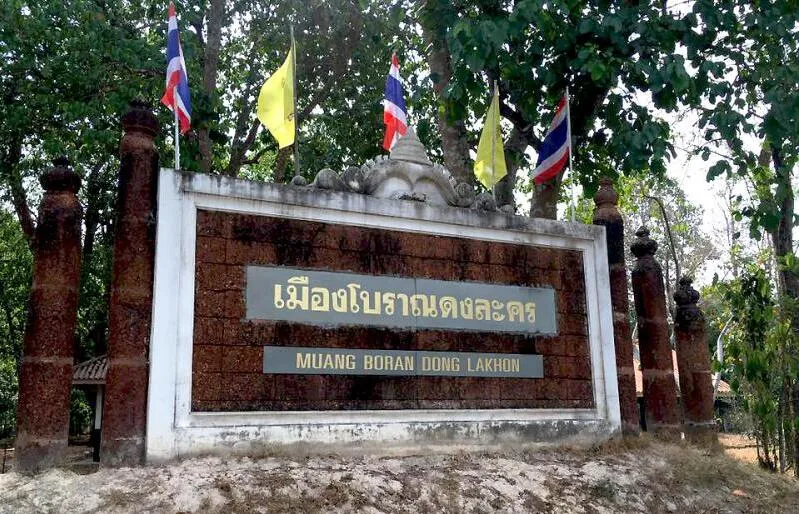
Dong Lakhon Ancient City, located in Dong Lakhon Subdistrict, Nakhon Nayok Province, is an important archaeological site in Central Thailand that reflects the development of urban communities from the Dvaravati period through the influence of the Khmer. It stands out for its oval city plan, double layers of moats and earthen embankments, the legend of the hidden city, and archaeological remains that reveal the prosperity of an ancient settlement that once played a role in the cultural network of the central region.
Dong Lakhon Ancient City is especially interesting for visitors who want to understand the history of Nakhon Nayok beyond its image as a transit town or a province known mainly for natural attractions. Beneath the quiet and simple landscape seen today, this area was once a complex urban community with defensive systems, spatial planning, and layered cultural development many centuries ago. A visit to Dong Lakhon is therefore not just about seeing ancient moats or earthen mounds, but about slowly reading the landscape to uncover the past that still lies just beneath the surface.
One of the most distinctive features of Dong Lakhon is that its city layout can still be seen in the natural terrain. The inner city has an oval or egg-shaped form and lies toward the western side of the larger earthen rise known locally as “Dong Yai.” Inside, the settlement is enclosed by 2 layers of moats and embankments, which villagers refer to as the “San Khu Mueang,” or city earthworks. This structure is a shared characteristic of many ancient Dvaravati cities and confirms that Dong Lakhon was not a small scattered settlement, but a planned city with an organized layout.
The broader Dong Yai area covers about 6 square kilometers. The central zone, or Dong Lek, was likely the space used by the ruling class or served as the main center for important activities, while ordinary residents probably lived in the lower surrounding areas outside the inner city. This pattern of land use clearly reflects social hierarchy and the organized structure of an ancient urban community. Dong Lakhon is therefore an important piece of evidence for the formation of urban society in Central Thailand, not merely a site with old artifacts.
The prosperity of Dong Lakhon can be clearly divided into 2 major phases. The first dates to approximately the 14th–16th Buddhist centuries, corresponding to the Dvaravati cultural period. During this phase, the city’s layout, moats, embankments, and traces of Buddhism became more prominent. Dong Lakhon likely served as a regional center connected to other settlements across Central Thailand. The second phase dates to around the 17th–19th Buddhist centuries, when Khmer influence and pre-Ayutthaya culture became involved, making the city more complex in terms of art, belief systems, and patterns of land use.
The fact that Dong Lakhon remained inhabited across multiple cultural periods gives the site high archaeological value. It helps explain that ancient communities did not remain fixed within a single cultural framework, but were able to adapt, absorb outside influences, and transform according to political, economic, and religious conditions. Dong Lakhon is thus like a window into the dynamics of ancient urban communities in Central Thailand, both during the flourishing of Dvaravati culture and during the period when outside powers began to play a greater role.
At the regional level, Dong Lakhon is often linked to Si Mahosot Ancient City in Prachin Buri Province, as the 2 sites are only about 55 kilometers apart and both are important ancient cities that share cultural characteristics. Their geographical proximity has led to the assumption that Dong Lakhon may have been connected to regional transportation routes, trade networks, or even political relationships. The city should therefore not be viewed in isolation, but rather read together with other ancient settlements in lower Central Thailand.
Archaeological evidence found at the site confirms that this was a prosperous urban community in many respects. Artifacts discovered here include pottery shards, blue-glazed ceramics, glass beads, stone beads, clay tokens, lead sheets, bronze earrings, gold sheets, a gilt Buddha head, a laterite stupa, bronze rings, and bronze bracelets. The discovery of such a wide range of objects suggests that the people of Dong Lakhon did not live only a basic agricultural life, but also engaged in craftsmanship, religious practice, personal adornment, and possibly continuous exchange with other communities.
In interpretive terms, earthenware and glazed ceramics point to everyday life and trade connections. Glass and stone beads reflect decorative preferences and the possible importation of materials or technology from outside. Metal objects such as gold sheets, bronze earrings, bronze rings, and bronze bracelets suggest skilled craftsmanship and the status of their owners. Meanwhile, the gilt Buddha head and laterite stupa are important pieces of evidence highlighting the role of Buddhism as a central belief system within the community.
What makes Dong Lakhon even more fascinating is the way “legend” overlaps with “archaeology.” This place was once called the “Hidden City,” based on local stories that it had been a city of a Khmer queen and a secluded royal retreat that ordinary people could not easily enter or leave. The surrounding area was covered by dense forest, and anyone who wandered in might lose their way and remain trapped within the woods. Such stories reveal how later communities understood this ancient landscape as a mysterious and powerful place.
Another part of the legend that makes the name Dong Lakhon so memorable is the belief that on Buddhist observance days, villagers could hear the sounds of krachappi, fiddles, piphat music, and mahori ensembles, as if a performance were taking place inside the ancient city. These disembodied sounds became part of the imagination surrounding the lost city in the forest, and led villagers to call the place “Dong Lakhon,” or “Forest of Performance.” Another explanation suggests that “Dong Lakhon” may be a corruption of “Dong Nakhon,” meaning “city in the forest.” Both interpretations add linguistic and cultural depth to the name of the place.
The name Dong Lakhon is therefore more than a geographical label. It brings together landscape, collective memory, and the later interpretation of local communities. Visitors are not simply walking among earthen ramparts and moats, but moving through a place where layers of history and imagination overlap. This quality makes Dong Lakhon different from archaeological sites known only through academic data, because it is also a place where cultural storytelling remains alive in local memory.
The geography inside the city also reveals a carefully organized use of space. On the eastern side is an area called “Nong Krapho,” which served as an entrance to the city, and there were ponds in all 4 directions. This detail is important because it suggests that Dong Lakhon was not merely a fortified city surrounded by moats for defense, but also one that placed importance on water management and internal connectivity for long-term habitation. When considered together with the double moats and embankments, it becomes even clearer that this was a city that had been purposefully designed and actively used over a long period.
As for the city’s decline, it has been assumed that around the 19th Buddhist century, the people of Dong Lakhon gradually moved to settle along the main waterways of Nakhon Nayok. This shift may have been influenced by several factors, including changing transportation routes, access to water resources, shifts in political power, and the relocation of economic networks from the old city to new areas. Once Dong Lakhon was no longer the center it had once been, the settlement gradually became abandoned, and was eventually overtaken by nature, reinforcing its later image as a “hidden city.”
Although it became deserted, Dong Lakhon never truly disappeared from the landscape of Nakhon Nayok. On the contrary, traces of the city can still be observed in the lines of its embankments, its moats, and the way the terrain differs from the surrounding agricultural land. Its registration as a national archaeological site by the Fine Arts Department further confirms that the city has value at the national level, not just within the local community, and that it is one of the key pieces of evidence for understanding the development of ancient urban society in Central Thailand.
For present-day visitors, Dong Lakhon offers a very different experience from mainstream tourist attractions. There is no large exhibition hall, no newly built structures disrupting the sense of the past, and no commercial bustle. What travelers receive instead is the quiet of the place, a feeling of age embedded in the environment, and the chance to take time reading the remains of the city directly from the land itself. Dong Lakhon is therefore especially suitable for people who enjoy places with stories, appreciate history, and value sites where an original atmosphere still survives.
From an experiential perspective, Dong Lakhon is a place best visited slowly. The more time one spends walking and observing, the more meaningful the site becomes. Earthen mounds that may at first seem like ordinary changes in ground level begin to matter once one understands that they were once city walls. Quiet moats become more intriguing when recognized as defensive works and part of a water management system. Even the name Dong Lakhon gains greater weight when one knows both the legend of ghostly court music and the linguistic theory linking it to the word “Dong Nakhon.”
Another reason Dong Lakhon Ancient City is so compelling is that it appeals to several groups of readers and travelers at the same time: those interested in Thai history, those wanting to learn about important archaeological sites in Nakhon Nayok, and those searching for a cultural attraction near Bangkok that offers a different kind of experience from nature-based travel alone. When considered together through its history, significance, local legends, and relatively convenient access, Dong Lakhon becomes a destination with strong appeal both as a source of knowledge and as a real travel experience.
Content about Dong Lakhon Ancient City can also be connected to multiple dimensions of travel in Nakhon Nayok, whether as part of a historical sightseeing route, an archaeological learning experience, or a one-day trip that includes important temples and noteworthy sites in the town area. Visitors do not come here only to stop briefly at an ancient site, but can also use the place as a starting point for understanding Nakhon Nayok in a way that is older, deeper, and more clearly rooted in cultural history.
In academic terms, Dong Lakhon is also important because it demonstrates the relationship between archaeology and landscape ecology. Establishing a city on slightly elevated ground not far from lowland areas allowed the community to access water resources while also maintaining land high enough for an urban core and defensive structures. Cities of this kind often did not rely on monumental stone architecture as the symbol of prosperity, as some Khmer cities did, but instead used city planning and landscape control as their defining foundation. Dong Lakhon is one of the clearest examples of this pattern in Nakhon Nayok.
The fact that cultural heritage authorities have continued to study Dong Lakhon archaeologically also shows that the site is not merely a place that “used to matter,” but one that still holds ongoing educational and interpretive value today. For general visitors, this adds another layer of significance to the trip, because it means the visit is not simply about seeing an old place, but about encountering a real landscape of Thai historical knowledge that is still being studied and that can still contribute to a broader understanding of ancient states in Central Thailand.
Although Dong Lakhon does not have the kind of instantly recognizable image associated with major waterfalls, famous temples, or highly photogenic landmarks elsewhere in Nakhon Nayok, its charm lies in stillness, age, and narrative depth. People who enjoy reading places through context will find that this site contains more layers than first appear, from its name and legend to its city planning and role in the cultural networks of ancient Central Thailand. For travelers wanting to see a different side of Nakhon Nayok, Dong Lakhon is a rewarding destination.
The atmosphere around Dong Lakhon Subdistrict also makes a visit to this ancient city more relaxed than sightseeing in a busy urban zone. Travelers can plan stops at nearby places such as Wat Mani Wong, the Nakhon Nayok City Pillar Shrine, Wat Fang Khlong, Wat Dong, and Wat Udom Thani Royal Monastery within the same trip. This means that visiting Dong Lakhon is not only about seeing an archaeological site, but can also become part of a wider cultural route through Nakhon Nayok that links history, faith, and local community life in a meaningful way.
Getting There Dong Lakhon Ancient City is fairly easy to reach by private car. From Nakhon Nayok town, take Highway 3076 and then turn in for about 6 km. The route passes Wat Chedi Thong, then continues in the same direction as Wat Dong Lakhon before reaching the ancient city area. Since the site is not far from the town center, it is suitable for a half-day trip or for combining with temple visits and other important attractions in Nakhon Nayok town. For travelers interested in cultural exploration, visiting in the morning or later in the afternoon, when the sun is less intense, makes walking around the site more comfortable.
Even so, visitors should approach Dong Lakhon with respect, because this is an archaeological site, not a general recreation area. Visitors should avoid climbing embankments in areas at risk of erosion, should not litter, should not disturb the surrounding community, and should never remove any objects. If pieces of brick, pottery, or possible archaeological traces are noticed, the most appropriate action is to observe them carefully and leave them exactly where they are, so that the site can preserve its historical value for as long as possible.
In the end, Dong Lakhon Ancient City does not stand out because of monumental architecture, but because it is a city that can still be read directly from the land. It is a place where history has not been separated from the landscape, and where even the name of the site carries a story of its own. For anyone wishing to experience Nakhon Nayok in a way that is older, deeper, and quieter than fast-paced sightseeing, Dong Lakhon is a destination that deserves a place on the itinerary. The more one learns about it, the more this quiet place reveals itself to be far more meaningful than it first appears.
| Place Name | Dong Lakhon Ancient City |
| Place Summary | An important archaeological site in Nakhon Nayok Province, this ancient city has an oval plan with 2 layers of moats and embankments, reflecting the development of urban communities from the Dvaravati period through Khmer influence. |
| Highlights | Double moats and embankments, oval inner city, the legend of the “Hidden City,” beliefs about ghostly court music on holy days, a wide range of archaeological finds, and strong national archaeological significance. |
| History / Period | The city flourished in 2 major phases: the 14th–16th Buddhist centuries during the Dvaravati period, and the 17th–19th Buddhist centuries under Khmer and pre-Ayutthaya influence, before the community gradually moved toward settlements along major waterways. |
| Address | Dong Lakhon Subdistrict, Mueang Nakhon Nayok District, Nakhon Nayok Province |
| Getting There | From Nakhon Nayok town, take Highway 3076 and turn in for about 6 km. Pass Wat Chedi Thong and continue in the same direction as Wat Dong Lakhon before reaching the ancient city area. |
| Open Days / Opening Hours | Open Daily, 08.00 – 16.00 |
| Current Status | Still open to visitors as an archaeological site and cultural attraction in Nakhon Nayok. |
| Zones / Key Features | The inner city or Dong Lek, 2 layers of moats and embankments, the line of the city earthworks, Nong Krapho on the eastern side, and ponds in all 4 directions. |
| Nearby Tourist Attractions | 1. Wat Mani Wong – approximately 2 km 2. Nakhon Nayok City Pillar Shrine – approximately 7 km 3. Wat Fang Khlong – approximately 11 km 4. Wat Dong – approximately 9 km 5. Wat Udom Thani Royal Monastery – approximately 9 km |
| Nearby Restaurants | 1. Pu Cha Ka Ya Choi Steak Restaurant – approximately 1 km – Tel. 062-840-0441 2. Laplae Cafe Nakhon Nayok – approximately 1 km – Tel. 092-882-9364 3. Oki Coffee Space Nakhon Nayok Headquarters – approximately 4 km – Tel. 095-704-7787 4. Krua Pla Si Khwae – approximately 6 km – Tel. 095-793-5455 5. Daeng Kaeng Pa – approximately 8 km – Tel. 089-073-4516 |
| Nearby Accommodations | 1. Baan Saraphot Resort – approximately 4 km – Tel. 086-011-1118 2. Baan Chomphu Resort – approximately 6 km – Tel. 084-599-6142 3. Juntra Resort & Hotel – approximately 6 km – Tel. 089-834-6797, 037-315-289 4. Khaohom Resort – approximately 6 km – Tel. 037-349-659, 098-636-6628 5. Siri Resotel Nakhon Nayok – approximately 7 km – Tel. 062-802-8717 |
Frequently Asked Questions (FAQ)
Q: What is Dong Lakhon Ancient City?
A: Dong Lakhon Ancient City is an important archaeological site in Dong Lakhon Subdistrict, Nakhon Nayok Province, where traces of continuous settlement remain from the Dvaravati period through later Khmer influence, and where the moats and earthen embankments of the city can still be seen in the natural landscape.
Q: What are the highlights of Dong Lakhon Ancient City?
A: The site is known for its oval city plan, 2 layers of moats and embankments, the legend of the hidden city, the origin of the name Dong Lakhon, and the discovery of many archaeological objects that reflect the prosperity of the ancient community.
Q: On which days and at what time is Dong Lakhon Ancient City open?
A: It is open daily from 08.00 to 16.00.
Q: How do I get to Dong Lakhon Ancient City?
A: From Nakhon Nayok town, take Highway 3076 and continue for about 6 km after turning in. Pass Wat Chedi Thong and continue in the same direction as Wat Dong Lakhon to reach the ancient city area.
Q: Why is this ancient city called the Hidden City?
A: Local legend says that the area was once a mysterious city hidden in dense forest, where people who entered could easily lose their way, and where villagers believed they could hear ghostly court music and performance sounds on Buddhist observance days.
Q: How is Dong Lakhon Ancient City connected to the Dvaravati period?
A: Dong Lakhon has an urban layout, moats, and embankments similar to those found in many Dvaravati cities, and its first major period of prosperity dates to around the 14th–16th Buddhist centuries, which corresponds with Dvaravati culture.
Q: How much time should I allow for visiting Dong Lakhon Ancient City?
A: If you want enough time to walk around and understand the history of the site without rushing, you should allow at least 1–2 hours, and you can combine the visit with temples or other attractions in Nakhon Nayok town on the same day.
Q: Who is Dong Lakhon Ancient City suitable for?
A: It is ideal for visitors interested in history, archaeology, Thai culture, and travelers who want to explore a deeper and more meaningful side of Nakhon Nayok beyond its natural attractions and popular landmarks.
 Dong Lakhon Ancient City Map
 Category:
  Group:
  Tag: ●Dong Lakhon Ancient City●dong lakhon ancient city ●nakhon nayok ancient site ●dvaravati city thailand ●dong lakhon history ●nakhon nayok attractions ●ancient city thailand central region ●archaeological site thailand ●dvaravati civilization thailand ●ancient settlement nakhon nayok ●thailand historical sites Last Update: 1 DayAgo
 Nearby Attractions
 Region
 Muang Nakhon Nayok(
 Copyright 2012,