
 Home
Home North(
 Chiang Mai(


Wat Yai Thakkhinaram
Rating: 4.4/5 (5 votes)
 Search By
  Map
Map 
 Have Map
  No Map
Nakhon Nayok attractions
Attractions in Thailand
Open Days: Daily
Opening Hours: 08.00 - 16.30 hrs.
Wat Yai Thakkhinaram in Nakhon Nayok is an old temple of the Ban Yai Lao community whose value goes far beyond that of a religious site. This is a center of memory for people of Lao Wiang Chan descent who migrated and settled in Thailand, gradually establishing cultural roots that have remained deeply connected to Nakhon Nayok society up to the present day. Looking beyond the image of a quiet riverside temple, this place stands as living evidence of migration, adaptation, the preservation of identity, and cultural blending that has continued through many generations.
Wat Yai Thakkhinaram, which many local people still know by its former name, “Wat Yai Lao,” is located in Ban Yai Subdistrict, Mueang Nakhon Nayok District, on the bank of the Nakhon Nayok River. The setting is peaceful, shady, and closely reflects the pattern of settlement in the past, when rivers served as the lifeblood of communities in terms of transportation, farming, and the building of settlements. Its identity as a riverside temple is therefore not merely a scenic feature, but a true part of the history of local settlement.
When looking back to the origins of the Ban Yai Lao community, it becomes clear that the story of this temple is closely tied to the political history of the Mekong region. A group of people from Wiang Chan who were affected by war and political instability in the past migrated into central Thailand and chose to settle in the Nakhon Nayok area. There, they gradually built a new community without abandoning their original cultural roots. The name “Ban Yai Lao” is therefore not simply the name of a place, but a trace of shared memory passed down within the community.
What is especially interesting is that the migration of the people of Wiang Chan was not only the movement of people, but also the movement of an entire cultural world. This included language, beliefs, merit-making practices, customary codes, food traditions, dance, and forms of communal living. Over time, these elements did not disappear with changing eras. Instead, they adapted naturally into central Thai society and gave this area a cultural identity far more distinctive than that of an ordinary old temple community.
Wat Yai Thakkhinaram is believed to have been founded in 1780 by Lao migrants who settled in Nakhon Nayok during the early phase of community establishment. The temple therefore served both as a place for religious practice and as the center of community life at the same time. In the world of Lao Wiang Chan communities, a temple is not merely a place for monks, but a space connected to every stage of life, from birth and childhood to learning, merit-making, cooperation in community festivals, and the transmission of cultural values from one generation to the next.
The name “Thakkhinaram” carries a directional meaning. The word “Thakkhin” means south, while “aram” means temple. Together, the name means “the temple to the south,” reflecting the fact that the temple was located on the southern side of the community in earlier times. This means that the temple’s name is not only an official title, but also linguistic and geographical evidence connected to how the community once understood its own landscape.
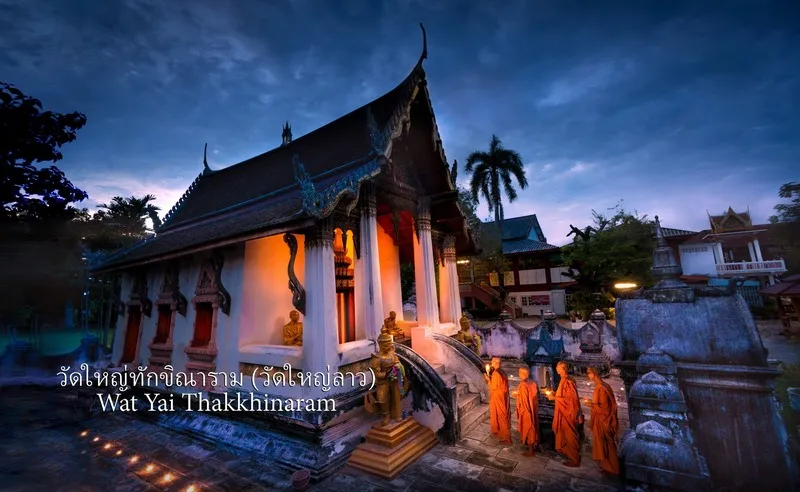
From an artistic point of view, Wat Yai Thakkhinaram is one of the most distinctive temples in Nakhon Nayok because its old ordination hall has long been described as a work reflecting the craftsmanship of Lao Wiang Chan artisans blended with Thai art and European influence in a highly interesting way. The structure of the ordination hall is not especially grand in scale, yet it stands out through its elegant proportions, arched entrances, and decorative features that differ from ordinary temples in Thailand’s central region. This allows visitors interested in architecture to clearly see traces of cultural fusion.
Another important feature of the old ordination hall is the refinement of its details, including the boundary wall, entrance archways, and the style of the guardian figures, all of which create an atmosphere distinct from other temples in the same area. Its beauty does not come from lavish grandeur, but from the weight of history embedded within the work itself. When observing the old structure closely, visitors can feel layers of time, repair, continuity, and the determination of the local community to preserve it together.
Inside the old ordination hall is the temple’s principal Buddha image, “Phra Phokphayan,” a revered Buddha image held in deep respect by local people. This principal image does not only serve a religious function, but has long been the center of community faith. Many people come to pay respect for good fortune, while in cultural terms the image also stands as a symbol of continuity between past and present, because it continues to serve as the center of the relationship between the temple, the community, and the faithful.
Wat Yai Thakkhinaram also holds value as a historic site of Nakhon Nayok because the old ordination hall has been recognized as an important building in the local history of art and architecture. Walking around this temple is therefore like reading history through real architecture. Every element, from the riverside setting and spatial layout to the form of the buildings and the beliefs of the community, helps visitors understand why this temple means far more than simply being an “old temple.”
When considering the role of the temple within the community, it becomes clear that Wat Yai Thakkhinaram has never been separate from the daily lives of local people. In the past, the temple was a place of learning, a venue for merit-making, festivals, and public activities. In the present, although the community’s way of life has changed with time, the temple still serves as a point of shared faith, a place where people return on important occasions, and a center for preserving traditions inherited from Lao Wiang Chan ancestors.
What makes Wat Yai Thakkhinaram especially compelling for those interested in culture is its close relationship with the traditions of the Lao Wiang Chan people, which can still be sensed in the Ban Yai community. Local residents still remember and value the customs of the Heet Sip Song and Khlong Sip Si as a framework for community life. Even though some forms have changed over time, the core values of living together through merit-making, mutual support, and the temple serving as the center of communal life can still be seen clearly.
The merit-making traditions most often mentioned by people in the community include Bun Khao Chi, Bun Bang Fai, and Bun Khao Pradap Din, all of which clearly reflect the cultural roots of the Mekong region. These traditions are important not only in ritual terms, but also because they connect people of different ages and allow younger generations to learn that community is not created simply by living near one another, but through continually doing things together. The temple therefore becomes the stage on which the memory of ancestors remains alive in the present.
Beyond these merit-making traditions, the culture of Lao dance, folk chanting, and the Lao Wiang Chan dialect still heard from elders in the area all add further depth to a visit to Wat Yai Thakkhinaram. Travelers interested in local history will not only see a beautiful temple, but will also encounter layers of culture still alive in real life, whether in local food, community memory, or patterns of social relationships shaped over a long period of time.
The atmosphere of Wat Yai Thakkhinaram is different from that of tourist-oriented temples filled with crowds and activity. Here, the feeling is peaceful, quiet, and full of the charm of an old community temple that still breathes with the lives of local people. The shade within the temple grounds, the breeze from the Nakhon Nayok River, and the unhurried rhythm of life make a visit feel more like slowly opening pages of an old story than rushing through a sightseeing stop. Those who appreciate temples with a strong sense of place will immediately feel that this temple holds a quiet but powerful presence.
The experience of visiting this temple is therefore best enjoyed slowly, whether by walking around the old ordination hall, observing the details of traditional craftsmanship, sitting and taking in the riverside atmosphere, or speaking with local people if the opportunity arises. A visit without haste allows travelers to understand the temple’s value much more deeply than simply arriving to take photographs or pay respects before leaving. Wat Yai Thakkhinaram is a place where the more time you spend, the more hidden beauty you begin to notice.
In terms of tourism, Wat Yai Thakkhinaram is especially suitable for those who want to explore Nakhon Nayok from a perspective deeper than waterfalls or outdoor nature activities. Nakhon Nayok is often remembered for its waterfalls, dam, and forests, but in reality the province also holds rich layers of culture and old communities that are highly interesting. Wat Yai Thakkhinaram is therefore like a doorway that allows travelers to see another side of Nakhon Nayok, one filled with history, memory, and the coexistence of people from different backgrounds on the same land.
When the story of the temple is connected with the Ban Yai Lao community, the value of this place becomes even clearer. The temple is not an isolated monument, but part of a wider cultural landscape. Within the community, traces of Lao Wiang Chan identity remain in many forms, including place names, historical narratives, speech, food, and merit-making traditions. The temple serves as the central axis holding all of these traces together, making it possible for such stories to still be recognized in the present world.
The present-day importance of Wat Yai Thakkhinaram exists on both a local and broader level. Locally, the temple remains the spiritual center of the community, a place for rituals and important communal occasions. On a broader level, it stands as important evidence of the movement of people and culture within Southeast Asia and reflects that when people are forced to migrate, they do not carry only their lives with them, but also their faith, wisdom, and identity, all of which help build a new home in a new land.
For those interested in old temples, local craftsmanship, or the history of migration, Wat Yai Thakkhinaram is a destination worthy of serious time and attention. This is not simply an old temple, but a temple that tells stories: the story of the Lao Wiang Chan community, the story of creating new roots on Thai soil, and the story of faith that has sustained a community through time with remarkable dignity.
Getting There to Wat Yai Thakkhinaram can be done by starting from Nakhon Nayok town and following Chaloem Phra Kiat Rama IX Road before turning into Soi 2 in Ban Yai Subdistrict. The temple stands by the Nakhon Nayok River. Traveling by private car is the most convenient option because it allows visitors to continue on to other temples and attractions in central Nakhon Nayok within the same day. If using a navigation system, you can search directly for “Wat Yai Thakkhinaram” or “Wat Yai Lao.” Those planning to pay respects and explore the architecture should allow at least 1 - 2 hours in order to fully experience the atmosphere, history, and details of the site.
In summary, Wat Yai Thakkhinaram is not simply another old temple in Nakhon Nayok, but a place that shows us that history does not exist only in books. It is embedded in communities, in architecture, in the language people speak, and in traditions that continue to be passed on. This temple therefore stands as a symbol of the re-rooting of the Lao Wiang Chan people on Thai soil and is a highly worthwhile destination for travelers who want to understand Nakhon Nayok in a dimension deeper than mainstream tourist attractions.
| Summary | An old temple of the Ban Yai Lao community in Nakhon Nayok, serving as the religious and cultural center of Lao Wiang Chan people who migrated and settled in the area |
| Highlights | Old ordination hall reflecting Lao Wiang Chan art blended with Thai and European styles, Phra Phokphayan, riverside temple atmosphere, and the story of the Ban Yai Lao community |
| History / Period | Believed to have been founded in 1780 by Lao migrants who settled in Nakhon Nayok. Its former name was “Wat Yai Lao,” and it was renamed “Wat Yai Thakkhinaram” in 1941. |
| Latest Abbot / Caretaker | Phra Khru Ophat Yanakhun |
| Address | Chaloem Phra Kiat Rama IX Road, Soi 2, Ban Yai Subdistrict, Mueang Nakhon Nayok District, Nakhon Nayok 26000 |
| Coordinates | 14.210000, 101.230000 |
| Getting There | From central Nakhon Nayok, follow Chaloem Phra Kiat Rama IX Road, then turn into Soi 2 in Ban Yai Subdistrict. The temple is located on the Nakhon Nayok River. Traveling by private car is the most convenient option. |
| Open Days | Daily |
| Opening Hours | 08.00 - 16.30 hrs. |
| Entrance Fee | No confirmed entrance fee information found |
| Facilities | Temple courtyard, worship areas inside the ordination hall and temple buildings, and parking areas within the temple grounds depending on available space |
| Zones | Old ordination hall, monastic area, temple courtyard, and riverside area along the Nakhon Nayok River |
| Nearby Attractions with Distance | 1. Wat Udom Thani Royal Monastery — approximately 500 m. 2. Wat Rangsi Sophon — approximately 700 m. 3. King Rama IX Commemorative Park — approximately 2.3 km. 4. Nakhon Nayok City Pillar Shrine — approximately 2.7 km. 5. Wat Pho Ni Yok — approximately 3 km. |
| Nearby Restaurants with Distance and Phone Numbers | 1. Ban Yai Chicken Rice Shop — approximately 700 m. — Tel. 095-241-6467 2. Khrua Khiang Nam — approximately 900 m. — Tel. 064-428-1650 3. Ahan Branch 1 — approximately 1.2 km. — Tel. 096-050-6766, 061-512-9565 4. SWITCH ON BLACK COCOA Ban Yai Branch — approximately 1.4 km. — Tel. 065-949-1494 5. Srisunee Restaurant — approximately 1.8 km. — Tel. 037-311-529 |
| Nearby Accommodations with Distance and Phone Numbers | 1. Win Resort — approximately 300 m. — Tel. 089-932-2209 2. Monkey Art Hotel & Cafe — approximately 1.8 km. — Tel. 086-655-5749 3. KOB KUEA Boutique Hotel — approximately 2 km. — Tel. 081-639-4122 4. Kob Kuea Palace Hotel — approximately 2.2 km. — Tel. 037-311-633 5. Ruen Phak Rim Nam — approximately 9 km. — Tel. 081-658-4154 |
| Main Contact Number | 037-311-503 |
Frequently Asked Questions (FAQ)
Q: Where is Wat Yai Thakkhinaram located?
A: Wat Yai Thakkhinaram is located on Chaloem Phra Kiat Rama IX Road, Soi 2, Ban Yai Subdistrict, Mueang Nakhon Nayok District, Nakhon Nayok, on the bank of the Nakhon Nayok River.
Q: What was the former name of Wat Yai Thakkhinaram?
A: The temple’s former name was “Wat Yai Lao,” reflecting its identity as the temple of the Lao Wiang Chan community that migrated and settled in Nakhon Nayok.
Q: What are the highlights of Wat Yai Thakkhinaram?
A: The highlights include the old ordination hall with distinctive Lao Wiang Chan art blended with Thai and European styles, the principal Buddha image Phra Phokphayan, and the story of the Ban Yai Lao community that has preserved its culture up to the present day.
Q: When was Wat Yai Thakkhinaram founded?
A: It is generally believed that the temple was founded in 1780 by Lao migrants who settled in Nakhon Nayok, and it was later renamed Wat Yai Thakkhinaram in 1941.
Q: What time does Wat Yai Thakkhinaram open?
A: The information currently in use states that the temple is open daily from 08.00 - 16.30 hrs.
Q: Who is the abbot of Wat Yai Thakkhinaram?
A: The latest verified information states that the abbot is Phra Khru Ophat Yanakhun.
Q: What places can visitors continue to after visiting Wat Yai Thakkhinaram?
A: Visitors can continue to Wat Udom Thani Royal Monastery, Wat Rangsi Sophon, King Rama IX Commemorative Park, Nakhon Nayok City Pillar Shrine, and Wat Pho Ni Yok, as they are all located within the same central city zone.
Q: What type of travelers is Wat Yai Thakkhinaram suitable for?
A: It is suitable for visitors interested in old temples, local craftsmanship, the history of the Lao Wiang Chan community, and travelers who want to understand Nakhon Nayok from a cultural perspective rather than only through nature tourism.
 Wat Yai Thakkhinaram Map
 Category:
  Group:
  Tag: ●Wat Yai Thakkhinaram●wat yai thakkhinaram ●wat yai lao ●ban yai lao nakhon nayok ●old temple nakhon nayok ●lao vieng chan temple ●lao vieng chan community thailand ●riverside temple nakhon nayok ●cultural attractions nakhon nayok ●historic temple nakhon nayok ●wat yai thakkhinaram history Last Update: 10 HourAgo
Comment
 Nearby Attractions
| Keyword (Advance) |
 Facebook Fanpage
 Region
 Art, Culture and Heritage
 Historical Sites and Monuments(
 Landmarks and Memorials(
 Art, Craft Centres, Tradition(
 Museums(
 Educational Places
 Educational Gardens, Farm(
 University
 Church(
 Mosque(
 Other religious and spiritural sites(
 Suburban Living
 Village, Community(
 Local Market(
 Nature and Wildlife
 Dam, Reservoir, Lake(
 Waterfalls(
 Other natural attractions(
 Entertainment and Agricultural
 Farm, Parks, Gardens and Ecotourism(
 Outdoor and Adventure Activities(
 Copyright 2012,