
lovethailand home >North Travel Attractions >Chiang Rai Travel Attractions >Muang Chiang Rai >Tha Sut > Mae Fah Luang University
TL;DR: Mae Fah Luang University, Chiang Rai attractions : University, Autonomous Universities.
Mae Fah Luang University
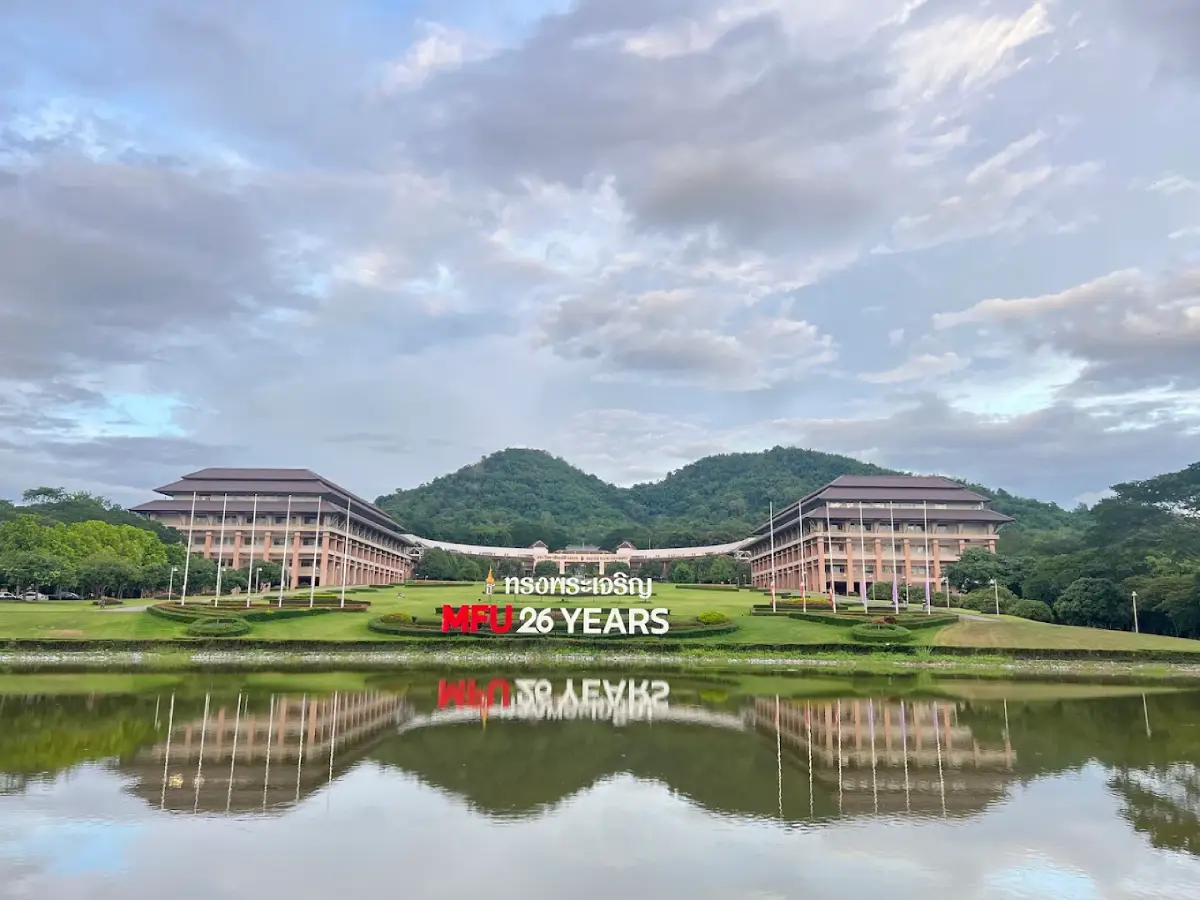
Open Days: Monday–Friday for Official Educational Visits, Excluding Public Holidays
Opening Hours: 09:00–16:00 for Educational Visits, with Prior Arrangements Required at Least 10 Working Days in Advance
One Stop Service Hours: Monday–Friday, 08:30–16:30, Excluding Public Holidays
Mae Fah Luang University (MFU) is an autonomous public university located at 333 Moo 1, Tha Sut Subdistrict, Mueang Chiang Rai District, Chiang Rai Province 57100, Thailand. Established on 25 September 1998 under the Mae Fah Luang University Act B.E. 2541 (1998), the university commemorates the profound contributions of Her Royal Highness Princess Srinagarindra, the Princess Mother, affectionately known as Mae Fah Luang. It also carries forward her royal aspiration to restore forests and develop people. Situated among the hills and green landscapes of Chiang Rai, the university is distinguished by its Lanna-inspired architecture, carefully planned campus environment, international academic outlook, and multidisciplinary educational programmes. Its academic strengths include science, digital technology, cosmetic science, agro-industry, medicine, nursing, dentistry, integrative medicine, Chinese studies, management, law, and international development. Today, Mae Fah Luang University serves as a major higher education institution in northern Thailand, a center for research and innovation, and a destination for educational visitors interested in history, culture, architecture, and environmental conservation.
One of the university's defining qualities is its setting as a university town surrounded by nature. Academic buildings, administrative offices, auditoriums, learning centers, and student residences are arranged across gently rising hills, with landscaped gardens, lawns, ponds, roads, and pedestrian routes connecting different parts of the campus. From an elevated viewpoint, the composition of buildings and their characteristic roofs reveals a design intended to harmonize with the surrounding mountains and greenery. The landscape reflects the ambition to create more than a collection of classrooms. It provides an environment for intellectual development, community life, personal well-being, and a continuing awareness of the relationship between people and nature.
Chiang Rai is an important historical region of the former Lanna Kingdom and a gateway linking Thailand with the Greater Mekong Subregion. Its geography combines the Kok River basin, mountain ranges, forests, agricultural valleys, and communities with diverse ethnic, linguistic, and cultural backgrounds. The province's connections with Laos, Myanmar, and southern China give it considerable potential in border trade, transportation, tourism, agriculture, and international cooperation. Establishing a major international-oriented university in Chiang Rai therefore represented both an expansion of educational opportunities and an investment in knowledge and human resources for a strategically important region.
Before Mae Fah Luang University was established, people in Chiang Rai had advocated for a university in the province for many years. Young people wishing to pursue higher education frequently had to move to other provinces, particularly Chiang Mai or Bangkok. This created additional costs for families and limited access to university education for some students. At the same time, Chiang Rai needed professionals with specialized knowledge to support economic development, public health, community welfare, environmental management, and the growing complexity of border-region activities.
The movement to establish the university received support from Chiang Rai residents and national higher education administrators. Professor Dr. Wanchai Sirichana, who was serving as Permanent Secretary of the Ministry of University Affairs during the founding process, played a leading role in advancing the project and coordinating its implementation. On 28 February 1997, he was appointed Chairman of the University Establishment Committee. The work involved planning the university's site, buildings, academic programmes, staffing, and administrative structure so that teaching and institutional operations could begin within the intended period.
Choosing Chiang Rai as the location was also closely connected with the legacy of Princess Srinagarindra. Throughout her life, the Princess Mother undertook extensive royal development activities to improve the quality of life of people in remote northern communities. Her contributions to healthcare, education, livelihoods, forest restoration, and the well-being of highland communities helped transform the region. The university was consequently conceived as an enduring educational institution that would honor her memory while continuing the work of developing people, protecting natural resources, and respecting the cultural traditions of northern communities.
On 25 September 1998, the Mae Fah Luang University Act B.E. 2541 was published in the Royal Gazette, establishing the university as an autonomous public institution. The legislation gave the university a legal and administrative status distinct from an ordinary government department, allowing greater flexibility in university management. Its statutory responsibilities included higher education, advanced professional development, teaching, research, academic services to society, the preservation of arts and culture, and environmental conservation. These responsibilities remain closely connected with the identity and mission of the university.
Mae Fah Luang University began with an inaugural class of just 64 students in 1998. During its earliest years, almost every part of the institution had to be developed simultaneously, including administrative systems, teaching staff, academic curricula, physical facilities, and student services. Establishing a new university in the hills around Doi Ngaem required careful master planning and extensive construction work. The project aimed to accommodate the long-term growth of a major educational institution while preserving the natural qualities of the surrounding landscape.
On 20 October 1998, Associate Professor Dr. Wanchai Sirichana was appointed Acting President and subsequently served as University President. His contribution to the development of Mae Fah Luang University extended to institutional management, academic direction, international collaboration, and the creation of the campus master plan. The founding vision emphasized the development of an internationally competitive university with a distinctive identity, despite the challenges of building an entirely new higher education institution.
The physical development of the campus presented significant challenges. Roads, academic buildings, and student facilities had to be constructed together with essential infrastructure, including electricity, water supply, drainage, transportation routes, and residential accommodation. Because the site covered a large hilly area, the university required a comprehensive plan capable of supporting future expansion. Landscaped open spaces, tree planting, and the careful arrangement of building clusters became defining features of the campus environment.
An especially distinctive element of the university master plan is Lan Dao, or Star Plaza, situated at the center of a group of important university buildings. Its design was inspired by Princess Srinagarindra's interest in astronomy and the celestial map depicted on the ceiling of the throne hall at Doi Tung Royal Villa. The concept imagines the buildings arranged like groups of stars radiating from a central point. As a result, Star Plaza functions both as a symbolic architectural feature and as an important gathering space for students, employees, and visitors.
Lan Dao covers approximately 2,256 square wah and has a diameter of around 95 meters. Its open landscape includes gardens, seasonal flowerbeds, a decorative fountain, and walkways connecting the surrounding buildings. Construction took place between 2000 and 2003. Over time, the plaza became closely associated with major university ceremonies, recreational activities, and shared memories of student life. Its architectural concept expresses the connection between the Princess Mother's interests and the physical identity of the university.
The name Mae Fah Luang is meaningful far beyond the designation of an educational institution. It is the affectionate royal title by which people in northern highland communities referred to Princess Srinagarindra. She frequently traveled by helicopter to visit residents of remote areas, bringing assistance and encouragement to communities that were difficult to reach by road. Her arrival from the sky became an enduring image of compassion and public service, inspiring the name Mae Fah Luang, often understood as the Royal Mother from the Sky.
The university emblem incorporates elements associated with the life and royal contributions of Princess Srinagarindra. Her royal initials form an important part of the design, together with decorative motifs connected to the lamduan flower and the university's commitment to environmental improvement and the quality of life of the people. The university's official colors are red and gold. Red is associated with Sunday, the day on which Princess Srinagarindra was born, while gold represents the continuing prosperity and development of the university.
The university flower and tree are the lamduan, also known locally as hom nuan, a flowering evergreen tree known for its delicate pale blossoms and fragrance. The University Council formally designated the lamduan as the institutional flower and tree on 9 October 2002. The plant has botanical as well as cultural significance, and its selection reflects the university's relationship with nature and personal development. Students are also collectively associated with the name lamduan, which reinforces a shared sense of institutional identity across generations.
Mae Fah Luang University's academic robes incorporate decorative elements inspired by Lanna culture, particularly the traditional tung banners associated with Doi Tung. These motifs symbolize auspiciousness, regional heritage, and cultural continuity. Designs appearing on the ceremonial robes include representations associated with palaces, nagas, tigers, and rats, reflecting Lanna artistic traditions and historical symbolism. Their use demonstrates the university's commitment to preserving local culture through meaningful elements of academic ceremony.
Another milestone occurred on 3 February 2004, when Her Royal Highness Princess Maha Chakri Sirindhorn, acting on behalf of His Majesty the King, officially opened Mae Fah Luang University and the Sirindhorn Chinese Language and Culture Center and conferred degrees upon the university's first graduating class, which had completed its studies in the 2002 academic year. This event symbolized the transition from the university's founding and construction period to its emergence as a fully functioning institution of higher education.
The Sirindhorn Chinese Language and Culture Center is one of the university's most significant architectural and cultural landmarks. Established through cooperation between Mae Fah Luang University and the Government of the People's Republic of China, the project reflects the university's international connections and commitment to Chinese language and cultural education. Its foundation stone was laid on 9 December 2000, construction began on 29 December 2001, and the completed project was formally handed over to the university on 20 August 2002. The official opening ceremony followed on 3 February 2004.
The center's design draws upon traditional Chinese architecture and garden planning. It includes academic buildings, working spaces, activity areas, ponds, pavilions, covered walkways, and landscaped gardens. Dark-tiled roofs, white walls, moon gates, lanterns, and decorative details give the complex a distinctive character, while the carefully composed garden creates a quiet and balanced environment. The center is therefore valuable not only as an academic facility but also as a place where visitors can appreciate Chinese architectural traditions and cultural exchange.
Chinese language studies at Mae Fah Luang University are closely connected with trade, tourism, education, and international cooperation between Thailand and China. The School of Sinology, Sirindhorn Chinese Language and Culture Center, and Confucius Institute contribute to a broader academic environment in which students can study Chinese language, history, literature, society, and cultural practices. Cultural events and academic collaboration with overseas institutions further strengthen this international dimension.
Another important landmark is the Monument of Princess Srinagarindra, created to honor the Princess Mother and provide a focal point for the university community's respect and gratitude. His Majesty King Bhumibol Adulyadej granted royal permission for its construction on 20 September 2004. The monument has become an important location for ceremonies and commemorative activities, particularly those associated with the Princess Mother's contributions and the historical origins of the university.
The Phra Chao Lan Thong Royal Commemorative Vihara is an important Buddhist sanctuary within the campus. It houses Phra Chao Lan Thong, the university's principal Buddha image, and reflects the architectural traditions of northern Thailand. The open-sided vihara takes inspiration from historic temples in Lampang Province and Luang Prabang, combining regional religious architecture with traditional materials and craftsmanship. Its creation involved consultation with specialists in Lanna architecture to preserve the integrity of the style.
The vihara features a timber roof structure, traditional clay roof tiles, carved decorative details, and elements characteristic of Lanna Buddhist architecture. It measures approximately 8.94 meters in width and 20.05 meters in length, with usable space of around 180 square meters. Construction began on 12 October 2006 and was completed on 13 December 2007. On 17 February 2008, Princess Maha Chakri Sirindhorn presided over important ceremonies associated with the Buddha image and vihara, marking a significant moment in the religious and cultural history of the campus.
The vihara is more than a place for religious ceremonies. It is also an educational resource for studying traditional northern Thai craftsmanship, building materials, architectural forms, roof construction, and Buddhist symbolism. Visitors interested in architectural history can observe how Lanna elements have been adapted within a contemporary university setting. The sanctuary also provides a peaceful environment for religious practice, contemplation, and cultural activities organized by the university community.
The Mae Fah Luang University Memorial Hall preserves the history of the institution, with particular attention to its first ten years. Permanent exhibitions present the founding process, the preparation of the campus, the development of the master plan, major academic milestones, important individuals, and royal ceremonies associated with the university. The exhibition is organized into six rooms covering university symbols, institutional history, leading figures, the campus's buildings, the relationship between the Chakri Dynasty and the university, and archival documents.
The Memorial Hall also preserves building models, architectural drawings, historical photographs, official records, and other evidence of the university's early development. It is particularly valuable for students, researchers, and visitors interested in the history of higher education in Thailand. Through these collections, visitors can understand how cooperation among local residents, government agencies, and university leaders contributed to the creation of a major educational institution.
Among the university's natural learning resources is the Mae Fah Luang University Botanical Garden, established as a space for studying plants, biodiversity, and environmental conservation. It supports botanical education and the preservation of plant species, including medicinal plants associated with local knowledge. The garden's educational mission is closely connected with the Princess Mother's aspiration to restore forests and conserve natural resources. It demonstrates how a university campus can incorporate environmental learning into everyday academic and community life.
The university is also home to the Tea and Coffee Institute, which reflects the agricultural and economic importance of these crops in northern Thailand. Chiang Rai is a major tea- and coffee-producing region, and scientific knowledge relating to cultivation, processing, product quality, and added value can benefit farmers, entrepreneurs, and producers. Tea and coffee research also connects with sustainable livelihoods in highland communities and the development of environmentally responsible agricultural practices.
The Institute of Art, Culture and Mekong Civilization contributes to the university's role as a center for studying regional history, cultural heritage, language, artistic traditions, and relationships among communities in the Greater Mekong Subregion. The area is marked by considerable ethnic and cultural diversity, making interdisciplinary cultural studies particularly valuable. By preserving knowledge and encouraging academic dialogue, the institute helps connect university research with regional identity and mutual understanding across national boundaries.
Mae Fah Luang University is especially recognized for its international academic outlook. English is widely used as a medium of instruction across its programmes, alongside the study of other languages and discipline-specific knowledge. This approach helps students access international academic literature, understand global research, communicate across cultures, and prepare for careers involving international organizations and economic networks.
In science and technology, the university provides education through the School of Science, School of Agro-Industry, School of Applied Digital Technology, and School of Cosmetic Science. Their fields include biosciences, applied chemistry, materials engineering, food science and technology, agri-food logistics, computer engineering, software engineering, multimedia technology, and cosmetic science. These subjects are closely associated with technological innovation, industrial production, and the development of new products and services.
The School of Cosmetic Science is one of the university's particularly distinctive academic units. Developing cosmetic products requires a combination of chemistry, biology, formulation science, quality assurance, product safety, and the scientific assessment of ingredients. Education and research in these areas contribute to the development of professionals who can work in cosmetics manufacturing, product innovation, health and beauty industries, and scientific research.
The School of Agro-Industry focuses on increasing the value of agricultural products through innovative food science and technology, agri-food logistics, and postharvest technology. These disciplines are important for modern food systems, where product quality, food safety, efficient production, storage, transportation, and supply-chain management are all essential. The academic work of the school therefore connects agricultural production with the demands of consumers and the food industry.
The School of Applied Digital Technology develops expertise in computer engineering, digital and communication engineering, software engineering, digital technology for business innovation, and multimedia technology and animation. These subjects support the development of software systems, digital infrastructure, information technologies, and creative digital media. They also prepare graduates to work in organizations increasingly dependent on reliable technology, data, and digital transformation.
In the health sciences, Mae Fah Luang University includes the School of Health Science, School of Nursing, School of Medicine, School of Dentistry, and School of Integrative Medicine. Together, these schools educate professionals in clinical healthcare, disease prevention, public health, rehabilitation, environmental health, and complementary health disciplines. Their programmes contribute to the development of healthcare personnel for Chiang Rai and the surrounding border region, where access to health services and professional expertise remains an important public priority.
The School of Medicine and School of Dentistry prepare professionals in medical and dental care, while the School of Nursing focuses on patient care and effective collaboration within healthcare teams. The School of Health Science covers public health, occupational health and safety, environmental health, and sports and health science. The School of Integrative Medicine offers education in applied Thai traditional medicine, physical therapy, and traditional Chinese medicine, reflecting the university's multidisciplinary approach to health education.
The university also operates the School of Anti-Aging and Regenerative Medicine, which offers graduate programmes in dermatology, anti-aging and regenerative science, and anti-aging and regenerative medicine. These specialized disciplines connect advanced health sciences with postgraduate professional education and research. Applicants should consult the individual programme requirements and teaching locations, as certain specialized programmes have arrangements distinct from undergraduate study at the main campus.
In the humanities and social sciences, the School of Liberal Arts, School of Sinology, School of Management, School of Law, and School of Social Innovation provide education in languages, international communication, economics, business, law, and international development. Their subject areas reflect the needs of a region characterized by cross-border trade, cultural diversity, and expanding international connections.
The School of Sinology offers Chinese Studies, Business Chinese, Chinese Language and Culture, and Teaching Chinese. Students gain opportunities to develop language competence while studying Chinese society and cultural contexts. The School of Liberal Arts provides programmes in English and Thai Language and Culture for Foreigners. Together, these programmes help prepare graduates for careers in education, translation, international business, tourism, and cross-cultural communication.
The School of Management encompasses business administration, economics, accountancy, tourism, hospitality, aviation business management, and logistics. These disciplines relate closely to the economy of Chiang Rai, where tourism, trade, investment, and service industries contribute to regional development. Students learn how organizations operate, how economic decisions are made, and how business systems can be improved through effective management and analytical skills.
The School of Law develops knowledge of legal principles and justice systems, including a programme connecting business law with Chinese communication. This combination is particularly relevant in a region where legal and commercial activities increasingly involve international partners. The School of Social Innovation offers International Development, encouraging the study of social change, economic development, community participation, and cooperation between countries.
Graduate education at Mae Fah Luang University covers numerous disciplines, including science, agro-industry, digital technology, health sciences, management, languages, law, and international development. Master's and doctoral programmes are important for developing researchers, specialists, and professionals capable of creating new knowledge and addressing practical challenges in society and industry. Prospective students should distinguish between programmes listed in the university's academic catalogue and the programmes actually accepting new applications in a particular semester.
Research at the university is strongly connected with the resources and development needs of northern Thailand. Areas of interest include natural products, cosmetic science, food and high-value agriculture, digital technology, environmental management, and healthcare for communities in border areas. Such research can contribute to product development, more efficient production, improvements in quality of life, and academic cooperation with international partners.
The university also serves society through knowledge transfer, professional training, academic visits, and cooperation with outside organizations. These activities allow schools, teachers, entrepreneurs, farmers, healthcare professionals, and members of the public to benefit from specialized university knowledge. This work reflects the broader purpose of higher education as a resource for lifelong learning and community development.
Mae Fah Luang University's traditions are closely linked with its founding history and the royal aspirations that inspired its creation. The university's foundation anniversary is observed on 25 September each year through ceremonies, commemorative activities, and events presenting the institution's achievements to the public. In 2026, the university marked the 28th anniversary of its establishment with activities held on 24–25 September, including an alms-giving ceremony for 160 Buddhist monks at Lan Dao and major ceremonies at Somdej Ya Auditorium.
The 2026 foundation anniversary programme also included religious observances, an educational robe-offering ceremony, presentations of plaques and certificates of honor, scholarship awards, and a university report to the public. These activities reflect the importance of community participation, gratitude, academic development, and the university's responsibilities to society.
Another particularly meaningful tradition is the Than Ha Mae Fah Luang Ceremony, held in remembrance of Princess Srinagarindra. The ceremony is associated with the northern Thai tradition of making merit and dedicating religious offerings in memory of the deceased. On 17 July 2026, the university organized commemorative offerings before the Princess Mother's portrait and religious ceremonies at Somdej Ya Auditorium. The event expresses gratitude for her contributions while preserving important elements of Lanna cultural practice.
New-student activities also play an important role in introducing students to university life. The How to Live and Learn on Campus programme helps incoming students understand the institution's history, academic expectations, university facilities, and the responsibilities of living within a diverse community. In the 2024 academic year, activities included learning about the Princess Mother's royal aspirations and making lamduan flowers from mulberry paper. The handmade flowers were connected with the university's symbolic identity and activities benefiting society.
The use of lamduan as a symbol for incoming students strengthens the sense of belonging within the university. The flower represents not merely a botanical emblem but also the gradual growth of knowledge and the transition into university life. Introducing students to the institution's founding history and values encourages them to understand education as a responsibility to develop themselves and contribute to others.
For visitors interested in educational tourism, Mae Fah Luang University offers a variety of experiences within one campus. Architecture enthusiasts can explore the design of Star Plaza and the arrangement of the main academic buildings. Visitors interested in Chinese culture can appreciate the gardens and buildings of the Sirindhorn Chinese Language and Culture Center. Those interested in Lanna architecture can study the Phra Chao Lan Thong Vihara, while history enthusiasts can learn about the university's origins through the Memorial Hall and the Monument of Princess Srinagarindra.
Official educational visits are arranged through the university's Public Relations Division. The university accepts organized study visits from Monday to Friday, 09:00–16:00, excluding public holidays, with preliminary contact required at least ten working days in advance. Visitors must follow the university's permission procedures, particularly when requesting access to laboratories, healthcare facilities, research areas, or specialized academic departments. These facilities may have separate operating requirements and safety restrictions.
For administrative assistance, the university's One Stop Service operates Monday to Friday, 08:30–16:30, excluding public holidays, at the Academic Service Building, fourth floor. The Learning Resources and Educational Media Centre, medical facilities, food outlets, shops, and other campus services may maintain different operating schedules. Visitors should therefore check the hours of the particular department or facility they intend to use.
Campus facilities include student dormitories, food centers, shops, banking services, postal services, internal shuttle transportation, sports facilities, libraries, and areas for student activities. These services are essential to the university-town concept, supporting academic study, residential life, social interaction, recreation, and day-to-day needs across the extensive campus.
The Mae Fah Luang University Medical Center Hospital and related healthcare units are important parts of the university's academic and public service system. They support health-profession education and patient care, while helping connect academic knowledge with professional practice. The presence of medical and health science schools alongside healthcare facilities strengthens the university's ability to contribute to the healthcare needs of Chiang Rai and surrounding communities.
Outside the campus, the Tha Sut area and wider Mueang Chiang Rai District offer several cultural and natural destinations that can be combined with a university visit. They include Baan Dam Museum, associated with renowned Thai artist Thawan Duchanee; Doi Din Dang Pottery, known for ceramic craftsmanship; cultural villages in Nang Lae; and natural attractions in the Ban Du area. These destinations reflect the creative traditions, cultural diversity, and natural heritage of Chiang Rai. A list of nearby attractions appears in the summary table for visitor reference.
Getting There: Mae Fah Luang University can be reached by private car from central Chiang Rai via Phahonyothin Road, Highway 1, heading toward Mae Chan District. Travelers then follow the access road into the university in Tha Sut Subdistrict. Those arriving at Mae Fah Luang–Chiang Rai International Airport can continue by taxi, hired vehicle, or private car using their preferred navigation route. Public transportation users can travel to Chiang Rai city and arrange suitable local transport for the final journey to campus.
Because the university occupies a large area and its academic buildings are distributed across several zones, visitors with appointments should confirm the exact building name and number before traveling. The university's campus map and navigation tools are useful for identifying departments, research centers, and administrative offices. Internal shuttle services may also help visitors move between different parts of the campus without a private vehicle.
Mae Fah Luang University represents an important achievement in the history of higher education, regional development, and cultural preservation in northern Thailand. From the determination of Chiang Rai residents to establish a university in their province, through its formal foundation on 25 September 1998, to its development as a distinctive international-oriented institution, the university has remained closely connected with the legacy of Princess Srinagarindra. By educating graduates, creating knowledge, promoting environmental responsibility, and supporting cooperation with communities and international partners, it continues to express the ideal that developing people and restoring nature are essential parts of a sustainable future.
Mae Fah Luang University Summary Table
| University Name | Mae Fah Luang University (MFU) |
| Thai Name | มหาวิทยาลัยแม่ฟ้าหลวง |
| University Type | Autonomous Public University |
| Location | Tha Sut Subdistrict, Mueang Chiang Rai District, Chiang Rai Province, Thailand |
| Full Address | 333 Moo 1, Tha Sut Subdistrict, Mueang Chiang Rai District, Chiang Rai 57100, Thailand |
| Foundation Date | 25 September 1998 |
| Establishing Legislation | Mae Fah Luang University Act B.E. 2541 (1998) |
| Institutional Age in 2026 | 28 Years |
| Inaugural Student Class | 64 Students in 1998 |
| Key Figure in the Establishment | Professor Dr. Wanchai Sirichana, the University Establishment Committee, Chiang Rai Residents, and Supporting Government Agencies |
| Royal Aspiration | Restore Forests and Develop People |
| University President | Assistant Professor Dr. Matchima Naradisorn |
| University Colors | Red and Gold |
| University Flower and Tree | Lamduan (Hom Nuan) |
| Academic Strengths | International Education, Cosmetic Science, Food Science, Tea and Coffee Research, Digital Technology, Health Sciences, Medicine, Dentistry, Chinese Studies, Management, and International Development |
| Academic Schools | 1. School of Liberal Arts 2. School of Science 3. School of Management 4. School of Applied Digital Technology 5. School of Agro-Industry 6. School of Law 7. School of Cosmetic Science 8. School of Health Science 9. School of Nursing 10. School of Anti-Aging and Regenerative Medicine 11. School of Medicine 12. School of Dentistry 13. School of Social Innovation 14. School of Sinology 15. School of Integrative Medicine |
| Important Campus Landmarks | 1. Monument of Princess Srinagarindra 2. Lan Dao (Star Plaza) 3. Sirindhorn Chinese Language and Culture Center 4. Phra Chao Lan Thong Royal Commemorative Vihara 5. Mae Fah Luang University Memorial Hall 6. Mae Fah Luang University Botanical Garden 7. Somdej Ya Auditorium 8. Learning Resources and Educational Media Centre 9. Tea and Coffee Institute 10. Mae Fah Luang University Medical Center Hospital |
| Major Traditions and Events | University Foundation Anniversary on 25 September, Than Ha Mae Fah Luang Ceremony, How to Live and Learn on Campus Student Orientation, Cultural Events, and Environmental Conservation Activities |
| Educational Visit Days | Monday–Friday, Excluding Public Holidays |
| Educational Visit Hours | 09:00–16:00; Arrangements Required at Least 10 Working Days in Advance |
| One Stop Service Days | Monday–Friday, Excluding Public Holidays |
| One Stop Service Hours | 08:30–16:30, Academic Service Building (AS), 4th Floor |
| Campus Access | Official Study Tours Require Advance Approval. Laboratories, Medical Facilities, and Specialist Research Areas Have Separate Access Requirements |
| Facilities | Student Dormitories, Food Centers, Library, Shops, Banking Services, Post Office, Campus Shuttle, Sports Facilities, and Student Activity Spaces |
| Getting There | From Central Chiang Rai, Take Phahonyothin Road (Highway 1) toward Mae Chan and follow the turnoff to Mae Fah Luang University in Tha Sut. Taxi and Private Car Services Are Available from Mae Fah Luang–Chiang Rai International Airport |
| Nearby Attractions | 1. Baan Dam Museum, Nang Lae 2. Doi Din Dang Pottery, Nang Lae 3. Union Hilltribe Villages and Cultural Communities, Nang Lae 4. Wat Tham Pha Tong, Tha Sut 5. Pong Phra Bat Waterfall, Ban Du |
| Nearby Restaurants | 1. Tid Doi Tid Din Cafe & Restaurant, Tel. +66 53 912 111 2. Xanas Roasted Duck Rice and Noodle, Tel. +66 83 322 5959 3. They Wish Ramen, Tel. +66 63 324 9622 4. Relax House Restaurant, Tel. +66 87 794 4769 5. Som Tum LA, Near Mae Fah Luang University, Tel. +66 65 478 9457 |
| Nearby Accommodation | 1. Wanawes Mae Fah Luang University, Tel. +66 53 917 899 2. Wanasom Mae Fah Luang University, Tel. +66 53 603 600 3. Phufa Waree Chiangrai Resort, Tel. +66 53 912 333 4. Kokotel Chiang Rai Airport Suites, Tel. +66 82 029 1088 5. Ing Fah Luang Hotel, Tel. +66 81 825 6426 |
| University Telephone | +66 53 916 000, +66 53 917 034 |
| Educational Visit Contact | +66 53 917 064 |
| Official Website | https://www.mfu.ac.th |
| Current Status | Operating and Providing Higher Education in Academic Year 2026 |
Mae Fah Luang University Academic Programmes — Academic Year 2026
| Academic School | Degrees and Fields of Study |
| School of Liberal Arts | Bachelor's Degree 1. English 2. Thai Language and Culture for Foreigners 1. English for Professional Development 1. English for Professional Development |
| School of Science | Bachelor's Degree 1. Biosciences 2. Applied Chemistry 3. Materials Engineering 1. Applied Chemistry 2. Biological Science 3. Computational and Data Science 4. Materials Innovation for Sustainability 1. Materials Innovation for Sustainability 2. Applied Chemistry 3. Biological Science 4. Computational and Data Science |
| School of Management | Bachelor's Degree 1. Business Administration, Including Majors in Business Administration, Tourism Business and Events, Hospitality Business Management, Aviation Business Management, and Logistics and Supply Chain Management 2. Economics 3. Accounting 1. International Logistics and Supply Chain Management 2. Business Administration 1. Business Administration |
| School of Applied Digital Technology | Bachelor's Degree 1. Computer Engineering 2. Digital and Communication Engineering 3. Software Engineering 4. Digital Technology for Business Innovation 5. Multimedia Technology and Animation 1. Digital Transformation Technology 2. Computer Engineering 1. Computer Engineering |
| School of Agro-Industry | Bachelor's Degree 1. Innovative Food Science and Technology 2. Agri-Food Logistics 3. Dual Bachelor's Degree Programme in Agri-Food Logistics and Logistics and Supply Chain Management 1. Innovative Food Science and Technology 2. Postharvest Technology and Innovation 1. Innovative Food Science and Technology |
| School of Law | Bachelor's Degree 1. Bachelor of Laws 2. Business Law and Chinese Communication 1. Master of Laws |
| School of Cosmetic Science | Bachelor's Degree 1. Beauty Technology 2. Cosmetic Science 1. Cosmetic Science 2. Creative Innovation in Cosmetic Science 1. Creative Innovation in Cosmetic Science |
| School of Health Science | Bachelor's Degree 1. Public Health 2. Sports and Health Science 3. Environmental Health 4. Occupational Health and Safety 1. Border Health Management 2. Health and Biomedical Analytics 3. Applied Sports Science and Technology 4. Technology and Sustainable Environmental Management 1. Public Health |
| School of Nursing | Bachelor's Degree 1. Nursing Science 1. Practical Nursing Certificate |
| School of Medicine | Professional Undergraduate Degree 1. Doctor of Medicine 1. Paraclinical Sciences |
| School of Dentistry | Professional Undergraduate Degree 1. Doctor of Dental Surgery 1. Dentistry 1. Dentistry 1. Dentistry 1. Dental Assistant Certificate |
| School of Integrative Medicine | Professional Undergraduate Degrees 1. Applied Thai Traditional Medicine 2. Physical Therapy 3. Traditional Chinese Medicine 1. Health Promotion through Integrative Medicine |
| School of Anti-Aging and Regenerative Medicine | Master's Degree 1. Dermatology 2. Anti-Aging and Regenerative Science 3. Anti-Aging and Regenerative Medicine 1. Dermatology 2. Anti-Aging and Regenerative Science 3. Anti-Aging and Regenerative Medicine |
| School of Sinology | Bachelor's Degree 1. Chinese Studies 2. Business Chinese 3. Chinese Language and Culture 4. Teaching Chinese |
| School of Social Innovation | Bachelor's Degree 1. International Development 1. International Development |
Frequently Asked Questions (FAQ)
Q: Where is Mae Fah Luang University located?
A: Mae Fah Luang University is located at 333 Moo 1, Tha Sut Subdistrict, Mueang Chiang Rai District, Chiang Rai 57100, Thailand, in the hilly Doi Ngaem area.
Q: What are the opening days and hours of Mae Fah Luang University?
A: Official educational visits are arranged Monday to Friday, 09:00–16:00, excluding public holidays, and require contact at least ten working days in advance. One Stop Service operates Monday to Friday, 08:30–16:30, at the Academic Service Building, fourth floor.
Q: When was Mae Fah Luang University established?
A: The university was officially established on 25 September 1998 under the Mae Fah Luang University Act B.E. 2541 (1998). It celebrated its 28th anniversary in 2026.
Q: Who founded Mae Fah Luang University?
A: The university resulted from the aspirations of Chiang Rai residents and the support of the Thai Government. Professor Dr. Wanchai Sirichana played a leading role in establishing the institution and served as one of its earliest university presidents.
Q: Why is the university named Mae Fah Luang?
A: Mae Fah Luang was an affectionate royal title given to Princess Srinagarindra, the Princess Mother, by people in northern highland communities. The university was named to honor her legacy and continue her aspiration to develop people while restoring and conserving nature.
Q: What is Mae Fah Luang University known for?
A: The university is known for its international academic environment, extensive use of English in teaching, cosmetic science, food science, digital technology, health professions, Chinese studies, international development, and its distinctive Lanna-inspired campus architecture.
Q: What are the main attractions inside Mae Fah Luang University?
A: Important landmarks include the Monument of Princess Srinagarindra, Lan Dao or Star Plaza, the Sirindhorn Chinese Language and Culture Center, Phra Chao Lan Thong Royal Commemorative Vihara, Mae Fah Luang University Memorial Hall, and the university's botanical garden.
Q: Can members of the public arrange a study tour at Mae Fah Luang University?
A: Yes. Organized educational visits can be arranged through the Public Relations Division by contacting +66 53 917 064 at least ten working days in advance. Access to specialist facilities is subject to permission from the relevant university departments.
 Category: ●University
 Group: ●Autonomous Universities
Last Update : 1 WeekAgo
 Last Update : 1 WeekAgo
 Click to Access the Navigation Map GPS
Mae Fah Luang University Map
Recommend

 Art, Culture and Heritage
 Historical Sites and Monuments(3)
 Landmarks and Memorials(7)
 Art, Craft Centres, Tradition(6)
 Museums(8)
 Historic Homes and Cities(1)
 Educational Places
 Museum for Study(1)
 Library(1)
 Educational Gardens, Farm(3)
 Public university(1)
Autonomous Universities(1)
 Rajamangala University of Technology(1)
 Rajabhat University(1)
 Places of Worship
 Temple(38)
 Other Sacred Sites(5)
 Research and Development
 Royal Project(9)
 Suburban Living
 Village, Community(16)
 Local Market(5)
 Nature and Wildlife
 National Parks and Marine Reserves(20)
 Mountain (Doi)(20)
 Dam, Reservoir, Lake(8)
 Waterfalls(16)
 Hot Springs(6)
 Caves(8)
 River, Canal(10)
 Sea, Beach(1)
 Other natural attractions(3)
 Entertainment and Agricultural
 Animal camps and shows(1)
 Farms, Parks and Ecotourism(9)
 Waterpark(1)
 Shopping
 Shopping and Night Market(2)
 Call Customer Service in Tourism
 Call Customer Service in Tourism(1)
 Travel Articles, Recipes
 Travel Review, Food Review(1)
 Food Menu, North Recipes(1)


