
lovethailand home >North Travel Attractions >Chiang Rai Travel Attractions >Chiang Saen >Wiang > Chiang Saen Four Kingdoms
TL;DR: Chiang Saen Four Kingdoms, Chiang Rai attractions : Art, Culture and Heritage, Landmarks and Memorials.
Chiang Saen Four Kingdoms
Open Days: No official opening-day notice is published for the Mekong riverfront history route and the Phra Buddha Nawa Lan Tue area
Opening Hours: No official opening-hours notice is published for the Mekong riverfront history route and the Phra Buddha Nawa Lan Tue area
The Mekong River History of Chiang Saen is one of the most compelling historical narratives in northern Thailand because it is not simply the story of a river. It is the story of a city, a vanished island, sacred sites, a lost Buddha image, and the way a powerful river can reshape both geography and memory. For travelers visiting Chiang Saen, this background adds remarkable depth to what might otherwise seem like a peaceful riverfront town. Once you understand the history, the Mekong is no longer just scenery. It becomes the main character.
The Mekong is one of Asia’s great rivers, flowing from China through Myanmar, Thailand, Laos, Cambodia, and Vietnam. In Chiang Saen, it has long sustained life on both banks while also shaping trade, movement, belief, and settlement. For this reason, the history of Chiang Saen cannot be separated from the river itself. The Mekong has always been more than a boundary. It has been a force that created, altered, and sometimes erased parts of the city’s lived landscape.
Local memory often describes the Mekong as if it were alive. Over generations, people have seen the river change direction, shift channels, and transform land that once belonged to one side into open water or river islands. This idea matters greatly in Chiang Saen because many stories about old sacred places are connected to exactly that kind of change. The most important of these stories centers on Ko Don Thaen, an old island in the Mekong once associated with the Chiang Saen side of the river.
According to chronicles and inherited local tradition, Ko Don Thaen was not an ordinary island. It was an important inhabited and sacred place, said to have contained more than ten temples. Among them, the most significant was Wat Phra Chao Thong Thip, the temple associated with the great bronze Buddha known as Phra Chao Lan Tue. This connection gives the island extraordinary importance in the historical imagination of Chiang Saen.
The name “Lan Tue” carries symbolic weight in Lanna culture. The word “Tue” refers to a very large measure, and “Lan Tue” suggests enormous scale and mass. In local understanding, Phra Chao Lan Tue was not just a large image, but a monumental sacred presence. The belief that the image sank together with Ko Don Thaen as the Mekong changed course is one of the most enduring historical traditions in Chiang Saen.
What makes this story especially powerful is that it is not supported by oral tradition alone. A key piece of material evidence is the radiance finial or halo element associated with Phra Chao Lan Tue, believed to have been recovered before 1903. This object gave historical substance to the long-standing belief that a very large Buddha image connected to the Mekong really once existed. Based on that surviving piece, some estimates suggest the original image may have had a lap width of about 8.5 meters and a height of around 10 meters.
Because of this, the story of Phra Chao Lan Tue has never been treated simply as a closed legend. In Chiang Saen, it remains an active subject of faith, curiosity, and historical discussion. Many local people continue to believe that one day the image may somehow return to the city, whether through discovery, archaeological evidence, or renewed attention to the places connected with the story. That sense of waiting is part of what keeps the narrative alive.
Over the decades, there have been repeated accounts of possible sightings and searches in the Mekong. One story places a fisherman in around 1936 at mid-river near the Chiang Saen police area, where he reportedly saw a massive Buddha image emerge from the water, recognizable by the radiance above the head and the visible upper portion of the image. Another account from 1945 describes large temple pillars underwater in the same general zone. Whether read as evidence, memory, or layered oral tradition, these accounts helped sustain popular belief that major sacred remains were still beneath the river.
Further efforts were made in the late 1940s and early 1950s, when ritual preparations, spirit offerings, monks, metal boats, and even elephants were involved in a serious attempt to locate the submerged image. The force and coldness of the Mekong made the effort unsuccessful. A later attempt in 1966, supported by divers and equipment during a period when Chiang Saen remained an important river connection toward Luang Prabang, also failed to recover the great image. Only smaller objects and fragments were found.
These repeated searches are part of why the history of the Mekong in Chiang Saen still feels vivid rather than distant. The story is not something frozen in a manuscript. It has been enacted through ritual, searching, local testimony, and the preservation of recovered objects. It lives in the relationship between the city and the river.
For present-day travelers, the best way to approach this history is to visit three connected zones. The first is the Mekong riverfront around old Chiang Saen, especially the area long associated in local memory with Ko Don Thaen and the searches for Phra Chao Lan Tue. The second is the Chiang Saen National Museum, where key historical evidence tied to the tradition is preserved and interpreted. The third is the Golden Triangle zone, where the monumental Phra Buddha Nawa Lan Tue was created as a modern commemorative image in place of the lost original.
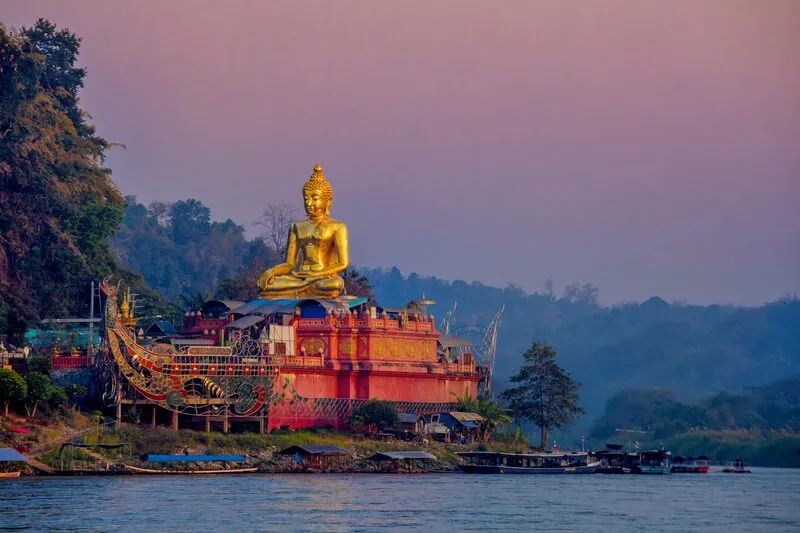
Phra Buddha Nawa Lan Tue is one of the clearest visual expressions of how Chiang Saen has carried the memory of the lost Buddha into the present. This great golden image stands near the Golden Triangle and has become a landmark in its own right. Made of bronze, weighing more than 69 tons, with a lap width of 9.99 meters and a height of 15.99 meters, it was designed not merely as a tourist icon but as a symbolic restoration of a missing sacred presence in the river history of the city.
The surrounding area deepens that symbolic role. The monumental setting, ceremonial structures, and the river landscape together give travelers a sense that the image is part of a larger cultural statement. It is not simply a viewpoint object. It is a modern response to a long historical absence. That makes it especially meaningful for visitors who want to understand how local faith and civic memory interact with place-making in the present.
The museum remains essential to the route because it anchors memory with evidence. There, visitors can move from oral tradition into documented interpretation. This is what makes Chiang Saen so rewarding for thoughtful travelers: river landscape, sacred tradition, archaeology, and museum knowledge all reinforce one another. You do not have to choose between legend and history here. Instead, you see how the city has held both together.
Getting There Travelers can begin in central Chiang Saen, where the riverside and old town context are easiest to understand, then continue to the Chiang Saen National Museum before driving onward to the Golden Triangle zone to see Phra Buddha Nawa Lan Tue and related riverfront landmarks. The route is compact enough for a half-day or full-day cultural itinerary.
In the end, the Mekong history of Chiang Saen is so memorable because it turns a river into a historical archive. The vanished island of Ko Don Thaen, the temples once said to stand there, the enduring belief in Phra Chao Lan Tue, the recovered halo element, the repeated underwater searches, and the creation of Phra Buddha Nawa Lan Tue in the present all combine to create one of the richest place-based narratives in northern Thailand.
| Name | The Mekong River History of Chiang Saen (Phra Chao Lan Tue Route) |
| Location | Mekong riverfront zone in Chiang Saen District, Chiang Rai, linking the old riverside area, Chiang Saen National Museum, and the Golden Triangle zone |
| Address | Main reference area: Wiang Subdistrict, Chiang Saen District, Chiang Rai 57150, Thailand |
| Highlights | The story of Ko Don Thaen, the lost Phra Chao Lan Tue, the recovered halo element, and the modern Phra Buddha Nawa Lan Tue |
| History / Significance | A major Chiang Saen historical narrative connecting river-course change, sacred geography, local memory, museum evidence, and Mekong faith traditions |
| Distinctive Features | A cultural learning route combining riverfront history, museum interpretation, and symbolic modern sacred architecture |
| Travel Information | Start in central Chiang Saen, continue to the national museum, then drive to the Golden Triangle area for Phra Buddha Nawa Lan Tue and related landmarks |
| Current Status | Still accessible as a historical and cultural learning route with active public landmarks and museum interpretation |
| Open Days | No official opening-day notice is published for the riverfront history route and the Phra Buddha Nawa Lan Tue area |
| Opening Hours | No official opening-hours notice is published for the riverfront history route and the Phra Buddha Nawa Lan Tue area |
| Fees | No official general admission information is published for the riverfront and Phra Buddha Nawa Lan Tue area; Chiang Saen National Museum has separate entrance fees under museum regulations |
| Managed By | Wiang Chiang Saen Municipality / Chiang Saen National Museum (for key historical evidence and interpretation) |
| Main Contact Number | Wiang Chiang Saen Municipality 053-650803 / Chiang Saen National Museum 053-777102 |
| Official Website / Official Page | www.wiangcs.go.th / www.finearts.go.th/chiangsaenmuseum |
| Nearby Tourist Attractions | 1. Chiang Saen National Museum – about 1 km – Tel. 053-777102 2. Wat Phra That Pha Ngao – about 6 km – Tel. 053-777151, 095-424-0126 3. Chiang Saen Skywalk – about 6 km – Tel. 092-793-6726 4. House of Opium – about 9 km – Tel. 053-784060 5. Phra Buddha Nawa Lan Tue – about 9 km – Tel. 053-650803 |
| Nearby Restaurants | 1. Fah Mai Restaurant – about 1 km – Tel. 053-650572 2. Rim Khong Restaurant Chiang Saen – about 2 km – Tel. 053-160845, 081-993-1061 3. The Terrace Chiang Saen – about 8 km – Tel. 061-686-7773, 061-686-7733 4. Flow Chiangsaen – about 9 km – Tel. 085-863-2569, 087-542-5189 5. JINCOFFEE&CAFA Mae Aep – about 18 km – Tel. 091-759-7984, 093-008-2815 |
| Nearby Accommodations | 1. Siam Triangle Hotel – about 8 km – Tel. 053-651115-17, 094-641-4447, 094-641-7771 2. River Breeze Chiang Saen – about 9 km – Tel. 052-029211 3. One Budget Hotel Chiang Saen – about 10 km – Tel. 080-075-4988, 080-085-3988 4. Anantara Golden Triangle Elephant Camp & Resort – about 11 km – Tel. 053-784084 5. View Khong Hotel – about 9 km – Tel. no verified phone published |
Frequently Asked Questions (FAQ)
Q: Why is the Mekong so important to Chiang Saen history?
A: Because the river shaped settlement, sacred geography, local trade, and the enduring story of Ko Don Thaen and Phra Chao Lan Tue.
Q: What was Ko Don Thaen?
A: It was an old island in the Mekong associated in local tradition with Chiang Saen, said to have contained many temples including Wat Phra Chao Thong Thip.
Q: Who or what is Phra Chao Lan Tue?
A: It is the name of the great bronze Buddha image believed to have once stood on Ko Don Thaen before being lost to the Mekong.
Q: Where can I follow this story today?
A: The best route includes the Chiang Saen riverfront, Chiang Saen National Museum, and the Phra Buddha Nawa Lan Tue area near the Golden Triangle.
Q: Why is the museum important to this topic?
A: It preserves key evidence linked to the tradition, including the halo element associated with Phra Chao Lan Tue.
Q: What kind of traveler would enjoy this route?
A: It is ideal for cultural travelers, history enthusiasts, and visitors who want a deeper understanding of Chiang Saen beyond standard sightseeing.
 Category: ●Art, Culture and Heritage
 Group: ●Landmarks and Memorials
Last Update : 6 MonthAgo
 Last Update : 6 MonthAgo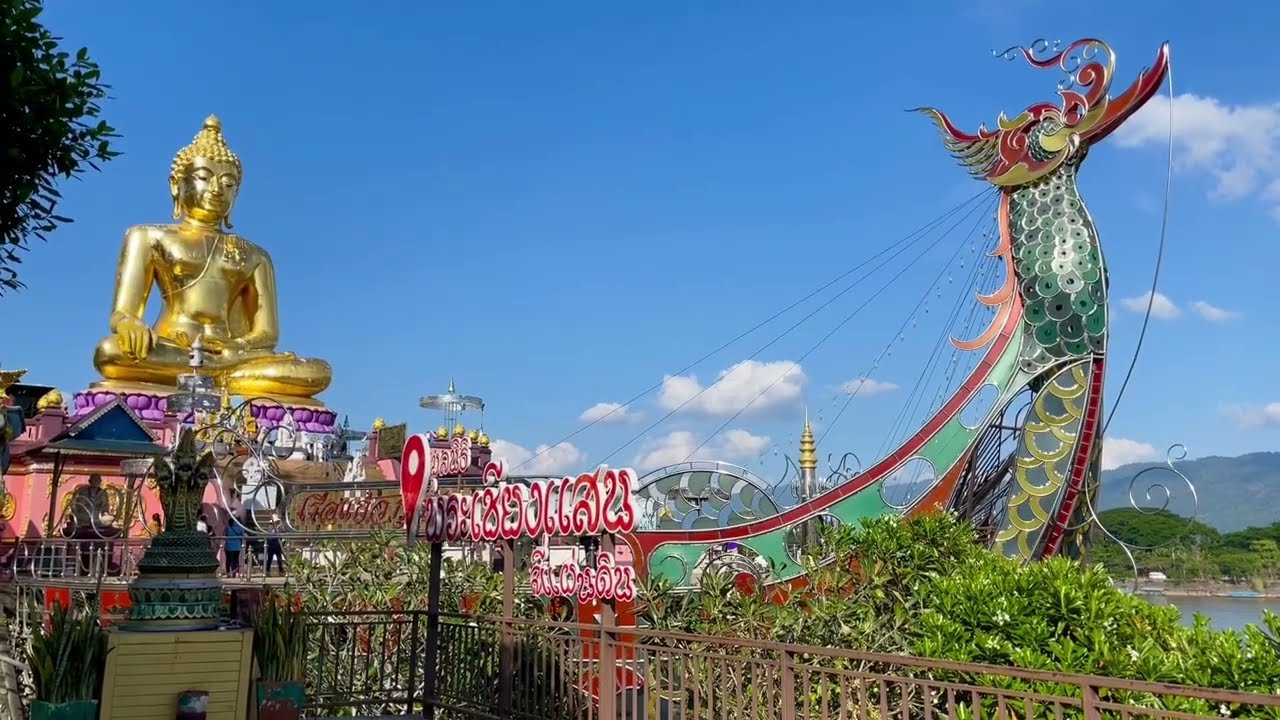
 Click to Access the Navigation Map GPS
Chiang Saen Four Kingdoms Map
Recommend

 Historical Sites and Monuments(3)
Landmarks and Memorials(7)
Historical Sites and Monuments(3)
Landmarks and Memorials(7)
 Art, Craft Centres, Tradition(6)
 Museums(8)
 Historic Homes and Cities(1)
 Educational Places
 Museum for Study(1)
 Library(1)
 Educational Gardens, Farm(3)
 Places of Worship
 Temple(38)
 Other Sacred Sites(5)
 Research and Development
 Royal Project(9)
 Suburban Living
 Village, Community(16)
 Local Market(5)
 Nature and Wildlife
 National Parks and Marine Reserves(18)
 Mountain (Doi)(20)
 Dam, Reservoir, Lake(8)
 Waterfalls(16)
 Hot Springs(6)
 Caves(8)
 River, Canal(10)
 Sea, Beach(1)
 Other natural attractions(3)
 Entertainment and Agricultural
 Animal camps and shows(1)
 Farms, Parks and Ecotourism(9)
 Shopping
 Shopping and Night Market(2)
 Call Customer Service in Tourism
 Call Customer Service in Tourism(1)
 Travel Articles, Recipes
 Travel Review, Food Review(1)
 Food Menu, North Recipes(1)


