
 Home
Home North(
 Chiang Mai(


Wat Bueng Thong Lang
Rating: 3.3/5 (7 votes)
 Search By
  Map
Map
 Have Map
  No Map
Bangkok attractions
Attractions in Thailand
Operating day: Daily
Operating time: 08.00 - 17.00
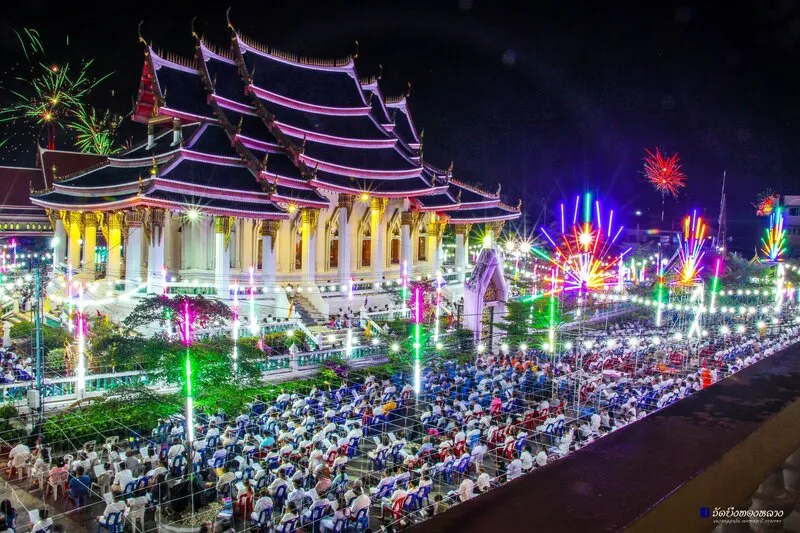
Wat Bueng Thong Lang is a local Buddhist temple under the Mahanikaya sect, located at 1155 Soi Lat Phrao 101, Lat Phrao Road, Khlong Chan Subdistrict, Bang Kapi District, Bangkok. This temple holds historical and religious significance in Bangkok and has long served as a center of faith and community for local residents. Wat Bueng Thong Lang reflects the collaboration between monks and the community in developing the area into a religious and cultural hub.
The temple’s early history lacks clear documentary evidence. However, historical research indicates that Wat Bueng Thong Lang was originally situated in a flood-prone area, making it difficult to use for agriculture or settlement. Despite this, the site attracted itinerant monks who came periodically to meditate. Their presence gradually inspired local villagers to make merit and support the monks, leading to the construction of monk’s quarters for a peaceful practice. The land for the original temple complex was donated by Mr. Nim and Mrs. Thongyu around 1876 (B.E. 2419).
Later, the villagers collectively built the ordination hall (ubosot) around 1887 (B.E. 2430) and maintained the temple over the years. A notable figure in the temple’s history is Luang Pu Phak Thammatatto, a highly respected monk and direct disciple of Wat Suthat Thepwararam under Somdej Phra Sangharaja Daeng. Luang Pu Phak led Wat Bueng Thong Lang from 1917 to 1958 (B.E. 2460–2501), laying the foundation for its development, including the construction of religious buildings, monk education, promotion of religious activities, and fostering community relations. Under his leadership, the temple became a center for Buddhist study and meditation and a spiritual hub for local devotees.
The temple’s structures feature unique architectural and artistic elements. The ubosot serves as the central venue for religious ceremonies. The Luang Pu Phak Memorial Pavilion houses and commemorates the revered monk. The sermon hall is used for monk education and community events. The crematorium pavilion supports religious rites and funeral ceremonies. A multipurpose hall accommodates community activities and annual merit-making events. The bell tower symbolizes the temple and signals prayer times. The Luang Pu Phak Vihara is a site of worship and commemoration, while the Phra Phon Si Suwes Suwann Vihara, the old ordination hall, showcases the beauty of traditional Thai art. Monk’s quarters provide accommodation for monks and novices.
Wat Bueng Thong Lang has maintained a continuous lineage of abbots, each playing a key role in the temple’s development and promotion of religious activities. After Luang Pu Phak Thammatatto (1917–1958), Phra Kru Phisan Wiriyakhun Singto Tisso served as abbot from 1958 to 2004 (B.E. 2501–2547), followed by the current abbot, Phra Kru Sujitwimon Juang Sujitto, who has served since 2004 (B.E. 2547). This continuity underscores the temple’s stability and importance to the community.
In addition to being a site for religious ceremonies, Wat Bueng Thong Lang serves as a center for community activities, including annual merit-making events, group chanting, almsgiving, and Dhamma classes for the public. Its long history and association with esteemed monks attract visitors from various areas who come to study and honor Luang Pu Phak. Visiting the temple provides an opportunity to learn history, study Buddhism, and experience Thai cultural traditions firsthand.
The temple is also a cultural tourism destination in Bangkok. Visitors can explore monastic history, Thai art, and architecture. Walking through the temple grounds reveals ancient ubosots and vihara that have been preserved for their historical beauty, along with multipurpose halls and bell towers that reflect the beliefs and lifestyles of the local community. Its location on Lat Phrao Soi 101 makes it easily accessible for those interested in Dhamma study and historical exploration.
Activities at Wat Bueng Thong Lang are diverse and cater to community needs, including religious ceremonies, annual merit-making events, group chanting, Dhamma training, and social support projects. These activities strengthen the relationship between the temple and the community, allowing villagers to participate actively in the temple’s growth and sustainability.
Wat Bueng Thong Lang exemplifies a Bangkok local temple that is significant not only for religion but also as a center for cultural and artistic learning. It preserves traditions, promotes Buddhist practice, and passes on religious values to future generations. Visiting the temple allows people to study the Buddha’s teachings while experiencing the history and lifestyle of Thai communities in Bang Kapi and Lat Phrao.
A visit to Wat Bueng Thong Lang is not only a spiritual pilgrimage but also a way to learn about and preserve Thai cultural heritage. The preservation of old buildings, vihara, ubosots, multipurpose halls, and monk’s quarters allows visitors to observe the community’s devotion and way of life in the past. Its location in Bang Kapi and near Lat Phrao Soi 101 makes it accessible while maintaining a serene atmosphere suitable for meditation.
In summary, Wat Bueng Thong Lang is more than a religious site; it symbolizes collaboration between monks and the community, serves as a center for learning and meditation, is a significant cultural tourism destination, and stands as a testament to the preservation of Thailand’s religious and cultural heritage in Bangkok.
 Wat Bueng Thong Lang Map
 Category:
  Group:
  Tag: ●Wat Bueng Thong Lang●wat bueng thong lang ●bangkok temple ●local temple ●lat phrao temple ●bang kapi temple ●thai architecture ●buddhist monk ●temple activities ●cultural tourism ●dharma study ●luang pu phak thammatatto ●community center Last Update: 7 MonthAgo
 Nearby Attractions
 Facebook Fanpage
 Region
 Copyright 2012,