
 Home
Home North(
 Chiang Mai(


Hidayatul Islamiyah Mosque (Surao Saen Saeb)
Rating: 4.4/5 (5 votes)
 Search By
  Map
Map 
 Have Map
  No Map
Bangkok attractions
Attractions in Thailand
Open Days: Daily (it is recommended to contact the mosque in advance to confirm prayer times and any on-site activities before visiting)
Opening Hours: Based on the adhan times and the mosque’s activities – it is recommended to call ahead
Hidayatul Islamiyah Mosque (Surao Saen Saeb) is a long-established community mosque that local residents have affectionately called “Surao Saen Saeb” for generations. Its appeal is not the kind that comes from being a crowded, headline-grabbing landmark, but from the quiet rhythm of a canal-side neighborhood where you can still sense the layers of settlement, the continuity of daily worship, and the way the area has grown alongside its people. If you are searching for a “mosque in Bangkok” or looking for a more meaningful “Bangkok attraction” with real context and a visit that is easy to plan without getting lost, this mosque offers a deeper look into the city’s eastern communities.
What gives the story of Surao Saen Saeb particular weight is that, even though there is no single written chronicle that lays out the full narrative in a neat timeline, the community’s long presence can be reasonably inferred from official evidence. One of the clearest examples is the old land title deeds of the mosque and nearby congregants. These deeds were issued in R.S. 125, which corresponds to 1907, and they identify Muslim names as the legal owners. This kind of evidence points to at least two important facts: first, Muslims were clearly settled in this area, and second, that settlement likely began even before the modern deed system formally recorded ownership. In simple terms, the community did not arrive late – it was already rooted here, and official documentation caught up afterward.
When we look specifically at the mosque building, both documentary traces and the memories of older residents help complete the picture. The earliest mosque was said to have been a wooden structure located along Saen Saeb Canal, and it was likely built before 1933. This is supported by records related to Surao Saen Saeb School, which was established on 1 November 1933 and initially used the Surao (the mosque) as a temporary teaching venue. That detail suggests that a functioning religious building already existed at the time and that the community had a shared space that served both worship and learning in the same period.
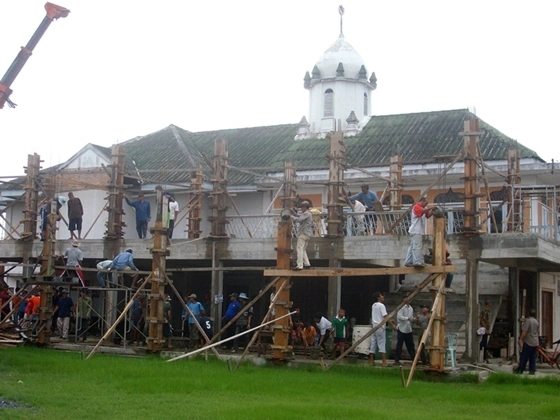
After the wooden structure deteriorated, the community moved toward constructing a brick-and-mortar building slightly to the north. This is the polygon-shaped mosque building still in use today, said to have been built around 1947, taking several years to complete. Once the masonry building was finished, the older wooden building was dismantled and repurposed as a school building. As the congregation grew, the original space became insufficient for prayers and community activities, so the mosque was extended to the east around 1974. Later, as attendance continued to increase, an additional extension to the north was made in 2004 to ensure the prayer space matched real needs.
Another layer that makes Surao Saen Saeb more than simply a prayer hall is its role in religious education. The community also speaks of Ajarn Abdulrahman Madsen, a former imam, known for his religious knowledge and for establishing a ponoh-style learning setting where students studied both day and night. The image of a ponoh connected to a community mosque in Bangkok’s eastern districts is notable because it reflects an effort to keep religious knowledge alive as part of everyday life, not only as occasional instruction. It is also said that many who studied under him later became religious leaders and mosque administrators elsewhere. His students respectfully called him “Kru Marn,” a name still mentioned with warmth and regard by people in the area.
For first-time visitors, the smoothest experience begins with basic respect for the space. Dress modestly and appropriately, maintain cleanliness, keep your voice low, place shoes in the designated area, and avoid walking directly in front of someone who is praying. If you are not Muslim and would like to visit, it is best to call in advance to ask for a suitable time, as certain prayer periods and activities require a higher level of quiet and privacy. Starting with courtesy makes the visit comfortable for both guests and the local community.
Getting There If you are driving, it is recommended to pin “Hidayatul Islamiyah Mosque (Surao Saen Saeb)” on your map and approach via the main roads in the Min Buri–Khlong Sam Wa area before turning toward Pracha Ruam Jai Road and the community access lanes as guided by real-time navigation. The main advantage of driving is being able to control your timing, especially if you want to arrive before prayer. If you are using public transport, it is usually easiest to reach a major point in the nearby area and then continue by taxi or motorcycle taxi for the final stretch, since neighborhood lanes can be complex and walking distances may be long in some sections. Using navigation from your actual starting point is strongly recommended, particularly on days with heavier traffic.
If you want a simple “one-day plan” that flows naturally, think in a straightforward sequence: pray/contact the mosque – eat – handle errands or make a nearby stop – return. If you plan to stay overnight, adding accommodation in the Min Buri zone usually keeps connections manageable. Having a short list of halal food options and backup accommodations helps reduce stress, especially on rainy days or when traffic becomes unpredictable in Bangkok’s eastern districts.
| Place Name | Hidayatul Islamiyah Mosque |
| Local Name | Surao Saen Saeb |
| Address | 17 Moo 10, Pracha Ruam Jai Road, Sai Kong Din Tai, Khlong Sam Wa, Bangkok 10510 |
| Highlights | A community mosque locally known as “Surao Saen Saeb,” with settlement evidence reflected in land title deeds from R.S. 125 (1907) and a clear building timeline (early wooden canal-side structure → polygon-shaped masonry mosque around 1947 → extensions in 1974 and 2004), alongside a strong legacy of religious education linked to the local narrative of “Kru Marn.” |
| Mosque Leader | Imam Wirot Madsen |
| Contact Number (Verified) | 02-914-6871 |
| Travel Summary | Min Buri–Khlong Sam Wa area → Pracha Ruam Jai Road → enter the community lanes using real-time navigation (driving is convenient; public transport is usually best with a taxi/motorcycle taxi for the final stretch) |
| Nearby Attractions (Approx. Distance) | Safari World – approx. 13 km Min Buri Market – approx. 14 km MRT Pink Line (Min Buri zone) – approx. 15 km Fashion Island – approx. 20 km Siam Amazing Park (Suan Siam) – approx. 18 km |
| Nearby Restaurants (Approx. Distance + Phone) | halal.a (Rom Klao 6) – approx. 9 km – 063-854-5941 b yummy (Ramkhamhaeng) – approx. 12 km – 098-856-4662 chob kin khong thot (Ramkhamhaeng) – approx. 12 km – 097-076-0750 krua madeenah by madeenah (Min Buri) – approx. 14 km – 095-330-6858 asmanjune halal homemade (Min Buri) – approx. 14 km – 084-655-7429 |
| Nearby Accommodations (Approx. Distance + Phone) | plume residence minburi – approx. 14 km – 02-046-1068 siam piman hotel – approx. 16 km – 02-917-5212 mintara hotel (minburi) – approx. 18 km – 086-392-8888 tara garden hotel – approx. 19 km – 02-917-6960 station 203 hotel – approx. 20 km – 02-976-9260 |
Frequently Asked Questions (FAQ)
Q: Where is Hidayatul Islamiyah Mosque (Surao Saen Saeb) located?
A: It is located at 17 Moo 10, Pracha Ruam Jai Road, Sai Kong Din Tai, Khlong Sam Wa, Bangkok 10510.
Q: What is the verified contact number for the mosque?
A: The verified contact number is 02-914-6871. It is recommended to call ahead to confirm prayer times or any activities on the day of your visit.
Q: Why do local residents call it “Surao Saen Saeb”?
A: The name is a long-used local reference tied to the canal-side community context. While there is no single written chronicle, official evidence and community narratives reflect an old Muslim settlement in this area.
Q: When was the current mosque building constructed?
A: The earlier mosque is described as a wooden canal-side structure, and the current polygon-shaped masonry mosque is said to have been built around 1947, with later extensions around 1974 and 2004 as the congregation increased.
Q: Who is “Kru Marn” mentioned in local stories?
A: “Kru Marn” is the respectful name used by students for Ajarn Abdulrahman Madsen, a former imam recognized for religious education and a ponoh-style learning setting in the area. Local accounts say many of his students later became religious leaders and mosque administrators elsewhere.
Q: Can non-Muslim visitors enter the mosque?
A: It is recommended to contact the mosque in advance to ask for an appropriate visiting time, and to follow modest dress and on-site etiquette strictly.
Q: If visiting on Friday, how early should I arrive?
A: It is recommended to arrive at least 20–30 minutes early and to call ahead to confirm the exact timing for that day.
 Tel: 029146871
 Hidayatul Islamiyah Mosque (Surao Saen Saeb) Map
 Category:
  Group:
  Tag: ●Hidayatul Islamiyah Mosque (Surao Saen Saeb)●hidayatul islamiyah mosque ●saen saeb mosque ●masjid saen saeb ●mosque in khlong sam wa ●sai kong din tai mosque ●pracha ruamjai road mosque ●islamic community bangkok east ●saen saeb canal muslim community ●bangkok mosque travel ●history of saen saeb mosque Last Update: 2 MonthAgo
Comment
 Nearby Attractions
| Keyword (Advance) |
 Region
|
 Phra Nakhon(
 Copyright 2012,