

 Home
Home Chiang Mai(
















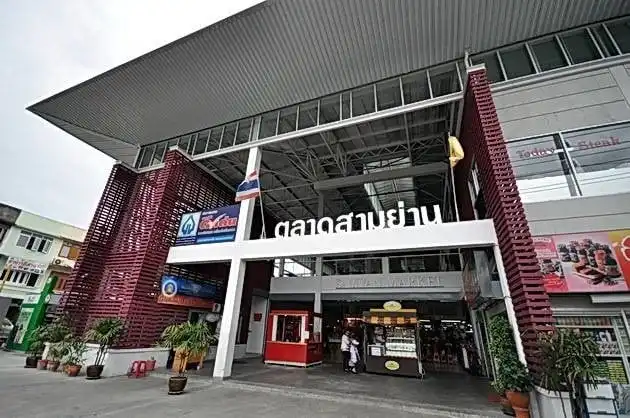
Samyan Market
Rating: 2.6/5 (10 votes)
 Search By
  Map
Map 
 Have Map
  No Map
Bangkok attractions
Attractions in Thailand
Open Days: Daily
Opening Hours: 06:00 – 17:00
Samyan Market In a large metropolis like Bangkok, fresh markets are not merely places for buying and selling goods. They function as an invisible yet essential foundation of urban life, quietly sustaining the daily rhythms of the city. Samyan Market stands out as one of the clearest examples of this role, as it is not only a long-standing market in the memories of many residents, but also a space intentionally developed to coexist with the modern city in a balanced way.
Samyan Market has long been intertwined with the surrounding educational district and residential communities. Its proximity to Chulalongkorn University has made it an integral part of daily life for students, university staff, office workers, and nearby residents. Beyond meeting basic food needs, the market functions as a component of the city’s living system, enabling people to maintain everyday routines amid a rapidly changing urban environment.
As time progressed, regulations and standards related to hygiene, safety, and urban land use were continuously updated. The original Samyan Market, constrained by its physical structure and limited space, could no longer be fully adapted to meet these newer requirements. Chulalongkorn University therefore recognized the importance of preserving the market as a vital element of the community, while simultaneously upgrading it to comply with legal standards and better align with the realities of the contemporary city.
The decision to relocate the old market and construct the new Samyan Market was not an attempt to erase the past, but rather to design a future in which the market could continue fulfilling its role. The new market was strategically positioned between Chula Soi 32 and 34, an area offering greater potential in terms of space, zoning organization, and connectivity to university facilities and surrounding communities.
The development of the new Samyan Market placed strong emphasis on comprehensive public utilities, including electricity, water supply, drainage, waste management, and a well-organized market layout. These elements were not introduced merely for visual appeal, but serve as the foundation that allows a fresh market to coexist sustainably within a large city, reducing health risks and enhancing consumer confidence.
As a result, the present-day atmosphere of Samyan Market feels more open, orderly, and structured. Clear walkways and well-defined zones help reduce the congestion once commonly associated with traditional fresh markets. Nevertheless, the essence of a fresh market has not disappeared. The morning bustle, conversations among vendors and shoppers, careful selection of produce, and the everyday rhythm of life remain central to the market’s character.
In terms of products, Samyan Market continues to preserve the diversity that lies at the heart of any fresh market. Visitors can find fresh vegetables, seasonal fruits, meat, seafood, dried goods, cooking ingredients, and prepared foods suitable for busy urban lifestyles. Unlike modern retail stores, the market offers a wide range of choices across different price points, quantities, and quality levels, ensuring accessibility for people from many walks of life.
Samyan Market also clearly reflects the city’s grassroots economic structure. It is a place where money circulates directly between buyers, sellers, and producers, reducing reliance on intermediaries and providing stability for many small-scale vendors. While this role may not be immediately visible to tourists, it is crucial to the long-term resilience of urban life.
Another distinctive dimension of Samyan Market is its coexistence with a university environment. Markets of this nature serve not only as commercial spaces, but as components of a broader social ecosystem that supports learning, working, and living. The shared use of the market by students, professionals, and local residents offers a tangible example of urban design that prioritizes everyday life over purely commercial development.
For visitors wishing to explore Samyan Market, the most suitable time is from early morning to late morning, when most vendors are open, fresh goods are abundant, and the lively atmosphere of a traditional market is most apparent. In the afternoon, the market becomes quieter as some stalls begin to close, offering a calmer and more relaxed walking experience.
Getting There Accessing Samyan Market is relatively easy within Bangkok’s urban context. MRT users can get off at Samyan Station and continue on foot or by a short local transfer. Several bus routes run along major roads surrounding the area. For those traveling by private car, parking facilities are available within the Chulalongkorn University zone and nearby parking buildings, making visits to a fresh market in the city center far more manageable.
One of Samyan Market’s key advantages is its proximity to lifestyle destinations and important landmarks. A visit to the market can easily be combined with other activities on the same day, such as exploring Samyan Mitrtown, visiting Wat Hua Lamphong, or heading toward nearby green spaces and shopping districts. In this way, a market visit becomes not an isolated activity, but a natural part of urban life.
In summary, Samyan Market represents a thoughtful effort to preserve fresh markets within a modern city through structured development rather than static conservation. It demonstrates how a market can meet legal requirements, hygiene standards, and quality-of-life expectations, while still maintaining its essential role as a fresh market—one of the foundational pillars of Thai everyday life.
| Place Name | Samyan Market |
| Highlights | A fresh market closely connected to both the local community and the university, redeveloped to be clean, well-organized, and compliant with hygiene standards, while preserving its role as a grassroots economic hub |
| Nearby Attractions | Samyan Mitrtown ~0.8 km Tel. +66 2-033-8900 Wat Hua Lamphong ~1.1 km Tel. +66 2-233-8109 Chulalongkorn University Centenary Park ~1.6 km MBK Center ~2.2 km Lumpini Park ~2.8 km |
| Nearby Restaurants | Jay Oh Jok Ped ~1.6 km Tel. +66 81-682-8816 Elvis Suki Banthat Thong ~1.6 km Tel. +66 81-994-5168 Somboon Seafood Surawong ~2.4 km Tel. +66 2-233-3104 Bar-B-Q Plaza Samyan Mitrtown ~0.9 km Tel. +66 65-506-7892 |
| Nearby Accommodations | Triple Y Hotel ~0.9 km Tel. +66 2-219-1611 Mandarin Hotel Bangkok ~1.7 km Tel. +66 2-238-0230 Pathumwan Princess Hotel ~2.6 km Tel. +66 2-216-3700 |
Frequently Asked Questions (FAQ)
Q: Is Samyan Market open every day?
A: Samyan Market is open daily, with operating hours generally from 06:00 to 17:00.
Q: Where is the new Samyan Market located?
A: The market is located between Chula Soi 32 and 34 in the Samyan area, close to Chulalongkorn University.
Q: What is the best time to visit Samyan Market?
A: Early morning to late morning is the best time, when the market is most active and fresh products are widely available.
Q: Is Samyan Market suitable for tourists?
A: It is well suited for visitors who want to experience everyday Bangkok life and explore a fresh market that has been thoughtfully modernized.
 Tel: 022153662
 Fax: 022153662
 Samyan Market Map
 Category:
  Group:
  Tag: ●Samyan Market●samyan market ●samyan market bangkok ●samyan fresh market ●samyan market opening hours ●local market near chulalongkorn university ●fresh market bangkok ●samyan area market ●bangkok local market ●samyan market travel Last Update: 2 MonthAgo
Comment
 Nearby Attractions
| Keyword (Advance) |
 Region
|
 Phra Nakhon(
 Copyright 2012,