
 Home
Home North(
 Chiang Mai(


Wat Maha Phruettharam Worawihan
Rating: 4.2/5 (5 votes)
 Search By
  Map
Map 
 Have Map
  No Map
Bangkok attractions
Attractions in Thailand
Open Days: Daily
Opening Hours: 08:00 – 18:00 (based on travel/directories; please verify again before visiting)
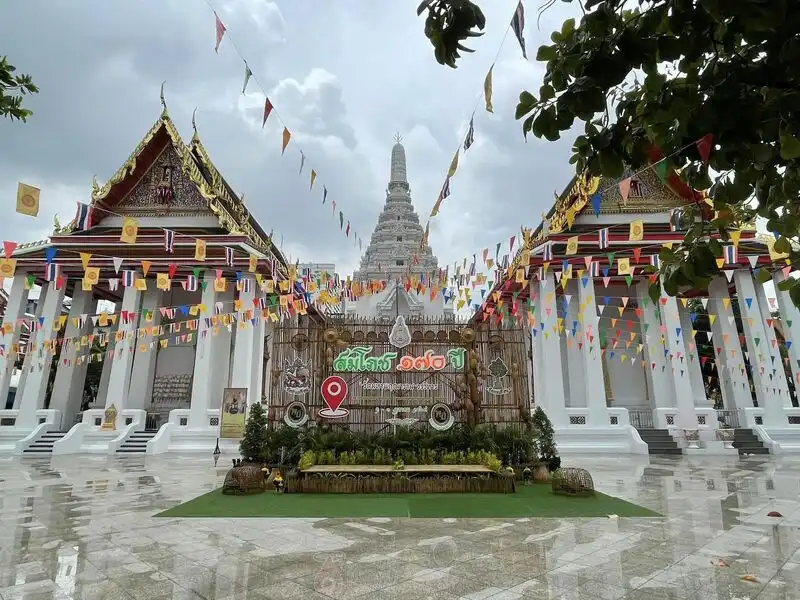
Wat Maha Phruettharam Worawihan is an old temple in the Bang Rak area that tells Bangkok’s story in a quiet but powerful way. Its roots are traced back to the Ayutthaya period, when Ayutthaya was still the capital, and the temple stands on the eastern side of Khlong Phadung Krung Kasem in what was historically a major commercial zone. Seen through the eyes of a city walker, this temple feels like a calm pause point near Hua Lamphong and Sam Yan, preserving layers of history through its former names, its restoration narrative, and the art housed in its key structures.
According to local historical accounts, the temple’s original name was “Wat Tha Kwian” (“Temple of the Cart Wharf”), because it once served as a resting place for ox-cart caravans that traveled into Bangkok for trade. When caravans stopped to rest, people naturally remembered the landscape through the ideas of a “wharf” and “carts,” and the place became firmly associated with that trading rhythm. Later, local usage shifted to “Wat Takhi(a)n” (“Temple of the Takhi(a)n Trees”), aligning with the belief that takhi(a)n trees once grew densely around the grounds. The temple’s sizable area — said to be about 14 rai — helped that community name become even more deeply rooted in memory.
A major turning point in the temple’s history is linked to King Rama IV. When he was still in the monastic order, he came here to present a forest-robes offering (phapa). On that occasion, the abbot “Phra Athikan Kaew” offered a prediction that he would soon become the ruler. The future king is said to have replied in the form of a vow: if he truly came to the throne, he would return to rebuild the temple. After his accession, he initiated a serious and systematic re-establishment of the temple.
The reconstruction and establishment proceeded over many years, beginning in 1854 and continuing until 1866. King Rama IV appointed Somdet Chao Phraya Borom Maha Phichaiyat (That Bunnag) as the chief supervisor of the project, and he granted Phra Athikan Kaew a new ecclesiastical title as “Phra Maha Phruetthachan.” Once construction was completed, the temple was elevated to royal monastery status and received the name “Wat Maha Phruettharam,” which has remained in use to this day.
If you enjoy temples through the lens of architectural detail, the ubosot (ordination hall) at Wat Maha Phruettharam deserves more than a quick glance. The building is designed as a long, continuous hall with a two-tiered roofline, finished with traditional decorative roof elements. A particularly compelling feature is the gable, which displays a royal crown emblem placed on a two-tiered tray within a decorative shrine form, set above a three-headed elephant. The symbolism directly references Prince Mongkut — King Rama IV — as the patron behind the construction of this ubosot. Reading the gable is therefore not only about appreciating beauty, but also about understanding the language of royal patronage and religious devotion embedded in craftsmanship.
Another layer of interest lies in the ubosot’s doors and windows. Instead of conventional patterns, they incorporate symbolic imagery that tells the temple’s story: ox-carts recalling the earlier name “Wat Tha Kwian,” elephants associated in local accounts with Abbot Phra Athikan Kaew, who is said to have lived to 107 years old, and celestial figures presenting a two-tiered tray with a crown above it, again pointing to King Rama IV. Seen together, these motifs reveal the temple’s effort to preserve the memory of the older place-name while also proclaiming its renewed identity as a royally patronized monastery.
What further distinguishes Wat Maha Phruettharam from many Bangkok temples is its mural painting program. Instead of the familiar Ten Jataka tales or standard Buddha biography cycles, the murals emphasize the “Thirteen Dhutanga Practices” and narratives connected to the continuation of Buddhism in Sri Lanka. Equally notable is the painting approach, which absorbs Western influence: landscape scenes are composed with a stronger sense of depth and three-dimensional space, and Western architectural forms appear as part of the visual setting. Standing before these murals can feel like witnessing a moment when Thai religious art was actively experimenting with new visual languages while remaining grounded in traditional belief.
The temple grounds also include a set of structures that help the visit feel like a coherent walk rather than a series of separate stops: four prangs (towers) dedicated in commemoration of the four Buddhas who have already passed into parinibbana. They vary in size and stand between the ubosot and the northern viharn. Passing through this zone, you can sense how the layout creates a gradual transition from the main ceremonial hall toward spaces carrying more specific layers of meaning.
And for many visitors, one of the main reasons to come is the reclining Buddha. Wat Maha Phruettharam enshrines a large reclining Buddha image, a gilded stucco sculpture in the Rattanakosin style. Local accounts say it has existed since the period when the temple was still known as Wat Tha Kwian / Wat Takhian, though it was not originally as long as it is today. King Rama IV is credited with enlarging and restoring it to its current scale: 19.25 meters from the feet to the topknot, with a chest width of 3.25 meters and a navel width of 2 meters. This is why the temple’s reclining Buddha is often mentioned as being second in size only to the renowned reclining Buddha at Wat Phra Chetuphon (Wat Pho), and it remains a compelling draw for those who love sacred art even if they are not visiting as typical tourists.
Getting There to Wat Maha Phruettharam Worawihan is straightforward by public transport because it sits in the Hua Lamphong – Sam Yan zone. You can take the MRT to Hua Lamphong Station or Sam Yan Station, then continue by a short taxi ride or on foot depending on your preference. It is also easy to get a ride from Silom, Si Phraya, or Sam Yan. For a more relaxed visit, mornings or late afternoons are recommended, since the weather is gentler and you can focus better on architectural details and mural viewing.
| Place Name | Wat Maha Phruettharam Worawihan |
| Location | Maha Phruettharam Subdistrict, Bang Rak District, Bangkok 10500 (Maha Phruettharam Road area, near Hua Lamphong – Sam Yan) |
| Key Features | Ayutthaya-era roots, major re-establishment under King Rama IV, an ubosot filled with symbolic motifs referencing the temple’s earlier name, mural paintings focusing on the Thirteen Dhutanga Practices and Buddhist transmission to Sri Lanka, four prangs, and a large reclining Buddha |
| Period | Ayutthaya roots; major establishment/reconstruction in 1854–1866 (reign of King Rama IV) |
| Key Evidence | Ubosot and its symbolic decorative program, distinctive mural paintings, four prangs, and the reclining Buddha (19.25 meters) |
| Name Origin | Formerly known as “Wat Tha Kwian” (a rest stop for trading cart caravans), later called “Wat Takhian,” and renamed “Wat Maha Phruettharam” by King Rama IV after re-establishment |
| Travel | MRT Hua Lamphong or MRT Sam Yan, then a short taxi ride or walk; convenient access from Silom – Si Phraya |
| Current Status | Open for worship/visits during operating hours (no indications of permanent closure) |
| Contact Phone Number | 02-266-2872 |
| Current Abbot | Phra Thammasuthee (Acting Abbot) |
| Nearby Attractions (Approx. Route Distance + Phone) | Wat Traimit Witthayaram Worawihan – 1.1 km – 095-516-9559; Samyan Mitrtown – 2.2 km – 02-033-8900; Yaowarat (main Yaowarat Road zone) – 2.3 km – (no single verified central phone number); Hua Lamphong Station (historic station building) – 1.0 km – (no single verified central phone number); Lumphini Park (Silom-side entrance) – 3.8 km – 02-252-7006 |
| Popular Restaurants Nearby (Approx. Route Distance + Phone) | Hia Pom & Je Aen (Red Pork & Crispy Pork Rice near the temple) – 0.2 km – 094-292-2624; Krua Je Ngor (Si Phraya) – 2.1 km – 086-520-9560; 100 Mahaseth (Si Phraya) – 2.0 km – 02-235-0023; Jok Prince (Bang Rak) – 3.2 km – 081-916-4390; Kuay Jub Nai Ek (Yaowarat) – 2.4 km – 02-226-4651 |
| Popular Accommodations Nearby (Approx. Route Distance + Phone) | The Quarter Hualamphong by UHG – 1.5 km – 02-092-7999; At Hua Lamphong Hotel – 1.2 km – 02-639-1925; Ago Hotel Chinatown – 2.2 km – 02-002-0802; Talakkia Boutique Hotel – 3.0 km – 02-639-1144; Mandarin Hotel Bangkok – 2.6 km – 02-238-0230 |
Frequently Asked Questions (FAQ)
Q: What was Wat Maha Phruettharam originally called?
A: Local historical accounts say it was originally known as “Wat Tha Kwian,” later commonly called “Wat Takhian,” and it was re-established and renamed “Wat Maha Phruettharam” under King Rama IV.
Q: What makes Wat Maha Phruettharam different from many other temples in Bangkok?
A: Its standout feature is the mural painting program, which depicts the “Thirteen Dhutanga Practices” and narratives of Buddhist transmission to Sri Lanka, alongside Western-influenced painting techniques that create depth and a more three-dimensional spatial feel.
Q: What should I look for in the ubosot (ordination hall)?
A: Look for symbolic motifs linked to King Rama IV and the temple’s former name, including gable imagery featuring the royal crown and door/window designs that reference the temple’s earlier “cart wharf” identity.
Q: Does the temple have a reclining Buddha, and how large is it?
A: Yes. The temple enshrines a large reclining Buddha. Local accounts credit King Rama IV with enlarging it to a length of 19.25 meters.
Q: Which MRT station is best for visiting Wat Maha Phruettharam?
A: You can use either MRT Hua Lamphong Station or MRT Sam Yan Station, then continue by a short taxi ride or on foot.
 Wat Maha Phruettharam Worawihan Map
 Category:
  Group:
  Tag: ●Wat Maha Phruettharam Worawihan●wat maha phruettharam ●wat maha phruettharam worawihan ●bangkok temple ●bang rak temple ●temple near hua lamphong ●temple near sam yan ●reclining buddha bangkok ●wall murals bangkok temple ●dhutanga 13 practices ●royal temple bangkok Last Update: 2 MonthAgo
Comment
 Nearby Attractions
| Keyword (Advance) |
 Region
|
 Phra Nakhon(
 Copyright 2012,