
 Home
Home North(
 Chiang Mai(


Wat Phakhininat Worawihan
Rating: 3/5 (26 votes)
 Search By
  Map
Map 
 Have Map
  No Map
Bangkok attractions
Attractions in Thailand
Open Days: Daily
Opening Hours: 05:00 – 20:00 (based on map/directory sources; please recheck before visiting)
Wat Phakhininat Worawihan is an old temple in the Bang Yi Khan area of Bang Phlat, with roots that predate the Rattanakosin period. According to local accounts and temple records, it was originally called “Wat Bang Chak” because it stood near the mouth of Khlong Bang Chak. With the Chao Phraya riverside landscape historically distinguishing temples as “inner–outer” in the neighborhood, locals often referred to this temple as “Wat Nok” (the outer temple), paired with nearby “Wat Nai” such as Wat Paorohit, Wat Thong, and Wat Sing. What makes the temple compelling is not only its age, but the way it reveals layered history from the late Ayutthaya era into early Rattanakosin, seen through surviving structures and restorations across different periods.
In terms of status and naming, sources confirm that Wat Phakhininat Worawihan is a third-class royal monastery (Worawihan) under the Mahanikaya order. Records also mention variations in how the name was spelled in earlier times before settling into the modern form “Phakhininat.” Contemporary explanations often connect the word “Phakhininat” with the idea of a “royal younger sister,” giving the name a meaningful link to court patronage and elite support in the early Bangkok period.
Looking at the chronology, scholars and temple sources commonly suggest that the temple’s origins reach back to the late Ayutthaya period, inferred from tangible remnants — especially a group of buildings interpreted as older structures that were later adapted during early Rattanakosin reconstruction. Put simply, this was not a site rebuilt all at once from scratch. It was gradually expanded, adjusted, and reorganized in response to practical needs and the resources of patrons in each era — a pattern that is typical of many old temples in Bangkok.
The key early Rattanakosin chapter in your material centers on Princess Krom Luang Thep Yawadi, a daughter of King Rama I, who is associated with major re-establishment and construction works at the temple. The easiest way to help readers follow the story is to explain that a “new ordination hall (ubosot)” was constructed, and once the new ubosot was in place, the former ubosot was repurposed as a “wihan” (assembly hall) and continued in use thereafter. This framing clarifies the idea of the “old ubosot–new ubosot” without confusion, and also highlights how the temple’s footprint expanded along the riverbank over time.
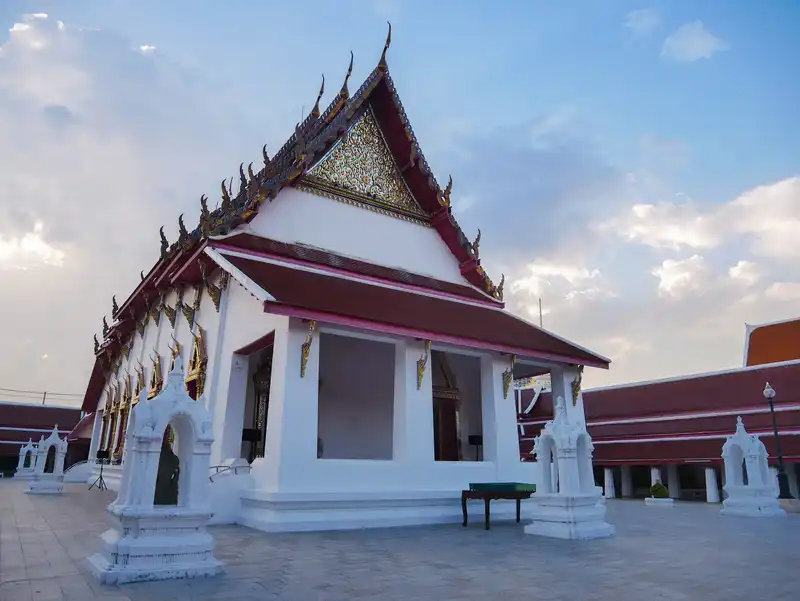
If you explore the temple with an architectural eye, the must-see elements are the “ubosot” and the “cloister (wihan kot) surrounding the ubosot.” Together, they give Wat Phakhininat a distinctive identity. Detailed descriptions note masonry construction, a tiled roof with traditional finials (chofa, bai raka, and hang hong), and interior ornamentation reflecting early Rattanakosin tastes with Chinese artistic influence — visible in ceiling patterns and decorative details. The cloister is especially notable because it functions both as a walkway and as a gallery-like setting for Buddha images, turning a circumambulation of the ubosot into an experience of viewing craftsmanship at close range.
Another highlight that really fixes the temple in memory is the presence of 80 stucco Buddha images in the Maravijaya posture enshrined within the cloister. At the corners of the ubosot, chedis form part of the overall layout, and taken as a whole, the design encourages visitors to “walk a full loop” and to see the sacred core from multiple angles. This creates a sense of calm order and makes the space suitable both for ceremonies and for quiet appreciation of the artisanship on non-festival days.
As for the temple’s revered centerpiece, one image that is often mentioned is “Luang Pho Dam,” the principal Buddha image in the wihan (temple sources describe it as a stucco Buddha in the Maravijaya posture). Many visitors begin their worship by paying respects in the wihan before continuing to the ubosot and walking the cloister. If you enjoy temples that still feel lived-in — with resident monks and a surrounding community that continues to make merit — this place carries the atmosphere of a genuine “old neighborhood temple” rather than a staged tourist site.
Getting There to Wat Phakhininat Worawihan is straightforward with several options, depending on how you like to travel in Bangkok. For rail users, the MRT Blue Line can bring you close, after which you can connect by bus, taxi, or a short walk into Bang Yi Khan. A more classic approach is to travel by boat: get off at Krung Thon Bridge (Sang Hi) Pier and walk onward to the temple. There are also multiple bus routes running along nearby main roads, making the temple convenient both for a quick merit-making visit and for building a longer riverside itinerary across the Phra Nakhon/Thonburi sides.
If your goal is photography and close study of details, morning or late afternoon tends to be the best time to visit. The light helps reveal the lines of the gables, roof elements, and the rhythm of the surrounding cloister. Temple etiquette follows the standard for royal temples: dress modestly, keep your voice low, and avoid taking photos that disturb monks or worshippers — especially when ceremonies are underway inside important buildings.
| Place Name | Wat Phakhininat Worawihan |
| Location | 295 Soi Ratchawithi 21, Ratchawithi Road, Bang Yi Khan, Bang Phlat, Bangkok 10700 |
| Key Features | Ancient temple predating Rattanakosin, ubosot with surrounding cloister (wihan kot), 80 stucco Buddha images, principal Buddha in the wihan known as “Luang Pho Dam” |
| Period | Believed to date to the late Ayutthaya era; major restoration/re-establishment in early Rattanakosin |
| Key Evidence / Important Elements | Luang Pho Dam (principal Buddha in the wihan), cloister encircling the ubosot, 80 stucco Buddha images |
| Name Origin | Originally “Wat Bang Chak” (near Khlong Bang Chak); later granted the name “Wat Phakhininat” |
| Travel | MRT Blue Line (then bus/walk into Bang Yi Khan), boat (Krung Thon Bridge/Sang Hi Pier then walk), multiple bus routes nearby |
| Current Status | Open for worship and visits (no indications of permanent closure found in temple sources and map listings) |
| Contact Phone Number | 02-434-7381 |
| Current Abbot | Phra Ratcha Udommongkhon (Wisit Nandiyo, P.Dh. 5) |
| Nearby Attractions (Approx. Route Distance) | Krung Thon Bridge (Sang Hi) – 0.5 km; Krung Thon Bridge (Sang Hi) Pier – 0.5 km; Wat Paorohit – 0.5 km; Krung Thon Market (Bang Yi Khan area) – 0.6 km; MRT Sirindhorn – 1.0 km |
| Popular Restaurants Nearby (Approx. Route Distance + Phone) | The Water Front (near Krung Thon Bridge) – 0.6 km – 0-2883-1802; Craftport River Bar & Restaurant – 0.6 km – 02-883-1588, 089-779-6957; Ruen Phae Restaurant – 1.5 km – 0-2424-5250; Krua Sorn Daeng – 0.7 km – 089-181-3910; Kuay Teow Kao Na (Noodle Shop) – 0.6 km – 02-883-4042 |
| Popular Accommodations Nearby (Approx. Route Distance + Phone) | GLOW Bangkok Riverside – 0.2 km – 02-243-9999; Riverside Bangkok Hotel – 0.2 km – 02-883-1588; The Royal River Hotel – 0.6 km – 02-422-9222; Paus Living (Apartment) – 0.7 km – 062-412-4566; Molly Apartment – 0.8 km – 085-831-3429 |
Frequently Asked Questions (FAQ)
Q: What was Wat Phakhininat Worawihan originally called?
A: It was originally known as “Wat Bang Chak,” named after its location near the mouth of Khlong Bang Chak, and locals historically referred to it as the “outer temple” paired with the “inner temples” in the same area.
Q: What are the architectural highlights of this temple?
A: The main highlights are the ubosot and the surrounding cloister (wihan kot), including 80 stucco Buddha images in the Maravijaya posture enshrined within the cloister.
Q: Where is Luang Pho Dam located within the temple?
A: Luang Pho Dam is the principal Buddha image enshrined in the temple’s wihan (assembly hall).
Q: Can you reach Wat Phakhininat Worawihan by boat?
A: Yes. You can get off at Krung Thon Bridge (Sang Hi) Pier and walk onward to the temple.
Q: Which MRT station is most convenient for visiting?
A: You can use the MRT Blue Line and then connect by bus or a short ride into Bang Yi Khan, with MRT Sirindhorn being a key nearby access point.
 Wat Phakhininat Worawihan Map
 Category:
  Group:
  Tag: ●Wat Phakhininat Worawihan●wat phakhininat worawihan ●wat phakhininat ●wat bang chak ●bang phlat temple ●bang yi khan temple ●royal temple bangkok ●old temple bangkok ●luang pho dam ●sang hi bridge ●riverside temple bangkok Last Update: 2 MonthAgo
Comment
 Nearby Attractions
| Keyword (Advance) |
 Region
|
 Phra Nakhon(
 Copyright 2012,