
 Home
Home North(
 Chiang Mai(


Wat Praya Tham Worawihan
Rating: 2.7/5 (32 votes)
 Search By
  Map
Map 
 Have Map
  No Map
Bangkok attractions
Attractions in Thailand
Open Days: Daily
Opening Hours: 08.00 – 17.00
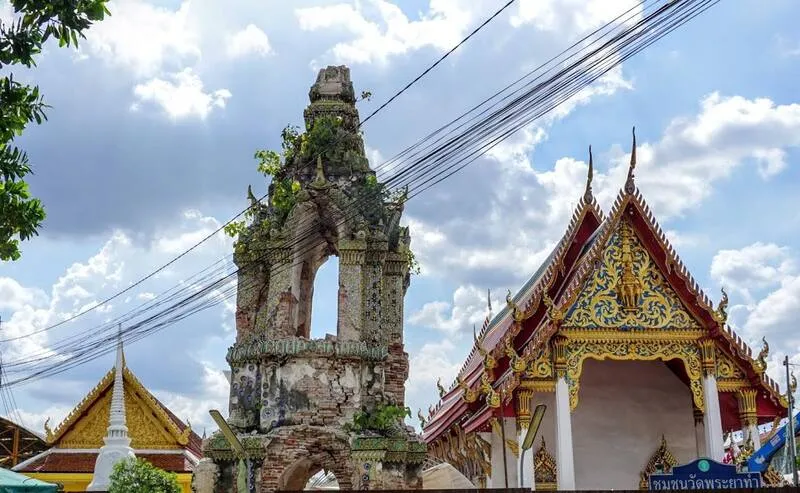
Wat Praya Tham Worawihan is a community-centered royal temple on the Thonburi side of Bangkok, officially classified as a third-class royal monastery (Worawihan type). It is located at No. 47, Ban Chang Lo Subdistrict, Bangkok Noi District, Bangkok. The front of the temple faces east, with its main entrance and exit connected to Arun Amarin Road at the northern end of the bridge over Khlong Mon, directly opposite the Royal Thai Naval Dockyard, and to the north of Wat Nak Klang, with Khlong Mon separating the two areas.
The temple grounds form a rectangular plot of approximately 16 rai. The land is divided into the main sacred area (phutthawat) and part of the monastic residential area (sangkhawat). Another portion—about half of the total area—was allocated for a government school located to the north and northeast of the ordination hall, and for local residential use. This arrangement reflects how the temple is not isolated from everyday life, but rather a space where religion, education, and the community naturally coexist.
The temple boundaries are clearly defined: the eastern side extends about 5 sen and 4 wa and borders a public canal (Khlong Soi Ban Khamin); the western side extends about 5 sen and borders Lam Kradong Suan Anan; the northern side extends about 3 sen and 3 wa and borders the land of a naval lieutenant; and the southern side extends about 3 sen and 3 wa and borders Khlong Mon. These waterways and boundary lines function as a geographic frame that tells the story of Bangkok Noi’s community structure just as vividly as historical documents do.
Wat Praya Tham was formerly known as “Wat Nak” and was paired with “Wat Klang,” which stands on the opposite bank of Khlong Mon: Wat Nak on the northern side and Wat Klang on the southern side. Later, when Wat Nak was renamed Wat Praya Tham, the names of Wat Nak and Wat Klang were combined into “Wat Nak Klang,” as the name is known today. Both temples are ancient. It is generally presumed that Wat Nak was established in the late Ayutthaya period, although there is no surviving documentary evidence identifying its founder or the reign during which it was built.
In the Thonburi period, the temple appears in the Royal Chronicles. Around 2313 BE, King Taksin of Thonburi successfully suppressed the faction of Phra Fang (Ruean) in the north. He ordered the arrest and punishment of monks who had collaborated with Phra Fang and caused suffering to the people, according to the severity of their offenses. He then instructed officials to invite senior monks and ecclesiastical dignitaries from Thonburi to travel north to re-ordain monks and restore the Sangha in every major northern town, and to teach the Dhamma and Vinaya throughout those cities. Notable appointments included: Phra Phimontham to Sawangkhaburi, Phra Thammakodom to Phichai, Phra Thammachedi to Phitsanulok, Phra Phrommuni to Sukhothai, Phra Thepkarawi to Sawankhalok, and Phra Phothiwong to Si Phanom Thung Yang.
Phra Thammachedi, whom King Taksin appointed to oversee the Sangha in Phitsanulok, had previously served as the abbot of Wat Nak. Later, he was promoted to the ecclesiastical rank of Phra Phimontham and was appointed to govern Wat Photharam (today Wat Phra Chetuphon Wimonmangkhalaram, or Wat Pho). This strongly suggests that Wat Nak must have existed before the Thonburi era, since a prominent figure in the Sangha had been directly associated with the temple from an earlier period.
In the early reign of King Rama I of the Rattanakosin Kingdom, there was once a proposal to merge Wat Nak and Wat Klang so that they would share a single consecrated boundary (phatthasima). An episode in the Royal Chronicles records that Phra Phutthachan (Yu) of Wat Bang Wa Yai (Wat Rakhang Khositaram) consulted Phra Thammathirarat Mahamuni (Chuen) of Wat Hong Rattanaram, and then petitioned King Rama I, stating: “Wat Nak and Wat Klang are extremely close in their precincts. It is not appropriate to have separate consecrated boundaries; they should share a single boundary and perform ordination-hall Sangha acts within one and the same phatthasima.” King Rama I therefore ordered the ecclesiastical council to convene and adjudicate the matter.
Ultimately, the council of senior monks, presided over by the Supreme Patriarch (Si), unanimously concluded that since a canal clearly separated the two temples, it was permissible for them to maintain separate consecrated boundaries, as had been the case in earlier Ayutthaya precedents. This dispute also invites the inference that, at the time, a significant restoration may have been underway at one or perhaps both temples; otherwise, there would have been little reason to revive the older issue of boundary jurisdiction so seriously.
In any case, clear evidence regarding the temple’s leadership shows that in the early reign of King Rama I (2325 BE), appointments were rearranged. The king ordered Phra Khru Thepsit Thepathibodi, abbot of Wat Nak (successor to Phra Thammachedi from the Thonburi period), and Phra Khru Si Sunthon Katsorn Wichit, who served as a paired chanter under the Supreme Patriarch, to move to Wat Klang. He then appointed Phra Maha Thongdi, a first-grade Pali scholar (prian ek) from Wat Hong Rattanaram, as Phra Nikrommuni to govern Wat Nak in their place.
In the reign of King Rama II, the king took a deep interest in supporting Buddhism. Many temples were restored, and royal family members as well as senior officials were encouraged to take responsibility for major renovations. In this context, Chao Phraya Rattanathibet (Kun), the Samuhanayok (Chief Minister), undertook a large-scale restoration of Wat Nak, rebuilding the entire temple anew on the original site. When the work was completed, he presented the temple to King Rama II. Wat Nak was then elevated to royal temple status and given the new name “Wat Praya Tham,” meaning the temple that the Chao Phraya rebuilt.
Chao Phraya Rattanathibet, who led this major restoration, was the fifth child of an overseas-trade merchant from the Ayutthaya era named Chin Kui, who lived near Khlong Rong Chang, north of Ratchaburi. After establishing a family, Chin Kun settled along the Mae Klong River (in present-day Samut Songkhram), near Wat Yai, about 500 meters north of Wat Phet Samut Worawihan. During the Thonburi period, Chin Kun entered government service with the rank of Phraratsasit, donated all of his land to Wat Yai, and moved to Thonburi, establishing a residence in front of Wat Ratchaburana (Wat Liap).
Later, he moved to establish a residence in the Bangkok Noi canal area. In the reign of King Rama I, he was promoted to Phraya Si Phiphat as supervisor of the Department of Royal Warehouse Affairs (Krom Phra Khlang Sinka). He was later promoted to Phraya Phra Khlang, and in the reign of King Rama II, he was elevated to Chao Phraya Rattanathibet, becoming the progenitor of the Rattanakun lineage. He passed away during the reign of King Rama II. He had four children: (1) Chamuen Mahadlek (Thongyu), (2) Phraya Phichai Songkhram (Sattawa), later promoted to Chao Phraya Rattanamatayaphongphakdi, (3) Thao Worachan (Yim), and (4) Phra Nikrommuni (Benchawan), abbot of Wat Praya Tham.
In the reign of King Rama III, King Nangklao (Rama III) further restored and strengthened the entire temple, resulting in a stable condition that continued into the reign of King Rama V. By the time of King Rama V, the ordination hall and various structures had begun to deteriorate. Phra Khru Sunthon Akson Wichit (Chaeng), the abbot, together with lay devotees, carried out another major restoration. Since then, repairs and renovations have continued as needed up to the present day.
Getting There If you are coming by private car or taxi, set your destination to Arun Amarin Road near the northern end of the bridge over Khlong Mon, which is the temple’s primary entrance and easy to recognize because it is directly opposite the Royal Thai Naval Dockyard. If you are using public transport, a practical approach is to start from the Siriraj or Arun Amarin–Phra Nokk area, then take a taxi or walk along Arun Amarin Road for a short distance. For travel by boat, you can use piers around the Siriraj/Wang Lang area as a connection point before continuing to Arun Amarin Road, choosing the route that best fits your starting point.
With a history that reaches back to a presumed late-Ayutthaya origin, supported by references in Thonburi-era chronicles and clarified further through Rattanakosin-period records, Wat Praya Tham Worawihan is more than a place to worship. It is a living reflection of the evolving relationship between Buddhism, local communities, and the state—one that has gradually shaped the identity of Bangkok Noi up to the present day.
| Place Name | Wat Praya Tham Worawihan |
| Location | No. 47, Arun Amarin Road, Ban Chang Lo, Bangkok Noi, Bangkok 10700 |
| Highlights | A third-class royal monastery (Worawihan type). Approximately 16 rai of grounds, serving as a community center, with part of the land allocated for a school and residential use. |
| Period | Presumed late Ayutthaya origin, with clear connections documented in the Thonburi and Rattanakosin periods. |
| Key Evidence | Royal Chronicles references to Sangha administration in the Thonburi era, and the major restoration in the reign of King Rama II by Chao Phraya Rattanathibet (Kun). |
| Name Origin | Formerly “Wat Nak.” After a major restoration by Chao Phraya Rattanathibet, it was renamed “Wat Praya Tham,” meaning the temple rebuilt by the Chao Phraya. |
| Travel | Arun Amarin Road (near the northern end of the bridge over Khlong Mon) / Start from Siriraj–Phra Nokk and take a taxi or walk / Connect via boat around the Siriraj–Wang Lang area as convenient. |
| Current Status | Open for visits and merit-making during operating days and hours. |
| Contact Number | +66 2 411 4023 |
| Current Abbot | Phra Khru Suthi Suttakit (Prathum Jintakuno) |
| Nearby Attractions (approx. road distance) | Siriraj Bimuk Sathan Museum (approx. 2.5 km) Wang Lang Market (approx. 2.5 km) Wat Rakhang Khositaram Woramahawihan (approx. 2.0 km) Wat Arun Ratchawararam Ratchaworamahawihan (approx. 4.0 km) The Grand Palace (approx. 5.5 km) |
| Nearby Restaurants (approx. road distance) + Phone | Supanniga Eating Room (Tha Tien) (approx. 5.0 km) Tel. +66 2 015 4224 The Deck by Arun Residence (approx. 5.0 km) Tel. +66 2 221 9158 Above Riva (Riva Arun) (approx. 5.0 km) Tel. +66 2 221 1188 Sala Arun Restaurant (approx. 5.0 km) Tel. +66 2 622 2932 Praya Dining (Praya Palazzo) (approx. 4.5 km) Tel. +66 81 402 8118 or +66 2 883 2998 |
| Nearby Accommodations (approx. road distance) + Phone | Theatre Residence (approx. 2.0 km) Tel. +66 2 848 9488 Praya Palazzo (approx. 4.5 km) Tel. +66 81 402 8118 or +66 2 883 2998 Riva Arun Bangkok (approx. 5.0 km) Tel. +66 2 221 1188 Sala Arun (approx. 5.0 km) Tel. +66 2 622 2932 Riva Surya Bangkok (approx. 6.0 km) Tel. +66 2 633 5000 |
Frequently Asked Questions (FAQ)
Q: Is Wat Praya Tham Worawihan open every day?
A: Yes. It is generally open daily from 08.00 – 17.00.
Q: What is the contact number for Wat Praya Tham Worawihan?
A: The verified contact number is +66 2 411 4023.
Q: What was the temple’s former name, and how is it related to Wat Nak Klang?
A: The temple was formerly known as “Wat Nak” and was paired with “Wat Klang” on the opposite bank of Khlong Mon. After Wat Nak was renamed “Wat Praya Tham,” the combined name “Wat Nak Klang” came into use as it is known today.
Q: What is the easiest way to get to Wat Praya Tham Worawihan?
A: A key landmark is Arun Amarin Road near the northern end of the bridge over Khlong Mon. You can also start from the Siriraj–Phra Nokk area and take a taxi or walk a short distance to the temple.
Q: Who led the major restoration that resulted in the name “Wat Praya Tham”?
A: In the reign of King Rama II, Chao Phraya Rattanathibet (Kun) undertook a complete rebuild of Wat Nak on its original site. Afterward, the temple received the new name “Wat Praya Tham.”
 Wat Praya Tham Worawihan Map
 Category:
  Group:
  Tag: ●Wat Praya Tham Worawihan●wat praya tham worawihan ●wat praya tham ●temple in bangkok noi ●ban chang lo temple ●thonburi temples ●royal temple bangkok ●things to do in bangkok noi ●temple near siriraj hospital ●wat nak history ●bangkok canal-side temple
Last Update: 3 MonthAgo
Tag: ●Wat Praya Tham Worawihan●wat praya tham worawihan ●wat praya tham ●temple in bangkok noi ●ban chang lo temple ●thonburi temples ●royal temple bangkok ●things to do in bangkok noi ●temple near siriraj hospital ●wat nak history ●bangkok canal-side temple
Last Update: 3 MonthAgo
Comment
 Nearby Attractions
| Keyword (Advance) |
 Region
|
 Phra Nakhon(
 Copyright 2012,