
 Home
Home North(
 Chiang Mai(


Wat Hiran Ruchi Worawihan (Wat Noi)
Rating: 2.7/5 (38 votes)
 Search By
  Map
Map 
 Have Map
  No Map
Bangkok attractions
Attractions in Thailand
Open Days: Daily
Opening Hours: 08:00 – 17:00
Wat Hiran Ruchi Worawihan (Wat Noi) If you’re looking for a Thonburi-side temple that offers the quiet charm of an old sanctuary, beautiful craftsmanship, and history you can actually feel on-site, Wat Hiran Ruchi Worawihan (Wat Noi) is one of those places that leaves you thinking you’ve gained more than just a merit-making visit. This temple has long served as a community center since the Thonburi era, and it still remains a space of faith, merit, and shared memories for people in the Intharaphithak–Hiran Ruchi neighborhood today.
The temple was originally called “Wat Noi” and was built around B.E. 2321 (1778 CE) during the Thonburi period by Chao Khrua Ngoen. Its story is also connected to the royal sphere through Somdet Phra Sri Suriyendramat (Queen Consort in the reign of King Rama II), giving the temple a dimension beyond being simply a local neighborhood temple—it reflects the social landscape and power networks of its time. Later, the temple underwent a major restoration during the reign of King Rama IV by Phraya Anuchit, and in B.E. 2397 (1854 CE) it was presented as a royal monastery. King Mongkut (Rama IV) graciously bestowed the new name “Wat Hiran Ruchi” and ordered the casting of a Buddha image made entirely of silver in the Mara-Vijaya posture to be enshrined in the ubosot as the principal Buddha image of the temple. This is why many visitors regard the temple as one with a clear identity in both history and art on Bangkok’s Thonburi side.
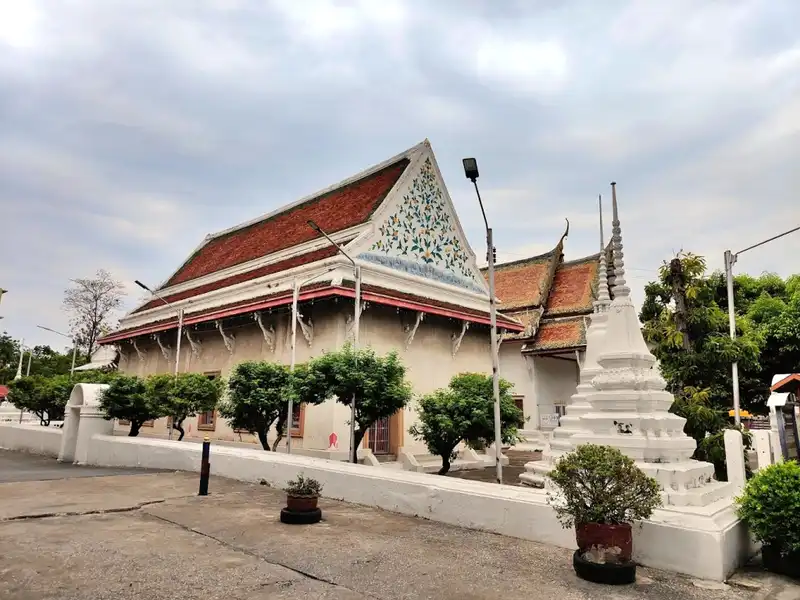
A walk through Wat Hiran Ruchi often begins at the ubosot, a brick-and-mortar structure that distinctly blends Thai and Chinese artistic character. The roof is covered with glazed tiles, while the stucco gable features delicate floral and bird motifs. The front porch, reminiscent of a Chinese pavilion, adds a gentle Chinese “flavor” to the Thai architectural framework in a way that feels both graceful and balanced. Around the exterior wall of the ubosot, you’ll also find boundary markers attached along the outside—a detail that architecture lovers often linger over, as it gives the building a strong ceremonial presence and clearly defined sacred space.
Inside the ubosot is the principal Buddha image in the Mara-Vijaya posture, with the left and right chief disciples enshrined alongside. The atmosphere is calm and formal, making it ideal for a focused, respectful visit rather than a quick photo stop. If you have time, look closely at the decorative details that reflect cultural blending during a transitional era—Thonburi has long been a place where Thai and Chinese cultures have met and merged, and this temple feels like a living record of that long relationship.
Another element that completes the temple’s overall picture is the viharn, a brick-and-mortar hall in a Thai style with a two-tiered roof, adorned with classic finials such as chofa, bai raka, and hang hong. Behind the ubosot stands a round-based stupa built in B.E. 2460 (1917 CE). There are also 6 “yo mum mai sip song” (twelve-cornered indented) stupas positioned at the corners of the inner wall. This area often feels especially quiet and atmospheric. Many people who come in the morning enjoy walking slowly here—it’s peaceful, breezy, and naturally suited for a simple moment of mindfulness.
Within the temple grounds, you’ll also find “Luang Pho Dam,” a cast Buddha image in the Mara-Vijaya posture enshrined in a sala. It’s a familiar focal point for locals who regularly come to pay respects. Another notable structure is the bell tower, a brick-and-mortar building in a four-porched castle-like form, which adds another layer of visual interest. Altogether, the temple does not feel like a frozen piece of the past, but a place that is actively cared for and continuously lived in—with merit-making, rituals, and an ongoing relationship between temple and community that still moves forward.
In terms of location, Wat Hiran Ruchi Worawihan (Wat Noi) is at 122 Intharaphithak Road, Hiran Ruchi Subdistrict, Thonburi District, Bangkok. It’s a convenient area for travel and easy to extend into a half-day trip, since it’s close to Wongwian Yai and many well-known food spots on the Thonburi side. Many visitors plan a relaxed visit—pay respects without rushing, then continue for a walk or a meal in nearby neighborhoods.
Getting There If you’re taking the BTS, you can get off around the Wongwian Yai or Krung Thonburi area, then continue by taxi or motorcycle taxi to Intharaphithak Road. Another option is taking the MRT and connecting into Thonburi via a convenient interchange for your route. There are also several bus lines in this area that pass near the temple’s access roads, making it practical even if you don’t drive. In general, weekday mornings to early afternoons are easier for getting around than the evening rush, when traffic is typically heavier.
| Place Name | Wat Hiran Ruchi Worawihan (Wat Noi) |
| Location | 122 Intharaphithak Road, Hiran Ruchi, Thonburi, Bangkok 10600 |
| Key Characteristics | A Thonburi-era temple with Thai-Chinese blended architecture, a beautiful ubosot, significant Buddha images, and a stupa group behind the ubosot |
| Period | Built around B.E. 2321 (Thonburi period) and restored/elevated as a royal monastery during the reign of King Rama IV |
| Highlights / Key Evidence | Thai-Chinese style ubosot, principal Buddha image (Mara-Vijaya), viharn, round stupa (B.E. 2460), 6 twelve-cornered stupas, Luang Pho Dam, four-porched castle-style bell tower |
| Current Status | Open for worship and visits during operating hours (ongoing temple activities) |
| Contact Number | 02-465-6220 |
| Nearby Attractions (Distance) | Wongwian Yai (1.3 km) Talat Phlu (4.5 km) Wat Intharam Worawihan (Wat Bang Yi Ruea Tai) (4.7 km) Baan Silapin, Khlong Bang Luang (6.2 km) ICONSIAM (4.0 km) |
| Popular Restaurants Nearby (Distance + Phone) | Kaeng Chuet Lueat Mu Jao Kao (Wat Klang, Talat Phlu) (4.6 km) Tel. 02-466-7089 Chin Lee Mee Krob (4.9 km) Tel. 02-466-9170, 02-466-9037 Talat Phlu Chive Dumplings (Li Po Ngek) (4.8 km) Tel. 081-858-5583 Stuffed Rice Noodle Rolls (under Talat Phlu Bridge) (5.0 km) Tel. 062-928-6216 Ting Fish Head Congee (Talat Phlu) (5.1 km) Tel. 02-466-0948 |
| Popular Accommodations Nearby (Distance + Phone) | Bangkok Loft Inn (2.6 km) Tel. 02-862-0300 HOP INN Bangkok Krung Thonburi Station (4.2 km) Tel. 02-080-2222 ZENNIQ (3.7 km) Tel. 02-466-4999 Avani+ Riverside Bangkok Hotel (6.7 km) Tel. 02-431-9100 Anantara Riverside Bangkok Resort (8.3 km) Tel. 02-476-0022 |
Frequently Asked Questions (FAQ)
Q: Is Wat Hiran Ruchi Worawihan open every day?
A: Generally, yes. Morning to early afternoon is ideal for a comfortable walk around the temple.
Q: What are the opening hours of Wat Hiran Ruchi Worawihan?
A: 08:00 – 17:00.
Q: What was Wat Hiran Ruchi originally called?
A: It was originally called “Wat Noi” and was built around the Thonburi era.
Q: What are the must-see highlights at Wat Hiran Ruchi?
A: The Thai-Chinese style ubosot, the stupa group behind the ubosot, and the temple’s community-centered atmosphere.
Q: Is it convenient to get to Wat Hiran Ruchi by BTS?
A: Yes. You can get off around Wongwian Yai or Krung Thonburi, then take a taxi or motorcycle taxi to Intharaphithak Road.
Q: What should I wear when visiting Wat Hiran Ruchi?
A: Dress modestly. Avoid very short or overly tight clothing, and keep quiet—especially around the ubosot.
 Wat Hiran Ruchi Worawihan (Wat Noi) Map
 Category:
  Group:
  Tag: ●Wat Hiran Ruchi Worawihan (Wat Noi)●wat hiran ruchi ●wat hiran ruchi worawihan ●wat noi ●thonburi temple ●thonburi era temple ●intharaphithak road ●wongwian yai ●bangkok old temple ●thai chinese temple ●things to do in thonburi Last Update: 2 MonthAgo
Comment
 Nearby Attractions
| Keyword (Advance) |
 Region
|
 Phra Nakhon(
 Copyright 2012,