

 Home
Home Chiang Mai(










Wat Suwet Chatcha Worawihan
Rating: 3.2/5 (18 votes)
 Search By
  Map
Map 
 Have Map
  No Map
Bangkok attractions
Attractions in Thailand
Open Days: Generally open daily (recommended to call and confirm before visiting, especially during merit-making events/ceremonies)
Opening Hours: Generally 07:00 – 18:00 (recommended to call and confirm before visiting)
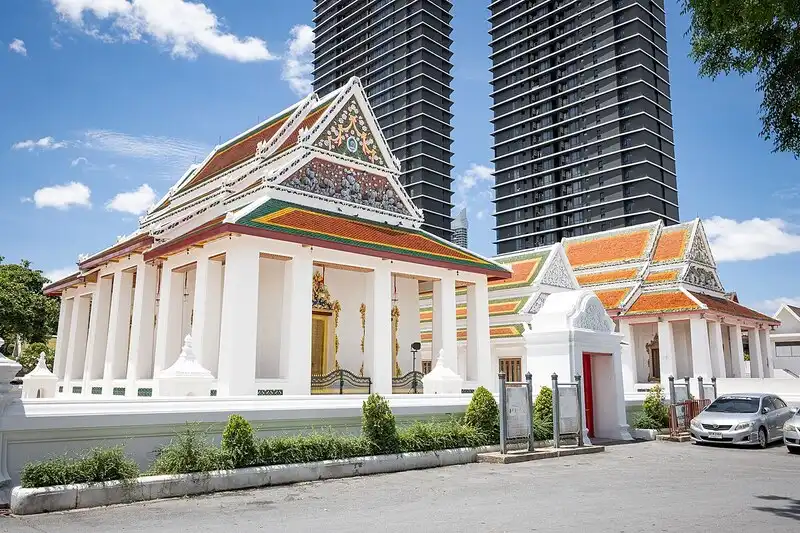
Wat Suwet Chatcha Worawihan is a royal monastery on the Thonburi side of the Chao Phraya River that feels “peaceful, but never empty.” Even though it sits in inner Bangkok, the temple still clearly functions as a living center of community life and faith. The front of the temple faces the west bank of the Chao Phraya River, while the back connects to Charoen Nakhon Road in Bang Lamphu Lang, Khlong San. That layout makes it easy to experience both a riverside-temple atmosphere and a real local neighborhood in the same visit—especially if you enjoy exploring Bangkok slowly, with history and place-based stories rather than rushing from spot to spot. It’s an excellent choice for a half-day trip.
The charm of Wat Suwet Chatcha isn’t only its riverside setting—it’s the “layers of time” you can feel in one space. This is a third-class royal temple of the Worawihan category, with a story that connects late Ayutthaya roots to early Rattanakosin development, and finally the royal bestowal of its name in the reign of King Rama IV. Local accounts describe the temple as having originated as an old temple from the late Ayutthaya period. While clear records of the original founder have not survived, an “old ubosot” remains as an important piece of evidence of its age. People in the area also used to call the temple by several names—such as Wat Maeng Phu, Wat Bang Lamphu Nai, or Wat Kampu Chat—reflecting a long-standing riverside community with deep shared memory.
The period that shaped the temple into what we see today was the construction and re-planning carried out from the late reign of King Rama II through the early reign of King Rama III. Phra Chao Ai Ka Thoe Krom Muen Surin Tharak (Prince Chat, ancestor of the Chatkul family) undertook the building works between 2359 and 2373 BE, and the temple was later presented as a royal monastery. In the reign of King Rama IV, King Mongkut bestowed the name “Wat Suwet Chatcha” as a memorial to Prince Chat, the temple’s founder. The name, therefore, is more than a label—it marks the founder’s significance and the temple’s position within Bangkok’s history.
The riverside location is both the temple’s beauty and its challenge. Accounts note that land at the front of the temple gradually extended and silted up along the riverbank, creating distance from the original site. Prince Chat therefore “relocated and rebuilt” the temple to its present position. There is also a tradition that he ordered his own residence to be dismantled and re-used as a large five-room kuti (forming a major monastic residence group today). Alongside that, key structures were built, including an ubosot, a viharn, a sermon hall, and a prang. In other words, the temple did not simply remain static—it evolved in response to the river landscape and the real needs of the community.
One feature many visitors remember is the reclining Buddha with the long, dignified name “Phra Phuttha Banduramon Pradit Satit Saiyas.” This is an early Rattanakosin-era reclining Buddha, believed to date to around 2364 BE. It was originally placed on a level ground area near the ubosot courtyard. Because the temple sits right beside the Chao Phraya River, the statue was once affected by annual flooding, leading to significant damage and deterioration over time. This detail turns a simple temple visit into something more meaningful: it reveals a real, lived relationship between temple heritage and the river, and highlights why conserving religious art in a major city matters.
Another spiritual focal point is “Luang Pho Bot Bon,” a seated Buddha in the Ayutthaya artistic tradition. Local belief describes it as a bamboo-lathed core plastered over with stucco—an old technique—and as a long-venerated image created together with the temple, though the original maker and exact date are unknown. The formal name is Phra Phuttha Samathikhun Sunthon Sama Thanburan Sukot, but most people simply call it “Luang Pho Bot Bon.” You’ll often see devotees coming to pay respects daily, not only during festivals—because faith here is sustained by ongoing community practice, not just special occasions.
As a Bangkok attraction, Wat Suwet Chatcha offers an experience that blends devotion with story. You’re not only here to make merit and leave—you can read history through the temple’s layout, see how the riverside environment shaped its development, and feel the everyday rhythm of Khlong San around it. On quieter days, the riverside air makes it especially easy to slow down, and the walk through the temple grounds falls naturally into a gentle pace that suits old Bangkok perfectly.
Getting There The easiest option if you don’t want to worry about parking is to take the BTS and then continue by taxi or motorbike taxi to Charoen Nakhon Road, since the back of the temple connects directly to this road and access is convenient. Another option is to take buses in the Charoen Nakhon – Khlong San area and walk a short distance. You can also plan a “Bangkok by river” trip by taking a boat on the Chao Phraya and getting off at a nearby pier for a riverside approach. If you drive, allow extra time for traffic, especially during weekday rush hours, and it’s wise to call ahead on the day you plan to visit.
To enjoy the temple properly, set aside about 60 – 90 minutes. Start by paying respects to Luang Pho Bot Bon in a calm, unhurried way, then continue to the reclining Buddha. After that, walk through the older ubosot area and the temple’s main structures, and finish by taking in the river breeze at the front of the temple. That final moment often makes you feel that “riverside temple” is more than a phrase—it’s a real place where city life and faith genuinely coexist.
| Name | Wat Suwet Chatcha Worawihan |
| Area / Zone | Khlong San – Charoen Nakhon (Bang Lamphu Lang), Bangkok |
| Location | Bang Lamphu Lang, Khlong San, Bangkok (front faces the west bank of the Chao Phraya River / back connects to Charoen Nakhon Road) |
| Highlights | Royal riverside temple, old ubosot as evidence of antiquity, key devotional points include Luang Pho Bot Bon and the reclining Buddha |
| Period | Roots in late Ayutthaya (old ubosot remains) / major construction and development 2359 – 2373 BE (late Rama II – early Rama III) / name bestowed in the reign of Rama IV |
| Key Evidence / Landmarks | Luang Pho Bot Bon (Ayutthaya-style seated Buddha), reclining Buddha “Phra Phuttha Banduramon Pradit Satit Saiyas” dated around 2364 BE, old ubosot, viharn, sermon hall, and prang |
| Name Origin | King Rama IV bestowed the name “Wat Suwet Chatcha” as a memorial to Prince Chat (Krom Muen Surin Tharak), the temple’s founder |
| Travel | BTS + taxi/motorbike taxi via Charoen Nakhon is convenient, buses in the Charoen Nakhon – Khlong San area with a short walk, or arrive by Chao Phraya river boat via a nearby pier |
| Current Status | Generally open for worship/visits (recommended to call and confirm before visiting) |
| Contact Number | 02-860-2215 |
| Nearby Tourist Attractions with Distance | ICONSIAM (approx. 2.0 km) Tel. 02-495-7000 LHONG 1919 (approx. 4.0 km) Tel. 02-168-3311 River City Bangkok (approx. 4.0 km) Tel. 02-237-0077 Asiatique The Riverfront (approx. 4.5 km) Tel. 02-108-4488 Wat Yannawa (approx. 5.0 km) Tel. 02-672-3213 |
| Popular Restaurants Nearby with Distance | Hong Sieng Kong (approx. 3.0 km) Tel. 095-998-9895 The Jam Factory (approx. 3.5 km) Tel. 02-861-0950 The Never Ending Summer (approx. 3.6 km) Tel. 02-861-0953 Blue by Alain Ducasse (ICONSIAM) (approx. 2.5 km) Tel. 065-731-2346 Sirimahannop (Asiatique) (approx. 5.0 km) Tel. 02-059-5999 |
| Popular Accommodations Nearby with Distance | Millennium Hilton Bangkok (approx. 2.5 km) Tel. 02-442-2000 ibis Bangkok Riverside (approx. 3.0 km) Tel. 02-659-2888 The Peninsula Bangkok (approx. 3.2 km) Tel. 02-861-2888 Shangri-La Bangkok (approx. 4.8 km) Tel. 02-236-7777 Avani+ Riverside Bangkok Hotel (approx. 6.5 km) Tel. 02-431-9100 |
Frequently Asked Questions (FAQ)
Q: Which area of Bangkok is Wat Suwet Chatcha Worawihan in?
A: It’s in Khlong San (Bang Lamphu Lang). The front faces the west bank of the Chao Phraya River, and the back connects to Charoen Nakhon Road, making it easy to link with other riverside attractions.
Q: What are the must-see highlights here?
A: The key highlights are Luang Pho Bot Bon (an Ayutthaya-style seated Buddha) and the reclining Buddha “Phra Phuttha Banduramon Pradit Satit Saiyas,” along with the riverside atmosphere that shows the temple’s long relationship with the river.
Q: What is Luang Pho Bot Bon?
A: It’s a seated Buddha image in the Ayutthaya artistic tradition, stucco with gilded finish, widely revered by locals who come to pay respects daily.
Q: How much time should I plan for a visit?
A: Plan about 60 – 90 minutes to pay respects, see the main landmarks, and enjoy the riverfront atmosphere at an unhurried pace.
Q: What’s the most convenient way to get there?
A: BTS + taxi/motorbike taxi via Charoen Nakhon is usually the easiest if you want to avoid parking concerns. You can also come by bus with a short walk, or arrive by boat on the Chao Phraya River via a nearby pier.
Q: Which number should I call to confirm details before visiting?
A: Call 02-860-2215.
 Wat Suwet Chatcha Worawihan Map
 Category:
  Group:
  Tag: ●Wat Suwet Chatcha Worawihan●wat suwetchat ●wat suwetchat worawihan ●khlong san temple ●charoen nakhon temple ●chao phraya riverside temple ●thonburi temple bangkok ●luang pho bot bon ●reclining buddha temple bangkok ●things to do khlong san ●temples in bangkok riverside Last Update: 2 MonthAgo
Comment

Photo Gellery(18) 
 Thank you photo(9) from: Piteekorn