

 Home
Home Chiang Mai(










Wat Suwannaram Ratchaworawihan (Wat Thong)
Rating: 4.3/5 (8 votes)
 Search By
  Map
Map 
 Have Map
  No Map
Bangkok attractions
Attractions in Thailand
Open Days: Daily
Opening Hours: 08:00 – 17:00
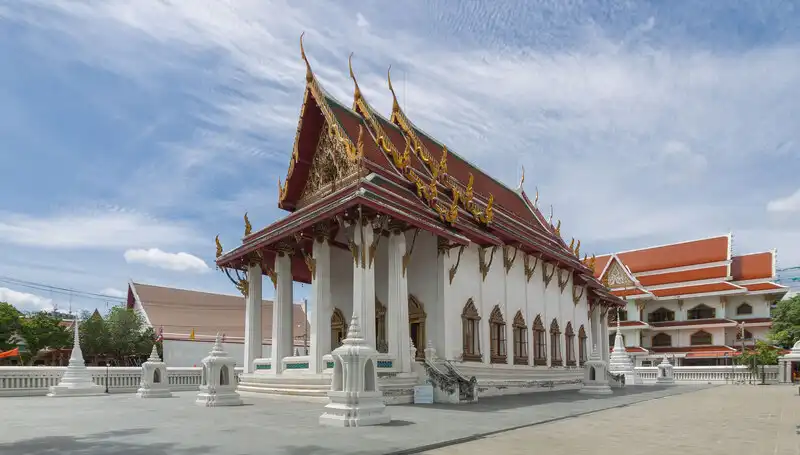
Wat Suwannaram Ratchaworawihan (Wat Thong) If you’re in the mood for a Thonburi-side temple that feels “quiet, but full of stories,” with fine art details that can easily make you lose track of time, Wat Suwannaram Ratchaworawihan is a seriously good pick. The temple sits along the western bank of Bangkok Noi Canal and is accessed via Charan Sanitwong Road. That canal-side setting softens the whole atmosphere, making it ideal for a calm visit — come to pay respects, reset your mind, and then slowly read the temple’s art and history corner by corner without rushing.
What anchors Wat Suwannaram is its long timeline. It traces back to the Ayutthaya period and was originally known as “Wat Thong.” Later, history pulled the temple into the political currents of the Thonburi era, before King Rama I re-established the entire monastery and bestowed the name “Wat Suwannaram.” That’s why this place isn’t only a neighborhood canal temple — it’s a living marker of Bangkok’s transitions from Ayutthaya to Thonburi and into early Rattanakosin, all concentrated in one walkable space.
For art lovers, the signature draw is the ordination hall (ubosot) and its mural paintings. During the reign of King Rama III, the temple underwent major restoration, and painters were commissioned to create murals inside the ubosot. Works associated with renowned artists such as Luang Wijit Jesada (Thong-oo) and Luang Sani Borirak (Khong-Pae) are often praised for their precision — linework, color control, and the way Buddhist stories are narrated across the walls. When you stand close, it’s easy to see how the composition makes the scenes feel “alive,” not just decorative — you end up reading the story as you move through the space.
Architecturally, the ubosot follows early Rattanakosin conventions from the reign of King Rama I. The columns are square with chamfered corners (yom-mum mai sip-song), and there are verandas at both the front and back. Details like the roof finials and decorative elements create a solemn, dignified mood. The gable carvings of kneeling deities and Narayana riding Garuda, finished with gold, are the kind of craftsmanship that makes people pause — it has that unmistakable feeling of “the real thing,” both in proportion and finesse.
Inside the ubosot, beyond the murals, you’ll find the principal Buddha image in the Mara-Vijaya posture. According to tradition, it is linked to the same master craftsmanship associated with Phra Si Sakyamuni at Wat Suthat, and it is also believed to have been brought from Sukhothai during the reign of King Rama I. That backstory adds an art-historical layer to the act of paying respects here — it’s not only devotion, but also standing before a long journey of Thai artistic lineage across eras.
After you move past the ubosot zone, the temple’s layout opens into elements that underline how this remains a true community temple. There is a viharn built during the reign of King Rama IV with transverse porches at both the front and back, and a beautiful cluster of old monk residences made of wooden panels (fa pakon). The residences are arranged as multiple buildings with a dining hall at the center, supported by structures such as a bell tower and a scripture hall (ho trai). The overall impression is of a “working temple” — not a place staged only for sightseeing, but a living space that continues to be used and cared for.
One of the most charming things about Wat Suwannaram is how clearly it still functions as a center of community life along Bangkok Noi Canal. Merit-making on Buddhist holy days, kathin ceremonies, pha pa offerings, and local activities supported by residents continue to flow through the temple. When you arrive, it doesn’t feel deserted — it feels like “living calm,” with visitors coming to pay respects and the rhythm of Thai temple life quietly continuing in the background.
Getting ThereThe temple is located in Charan Sanitwong Soi 32 in the Bangkok Noi–Siriraj area. If you’re driving, set your map pin to “Wat Suwannaram Ratchaworawihan” and allow extra time for traffic on Charan Sanitwong Road, especially in the morning and evening. By public transport, you can use the rail network and then connect by taxi or motorbike taxi into the soi. It also works well as a continuous half-day route with the Siriraj–Wang Lang–nearby museum area, so you can keep the trip flowing without bouncing back and forth.
| Place Name | Wat Suwannaram Ratchaworawihan (Wat Thong) |
| Location | Charan Sanitwong Soi 32, Charan Sanitwong Road, Siriraj Subdistrict, Bangkok Noi District, Bangkok (along Bangkok Noi Canal) |
| Highlights | A 2nd-class royal temple, formerly known as Wat Thong (Ayutthaya-era origins), linked to Thonburi-period history, and especially known for ubosot murals (master-level painting) and early Rattanakosin (Rama I) architectural style |
| Period | Ayutthaya → Thonburi → Early Rattanakosin (re-established under Rama I) → Major restoration and mural works (Rama III) |
| Key Things To See | The ubosot and its mural paintings, the principal Buddha image (Mara-Vijaya posture), gable/roof-finial details, the viharn (Rama IV period), the old wooden monk residences (fa pakon), the bell tower, and the scripture hall (ho trai) |
| Current Status | Open for worship and visits during operating hours; an active community temple with ongoing Buddhist-calendar activities |
| Contact | 089-815-6985, 02-433-7129 |
| Nearby Attractions (Distance) | Wang Lang Market (3.5 km) Siriraj Bimuksthan Museum (3.8 km) National Museum of Royal Barges (3.0 km) Bangkok Noi Canal (boat/canal-walk spots) (2.0 km) Wat Arun Ratchawararam Ratchaworamahawihan (6.5 km) |
| Popular Restaurants Nearby (Distance + Phone) | Supanniga Eating Room (Tha Tien) (7.0 km) Tel. 092-253-9251 Rongros (6.8 km) Tel. 096-946-1785 The Deck by Arun Residence (7.2 km) Tel. 02-221-9158 Saeng Tha Tien (7.0 km) Tel. 062-169-6591 The Sixth (Tha Tien area) (7.4 km) Tel. 064-078-7278 |
| Popular Accommodations Nearby (Distance + Phone) | Arun Haus 39 (2.2 km) Tel. 061-982-5141 Thamrong Inn (3.8 km) Tel. 02-411-1901 Poonsuk Place (3.0 km) Tel. 098-875-6789 Amarin Mansion (3.2 km) Tel. 02-882-4848 ibis Bangkok Riverside (8.5 km) Tel. 02-805-9888 |
Frequently Asked Questions (FAQ)
Q: Is Wat Suwannaram Ratchaworawihan open every day?
A: Generally, yes. Weekday mornings are a great time to enjoy the murals and architecture without rushing.
Q: What are the opening hours of Wat Suwannaram?
A: Generally, 08:00 – 17:00.
Q: What shouldn’t I miss at Wat Suwannaram?
A: The ubosot and its mural paintings, the Rama I–style architectural details, and the calm canal-side atmosphere that still feels deeply rooted in the community.
Q: When is the temple less crowded?
A: Weekday mornings are usually easier to walk around. Weekends tend to get busier from late morning onward.
Q: How much time should I plan for a visit?
A: About 1–2 hours is a good baseline. If you enjoy studying mural details and craftsmanship, 2–3 hours can pass quickly.
Q: What should I wear when visiting Wat Suwannaram?
A: Dress respectfully — avoid very short or overly tight clothing, and keep a quiet, respectful tone in sacred areas, especially inside the ubosot.
 Wat Suwannaram Ratchaworawihan (Wat Thong) Map
 Category:
  Group:
  Tag: ●Wat Suwannaram Ratchaworawihan (Wat Thong)●wat suwannaram ●wat suwannaram ratchaworawihan ●wat thong ●bangkok noi canal temple ●thonburi temples ●temple murals bangkok ●ubosot murals thailand ●historic temples in bangkok ●buddhist temple thonburi ●cultural attractions bangkok Last Update: 2 MonthAgo
Comment
 Nearby Attractions
| Keyword (Advance) |
 Region
|
 Phra Nakhon(
 Copyright 2012,