
 Home
Home North(
 Chiang Mai(


Wat Thong Song Tham
Rating: 4/5 (9 votes)
 Search By
  Map
Map 
 Have Map
  No Map
Phranakhon Si Ayutthaya attractions
Attractions in Thailand
Open Days: Daily
Opening Hours: 08:00 – 17:00
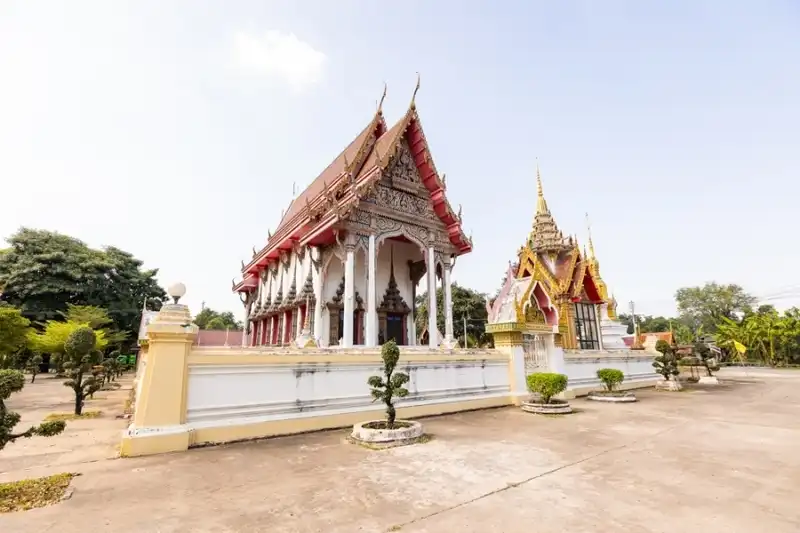
Wat Thong Song Tham (Samakkhi Narumit) is a community temple on the banks of the Pa Sak River in Khlong Sakae Subdistrict, Nakhon Luang District, Phra Nakhon Si Ayutthaya Province. This temple does not stand out as a mainstream “tourist landmark”; instead, its significance comes from the continuity of local faith and the long-standing mutual support within the community—a living reflection of the real Ayutthaya, a city historically sustained not only by the grandeur of its former capital status, but also by networks of riverine communities, temples, and waterborne routes.
Viewed through a historical lens, Ayutthaya’s “river basin” is the heart, and the “temple” is the everyday anchor of life. The Pa Sak River is not merely a waterway; it has long functioned as the lifeblood that nourished settlement, travel, trade, and cultural exchange for communities on Ayutthaya’s eastern side. In an era before straight highways and modern bridges, riverside communities grew alongside landing piers, local markets, and temples. Temples therefore served simultaneously as religious centers, social hubs, and ritual spaces that gave people a sense of “order” and “meaning” amid the uncertainties of nature and livelihood.
Wat Thong Song Tham is recorded as having been established in the late Ayutthaya period (B.E. 2250). In the wider historical context, this was a time when the Ayutthaya Kingdom experienced increasing political complexity and international trade activity. Many communities outside the island city relied heavily on river-and-canal ecosystems both for agriculture and for connection to major markets. Temples in such communities often emerged from collective effort rather than royal patronage. They were not necessarily royal temples, but temples that “worked” in everyday life. Over time, a place becomes sacred not only through stories, but through repeated returns—on holy days, in times of hardship, in moments of joy—until the temple becomes part of the shared biography of the village.
As a community temple, Wat Thong Song Tham is mentioned in some sources as having once been known by another name (“Wat Khwit”) before it became widely recognized by its current name. This kind of information is valuable anthropologically, because community temple names often reflect geography, local occupations, or shared memories. “Thong Song Tham” carries a sense of value and moral steadiness, while “Samakkhi Narumit” clearly signals a social meaning: the temple as a place where unity is “created” and “sustained,” whether through merit-making, maintenance of monastic buildings, or the organization of annual traditions.
The Pa Sak riverscape gives the temple an atmosphere distinct from temples in dense urban neighborhoods. The greenery along the river, the passing breeze, and the rhythms of local life that still feel close to the past allow visitors to experience “another Ayutthaya”—Ayutthaya as people’s home, not merely an open-air museum. This context is increasingly important for cultural travel today, as many travelers seek layered, meaningful experiences rather than quick check-ins at popular sites.
The ordination hall and other temple structures—such as the sermon hall, monks’ quarters, bell tower, chanting hall, and riverfront pavilion—help confirm the image of a community temple with facilities that support complete ritual practice. One notable detail is the mention of a large stupa and several smaller stupas that were restored in the past (for example, restoration around B.E. 2480). Such details show that the community did not merely “use” the temple; it continually “cared for” it over time. Restoration is evidence of a living relationship between people and sacred place—measurable through action, not only through narration.
For the community, the temple’s heart is the “principal Buddha image,” because it is the focal point of both sight and spirit. Whatever the reason for visiting, standing before the principal Buddha image naturally invites self-reflection. In riverside communities, the principal Buddha image is often tied to beliefs about family well-being, smooth livelihoods, and safe travel—especially in earlier times when water travel carried real risks. Faith thus worked like a psychological pillar of society, making the temple feel like a “second home” for everyone in the village.
Some contemporary social-media sources mention “Luang Pho Phra Prathan Phon” or “Luang Pu Thong” as figures of local reverence. This reflects a layer of community faith that is often connected to specific names and shared stories. From a historical-writing perspective, it is best read as “present-day social evidence” indicating what the community emotionally centers on, rather than as fixed historical fact. What is consistent is that Wat Thong Song Tham functions as a spiritual refuge for people along the Pa Sak River, aligning with the long-standing role of community temples in Ayutthaya.
Another key piece of institutional evidence is the record of the temple receiving Wisungkhamsima, noted as granted on 10 March B.E. 2525. This matters because Wisungkhamsima designates an officially sanctioned boundary for conducting ordination rites in the Thai monastic system. In other words, the temple is not only a place for merit-making gatherings; it is a religious institution that supports ordination, monastic education, the transmission of Buddhism, and the continuation of community life through major life rituals.
Returning to the idea of Wat Thong Song Tham as the long-standing temple for communities in Village No. 2 and Village No. 4, the clearest image is that it functions as a shared space accessible to everyone. Regardless of which part of the community one comes from, on Buddhist holy days, merit-making occasions, or funerary rites, the temple is where relationships are reaffirmed. Many community temples in Ayutthaya therefore carry social importance equal to their religious importance, which explains why even as the modern world changes quickly, people continue to value temples as “roots” that hold communities together.
If you visit Wat Thong Song Tham with a historical travel mindset, the best approach is to spend time with the “small details”—wooden structures, the riverfront pavilion, the cadence of local life around the temple, and the atmosphere of the Pa Sak River. These details help you “read the past through the present” in a tangible way. Ayutthaya is not only grand temples in tourist zones; it also has community temples that help us understand how the former capital relied on surrounding communities, and how ordinary people played a crucial role in sustaining the city across time.
Getting There Wat Thong Song Tham is convenient to reach by private car. Travel via Asia Road, then turn onto the Khlong Sakae–Nakhon Luang Road. Continue for about 2 km, then turn right onto the local community road as indicated by signposts or navigation. Because the temple is within a riverside community setting, drive carefully on local roads and allow a little extra time on weekends and Buddhist holy days when there may be community activity in the area.
Overall, Wat Thong Song Tham (Samakkhi Narumit) is ideal for travelers who want to see a “living Ayutthaya” through the lens of a Pa Sak riverside community temple. It suits those who enjoy history at the community level, prefer a calm atmosphere, and want to experience a continuity of faith that is still actively present. The temple may not have monumental architecture on the scale of royal temples, but it offers something that some major sites cannot: a genuine sense of belonging to the community. This is the enduring charm that keeps many community temples meaningful, no matter how much time passes.
| Place Summary | A Pa Sak riverside community temple in Khlong Sakae Subdistrict, Nakhon Luang District, Phra Nakhon Si Ayutthaya; a spiritual center for the Village No. 2 and Village No. 4 communities. |
| Key Highlights | A calm riverside atmosphere and an authentic local-temple setting with a community-history dimension from the late Ayutthaya era (established B.E. 2250). |
| Address | 103 Moo 2, Khlong Sakae Subdistrict, Nakhon Luang District, Phra Nakhon Si Ayutthaya 13260, Thailand |
| Era / Timeline | Established B.E. 2250 (late Ayutthaya period) and received Wisungkhamsima on 10 March B.E. 2525. |
| Key Evidence | Recorded establishment status and Wisungkhamsima date, plus details of temple buildings/stupas and past restorations (as referenced in temple databases). |
| Name Origin | “Thong Song Tham” conveys moral value and dignity; “Samakkhi Narumit” reflects the temple’s role in cultivating community unity. |
| Abbot / Caretaker (Latest Found) | Phra Khru Winai Thora Maha Khun, Puttakamo |
| Phone (Temple Contact) | 035-359-534 |
| Getting There | Asia Road → turn onto Khlong Sakae–Nakhon Luang Road → about 2 km → turn right into the local community road to the temple. |
| Current Status | Open for worship during typical temple hours. |
| Nearby Attractions (Approx. Distance) | 1) Prasat Nakhon Luang – 12 km 2) Wat Yai Chai Mongkhon – 28 km 3) Ayutthaya Historical Park (Island-City Zone) – 30 km 4) Wat Mahathat – 31 km 5) Wat Phra Si Sanphet – 32 km |
| Nearby Restaurants (Approx. Distance + Phone) | 1) Baan U-Thong Riverside – 31 km – 035-242-248, 084-329-3333 2) Suan Ahan Rim Nam (Ayutthaya) – 30 km – 081-494-9440 3) Phongphan (Grilled River Prawns, Talat Klang Ayutthaya) – 34 km – 083-303-9994 4) Roti Sai Mai Bang Imron – 31 km – 088-195-6999, 095-167-6999 5) Krua Khun Tao (Nakhon Luang) – 15 km – 081-070-9071 |
| Nearby Accommodations (Approx. Distance + Phone) | 1) sala ayutthaya – 30 km – 035-242-588 2) krungsri river hotel – 29 km – 035-244-333 3) classic kameo hotel, ayutthaya – 32 km – 035-212-535 4) kantary hotel and serviced apartments, ayutthaya – 36 km – 035-337-177 |
Frequently Asked Questions (FAQ)
Q: Where is Wat Thong Song Tham (Samakkhi Narumit) located?
A: The temple is located at 103 Moo 2, Khlong Sakae Subdistrict, Nakhon Luang District, Phra Nakhon Si Ayutthaya, within a Pa Sak riverside community setting.
Q: How is the temple connected to Ayutthaya’s history?
A: It is recorded as established in the late Ayutthaya period (B.E. 2250), offering community-level historical context tied to river-basin life and local temples that have endured alongside the community.
Q: Why is the principal Buddha image important to the community?
A: The principal Buddha image is a spiritual focal point, especially for residents of Village No. 2 and Village No. 4, who come to pay respect, seek blessings, and gather at the temple for key life events.
Q: Who is the abbot of the temple?
A: The latest found information lists Phra Khru Winai Thora Maha Khun, Puttakamo. It is advisable to confirm onsite or by phone, as positions may change over time.
Q: How do I get to Wat Thong Song Tham?
A: Take Asia Road, turn onto Khlong Sakae–Nakhon Luang Road, drive about 2 km, then turn right into the local community road leading to the temple.
Q: What are the visiting hours?
A: The latest found information indicates daily hours of 08:00 – 17:00. On special merit-making days or community events, hours may be flexible; calling ahead is recommended.
 Wat Thong Song Tham Map
 Category:
  Group:
  Tag: ●Wat Thong Song Tham●wat thong song tham ●samakkhi narumit temple ●temples in ayutthaya ●nakhon luang temple ●pa sak river temple ●ayutthaya historical travel ●local community temple ayutthaya ●off the beaten path ayutthaya ●buddhist temple near pa sak river ●things to do in nakhon luang Last Update: 2 MonthAgo
Comment
 Nearby Attractions
| Keyword (Advance) |
 Region
|
 Phranakhon Si Ayutthaya(
 Copyright 2012,