
 Home
Home North(
 Chiang Mai(


Wat Klang
Rating: 4/5 (7 votes)
 Search By
  Map
Map 
 Have Map
  No Map
Phranakhon Si Ayutthaya attractions
Attractions in Thailand
Open Days: daily
Opening Hours: 06:00 – 18:00
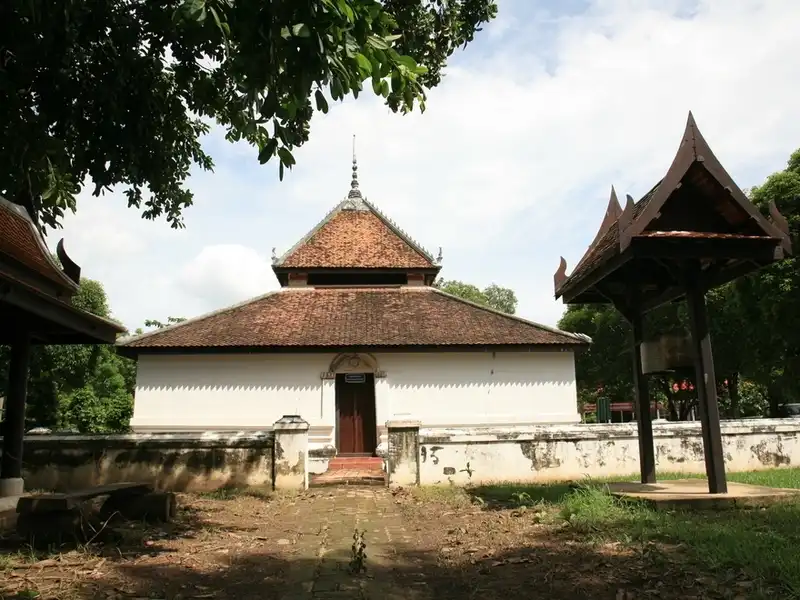
Wat Klang is located in Moo 4, Nakhon Luang Subdistrict, Nakhon Luang District, Phra Nakhon Si Ayutthaya Province. It is a quiet riverside temple along the Pa Sak River, but it holds something genuinely rare—the kind of detail that makes people drive here on purpose. Inside an old mondop or ancient chapel, the temple presents a three-dimensional reconstruction of a major episode in the Buddha’s life: the cremation rite of the Buddha’s sacred remains. The most striking element is at the end of a gilded coffin where the “soles of the Buddha’s feet” appear to extend beyond the coffin, allowing visitors to pay respects in a way that feels unusually tangible. It is not just visually surprising; it makes many people feel as if they are standing before a living scene from Buddhist history.
The charm of Wat Klang is not about grand scale like the famous temples in Ayutthaya’s old city, where visitor numbers are often much heavier. Instead, it lies in the feel of a real community temple by the river, where everyday rhythms still remain. From the riverside breeze and shaded corners to the gentle quiet that naturally slows you down, it suits travelers who prefer an unhurried visit. Take time to observe the details, then continue to nearby places in Nakhon Luang District in a smooth, easy flow.
What makes Wat Klang stand out is the “old mondop / ancient chapel,” a brick-and-mortar structure associated with the early Rattanakosin period in local accounts. Several sources describe the temple as having been established around the early Rattanakosin era (approximately 2330 BE), and the key mondop is often believed to date to the reign of King Rama III. The remarkable point is that, even as a community temple, its core highlight is religious storytelling that is intentionally designed to be immediately understandable—and that is a major reason Wat Klang continues to be discussed and sought out.
As you step inside the mondop, you will see an elevated platform at the center, decorated with lotus-base motifs (bua khwam – bua hong) and approached by stairways from all four directions. The central space feels like a ceremonial stage that guides worshippers inward with a deliberate sense of movement. On the platform rests a red-and-gold coffin, and what is “unlike anywhere else” is that one end shows two soles of the Buddha’s feet extending beyond the coffin. The soles display refined symbolic designs—including a Dharma wheel motif and spiral-like patterns—and at the end stands an image or sculpture of “Mahākassapa” paying reverence at the feet. The entire composition is arranged so clearly that visitors can instantly understand it as a pivotal scene from Buddhist history, not merely decorative art.
If you are familiar with the Buddha’s life story, you may recall that after the Buddha’s Parinibbāna, Mahākassapa is a crucial figure connected to the moment of final homage before the cremation rite proceeds. By telling this episode in a three-dimensional form, Wat Klang makes the meaning far more vivid than a mural alone. You can see how the elements relate in real space—the platform, the coffin, the feet, and the key figure—so standing there can feel less like viewing an exhibit and more like “being present in a chapter of Buddhist history.”
Beyond the central scene, the surrounding walls feature murals that recount Buddhist narratives and depict disciples who gather for the event. The murals serve like a contextual backdrop, expanding the story so visitors do not feel they are venerating a single object in isolation. Instead, it becomes a complete narrative with a clear beginning, meaning, and continuity. As you walk around the interior, more details gradually reveal themselves—gestures, expressions, narrative moments, and artistic choices that give the mondop a sense of life.
Many visitors find the most comfortable time to come is early morning or late afternoon, when the light is softer, the riverside air feels gentler, and the space is less crowded. Visiting without rushing helps you settle your mind. A simple approach is to pay respects in the main worship area first, then move to the old mondop / chapel to observe the three-dimensional scene carefully. Spending 30–60 minutes quietly, without constantly hunting for photo angles, often leaves a stronger impression than expected.
In terms of etiquette, Wat Klang is an active community temple. Dress modestly, keep your voice low, and avoid climbing or touching artwork and historic elements unnecessarily. If you want to take photos, be mindful of people making merit or working nearby. If a ritual or temple activity is happening that day, standing respectfully and giving worshippers space helps preserve the atmosphere for everyone.
Another point worth including in your plan is the temple’s “seasonal merit-making events.” Many Thai temples become livelier after Buddhist Lent (Ok Phansa), when the Kathin season begins. For Wat Klang, published information mentions Kathin Samakkhi (a community Kathin ceremony) in some years, reflecting the temple’s continuing role as a real spiritual hub for local people. If you want the fuller “festival-of-faith” atmosphere, follow the temple’s announcements for the Kathin period each year and plan your visit accordingly—that is when you are more likely to see community gatherings, merit-making, food-sharing, and the kind of lived energy that makes a temple feel truly “alive.”
Getting There If you are driving from Bangkok, you can take Phahonyothin Road (Highway 1) and connect to Asia Road (Highway 32) toward Nakhon Luang District. Then enter Nakhon Luang Subdistrict and follow signs or navigation to “Wat Klang.” Driving in this area is generally straightforward, but it is smart to allow extra time on weekday mornings and during long holidays when out-of-town traffic is heavier.
If you are traveling by public transport, a practical option is to first reach Phra Nakhon Si Ayutthaya (city area) and then continue to Nakhon Luang District. From there, use local transport such as a hired car or local taxi to reach Wat Klang. Visiting as a group can be more cost-effective and flexible, especially if you want to add nearby stops such as Prasat Nakhon Luang or other sites in the same area.
Overall, Wat Klang is an excellent destination for travelers who want to see Ayutthaya “beyond the old-city route” and who value calm atmosphere alongside distinctive cultural art. The three-dimensional reconstruction inside the mondop, paired with the unforgettable image of the Buddha’s feet appearing beyond the gilded coffin, is not something commonly found at ordinary temples. Combined with the Pa Sak riverside setting and community feel, it becomes a place you remember immediately—and can easily describe to others as “the temple with something truly special.”
| Place Name | Wat Klang (Nakhon Luang District) |
| Location | Moo 4, Nakhon Luang Subdistrict, Nakhon Luang District, Phra Nakhon Si Ayutthaya |
| Address | 92 Moo 4, Nakhon Luang, Nakhon Luang, Phra Nakhon Si Ayutthaya 13260 |
| Open Days | daily |
| Opening Hours | 06:00 – 18:00 |
| Summary | A Pa Sak riverside community temple in Nakhon Luang, notable for an old mondop / chapel featuring a three-dimensional reconstruction of the Buddha’s cremation rite, including the unforgettable detail of the Buddha’s feet appearing beyond a gilded coffin. |
| Highlights | 1) A three-dimensional Buddhist-history scene inside the mondop 2) The rare “Buddha’s feet extending beyond the gilded coffin” detail 3) A calm riverside community-temple atmosphere suited to unhurried merit-making |
| Brief History | Published accounts describe the temple as established around the early Rattanakosin period (approx. 2330 BE), with the key mondop often believed to date to the reign of King Rama III. The interior presents murals and a three-dimensional depiction connected to the Parinibbāna and cremation rite narrative. |
| Abbot / Current Caretaker | Phra Khru Sophit Wihankhun |
| Contact Number | 035-359-549 |
| Fees | no admission fee (donations welcomed) |
| Facilities | parking area, shaded resting spots, riverside atmosphere (conditions may vary by time and temple activities) |
| Current Status | open for merit-making and visits during stated hours |
| Getting There | Drive via Highway 1 connecting to Highway 32 toward Nakhon Luang, then follow navigation to “Wat Klang” / Public transport: reach Ayutthaya, continue to Nakhon Luang District, then hire local transport to the temple |
| Traditions / Related Activities | Kathin Samakkhi (after Ok Phansa; dates vary by year, call to confirm) |
| Nearby Attractions With Distance | 1) Prasat Nakhon Luang – approx. 2 km 2) Wat Nakhon Luang (Prasat Nakhon Luang Area) – approx. 2 km 3) Nakhon Luang Municipality Market Area – approx. 1 km 4) Ayutthaya Old City (Island Area) – approx. 30 km 5) Wat Yai Chai Mongkhon – approx. 32 km |
| Popular Restaurants Nearby With Distance & Phone | 1) Krua Nakhon Luang (A. Kung Pao Seafood) – approx. 3 km – 081-070-9071 2) Krua Im Aroi (Nakhon Luang) – approx. 4 km – 087-080-8765 3) Kuay Tiao / Khao Lao Gai Ruan (Ban Chung Area) – approx. 8 km – 080-994-2695 4) Som Tam Saep Nua (Suwannakliaothong Market Area) – approx. 4 km – 081-851-8194 5) Krua Khun Tao (Nakhon Luang) – approx. 6 km – 092-845-3047 |
| Popular Accommodations Nearby With Distance & Phone | 1) Waree Resort – approx. 6 km – 062-553-6559 2) Rim Bueng Suan Prik Resort (Tha Ruea Area) – approx. 22 km – 084-516-6553 3) The Cavalli Casa Resort (Ayutthaya City Area) – approx. 32 km – 035-881-222 4) sala ayutthaya (Ayutthaya City Area) – approx. 30 km – 035-242-588 5) iuDia on the river (Ayutthaya City Area) – approx. 30 km – 086-080-1888 |
Frequently Asked Questions (FAQ)
Q: Where is Wat Klang located?
A: Wat Klang is in Moo 4, Nakhon Luang Subdistrict, Nakhon Luang District, Phra Nakhon Si Ayutthaya Province. It is a riverside temple along the Pa Sak River in the Nakhon Luang area.
Q: Is Wat Klang open every day?
A: Published information indicates the temple is open daily from 06:00 – 18:00. If you plan to visit during long holidays or around temple events, it is best to call in advance to confirm.
Q: What is the main highlight that makes Wat Klang famous?
A: The key highlight is the old mondop / chapel that presents a three-dimensional reconstruction of the Buddha’s cremation rite, including the rare detail of the Buddha’s feet appearing beyond a gilded coffin, which visitors can respectfully venerate.
Q: Why is Mahākassapa shown at the end near the Buddha’s feet?
A: The scene refers to Buddhist history connected to the period after the Parinibbāna. Mahākassapa is an important elder who offers final reverence before the cremation rite proceeds, so his presence helps clarify the meaning of the episode.
Q: Is there an admission fee at Wat Klang?
A: There is generally no admission fee. Visitors may make donations according to faith, and should help maintain quiet and respectful behavior within the temple grounds.
Q: Are there any traditions or annual events clearly associated with the temple?
A: Published information mentions Kathin Samakkhi after Ok Phansa (dates vary by year). If you want to visit during the event period, it is recommended to call the temple to confirm the exact date.
Q: Which phone number should I call to contact Wat Klang?
A: You can call 035-359-549 to ask about visiting details, merit-making events, or practical information before traveling.
 Wat Klang Map
 Category:
  Group:
  Tag: ●Wat Klang●wat klang nakhon luang ●wat klang ayutthaya ●nakhon luang temple ●pasak river temple ●wat klang mondop ●old chapel wat klang ●buddha feet coffin ●buddhist mural painting ●kathin ceremony wat klang ●ayutthaya hidden temple Last Update: 2 MonthAgo
Comment
 Nearby Attractions
| Keyword (Advance) |
 Region
|
 Phranakhon Si Ayutthaya(
 Copyright 2012,