
lovethailand home >Central Travel Attractions >Phranakhon Si Ayutthaya Travel Attractions >Wang Noi >Sanap Thuep > Wat Nong Son
TL;DR: Wat Nong Son is located at No. 27, Ban Nong Son, Moo 4, Sanap Thuep Subdistrict, Wang Noi District, Phra Nakhon Si Ayutthaya 13170, open Open daily, hours 08:00 – 17:00.
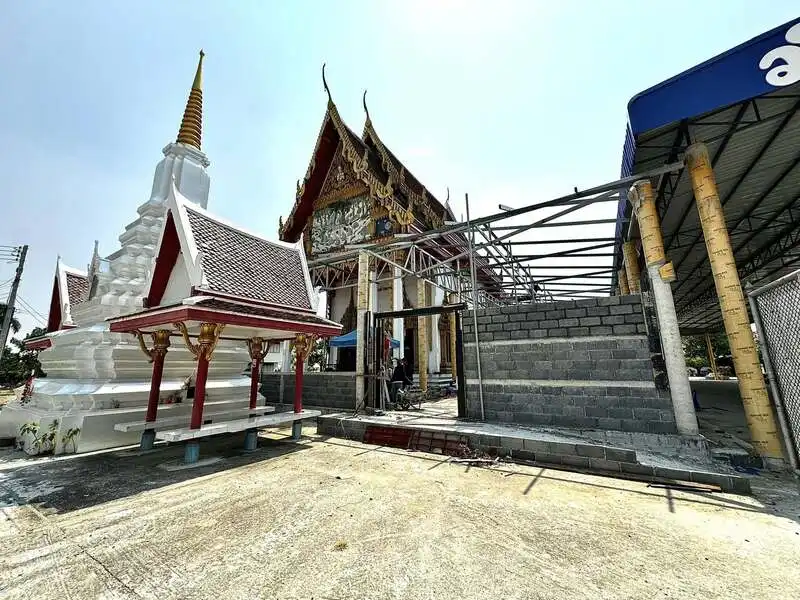
Wat Nong Son
Open Days: Open daily
Opening Hours: 08:00 – 17:00
Wat Nong Son is a long-established community temple that has been deeply respected by local residents for generations. It has traditionally served as the spiritual center of the surrounding community. Founded in 1852 through the donation of land by devoted lay supporters, the temple gradually expanded from a modest beginning into a fully developed religious complex capable of supporting both Buddhist rites and community activities. Today, Wat Nong Son is not only a place for merit-making on Buddhist holy days or important religious occasions, but also a space for learning, moral cultivation, and the preservation of a distinctly Buddhist Thai cultural core within the community.
The establishment of the temple during that period reflects the lifestyle of rural central Thailand, where people maintained a profound connection with Buddhism and the temple institution. For the community, a temple was never merely a collection of buildings or a venue for rituals; it was the foundation that provided social and spiritual structure. With a temple, the community gained a focal point for merit-making traditions, monastic ceremonies, and moral education for children and youth. Through Wat Nong Son, generations have absorbed values such as gratitude, discipline, and compassion. The temple has continued along this path through ongoing development of its grounds, construction of religious buildings, and the uninterrupted practice of Buddhist routines.
A significant turning point in the history of Wat Nong Son occurred in 1971, when additional land was donated for the construction of a new ordination hall (ubosot). This development reflected the strong faith of the community and a collective intention to enhance the temple’s capacity for formal monastic ceremonies. An ordination hall is not merely an architectural structure; it is the heart of important Sangha rituals, which must take place within a consecrated boundary (wisungkhamsima). Recognizing this importance, the temple carefully developed the area, culminating in the royal granting of a new wisungkhamsima on June 16, 2006. The consecrated boundary measures 22 meters wide and 40 meters long, confirming the temple’s full legitimacy for conducting monastic rites in accordance with Buddhist discipline.
In terms of tangible experience, visitors to Wat Nong Son often sense immediately that it is a living community temple. It is not a symbolic or purely touristic site, but a place actively integrated into everyday local life. The temple functions as a venue for merit-making, listening to sermons, offering alms, chanting, and participating in community religious events. The close relationship between monks and villagers creates a warm and approachable atmosphere that is rarely found in large urban temples. Visitors seeking a simple act of worship or a moment of reflection away from the pace of modern life often find a sense of calm rooted in the genuine rhythm of community life, rather than tranquility staged for tourism.
The sacred objects at Wat Nong Son hold deep religious significance as well as collective memory for the community. In the new ordination hall stands the principal Buddha image known as “Phra Phuttha Lokkanat Satsada,” depicted in the Mara-Victory posture beneath an ornate aureole. Cast in metal, this image carries clear symbolic meaning in Buddhist art, representing triumph over inner defilements and obstacles. Worshippers commonly pray here for stability in life, mindfulness, and the strength to overcome difficulties with patience and wisdom. The presence of a revered principal Buddha image transforms acts of merit-making into moments of sincere inner realignment.
Meanwhile, inside the viharn, which formerly served as the old ordination hall, resides another highly respected Buddha image known locally as “Phra Phuttha Mongkhon Muni (Luang Pho Dam).” This stucco image has long been venerated by villagers and serves as an additional focal point of devotion, especially during important occasions. In many rural temples, such long-standing Buddha images are deeply tied to community memory, acting as silent witnesses to generations of local life. Wat Nong Son similarly preserves both continuity and development through its dual sacred centers: the newer principal image reflecting growth and progress, and the older image representing enduring roots and community attachment.
The temple’s buildings and monastic structures reflect gradual growth across different periods. Construction of the new ordination hall began in 1985 and was completed in 2007. The structure measures 9.50 meters wide, 25.70 meters long, and 9.00 meters high. The extended construction period reflects both careful craftsmanship and the sustained faith of community members and donors. Additional facilities include one viharn, a reinforced-concrete sermon hall, a prayer hall, monks’ residences, meditation quarters, and a bell tower. Together, these structures enable the temple to support formal religious rites, community ceremonies, and educational or meditative activities within a single integrated space.
From a broader cultural perspective, Wat Nong Son functions as a place where Thai traditions continue to thrive. Major Buddhist observances such as Makha Bucha, Visakha Bucha, Asalha Bucha, the beginning and end of Buddhist Lent, as well as kathina and pha pa ceremonies, remain central to community life. These occasions bring people together to make merit, listen to sermons, and reaffirm a shared sense of ownership over their religious space. Such traditions serve as social capital, maintaining interpersonal bonds and mutual support in an era when modern life can otherwise fragment community relationships.
In terms of education, Wat Nong Son exemplifies a community temple that sustains moral education alongside religious practice. Facilities such as the sermon hall and prayer hall allow the temple to host ethical training programs for children and youth, as well as collective chanting and teaching sessions. When young people have accessible opportunities to engage with the temple, they are more likely to internalize values of respect, mindfulness, and responsibility toward the common good. Although these roles are rarely highlighted in tourism narratives, they remain a vital reality for many community temples and a key reason Buddhism continues to hold relevance in Thai society.
Visitors who make a deliberate journey to Wat Nong Son often seek a calm and natural atmosphere. Community temples in Ayutthaya outside the historic city center tend to be less crowded, making them suitable for quiet worship and personal reflection. Visits can be brief, focused on paying respects and setting intentions, or unhurried, allowing time to walk the grounds, listen to the wind or temple bells, and observe the simplicity of surrounding village life. From the perspective of peaceful cultural tourism, Wat Nong Son offers an alternative view of Ayutthaya—not as a collection of famous ruins, but as a living religious space closely intertwined with everyday human experience.
Getting There Wat Nong Son is located in Wang Noi District, Phra Nakhon Si Ayutthaya Province. The most convenient way to reach the temple is by private car, driving from Bangkok toward Wang Noi District and using a navigation system to search for “Wat Nong Son” for accuracy. Upon entering the local community area, visitors should observe signage and drive cautiously, as some roads are narrow local routes. Those traveling by public transport can first reach a main transport hub in Wang Noi District or nearby areas, then continue by local taxi or hired vehicle. Allowing sufficient travel time and checking road conditions in advance will help ensure a smooth journey.
To gain the most from a visit to Wat Nong Son, it is advisable to slow down and approach activities with mindfulness. This may include paying respects to the principal Buddha image in the new ordination hall, venerating Luang Pho Dam in the viharn, and making offerings according to one’s means, such as donating alms or contributing to temple funds. Visitors should dress modestly, speak softly, and show respect for the space, especially if ceremonies or meditation activities are underway. Observing proper temple etiquette is not merely a formality but a way of preserving the dignity and serenity of the religious environment for all.
Overall, Wat Nong Son stands as a clear reflection of enduring faith and adaptive development within Thai society. From its founding in 1852, through periods of expansion and the construction of a new ordination hall, to the royal granting of a new wisungkhamsima in 2006, the temple has consistently served as a spiritual refuge for the community. It offers visitors an opportunity to understand Buddhism not only as doctrine, but as a lived tradition embedded in daily routines, communal rituals, and relationships sustained through shared faith and merit-making.
| Place Name | Wat Nong Son |
| Address | No. 27, Ban Nong Son, Moo 4, Sanap Thuep Subdistrict, Wang Noi District, Phra Nakhon Si Ayutthaya 13170 |
| Overview | A community temple founded in 1852, featuring a new ordination hall and a royally granted wisungkhamsima on June 16, 2006. It serves as a center of faith, community traditions, and religious activities in Wang Noi District. |
| Key Highlights | Phra Phuttha Lokkanat Satsada (principal Buddha image), Phra Phuttha Mongkhon Muni (Luang Pho Dam), community-based atmosphere, and a functioning ordination hall |
| Current Abbot | Phra Khru Samuh Bunchoak Silatecho |
| Regular Activities | Buddhist holy day ceremonies, candlelight processions, kathina and pha pa offerings, and community merit-making events |
| Getting There | Best reached by private car using navigation search for “Wat Nong Son”; public transport requires onward travel from Wang Noi District transport hubs |
| Admission | Free entry (donations welcome) |
Frequently Asked Questions (FAQ)
Q: Where is Wat Nong Son located?
A: Wat Nong Son is located at No. 27, Ban Nong Son, Moo 4, Sanap Thuep Subdistrict, Wang Noi District, Phra Nakhon Si Ayutthaya Province.
Q: When was Wat Nong Son founded?
A: The temple was founded in 1852 through the donation of land by local devotees.
Q: What are the main highlights of Wat Nong Son?
A: Key highlights include the principal Buddha image Phra Phuttha Lokkanat Satsada, Luang Pho Dam in the old viharn, and its role as an active community temple.
Q: Is there an entrance fee to visit Wat Nong Son?
A: No, entry is free. Visitors may make donations according to their faith.
Q: What is the best way to travel to Wat Nong Son?
A: The most convenient way is by private car using a navigation system. Public transport visitors should continue by local taxi from Wang Noi District.
 Category: ●Places of Worship
 Group: ●Temple
Last Update : 7 MonthAgo
 Last Update : 7 MonthAgo
 Click to Access the Navigation Map GPS
Wat Nong Son Map
Recommend

 Art, Culture and Heritage
 Historical Sites and Monuments(7)
 Landmarks and Memorials(6)
 Royal Palace(4)
 Art, Craft Centres, Tradition(6)
 Museums(9)
 Educational Places
 Museum for Study(1)
 Educational Gardens, Farm(2)
 Training Center(1)
Temple(133)
Training Center(1)
Temple(133)
 Church(2)
 Mosque(2)
 Other Sacred Sites(15)
 Research and Development
 Royal Project(4)
 Suburban Living
 Village, Community(10)
 Local Market(7)
 Floating Market(3)
 Nature and Wildlife
 Dam, Reservoir, Lake(1)
 River, Canal(3)
 Islands(2)
 Other natural attractions(1)
 Entertainment and Agricultural
 Animal camps and shows(2)
 Farms, Parks and Ecotourism(4)
 Travel Articles, Recipes
 Travel Review, Food Review(2)


