
 Home
Home North(
 Chiang Mai(


Wat Muang
Rating: 3.8/5 (4 votes)
 Search By
  Map
Map 
 Have Map
  No Map
Phranakhon Si Ayutthaya attractions
Attractions in Thailand
Open Days: Daily
Opening Hours: 06.30 – 17.30
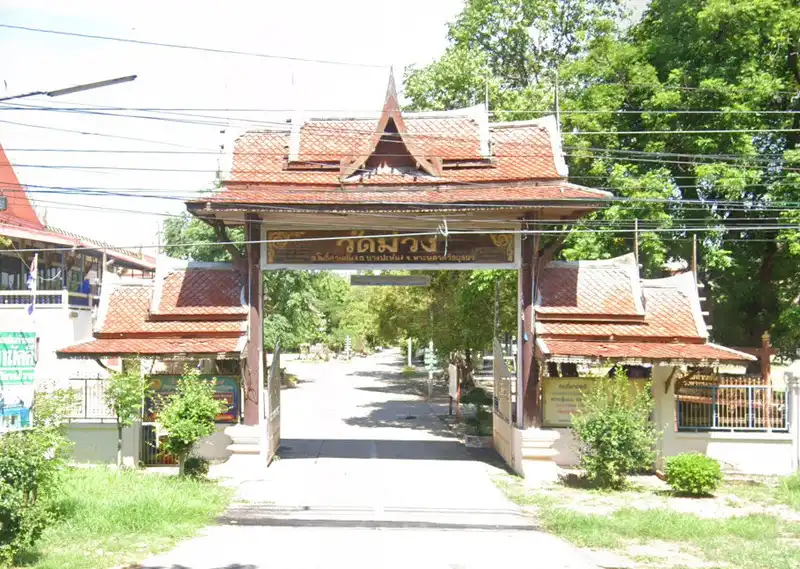
Wat Muang at No. 48, Moo 5, Pho Sam Ton Subdistrict, Bang Pahan District, Phra Nakhon Si Ayutthaya Province, is a community temple under the Mahanikaya sect located in a low-lying area. The surrounding landscape clearly reflects the character of a “community temple”: the northern side borders an industrial zone, while the south, east, and west remain connected to local residential neighborhoods. Once you step inside the temple grounds, what you feel is calmness and the sense of a sacred place that is genuinely used in daily life. It is not arranged for tourism in the way many large temples in Ayutthaya’s old city are; instead, it remains a place where locals regularly come to make merit, pay respects, join religious events, and sustain the community’s ongoing relationship with Buddhism.
The main charm of Wat Muang is not the grandeur of its exterior architecture, but the “old ordination hall” and the mural paintings inside, which carry strong historical and artistic value. There is information suggesting that the ordination hall is over 200 years old, which is why lovers of traditional Thai art and those who explore Ayutthaya in depth often come specifically to see these “ancient painted murals” whose story details remain visible. Once inside, the significance becomes even clearer because the murals are not mere decoration; they are a structured narrative system presented in sequence. The paintings include core Buddhist teachings, stories from the Jataka tales, and vivid reflections of everyday life from that period. As a result, viewing the murals at Wat Muang can feel like “reading history through walls” rather than simply visiting for a photo check-in.
Regarding the temple’s founding history, information from multiple sources aligns in stating that there is no clear documentary evidence. What is known comes mainly from oral accounts about a restoration carried out around the same period as the restoration of Wat Khao Din (Wat Wor Nayok Rangsan Chedi Banphot Tharam). These accounts mention “Mom Chao Kesorn” as the person who restored Wat Muang, and compare this with the role of Chao Phraya Phutharaphai (But Bunrat), the Samuhanayok in the reign of King Chulalongkorn (Rama V), who restored Wat Khao Din until it was presented as a royal monastery. In contrast, Wat Muang is said to have been intended by Mom Chao Kesorn for presentation as a royal monastery in the reign of Rama V as well, but this did not happen because, after the restoration was completed, Mom Chao Kesorn was accused of rebellion. This narrative adds a layer of social and political history at the community level and offers an intriguing view of how elite patronage and Buddhist institutions related to each other in the late 19th century.
Another point that helps clarify Wat Muang’s identity is the origin of its name. One explanation suggests that the name “Wat Muang” likely comes from the name of the village where the temple stands—Ban Muang—which existed before the temple was built. This naming pattern is common among Thai community temples because temples often function as central public spaces of a village. Once a locality name becomes established, the temple in that area naturally adopts the same name. With this context, “Wat Muang” is not merely a place name but a label deeply tied to the community and local geography.
The true highlight of visiting Wat Muang is the mural paintings inside the vihara or a principal religious building, where paintings cover all four interior walls. Available information states that these murals were created in 1901 (B.E. 2444) during the reign of King Rama V and executed using a dry-pigment technique on a prepared ground. This aligns with traditional Thai mural painting from the transitional era toward modernity: it retains classical narrative conventions while beginning to incorporate certain Western-influenced visual ideas. In terms of content, the murals depict the Buddha’s life, the Ten Jataka tales, the Traibhumi cosmology, and Dhamma riddles, alongside scenes of everyday life. This makes the mural set highly valuable for social and cultural interpretation, because small embedded details across scenes and figures often reveal clothing, objects, social relationships, and daily-life realities of that era in a concrete, visual way.
The composition of Wat Muang’s murals is systematic and deliberately arranged in a clear narrative order. Information from the Fine Arts Department describes compatible storytelling structures across multiple aspects, such as the wall behind the principal Buddha image often depicting Traibhumi themes, while side walls present episodes from the Buddha’s life in the upper sections, and the Ten Jataka tales appear in lower bands between windows. The continuous sequencing across three walls allows viewers to “read the paintings” by following the story path with their eyes. If you take your time, you can see how traditional Thai craftsmen attempted to organize the religious universe into a single visual system—from Traibhumi cosmology, to assemblies of deities, to Mara, and to pivotal events in the Buddha’s life that emphasize awakening, teaching, and guiding humanity to understand karma and liberation.
What makes the Wat Muang murals especially compelling is the blend of “traditional Thai mural painting” with some Western-style elements, a hallmark of art in the Rama V period when Thai society increasingly engaged with modernity and the outside world. In certain areas, you may notice attempts to create depth, use light and shadow, or render proportions and scenery with greater realism. At the same time, the murals still follow traditional narrative logic and placement according to classical beliefs, such as Traibhumi scenes positioned behind the principal Buddha image or deity assemblies placed in upper zones—visual conventions long used by Thai artists to communicate sacredness and cosmic hierarchy.
When focusing on “everyday-life scenes,” the embedded depictions of people from that time are often the most immediately relatable for today’s viewers, because they connect past and present directly. Whether it is travelers on the move, market scenes, ceremonial gatherings, or rural and riverside community life, these details make Wat Muang feel like visual evidence that records one chapter of Ayutthaya’s lived history. They capture clothing culture, vernacular architectural forms, tools and household items, and the practical relationship between religion and daily life. This differs from reading history that often centers on kings and major events, because the murals allow us to see “ordinary people” existing closely alongside religious narratives.
From an art perspective, the year 1901 (B.E. 2444) was also a period when artistic patronage at community temples was significant, because temples served as key public spaces of villages. Painting murals therefore functioned as merit-making, moral education, and religious communication for people who may not have had broad access to books. Scenes from the Buddha’s life and the Ten Jataka tales teach about the cultivation of virtues, Traibhumi imagery reinforces the consequences of karma and realms of existence, and Dhamma riddles encourage reflective thinking. This is why viewing Wat Muang’s murals should not be seen as simply “looking at beautiful pictures,” but as encountering a historical learning system in which temples acted as community schools.
Wat Muang also carries the character of a “living temple” through religious activities organized collectively by the community. There is information indicating that the temple has held Kathina Samakkhi ceremonies in some years, and there is also evidence in images or text referring to Buddhist Lent activities, such as the Pavarana ceremony at the end of Lent and regular chanting. This suggests that the site is not only a place to view art but a temple with an ongoing religious rhythm in the present. If you plan to join a merit-making event, the key step is to check the temple’s latest announcements before traveling, because schedules may change depending on temple arrangements and timing considerations.
Visiting Wat Muang is therefore well suited to travelers who want to experience Ayutthaya from a different angle than the most popular routes on the old city island. This is Ayutthaya within the outer community zone, where the relationship between temple and everyday life remains clearly visible. Cultural travelers often value this kind of experience because it offers the “realness” of local community life rather than a curated tourist scene. Wat Muang also works well as a destination for those who want an unhurried visit, taking time to study the murals thoughtfully, then connecting the route to Bang Pa-In or the old city island depending on time available. This makes a half-day or one-day trip flexible and rich in art, culture, and local atmosphere within a single itinerary.
Getting There If you start from Ayutthaya town, traveling to Wat Muang by private car or rental car is usually the most convenient, because you can plan stops along the way as needed. A smooth trip often comes from setting your navigation destination as “Wat Muang, Pho Sam Ton Subdistrict, Bang Pahan District” or using the latest verified map pin, then allowing extra time for community roads before reaching the temple. Upon arrival, look for designated parking areas and avoid blocking community traffic routes to maintain order. If you travel during merit-making events or long holidays, allowing extra time for crowd levels and on-site management will help keep the visit unhurried and appropriate for a sacred place.
Temple etiquette and behavior when viewing an old ordination hall are especially important because mural areas are culturally significant and fragile. Visitors should dress modestly, avoid sleeveless tops and shorts or skirts above the knee, and remove shoes before entering important buildings. When viewing the murals, avoid touching the walls or surfaces near the paintings, because moisture and friction can affect conservation. If you wish to take photos, do so respectfully, be mindful of times when ceremonies are taking place, and avoid using flash inside the building to prevent disturbance and to maintain the appropriate atmosphere of a sacred space.
Ultimately, Wat Muang is a community temple with artistic and historical value that visitors can experience directly. Its murals do not only tell religious stories; they also portray Thai society during the reign of King Rama V through characters, scenes, and tangible details of daily life. Combined with the restoration narrative and the name origin tied to Ban Muang, a visit here is not simply a stop to pay respects but an entry into a quiet space where community memory has been preserved on the walls. If you want to see a deeper, unhurried side of Ayutthaya and take time to “read the paintings” with intention, Wat Muang is one destination worth keeping on your cultural itinerary for Ayutthaya.
| Place Name | Wat Muang (Wat Muang) |
| Address | No. 48, Moo 5, Pho Sam Ton Subdistrict, Bang Pahan District, Phra Nakhon Si Ayutthaya 13220 |
| Summary | A community temple under the Mahanikaya sect in Bang Pahan, notable for its old ordination hall and dry-pigment murals on a prepared ground, created in 1901 (B.E. 2444) during the reign of King Rama V. The murals depict the Buddha’s life, the Ten Jataka tales, Traibhumi cosmology, and Dhamma riddles, with vivid scenes of everyday life from the period. |
| Highlights | 1) Four-wall mural paintings depicting the Buddha’s life, the Ten Jataka tales, Traibhumi, and Dhamma riddles 2) Dry-pigment technique and continuous narrative sequencing in the traditional Thai artisan style 3) Rama V-era artistic character blending Thai tradition with some Western influences 4) A calm outer-Ayutthaya community temple atmosphere, ideal for cultural travelers who prefer an unhurried visit |
| Abbot / Current Caretaker | Phra Maha Phonranong Khemavaro |
| Open Days | Daily |
| Opening Hours | 06.30 – 17.30 |
| Traditions / Regular Events | Kathina Samakkhi (information indicates schedules in some years) Buddhist Lent activities such as Pavarana and regular chanting (evidence has been communicated through the temple’s channels) |
| Phone (Verified) | 092-892-1914 |
| Nearby Tourist Attractions (Driving Distance + Phone) | 1) Bang Pa-In Royal Palace – 23 km – 035-261-548 2) Wat Niwet Thammaprawat Ratchaworawihan – 24 km – 035-261-237 3) Ayutthaya Historical Park – 29 km – 035-245-123 4) Wat Yai Chai Mongkhon – 28 km – 035-241-195 5) Wat Phanan Choeng Worawihan – 31 km – 035-243-367 |
| Nearby Restaurants (Driving Distance + Phone) | 1) Baan Watcharachai (Ayutthaya River Prawns) – 33 km – 035-801-333 2) Baan Mai Rim Nam Ayutthaya – 32 km – 035-242-248 3) Krua Han Phalo (Ayutthaya) – 30 km – 035-245-858 4) Ayutthaya Boat Noodles (Old City Area) – 30 km – 035-242-587 5) Ayutthaya Grilled Prawns (Asia Road Area) – 31 km – 035-246-555 |
| Nearby Accommodations (Driving Distance + Phone) | 1) Krungsri River Hotel (Ayutthaya) – 29 km – 035-244-333 2) Classic Kameo Hotel & Serviced Apartments, Ayutthaya – 30 km – 035-212-535 3) Centara Ayutthaya Hotel – 30 km – 035-212-222 4) Baan Luang Harn (Ayutthaya) – 30 km – 081-994-5663 5) Ayutthaya Retreat – 31 km – 035-246-499 |
Frequently Asked Questions (FAQ)
Q: Where is Wat Muang located?
A: Wat Muang is located at No. 48, Moo 5, Pho Sam Ton Subdistrict, Bang Pahan District, Phra Nakhon Si Ayutthaya 13220.
Q: Is Wat Muang open daily, and what are the opening hours?
A: The temple is open daily, and the most recently published opening hours are 06.30 – 17.30.
Q: What is the main highlight of Wat Muang that I should not miss?
A: The key highlight is the old ordination hall and the interior mural paintings covering all four walls, created in 1901 (B.E. 2444) during the reign of King Rama V, depicting the Buddha’s life, the Ten Jataka tales, Traibhumi cosmology, and Dhamma riddles.
Q: What stories do the murals at Wat Muang depict?
A: The murals depict the Buddha’s life, the Ten Jataka tales, Traibhumi, Dhamma riddles, and clearly include embedded scenes of everyday life from the period.
Q: Does Wat Muang have any annual merit-making events or traditions?
A: There is information indicating that the temple holds Kathina Samakkhi ceremonies in some years, and there is also evidence of Buddhist Lent-related activities such as Pavarana and chanting. It is recommended to check the temple’s latest announcements before traveling.
Q: Who is the current abbot of Wat Muang?
A: The current abbot/caretaker is Phra Maha Phonranong Khemavaro.
Q: How should I dress and behave when entering the old ordination hall and viewing the murals?
A: Dress modestly, remove shoes before entering important buildings, behave respectfully, avoid touching the walls or surfaces near the murals, and avoid using flash inside the building.
 Wat Muang Map
 Category:
  Group:
  Tag: ●Wat Muang●wat muang bang pahan ●wat muang pho sam ton ●wat muang ayutthaya murals ●ayutthaya old ordination hall ●thai mural painting rama v ●ayutthaya community temple ●cultural travel ayutthaya ●bang pahan attractions ●ayutthaya hidden temple ●traditional thai mural art Last Update: 2 MonthAgo
Comment
 Nearby Attractions
| Keyword (Advance) |
 Region
|
 Phranakhon Si Ayutthaya(
 Copyright 2012,