

 Home
Home Chiang Mai(




Moo Ban Pla Tapian San (Ayutthaya)
Rating: 3.4/5 (7 votes)
 Search By
  Map
Map 
 Have Map
  No Map
Phranakhon Si Ayutthaya attractions
Attractions in Thailand
Open Days: Daily
Opening Hours: 08.00–17.00
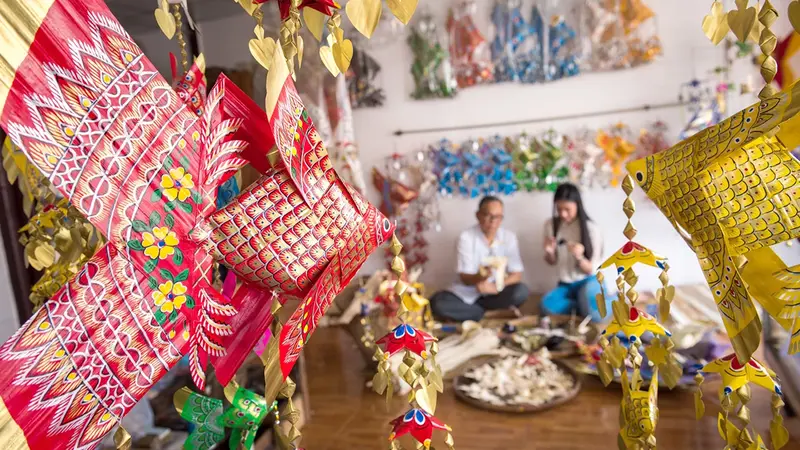
Moo Ban Pla Tapian San (Ayutthaya) is one of the most distinctive places to visit in Ayutthaya for travelers who want to see the province through craftsmanship and living local wisdom rather than only through ancient ruins. A woven pla tapian is not simply a charming hanging ornament. It is a handmade object rooted in Thai rural life and household beliefs, carrying meanings of abundance, well-being, and gentle blessings that have been passed on for generations. When you stand close to real weaving, it becomes immediately clear that this small craft is full of discipline and detail: the rhythm of the strands, the tightness of the interlock, the cleanliness of the edges, and the balance of the silhouette that makes the fish look as if it has its own presence. This is why the village appeals to visitors who want both knowledge and emotion in one stop, and who want to bring home something that feels more meaningful than an ordinary souvenir.
If you are planning an Ayutthaya day trip and you want something beyond the classic route of temple-hopping inside the historical island, visiting a community craft village can make your picture of Ayutthaya feel complete. Ayutthaya is not only about monumental history and archaeological grandeur. It is also about the hands of people who still work with patience and precision, keeping traditions alive in everyday life. The charm of Moo Ban Pla Tapian San is that you do not need specialist knowledge to appreciate it. You can understand the craft at first sight, because it looks deceptively simple and yet surprisingly refined. A few palm strips become a balanced form with a clear structure. And once you learn the auspicious meaning behind pla tapian weaving, you start to notice that the craft is not only decorative—it is a quiet language of blessing.
At a cultural level, pla tapian weaving represents a natural journey of Thai folk wisdom, moving from objects tied closely to household life and beliefs into items that now function as decor, gifts, and community products. Thai society has long been intertwined with water, rice fields, canals, and seasonal cycles, so it is no surprise that fish became a symbol associated with abundance and having enough to eat and use. Turning a fish into a woven form is like compressing the world of “fields–water–fish” into something you can hold, hang, and see every day. In that sense, a pla tapian from Ayutthaya is not only something cute to take photos with or to buy quickly and move on. It is a small object carrying the memory of a way of life.
Pla tapian weaving is widely recognized in Thailand as a fish-shaped craft often used as a hanging mobile. Many Thais associate it with the image of a traditional Thai home and the idea of prosperity. In older household practices, people often hung woven pla tapian above a baby’s cradle as a gentle blessing, wishing the child strength, healthy growth, and a peaceful home. This belief gives the craft a warm emotional tone. Even when it becomes modern decor, that original meaning still tends to stay with it. That is why the craft is frequently chosen as a gift: it communicates good wishes in a Thai way without needing a long speech.
For Ayutthaya, the craft is also significant because it expands what “Ayutthaya travel” can mean. Many visitors come to Ayutthaya for temples, brick chedis, Buddha images, and heritage landscapes, which are all essential. But when you add a craft stop, you see the province as more than a museum of the past. You see a living economy and a living identity. Craft, when it is done well, also teaches you about standards, responsibility, and time. A woven fish that is loose will not hold shape and will not look good when hung. A piece with messy edges will not feel refined in your home. So the maker is responsible not only for the moment of sale, but also for how the object survives daily life. This quiet seriousness is part of why good Thai craftwork has real value.
Historically, pla tapian weaving in the Phu Khao Thong area is often described as a long-standing tradition in the community, with local narratives emphasizing that the craft has existed for well over a century in one form or another, carried through households and shared skills. In more organized community terms, the craft later became a structured group activity as villagers collaborated to strengthen production, raise standards, and connect the work to community income. This is a familiar pattern in Thai craft communities: a tradition begins at home, becomes a shared skill, and then evolves into an identity that supports livelihoods when tourism and community product programs create new opportunities.
In many craft villages, you can sense a shift from “making for use” to “making for selection.” In the past, the object might have been made primarily for household use or ritual meaning. Today, the object must also compete visually, communicate quality quickly, and fit contemporary lifestyles. Moo Ban Pla Tapian San sits at this intersection. The craft still keeps the idea of auspicious meaning, but the products often expand into different sizes, color palettes, decorative patterns, and modern variations that suit homes, cafes, restaurants, and hotels that want Thai elements without looking heavy or old-fashioned.
The classic material often associated with traditional pla tapian weaving is palm leaf, valued for its toughness, strength, and a distinctive natural texture. Preparing palm leaf into weaving strips is a craft in itself. The strips must be handled so they reach a “just right” softness for weaving, because overly stiff strips crack and resist shaping, while overly soft strips can lose crispness and structure. The preparation stage therefore demands experience, not only technique. This is one reason the craft looks simple on the surface yet requires real skill to produce consistently strong and attractive pieces.
Once the strips are ready, weaving the fish is where precision becomes visible. A good pla tapian is not only fish-shaped. It must look balanced from multiple angles, because it is usually viewed while hanging and turning slightly in the air. People who know the craft often pay attention to the firmness along the body line and the overall symmetry of the form. Clean edges are especially important around features like fins and tail, because those details create the feeling of sharpness and energy that makes the fish look “alive.” The tighter and more consistent the weave, the more refined the final piece will feel.
As the craft developed into a broader range of products, color and decorative pattern became part of its evolution. Some pieces maintain the natural palm color, which many people find calm, warm, and suitable for minimalist interiors. Others are dyed or painted for a more playful look, which suits bright homes, children’s spaces, or themed restaurants. In some modern adaptations, the craft may incorporate additional materials or finishing techniques to expand durability, highlight patterns, or match a specific design concept. This is not necessarily a break from tradition. In many Thai craft communities, adaptation is one of the key ways tradition stays alive without becoming frozen in time.
One of the most appealing qualities of handmade work is that it carries small differences that cannot be reproduced perfectly, even when the maker follows the same pattern. Two woven fish made on the same day can still have different “personalities.” One might look crisper and more angular. Another might feel softer in curve and rhythm. These differences are not defects. They are signatures of handwork. For people who enjoy craft, that individuality is part of the value, because it makes the object feel like it has a story and a maker behind it, not a factory line.
If you want to “read” a pla tapian like someone who understands craft quality, it helps to follow a simple sequence. Start with structure, because structure determines durability. Look for tightness and consistency. Next look at edges, especially around the tail and fins, because clean edges signal careful finishing. Then look at balance and symmetry, because a piece that leans or looks uneven will not hang elegantly. Only after those fundamentals should you decide on color or decorative style, because an attractive color cannot compensate for weak structure. Choosing in this way makes it more likely that the piece will stay beautiful in your home for a long time.
Visiting the village also gives you an experience that is different from browsing craft items in a tourist shop. When you see craft in its community context, you notice the human side of the process: the pace, the focus, the repetition, the calm patience needed to keep strands even. This is why craft villages are powerful in cultural tourism. They do not only sell products. They show how value is made. In the best visits, you come away with more respect for skill, and your purchase feels less like consumption and more like support for the continuity of local knowledge.
In the broader picture of community sustainability, pla tapian weaving is also a useful example of how local wisdom can become a stable identity when it is organized well. Community groups often develop standards, coordinate production roles, and expand sales channels. Sometimes households specialize: one family may weave fish bodies, another may handle coloring, another may assemble or finish products. This kind of cooperative structure helps the craft function as a community industry rather than only an individual hobby. It also makes it easier to maintain consistent quality, meet larger orders, and present the village as a recognizable destination for visitors.
For travelers, the most practical benefit is that Moo Ban Pla Tapian San complements the usual Ayutthaya itinerary beautifully. After spending hours walking among ancient bricks, large temple grounds, and open historical landscapes, a craft stop changes the rhythm of your day. It gives you a quieter moment, often indoors or in shaded community spaces, where attention shifts from big monuments to small details. This contrast makes the trip feel more dimensional. You move from the grand scale of history to the intimate scale of everyday skill, and together those two layers create a richer understanding of Ayutthaya.
Many visitors also like craft villages because they are family-friendly in a natural way. Children can immediately recognize the fish shape and enjoy the colors and movement, while adults can appreciate the cultural meaning and the workmanship. If your trip includes different age groups, a craft stop can act as a bridge: it is neither too academic nor too physically demanding, and it allows each person to take something different from the same place.
Another reason the visit can feel especially rewarding is that pla tapian weaving is not an abstract symbol. It is a symbol connected to Thai life in a straightforward way. Abundance in a rice-farming society is not theoretical. It is the difference between having enough and not having enough. Blessings for children are not decorative ideas. They are expressions of care, responsibility, and hope. When you hang a pla tapian in your home, it continues to function as a reminder of those values. This emotional continuity is part of what makes the craft more than a typical souvenir.
If you intend to buy a piece, it helps to think ahead about where it will live in your space. Natural palm tones tend to work well in calm corners, reading nooks, and minimalist interiors where texture matters more than bright color. Painted pieces can serve as a focal point in playful spaces, cafes, or areas where you want something lively. If you are buying as a gift, consider the recipient’s style and also the symbolic message. In Thai gifting culture, an object that carries a blessing can be more meaningful than an expensive item that has no story.
For care and longevity, it is usually best to hang woven crafts in a place with gentle airflow and away from moisture. Like many natural-fiber crafts, palm-based products generally prefer dry conditions. Dust can be removed gently, and careful handling helps the piece keep its crisp edges. When you treat the item as a crafted object rather than a disposable decoration, it tends to stay attractive and meaningful for much longer.
Getting There to Moo Ban Pla Tapian San (Ayutthaya), it is practical to base your route from the Ayutthaya Historical Island zone or from Ayutthaya Railway Station and then continue by private car or hired transport for flexibility. This approach makes it easier to combine stops without wasting time backtracking. Many travelers like to structure the day as a loop: begin with major historical sites in the morning when the light is soft, then shift to a craft visit later when the sun is stronger, and finally finish with a riverside meal or cafe. With that rhythm, the day feels balanced rather than exhausting, and you get both the iconic Ayutthaya image and the contemporary living community layer in a single trip.
Ultimately, Moo Ban Pla Tapian San (Ayutthaya) is a destination that makes the idea of Thai wisdom feel tangible and close. You can see, in a very direct way, how much skill, time, and precision are required to create something small yet structurally sound and aesthetically balanced. Once you understand the pla tapian as a symbol of abundance and blessing, the object becomes even more valuable in the mind. Visiting here is not only about buying something. It is also a way of supporting the hands that keep local knowledge alive. If you want to return from Ayutthaya with something that carries a story and a meaningful Thai message, this village offers that answer in a quiet but very clear way.
| Place Name | Moo Ban Pla Tapian San (Ayutthaya) |
| Address | Phu Khao Thong Subdistrict, Phra Nakhon Si Ayutthaya District, Phra Nakhon Si Ayutthaya, Thailand |
| Overview | A community-based craft destination focused on traditional pla tapian weaving, known for auspicious cultural meaning (abundance and blessings) and suitable for travelers who want a living-wisdom experience beyond the historic ruins. |
| Highlights | Hands-on insight into Thai folk craftsmanship, traditional palm-leaf weaving skills, meaningful cultural symbolism, a strong complement to a classic Ayutthaya itinerary, and gift-worthy craft items with a clear story. |
| Latest Caretaker | Local pla tapian weaving occupational group / community producers in the Phu Khao Thong area |
| Open Days | Daily |
| Opening Hours | 08.00–17.00 |
| Contact Number | +66 81 506 3160, +66 35 211 608 |
| Getting There | Base your route from Ayutthaya Historical Island or Ayutthaya Railway Station, then continue by private car or hired transport for flexibility. Plan a loop route to avoid backtracking and combine with historic sites and a riverside meal. |
| Current Status | Open for visits and inquiries (calling ahead is recommended). |
| Nearby Tourist Attractions With Distance | 1) Ayutthaya Historical Park (Approx. 7 km) Tel. 035-242-525 2) Chao Sam Phraya National Museum (Approx. 8 km) Tel. 035-241-587 3) Ayutthaya Historical Study Centre (Approx. 8 km) Tel. 035-245-123 4) Wat Yai Chai Mongkhon (Approx. 10 km) Tel. 035-242-640 5) Ayutthaya Elephant Palace & Royal Kraal (Approx. 10 km) Tel. 065-009-9361 |
| Popular Restaurants Nearby With Distance | 1) Ruay Kung Phao (Bang Sai) (Approx. 9 km) Tel. 086-007-1451 2) Baan Mai Rim Nam (Ayutthaya) (Approx. 10 km) Tel. 035-242-248 3) Baan Pomphet (Approx. 11 km) Tel. 035-242-242 4) The Summer House Ayutthaya (Approx. 11 km) Tel. 094-224-2223 5) Malakor Kitchen and Cafe (Approx. 12 km) Tel. 091-779-6475 |
| Popular Accommodations Nearby With Distance | 1) Krungsri River Hotel (Approx. 10 km) Tel. 035-244-333 2) sala ayutthaya (Approx. 11 km) Tel. 035-242-588 3) Classic Kameo Ayutthaya (Approx. 12 km) Tel. 035-212-535 4) Kantary Hotel Ayutthaya (Approx. 12 km) Tel. 035-337-177 5) Centara Ayutthaya (Approx. 13 km) Tel. 035-243-555 |
Frequently Asked Questions (FAQ)
Q: Who is Moo Ban Pla Tapian San (Ayutthaya) best for?
A: It is ideal for craft lovers, families who want children to see real handwork, travelers who want a different Ayutthaya experience beyond temples, and anyone looking for a meaningful Thai-style blessing gift associated with abundance.
Q: What does a woven pla tapian symbolize?
A: In Thai belief, it is commonly linked to abundance and well-being, and it is also traditionally hung above a baby’s cradle as a gentle blessing for strength, healthy growth, and a peaceful home.
Q: What should I check when buying a woven pla tapian?
A: Check the tightness and consistency of the weave, the cleanliness of the edges (especially fins and tail), and the overall balance of the shape. If it is painted, look for clean lines and even color coverage because these details affect both beauty and durability.
Q: How long should I plan to spend at the village?
A: Many visitors spend about 1–2 hours for browsing and selecting items comfortably. If you plan to learn the details more deeply or join an activity, it is sensible to allow additional time.
Q: What is the most convenient way to get there?
A: It is most convenient to base your route from Ayutthaya Historical Island or Ayutthaya Railway Station and continue by private car or hired transport for flexibility, then plan a loop route so you can connect the visit smoothly with nearby historical sites.
 Moo Ban Pla Tapian San (Ayutthaya) Map
 Category:
  Group:
  Tag: ●Moo Ban Pla Tapian San (Ayutthaya)●moo ban pla tapian san ●pla tapian weaving ayutthaya ●ayutthaya cultural travel ●thai palm leaf weaving ●ayutthaya handicraft village ●thai craft souvenirs ●otop ayutthaya ●things to do in ayutthaya ●ayutthaya local craft Last Update: 3 DayAgo
Comment
 Nearby Attractions
| Keyword (Advance) |
 Region
|
 Phranakhon Si Ayutthaya(
 Copyright 2012,