

 Home
Home Chiang Mai(




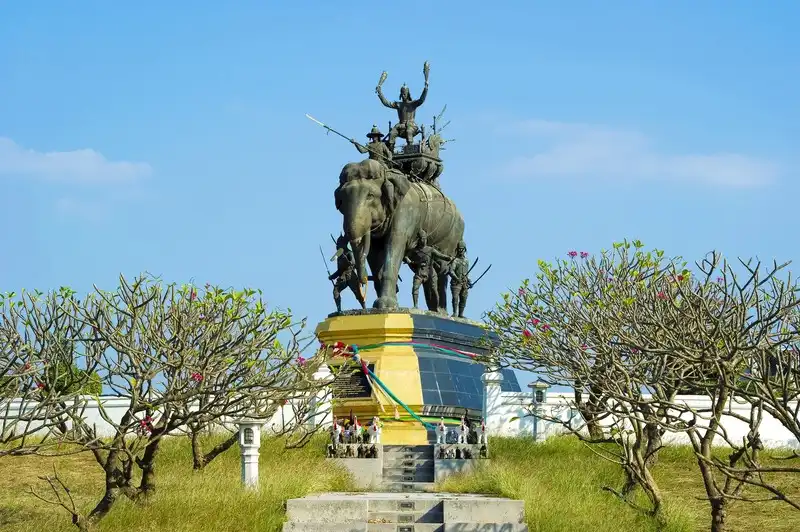
Archive of the Queen Suriyothai Monument
Rating: 4.2/5 (5 votes)
 Search By
  Map
Map 
 Have Map
  No Map
Phranakhon Si Ayutthaya attractions
Attractions in Thailand
Open Days: Open Daily
Opening Hours: 08:30 – 16:30
Archive of the Queen Suriyothai Monument (Thung Makham Yong) Ayutthaya. If you are looking for an Ayutthaya attraction that is not only visually pleasing for photos, but also carries a story tied to the ground itself—so that walking here feels like stepping lightly across living history—the Archive of the Queen Suriyothai Monument is one place worth pinning on your map. It sits within the Queen Suriyothai Royal Monument complex at Thung Makham Yong, Ban Mai Subdistrict, Phra Nakhon Si Ayutthaya District. The area is spacious and open, framed by a pond and surrounding greenery, creating an atmosphere quite different from the ancient temple zone on Ayutthaya Island, and it suits a slow, unhurried visit to “understand” Ayutthaya from another angle.
The heart of this place holds two overlapping layers of meaning. The first is its identity as a historic battleground: Thai collective memory recognizes Thung Makham Yong as a landscape linked to warfare in the Ayutthaya era, and to the story of Queen Suriyothai, long recounted as a heroic figure who defended the realm. The second is its role as a “land of royal benevolence” in the present day, shaped through development intended to ease seasonal flooding and bring irrigation benefits to nearby communities. This dual role helps visitors see that Thung Makham Yong is not only a word from the past, but a place that continues to matter in real life today.
What makes this archive distinctive is its role as a public space that gathers narratives and supporting materials, allowing those who arrive at Thung Makham Yong to understand why this site is regarded as nationally significant—not only as a memorial, but also as a shared civic experience. One key moment that drew a large number of visitors was the royal visit to Thung Makham Yong on 25 May 2012 by His Majesty the King, Her Majesty the Queen, and Her Royal Highness Princess Maha Chakri Sirindhorn. That occasion became a “day of shared remembrance,” giving the area a stronger contemporary social dimension. Later, the archive was established to convey the background, meaning, and atmosphere of that important day so future generations can continue to learn from it.
Inside the archive, you will find an exhibition built primarily around “images that tell a story.” There are royal portraits of all three royals during the visit, photographs capturing the public awaiting the royal procession, and a narrative sequence that helps visitors follow what happened, why people gathered in such numbers, and why this day is often remembered as a powerful national image for many Thais. This type of exhibition rewards a slow pace: by moving from photograph to photograph and reading the captions carefully, small details—expressions, gestures, and how the space was arranged on the day—can make the past feel vivid in a way that short summaries rarely do.
Another section many people come specifically to see is the area associated with the “waterside pavilion,” linked to the place where the royals were seated to watch performances on that important day. Certain elements were arranged to recreate an atmosphere close to the original moment, including the placement of the chairs used as the royal seats in the recorded positions. For many visitors, this makes the site feel like more than an exhibition building; it becomes a place where something real occurred, and where shared memory is made tangible through objects and careful staging.
Beyond the contemporary narrative, the archive also connects visitors to the broader picture of Thung Makham Yong as a public space that benefits the local community. It presents stories about using the area to receive floodwater in a “monkey cheek” retention concept, and about irrigation development intended to relieve hardship for residents. This helps travelers understand that a memorial landscape is not only designed to recall the past, but can also be shaped to serve people in the present—especially in a city like Ayutthaya that faces recurring flood challenges.
If you want to make the most of your visit, consider dividing your walk into two phases. First, begin inside the archive to gain a clear “story frame,” then step outside to explore the surrounding grounds, including the monument area and the atmosphere of Thung Makham Yong itself. Once you have a sense of how events and spaces connect, the outdoor walk becomes more than a stroll; it becomes a way of “reading the landscape.” The second phase is to allow time for rest and photography. With open space, water, sky, and quiet corners, the area feels calm and accommodating—good for families, visitors accompanying older relatives, or anyone who wants an Ayutthaya mood without the dense crowds of the most popular spots.
For atmosphere, mornings are often the most comfortable for walking, with gentler temperatures and soft light reflecting on the water. Late afternoon, closer to closing time, can bring warmer tones as well, but it is wise to leave enough time. If you explore the exhibition carefully—reading captions and following the story—it usually takes longer than people expect, and many visitors find themselves lingering as the narrative draws them onward.
As for etiquette, while this is a travel site, the content relates to history, significant national moments, and a memorial landscape. Keeping voices at a respectful level, moving carefully through exhibition areas, and treating the overall atmosphere with consideration helps everyone experience the place more fully. Photography is generally possible in many areas, but if any section has restrictions or posted notices, it is best to follow them for smooth visiting and for the comfort of others.
Getting There Visiting Thung Makham Yong and the archive is convenient for both self-drivers and travelers using public transport. If you drive from Bangkok, the common route is along Asia Road (Highway 32) toward Phra Nakhon Si Ayutthaya, then continue into the city and pin the destination as “Queen Suriyothai Monument (Thung Makham Yong).” Once you arrive at the monument grounds, you can walk to the archive within the same complex. Driving is flexible and makes it easy to continue your trip to other attractions around Ayutthaya Island.
If you do not drive, you can take a train or van to Ayutthaya and then continue by local transport to the Thung Makham Yong area. This works well for travelers planning a multi-stop day: begin near the station or the island area, then head out to Thung Makham Yong for another chapter of the day. To keep things smooth, it helps to allow extra time for in-town travel and to avoid peak traffic hours or major festival periods when roads may be more crowded.
What makes this trip feel rewarding is that you can shape it as a nearby loop of “history + food + rest” without traveling far between each part. Spend the morning in the archive and around Thung Makham Yong, enjoy lunch back on Ayutthaya Island by the Chao Phraya River, then continue with key temples or museums in the historical park area. Ayutthaya can absolutely be done as a day trip, but if you want to absorb the city without rushing, staying one night often reveals a gentler rhythm—especially in the evening, when the light is beautiful and the crowds begin to thin.
In the end, if you like travel that offers both knowledge and feeling, this place delivers both. On one side is the tangible learning from photographs, narratives, and context; on the other is the quieter emotion of standing in a landscape that holds layers of history and shared public memory. When you step out of the archive and look again across the fields and water, “Ayutthaya” may stop being only images of temples and old bricks, and become also a picture of people and a place that continues to breathe in the present.
| Place Name | Archive of the Queen Suriyothai Monument (Thung Makham Yong) |
| Location | Within the Queen Suriyothai Royal Monument grounds (Thung Makham Yong), Ban Mai Subdistrict, Phra Nakhon Si Ayutthaya District, Phra Nakhon Si Ayutthaya Province |
| Address | Ban Mai Subdistrict, Phra Nakhon Si Ayutthaya District, Phra Nakhon Si Ayutthaya 13000 |
| Highlights | A learning space about Thung Makham Yong, covering both historical context and contemporary national memory Displays royal portraits and photographs from the 25 May 2012 royal visit Connects the site to the “royal benevolence” narrative and the flood-retention/irrigation role of the area Open, peaceful atmosphere with water and greenery, suitable for walking and photography |
| Current Status | Open to visitors daily, 08:30 – 16:30 |
| Contact Number | 0 3532 2730–1 |
| Nearby Attractions With Distance | Wat Phukhao Thong (approx. 2 km) Wat Mahathat (approx. 5 km) Wat Phra Si Sanphet (approx. 5 km) Wat Yai Chai Mongkhon (approx. 7 km) Ayothaya Floating Market (approx. 10 km) Tel. 0 3588 1733, 0 3588 1688 |
| Popular Restaurants Nearby With Distance And Phone Number | Sala Ayutthaya Eatery and Bar (approx. 6 km) Tel. 0 3524 2588 Baan Mai Rim Nam (approx. 6 km) Tel. 0 3524 2248 Baan Pom Phet (approx. 7 km) Tel. 0 3524 2242 Kuay Tiew Ruea Hoi Kha (Hospital Branch) (approx. 6 km) Tel. 0 9274 32200 Kuay Tiew Wat Yai (approx. 8 km) Tel. 0 3524 2679 |
| Popular Accommodations Nearby With Distance And Phone Number | iuDia on the River (approx. 6 km) Tel. 0 8608 1888 Krungsri River Hotel (approx. 7 km) Tel. 0 3524 4333 Centara Ayutthaya (approx. 9 km) Tel. 0 3524 3555 Classic Kameo Ayutthaya (approx. 11 km) Tel. 0 3521 2535 Kantary Hotel Ayutthaya (approx. 12 km) Tel. 0 3533 7177 |
Frequently Asked Questions (FAQ)
Q: Is the Archive of the Queen Suriyothai Monument open every day?
A: The latest information indicates it is open daily, with visiting hours from 08:30 – 16:30. If there is a special event, it is best to call ahead to confirm before you go.
Q: How much time should I plan for this visit?
A: If you want to read the captions carefully and also walk around the grounds, planning around 1–2 hours is a comfortable pace.
Q: Is it suitable for families or older visitors?
A: Yes. The area is fairly open and relaxed, with places to pause along the way, and it is generally less crowded than many high-traffic spots in Ayutthaya.
Q: Can I take photos, and where are the best spots?
A: Photography is suitable in many areas, especially in the morning or late afternoon when the light is soft. Consider capturing the open landscape, the pond, and the monument surroundings, while following any posted notices in exhibition sections.
Q: If I need directions or updated details, who should I contact?
A: You can call 0 3532 2730–1 to ask for the latest information before your trip.
 Archive of the Queen Suriyothai Monument Map
 Category:
  Group:
  Tag: ●Archive of the Queen Suriyothai Monument●thung makham yong archives ●queen suriyothai monument ●ayutthaya historical attraction ●things to do in ayutthaya ●ayutthaya day trip ●ayutthaya travel guide ●ayutthaya museum ●places to visit in ayutthaya ●ayutthaya landmark ●thung makham yong ayutthaya Last Update: 2 MonthAgo
Comment
 Nearby Attractions
| Keyword (Advance) |
 Region
|
 Phranakhon Si Ayutthaya(
 Copyright 2012,