

 Home
Home Chiang Mai(




Wat Chaiwatthanaram
Rating: 4.3/5 (6 votes)
 Search By
  Map
Map 
 Have Map
  No Map
Phranakhon Si Ayutthaya attractions
Attractions in Thailand
Open Days: Daily
Opening Hours: 08:00 – 18:00
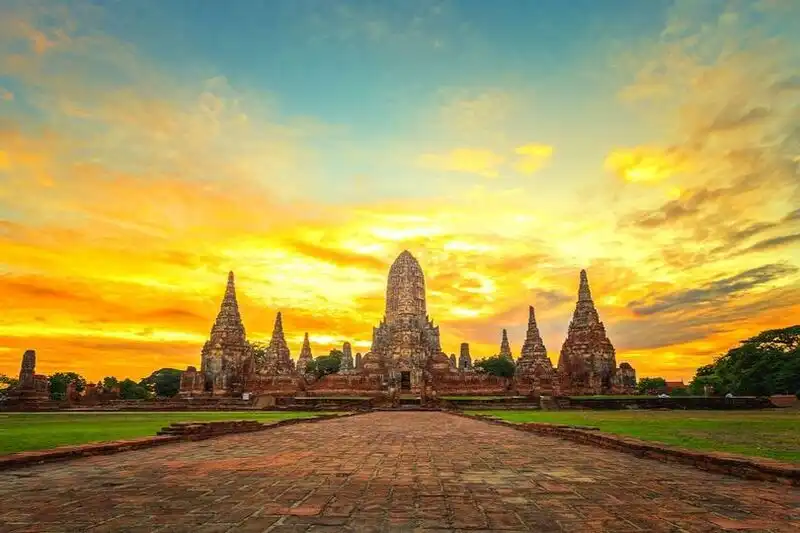
Wat Chaiwatthanaram in Phra Nakhon Si Ayutthaya Province is a riverside historical monument on the west bank of the Chao Phraya River, just outside Ayutthaya Island, and many people call it one of the most beautiful “signature images” of the old capital. Even if you simply stand by the river, you can read the intentional elegance of its architecture — from the temple’s central axis to the surrounding galleries. It feels a bit like looking at a living scene from history. Although what remains today is largely brick-and-stucco ruins and traces of decorative work, the grandeur is still strong enough to quiet you down without anyone having to tell you to.
Wat Chaiwatthanaram was built during the reign of King Prasat Thong in the late Ayutthaya period, and the construction year is commonly cited as 2173 BE. At that time, Ayutthaya was in a phase where political strength and religious architecture often worked together to express power and legitimacy. So this temple was not created merely “to exist” — it was a statement of taste and devotion that reflected a certain confidence of the kingdom. Choosing a riverside location made the temple feel like a visual gateway to Ayutthaya, welcoming both people from within the city and visitors arriving by water.
For many people, the importance of Wat Chaiwatthanaram is not only its beauty, but also the historical narratives that have been mentioned over time — such as its association with royal activities in the late Ayutthaya era, and accounts that connect the site with royal burials of certain important figures. Stories like this are best told carefully, because documentary evidence and interpretations can vary. Still, as “the place’s remembered story,” it helps explain why people often see this temple as something weightier than a typical tourist attraction.
When you look at the layout and key elements, your eyes are pulled almost immediately to the main prang, because it anchors the entire atmosphere. The main prang of Wat Chaiwatthanaram is often referred to as Phra Prang Si Rattanamahathat. It stands on a square base, with four corner prangs positioned at the corners of that base. This arrangement creates strong symmetry and a clear center, giving the impression of a “miniature cosmos” based on sacred architectural concepts found across Southeast Asia. As you walk closer, you begin to notice how the space is designed to guide you gradually from the outer edges toward the core.
One reason the temple is especially interesting from an art-history perspective is King Prasat Thong’s choice to place a large prang as the main sanctum. This is often viewed as a revival of an early Ayutthaya preference for prang-centered temples, similar in concept to major sites like Wat Mahathat and Wat Ratchaburana. At the same time, it is also explained that during a period when Ayutthaya held influence over Khmer territories, certain Khmer-inspired architectural forms were reintroduced into prang construction. Reading this temple becomes fascinating because it feels like a “conversation across eras” — early Ayutthaya, late Ayutthaya, and outside influences blending into a distinct identity here.
As you walk deeper inside, you reach the gallery encircling the main prang, a zone that naturally slows your pace. Along this gallery there were once stucco Buddha images in the Mara-vijaya posture arranged in sequence, with brick-and-stucco walls and details such as “false balustrades” that add visual depth. Even though many parts have deteriorated over time, walking along the gallery in segments makes it clear that this temple’s beauty does not rely on a single highlight. It is a layered beauty built from smaller components carefully placed throughout the entire complex.
At the front of the temple is the ordination hall area. Inside are remains of the principal Buddha image, described as a Mara-vijaya Buddha originally made of sandstone. Another detail that many people who love craftsmanship notice is the boundary stones (bai sema), carved from greenish stone with classic patterns such as the “pradjam-yam” motif and curling vine designs. There are also “twelve-cornered” chedis (chedi yoh mum mai sip song), a style that became more widespread during King Prasat Thong’s era. In front of the ordination hall are two chedis often described as having bases about 12 meters wide and about 12 meters high. These details are why visiting Wat Chaiwatthanaram is not only about getting beautiful photos — it is also a walk that quietly collects pieces of Ayutthaya’s artistic knowledge as you go.
Wat Chaiwatthanaram was registered as a national historical monument in the early 25th Buddhist century, and since then, conservation and restoration work by public authorities has helped return the site to a condition suitable for visitors. Many people remember it as a place that once felt overgrown and abandoned, but later became an open, accessible space where the structure is clear, walking routes are manageable, and the lines of its grandeur are visible again — “impressive without shouting,” which is a kind of charm unique to this temple.
If you want to make the most of your visit, it helps to set aside at least 60–120 minutes, because the experience has several layers. Start by taking in the whole scene from outside, then walk toward the central axis. Spend time observing the symmetry of the main prang and the four corner prangs, then continue along the gallery to notice brick textures, decorative traces, and how the view changes with every small shift in position. If you enjoy photography, even a slight change in angle can completely transform the shadows, lines, and background.
A favorite time for many visitors is late afternoon approaching evening, when the light becomes softer and the orange-gold tone of the bricks gains more depth. The riverside breeze here also helps make walking more comfortable than under harsh midday sun. Still, it is an open-air site, so bringing water, a hat, or an umbrella is a smart move, and wearing comfortable walking shoes matters because some sections can be uneven with brick fragments and surface joints.
Another experience people often talk about is seeing the temple at night under illumination. The main prang can look calm and stately, almost as if it is floating out of the darkness. The atmosphere feels very different from daytime because visitors naturally slow down and look longer. If there is an evening viewing session available under the announced conditions, it is worth keeping your voice especially soft, because the quiet is part of what makes that moment beautiful.
For those who like to walk while “understanding as you go,” the Ayutthaya Historical Park has offered audio-guide devices with Thai and English narration at certain monuments, including Wat Chaiwatthanaram. It can be a great fit if you want concise context without relying on a guide for the whole trip. If you visit on a day when the service is available, the walk tends to flow more smoothly, because you know which points deserve longer stops and which elements serve as supporting details that complete the overall picture.
Getting There If you drive, Wat Chaiwatthanaram is on the west side outside Ayutthaya Island and is commonly reached via the same route as Wat Kasattrathirat Worawihan. After crossing the bridge near Wat Kasattrathirat, turn right and continue straight — the temple stands prominently ahead and is hard to miss. If you are coming from the Chao Phrom Market area or from within the island zone, taking a tuk-tuk is convenient, but if you do not hire one for a round trip, you may want to allow extra time for the return because local public transport does not run very frequently. If you want the classic “Ayutthaya by water” experience, you can charter a long-tail boat from popular piers in town and cruise past riverside monuments before arriving at Wat Chaiwatthanaram — and the view during twilight is especially striking.
The charm of Wat Chaiwatthanaram is how it lets you see Ayutthaya as both grand and delicate at the same time. When you stand before the main prang, you can feel the builder’s intention. And when you walk along the gallery and step back out, it can feel like you have just finished a chapter of history — not written with letters, but told through bricks, light, shadow, and meaningful proportions. If you have time, slow your rhythm a little and let the place tell its own story. You will take away more than photographs.
| Name | Wat Chaiwatthanaram / Wat Chaiwatthanaram |
| Place Summary | A riverside historical monument on the west bank of the Chao Phraya River outside Ayutthaya Island, famous for its majestic prang-centered layout with four corner prangs. It is one of Ayutthaya’s best sunset and photography spots. |
| Highlights | Main Prang (Phra Prang Si Rattanamahathat) with four corner prangs, surrounding gallery, traces of stucco Buddhas in the Mara-vijaya posture, ordination hall remains and greenish stone boundary markers, riverside atmosphere and late-afternoon views |
| Address | Ban Pom Subdistrict, Phra Nakhon Si Ayutthaya District, Phra Nakhon Si Ayutthaya Province |
| Open Days | Daily |
| Opening Hours | 08:00 – 18:00 (Ticket Sales Until 17:00) |
| Fees | Thai Visitors: 10 THB, Foreign Visitors: 80 THB, Combined Pass (6 Sites): Thai Visitors 40 THB, Foreign Visitors 220 THB (Valid For 30 Days, Subject To Posted Conditions) |
| Site Manager / Abbot (Latest) | Historical Monument (No Resident Abbot) — Site Managed By: Ayutthaya Historical Park (Fine Arts Department) |
| Travel | Car: Follow the route toward Wat Kasattrathirat Worawihan, cross the bridge, turn right, and continue straight — the temple is clearly visible ahead | Tuk-tuk: Hire from Chao Phrom Market / Ayutthaya Island zone | Boat: Charter a long-tail boat from town piers and cruise past riverside landmarks before arriving |
| Current Status | Open to visitors as a historical monument under the Ayutthaya Historical Park administration |
| Facilities | Ticket counter / visitor pathways, riverside photo areas, open walking grounds (bring water and sun protection in hot weather) |
| Night Illumination Viewing (If Announced) | Evening viewing with monument lighting has been offered on certain dates / time windows (please check the latest announcement before visiting) |
| Contact (Site Management) | Ayutthaya Historical Park Tel. 0 3524 2525 |
| Nearby Tourist Attractions (Approx. Distance) | 1) Wat Kasattrathirat Worawihan (Approx. 2 km) 2) Wat Phutthaisawan (Approx. 4 km) 3) Portuguese Village (Approx. 5 km) 4) Wat Phra Si Sanphet / Ancient Royal Palace Area (Approx. 6 km) 5) Wat Mahathat (Approx. 6 km) |
| Popular Restaurants Nearby (Approx. Distance + Phone) | 1) Baan Watcharachi (Approx. 2 km) Tel. 035-801-333 2) Baan Ayutthayarom (Approx. 2 km) Tel. 092-935-4264 3) De Riva Ayothaya (Approx. 3 km) Tel. 035-249-888 4) WAAN KRUNG • Waan Krung (Approx. 6 km) Tel. 097-935-1498 5) Krua Phruek Thara (Approx. 6 km) Tel. 095-597-7091 |
| Popular Accommodations Nearby (Approx. Distance + Phone) | 1) sala ayutthaya (Approx. 5 km) Tel. 035-242-588 2) iuDia on the River (Approx. 6 km) Tel. 086-080-1888 3) Baan Thai House Ayutthaya (Approx. 8 km) Tel. 080-437-4555 4) Krungsri River Hotel (Approx. 9 km) Tel. 035-244-333 5) Classic Kameo Hotel, Ayutthaya (Approx. 10 km) Tel. 035-212-535 |
Frequently Asked Questions (FAQ)
Q: Is Wat Chaiwatthanaram open every day?
A: Yes, it is generally open daily, and ticket sales follow the posted conditions (often until 17:00).
Q: How much is the entrance fee for Wat Chaiwatthanaram?
A: There are published rates for Thai and foreign visitors, and there is also a combined pass for multiple historical sites that is valid for a set period under stated conditions.
Q: What are the must-see highlights at Wat Chaiwatthanaram?
A: The main prang with the four corner prangs, the surrounding gallery, and the riverside viewpoints that make the whole complex look especially elegant.
Q: What time is best for photos at Wat Chaiwatthanaram?
A: Late afternoon into early evening, when the light is softer and the brick textures look more dimensional. For lighter crowds, avoid peak midday hours on weekends.
Q: Does Wat Chaiwatthanaram have a resident abbot?
A: It is a historical monument, so it does not operate like an active monastery with a resident abbot. The site is managed by the Ayutthaya Historical Park.
Q: Can you visit at night to see the illumination?
A: Evening illumination viewing has been offered on certain dates or time windows. It is best to check the latest announcement before you go for the most accurate details.
 Wat Chaiwatthanaram Map
 Category:
  Group:
  Tag: ●Wat Chaiwatthanaram●wat chaiwatthanaram ●wat chaiwatthanaram ayutthaya ●ayutthaya historical park ●ayutthaya temples ●chaiwatthanaram temple opening hours ●chaiwatthanaram entrance fee ●sunset at wat chaiwatthanaram ●how to get to wat chaiwatthanaram ●nearby attractions wat chaiwatthanaram ●riverside temple ayutthaya Last Update: 1 MonthAgo
Comment

Photo Gellery(18) 
 Thank you photo(3) from: Nrsk