
 Home
Home North(
 Chiang Mai(


Wat Ratchapraditthan
Rating: 4/5 (4 votes)
 Search By
  Map
Map 
 Have Map
  No Map
Phranakhon Si Ayutthaya attractions
Attractions in Thailand
Open Days: Daily
Opening Hours: 08.00 – 18.00
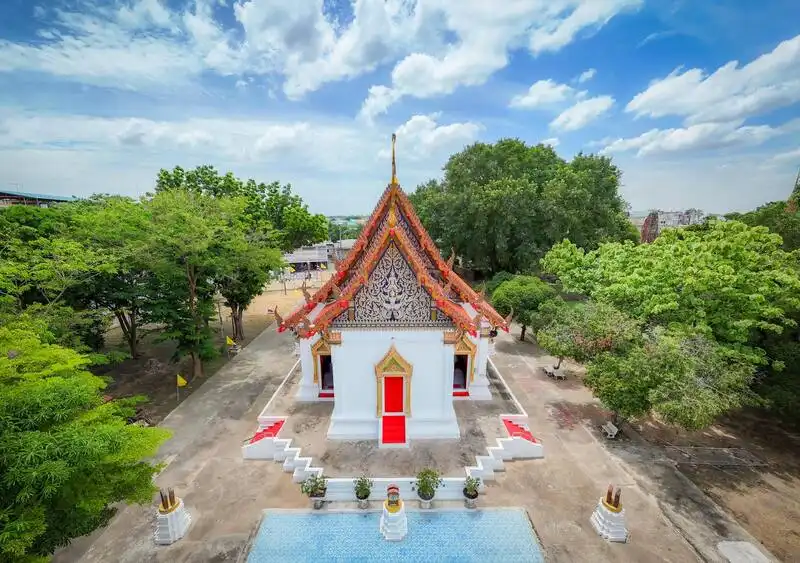
Wat Ratchapraditthan (Phra Nakhon Si Ayutthaya) is an old temple in the Hua Ro area with a quiet, grounded charm. Its story is woven through several layers of Ayutthaya history, from the early period of the kingdom to the tense years leading up to the fall of Ayutthaya in 2310. At the same time, it is not far from the main sightseeing zones, which makes it ideal for travelers who want a calmer corner of the city while still being able to connect their trip to the better-known temples on the island. The temple sits along Khlong Pratu Khao Plueak on the west bank of the canal, on U-Thong Road in Hua Ro Subdistrict, and many visitors experience it as a brief pause to breathe in the atmosphere of the old city rather than the busier, landmark-style stops.
In the bigger picture, Wat Ratchapraditthan is described as a temple founded in the early Ayutthaya era, with historical memory tied to key figures of the royal court. Local accounts commonly recount that King Maha Chakraphat, when he held the rank of Phra Thian Racha, once ordained as a monk at this temple. This kind of story gives the visit a different weight: it is not only about making merit or viewing structures, but about standing in a place that once held a moment where royal authority and monastic life intersected in a very real, personal way for an Ayutthaya king.
Another layer that strengthens the temple’s historical significance is its association with the final chapter before the fall of Ayutthaya in 2310. It is said that King Uthumphon, Krom Khun Phonphinit, widely remembered as Khun Luang Ha Wat, who had ordained at Wat Pradu Rong Tham outside the royal city, later came to reside at Wat Ratchapraditthan. After Ayutthaya fell, he was taken to Burma. This narrative turns Wat Ratchapraditthan into more than a religious backdrop; it becomes a site that reflects political upheaval and invites visitors to see Ayutthaya as a living historical landscape rather than only a city of ruins.
One of the most poignant things to know about this temple is the Ayutthaya-period mural painting that once appeared on the walls of the old ordination hall. Historical accounts state that King Mongkut (Rama IV) visited to view the paintings and ordered copies to be made, and that King Chulalongkorn (Rama V) also visited to view them twice early in his reign. Over time, however, the old ordination hall lacked a roof and protection from the elements, and the paintings gradually faded away. Eventually, the original hall was dismantled in 2507 to build a new ordination hall. Even though the murals are no longer visible today, simply knowing that royal visits were made specifically to view Ayutthaya-era paintings is enough to suggest how culturally and artistically valued this temple once was.
The temple becomes even more memorable through its present-day connection to the “Tha Sai Group” (Khana Tha Sai). Wat Ratchapraditthan has incorporated the former Wat Tha Sai (now a deserted temple site) into a single complex under this designation. This also links to a notable cultural detail: during the reign of King Borommakot, Wat Tha Sai was associated with Phra Mahanak, the author of “Punno Wat Kham Chan,” a respected work in Thai literary tradition. Recognizing this connection means that visiting Wat Ratchapraditthan is not only about religion and political history, but also about the continuity of Thai literary culture across centuries.
Because of these layers, Wat Ratchapraditthan is best suited to visitors who like to read history through place rather than rushing through a checklist. The strength of the site is its blend of people, court history, and cultural context in one setting. If you visit without hurrying, it is worth beginning by absorbing the canal-side atmosphere, since waterways were deeply tied to how Ayutthaya functioned and felt in everyday life. From there, you can move inward to the key buildings, taking in the parts still in active use today while keeping good temple etiquette: dress respectfully, speak softly, and avoid entering areas where ceremonies or religious activities are underway unless you are participating appropriately.
Getting There From Bangkok, you can reach Ayutthaya by private car, van/bus, or train. By car, most travelers use Highway 1 or Highway 32 (Asian Highway) into Phra Nakhon Si Ayutthaya city, then head toward the Hua Ro area and U-Thong Road near the canal and the edge of the island zone. If you arrive by train, get off at Ayutthaya Railway Station and continue by local taxi, tuk-tuk, or hired transport to U-Thong Road. A smooth way to plan the day is to start at Wat Ratchapraditthan for a quieter historical perspective in the Hua Ro area, then continue to major heritage sites on the island such as Wat Mahathat, Wat Ratchaburana, or Wat Phra Si Sanphet to balance the trip with more iconic highlights.
In the end, if you are looking for an Ayutthaya temple that is not famous for a single photo spot but stands out for a meaningful historical narrative, Wat Ratchapraditthan is well worth a visit. It helps you see Ayutthaya as a city shaped by faith, shifting power, and cultural traces that still echo into the present. Giving the place a little time often turns it from “just another temple on the map” into a point that completes the larger picture of Ayutthaya in a more human and memorable way.
| Name | Wat Ratchapraditthan (Phra Nakhon Si Ayutthaya) |
| Address | U-Thong Road, Hua Ro Subdistrict, Phra Nakhon Si Ayutthaya District, Phra Nakhon Si Ayutthaya |
| Place Summary | An early Ayutthaya-era temple beside Khlong Pratu Khao Plueak, known for layered historical narratives tied to major royal figures and the “Tha Sai Group” context that connects history, literature, and living faith in one area. |
| Highlights | Accounts linking the temple to King Maha Chakraphat’s ordination as Phra Thian Racha, narratives related to King Uthumphon (Khun Luang Ha Wat) before the fall of Ayutthaya in 2310, the recorded history of Ayutthaya-era murals once seen in the old ordination hall, the Tha Sai Group connection and the literary note about Phra Mahanak and “Punno Wat Kham Chan,” and a calm canal-side atmosphere suited to an unhurried visit. |
| Period / History | Described as an early Ayutthaya-era temple, associated in local accounts with Phra Thian Racha (King Maha Chakraphat) and with Khun Luang Ha Wat (King Uthumphon) before the fall of Ayutthaya in 2310, with a new ordination hall built in 2507. |
| Key Evidence | Recorded accounts about Ayutthaya-period murals once present in the old ordination hall and the Tha Sai Group linkage, including the literary association with Phra Mahanak and “Punno Wat Kham Chan.” |
| Name Origin | The name “Ratchapraditthan” is commonly understood as implying royal establishment or formal placement, reflecting traditional local usage connected to royal context. |
| Current Abbot / Caretaker | Phra Wachiraphivat (Abbot of Wat Phrom Niwas Worawihan and Acting Abbot of Wat Ratchapraditthan) |
| Open Days & Hours | Daily / 08.00 – 18.00 |
| Fees | No Admission Fee |
| Travel | From Bangkok, travel to Ayutthaya by car, van/bus, or train, then head to the Hua Ro area and U-Thong Road beside Khlong Pratu Khao Plueak; from Ayutthaya Railway Station, continue by taxi, tuk-tuk, or hired transport. |
| Current Status | Open for worship and visits |
| Contact Number | 035-232-335 |
| Nearby Tourist Attractions (Approx. Distance) | 1) Wat Mahathat – 3 km 2) Wat Ratchaburana – 3 km 3) Chao Sam Phraya National Museum – 4 km 4) Wat Phra Si Sanphet / Royal Palace Area – 4 km 5) Wihan Phra Mongkhon Bophit – 4 km |
| Popular Restaurants Nearby (Distance + Phone) | 1) Sukunya Bistro – 4 km – 089-163-7342 2) Coffee Old City Thai Bistro – 4 km – 089-889-9092 3) Malakor Kitchen and Cafe – 4 km – 091-779-6475 4) Earl Thai Restaurant – 5 km – 035-900-699 5) Busaba Ayutthaya Cuisine – 5 km – 084-026-2657 |
| Popular Accommodations Nearby (Distance + Phone) | 1) Krungsri River Hotel – 7 km – 035-244-333 2) Ayothaya Riverside Hotel – 8 km – 035-243-139 3) Classic Kameo Hotel Ayutthaya – 10 km – 035-212-535 4) Centara Ayutthaya – 12 km – 035-243-555 |
Frequently Asked Questions (FAQ)
Q: Is Wat Ratchapraditthan open every day?
A: Yes, it is generally open daily. Visiting during daytime hours is recommended, and visitors should be respectful of any religious activities taking place.
Q: What are the opening hours for Wat Ratchapraditthan?
A: The commonly recommended visiting window is 08.00 – 18.00. If you plan a specific worship visit, calling ahead is advised.
Q: Where is Wat Ratchapraditthan located?
A: It is on U-Thong Road in Hua Ro Subdistrict, beside Khlong Pratu Khao Plueak on the west bank of the canal in Phra Nakhon Si Ayutthaya.
Q: Which historical figures are associated with Wat Ratchapraditthan?
A: Local accounts associate the temple with King Maha Chakraphat (as Phra Thian Racha) and with King Uthumphon (Khun Luang Ha Wat) in the period leading up to the fall of Ayutthaya in 2310.
Q: Why are the Ayutthaya-era murals no longer visible in the old ordination hall?
A: Accounts describe the old hall as lacking a roof and protection from the elements, so the paintings gradually faded. The original hall was later dismantled and replaced with a new ordination hall in 2507.
Q: What temples or museums are good to visit next after Wat Ratchapraditthan?
A: Many travelers continue to Wat Mahathat, Wat Ratchaburana, Chao Sam Phraya National Museum, and Wat Phra Si Sanphet / the Royal Palace area for a more complete Ayutthaya historical route.
 Wat Ratchapraditthan Map
 Category:
  Group:
  Tag: ●Wat Ratchapraditthan●wat ratchapraditthan ●wat ratchapraditthan ayutthaya ●hua ro ayutthaya temple ●u-thong road ayutthaya ●khlong pratu khao plueak ●khun luang ha wat ●king uthumphon ●phra thian racha ●ayutthaya hidden temple ●ayutthaya cultural heritage Last Update: 2 MonthAgo
Comment
 Nearby Attractions
| Keyword (Advance) |
 Region
|
 Phranakhon Si Ayutthaya(
 Copyright 2012,