
lovethailand home >Central Travel Attractions
>Phranakhon Si Ayutthaya Travel Attractions >Phranakhon Si Ayutthaya
>Sam Phao Lom
> Wat Phutthaisawan
TL;DR: Wat Phutthaisawan is located at Moo 8, Samphao Lom Subdistrict, Phra Nakhon Si Ayutthaya District, Phra Nakhon Si Ayutthaya 13000, Thailand, open Every day, hours 08.00–17.00 (approximate hours, subject to change depending on temple.
Wat Phutthaisawan
Open Days: Every day
Opening Hours: 08.00–17.00 (approximate hours, subject to change depending on temple activities)
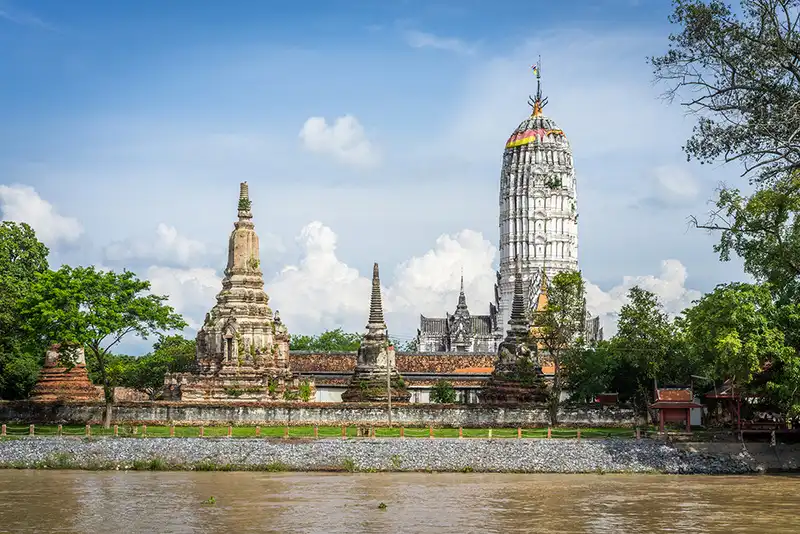
Wat Phutthaisawan, a royal monastery on the banks of the Chao Phraya River, is one of Ayutthaya’s oldest temples that still feels very much alive amidst the layers of history. It is located on the western bank of the Chao Phraya River, just south of the island city of Ayutthaya, in Samphao Lom Subdistrict, Phra Nakhon Si Ayutthaya District. When you look across the river from the island, you will see the tall white main prang rising against the sky — an iconic view that many visitors immediately think of when they hear the name Wat Phutthaisawan. It has become a must-visit spot for those planning an Ayutthaya trip that blends both faith and history in one place.
The uniqueness of Wat Phutthaisawan lies not only in its peaceful riverside setting along the Chao Phraya River, but also in its age of more than 600 years and the fact that it survived the destruction when Ayutthaya fell to the Burmese for the second time. As a result, many architectural structures and sacred objects remain in a more complete state than those of many other temples in the area. Travelers looking for Ayutthaya attractions that combine sacred ambience, historical depth, and beautiful photo spots will find Wat Phutthaisawan a destination not to be missed.
The temple grounds stretch along the Chao Phraya River. Inside, the area is divided into the inner sanctuary (buddhawat), which contains the main prang and a surrounding cloister, and the monastic living quarters (sanghawat), where monks reside. Passing through the ancient gate, you are immediately wrapped in the atmosphere of the old capital: faded bricks, remnants of stucco decorations, and rows of Buddha images along the cloister that have been restored to their former elegance.
The history of Wat Phutthaisawan is directly tied to the founding of Ayutthaya. This area was originally the residence of King Ramathibodi I (King U Thong) before he crossed the Chao Phraya River to establish Ayutthaya as the capital on the island side. Chronicles mention this place as “Wiang Lek” or “Wiang Lek (Iron City)”. After the capital had been successfully established, around 1353 CE (B.E. 1896), the king ordered a temple to be built on the site of his former residence as a royal memorial and as a royal monastery for the court.
As a royal monastery, Wat Phutthaisawan was used for various royal ceremonies and major merit-making events during the Ayutthaya period. Towards the end of the kingdom, the temple also played an important role in military strategy because of its location, which was suitable for setting up camps to defend against enemy forces coming along the river. The temple grounds and the nearby Catholic community across the river were used as defensive lines against Burmese troops advancing by water. Thus, the name Wat Phutthaisawan is remembered not only as an ancient temple but also as a historical site linked to the city’s defensive strategy.
When Ayutthaya finally fell in 1767 CE (B.E. 2310), Wat Phutthaisawan escaped from the severe burning and destruction that affected many other temples. Large parts of the main prang, cloister, and groups of chedis retained their original structure. During the Rattanakosin period, the temple underwent continuous restoration and was later designated a third-class royal monastery. The abbot and the monastic community have helped preserve both the ancient structures and the Buddhist art within the temple, keeping its historical and spiritual value alive alongside the city of Ayutthaya.
The most striking feature of Wat Phutthaisawan is the large main prang, painted white and standing prominently at the center of the inner sanctuary on a multi-angled base. The prang is built in a Khmer-influenced style blended with Thai aesthetics and symbolizes Mount Meru, the cosmic center in Buddhist cosmology. On the east and west sides of the base are stairways that lead up to a walkway around the prang. Visitors can climb up to observe the stucco details and enjoy elevated views over the temple compound and the Chao Phraya River — a truly impressive sight.
Surrounding the main prang is a rectangular cloister lined with golden Buddha images in Sukhothai style seated on intricately decorated bases. Some images have been fully restored to their former majesty, while others still show clear traces of weathering and time. The combination of restored and aged statues creates an evocative contrast between old and new. For those who love photographing ancient temples, the cloister at Wat Phutthaisawan is an absolute highlight.
To the west of the main prang stands the ordination hall (ubosot), which has been renovated and houses the principal Buddha image. The atmosphere is calm and suitable for quiet prayer and reflection. Around it are twelve chedis clustered on a single base, believed to contain the remains of former abbots or important figures associated with the temple in the past.
Another major attraction is the reclining Buddha hall (wihan Phra Non), located nearby. Although only parts of the walls and base of the building remain, a large reclining Buddha image still lies peacefully within. The scene evokes a solemn, slightly melancholic feeling when one reflects on the passage of time. Many visitors choose to walk a loop past the main prang, cloister, ubosot, group of chedis, and the reclining Buddha hall before returning to relax by the riverbank.
On the north and south sides of the prang are two mondops (pavilions). One of the key locations is the area known as the residence of Phra Buddhaghosacariya. The interior walls were once painted with scenes of celestial beings, ascetics, the worship of the Buddha’s footprint, and ships representing the voyage of this senior monk to Sri Lanka. Although much of the painting has faded with time, the outlines and some details are still visible, allowing visitors to imagine the artistic splendor of the Ayutthaya period.
In terms of sacred objects, Wat Phutthaisawan enshrines many important Buddha images: the principal Buddha in the ordination hall, the Buddha images in the cloister, and the reclining Buddha in the wihan. There are also stories about a sacred well or “Nam Thip” (heavenly water) within the temple, from which people once drew water to drink or sprinkle for blessings. Today, the temple emphasizes traditional Buddhist merit-making more than esoteric beliefs, but the image of Wat Phutthaisawan as a place of spiritual power and amulets still persists and continues to attract devotees throughout the year.
Another distinctive aspect that sets Wat Phutthaisawan apart from many other temples in Ayutthaya is its connection with ancient Thai martial arts, especially Krabi Krabong (traditional sword-fighting). Historical records and various sources note that the temple was associated with the training of warriors in weaponry and esoteric practices during the Ayutthaya era. Today, this heritage has been carried on under the name “Phutthaisawan Sword School”, where the focus is on cultural martial arts rather than actual combat. At certain times, visitors may witness demonstrations or cultural activities related to Thai swordplay, adding a “warrior way of life” dimension to the temple visit.
Throughout the year, Wat Phutthaisawan hosts several important traditional events, especially the “Cloth-Offering Ceremony for the Main Prang of Wat Phutthaisawan”, held on the full moon of the sixth lunar month. This is an ancient tradition that the local community in Samphao Lom has preserved for generations. On the fourteenth day of the waxing moon, there is an evening chanting ceremony at the temple. On the full moon day, villagers bring food offerings to the monks in the morning. Around 9 a.m., a procession begins with three-colored cloths — green, red, and yellow. People write their names and those of their families on the cloth before joining the procession towards the main prang. The lively atmosphere is filled with brass bands, piphat ensembles, and drums. When the procession reaches the prang courtyard, a ritual of worship and an offering ceremony takes place, followed by the cloth being taken up to wrap around the prang. It is a truly beautiful and faith-filled scene.
After the daytime rituals, the temple grounds come alive again in the evening of the full moon. There are usually performances and stalls set up in the area, such as Likay (traditional Thai theatre), open-air movies, food stalls, and souvenir vendors. The surroundings are bustling with locals and visitors alike. At the same time, this tradition acts as a bridge connecting younger generations to the cultural roots of the Samphao Lom community.
On regular days, the atmosphere at Wat Phutthaisawan is especially serene in the early morning and late afternoon. The sun is not too harsh, making it pleasant to walk around the prang, cloister, and other ancient structures. Many visitors like to start their Ayutthaya day trip by stopping at Wat Phutthaisawan first, then continuing on to Wat Chaiwatthanaram and temples on the island, while others prefer to visit in the late afternoon to capture the warm light illuminating the prang and the river. It is a favorite time for photographers and content creators alike.
Popular photo spots at the temple include close-up angles of the main prang reaching into the sky, the cloister with rows of Buddha images forming strong leading lines, and riverbank views looking back at the temple reflected in the water. For those who want serene, atmospheric shots of the old capital, Wat Phutthaisawan is an ideal location and is frequently used as a filming site for historical dramas, movies, and spiritual-themed content.
In terms of facilities, Wat Phutthaisawan has parking areas for private cars and tour vans, restrooms, and small shops selling snacks and basic items near the entrance. This allows visitors to spend a comfortable amount of time at the temple. However, because the temple has retained its traditional character and has not been overly modernized, it is recommended to bring drinking water, a hat, and an umbrella, especially if you plan to explore the ancient structures in detail.
As for dress, visitors to Wat Phutthaisawan are encouraged to dress modestly. Shirts with sleeves, trousers or skirts that cover the knees, and comfortable walking shoes are ideal. It is best to avoid strapless tops, spaghetti straps, very short shorts, or overly tight or sheer clothing. Even though the temple does not strictly enforce dress codes to the same extent as some royal temples, dressing respectfully is a way of honoring the sacred space and the monastic community residing there.
Photography is generally welcomed at Wat Phutthaisawan. Visitors may take photos of the ancient structures, Buddha images, and temple surroundings as appropriate. However, climbing on ancient ruins or standing on the bases of Buddha images should be strictly avoided for safety reasons and to help preserve the site. For commercial shoots or drone use, it is essential to seek permission in advance from the abbot or temple authorities to comply with temple regulations.
For those driving from Bangkok, you can take Highway 1 and then merge onto Highway 32 (Asian Highway) towards Phra Nakhon Si Ayutthaya. Follow the signs into Ayutthaya city and the island area. From there, you can take riverside roads to reach the western bank of the Chao Phraya River. The route is straightforward, with wide roads and generally smooth traffic.
If you start from within Ayutthaya city or the island area, a common route is to take the Ayutthaya–Sena Road and cross the bridge at Wat Kasattrathirat Worawihan to the western bank of the Chao Phraya River. After descending the bridge, turn left and continue driving. You will pass Wat Chaiwatthanaram, another landmark of Ayutthaya. Along the way, you will see signs directing you to Wat Phutthaisawan at intervals. Turn left at the small junction leading into the temple. Even first-time visitors generally find the route easy to follow.
For those traveling by public transportation, you can take a train to Ayutthaya Railway Station or a van from Bangkok to Ayutthaya city. From there, continue by local songthaew, tuk-tuk, or motorcycle taxi to Wat Phutthaisawan. Fares vary depending on distance and negotiation but are generally reasonable. For small groups, hiring a local taxi or songthaew for a full day to visit multiple temples can save time and make planning your route more efficient.
Another enjoyable way to experience the area is by taking a boat tour around the island, visiting temples along the Chao Phraya River. Some boat tours include stops at Wat Phutthaisawan, Wat Chaiwatthanaram, and other important riverfront temples. Seeing the temple from the water offers a completely different perspective compared to viewing it from the road. During the flood season, the riverside scenery around the temple is especially beautiful. Those who enjoy a relaxed, scenic atmosphere can easily include Wat Phutthaisawan in their boat itinerary.
When planning a trip to Ayutthaya, many visitors include Wat Phutthaisawan in a one-day itinerary together with Wat Chaiwatthanaram, Wat Phra Si Sanphet, Wat Mahathat, and popular markets such as Ayothaya Floating Market or other old-style markets in town. This combination offers both the experience of exploring World Heritage-level ruins and a chance to see the everyday life of modern Ayutthaya residents, where tradition and modernity blend in interesting ways.
Today, the abbot and monastic community of Wat Phutthaisawan, led by Phra Wachirayan (Atichot Thammavaro), play an important role in maintaining the Buddhist faith, restoring ancient structures, and overseeing religious and cultural activities in the surrounding community. This helps ensure that the temple remains a living place of worship rather than just an open-air museum — a space where people can make merit, pay respects, and learn about history all in one visit.
Overall, Wat Phutthaisawan is much more than just an old riverside temple. It is one of Ayutthaya’s clearest bridges between the “past” and the “present”. For anyone who wants to experience the charm of the old capital beyond just walking among ruined walls and crumbling stupas, and instead see a temple where monks still reside, living traditions continue, and the local community’s faith remains strong, Wat Phutthaisawan is a destination that deserves a firm place on every Ayutthaya trip list.
Getting There — To reach Wat Phutthaisawan from Bangkok by private car, take Highway 32 (Asian Highway) to Phra Nakhon Si Ayutthaya and then drive into the city center. Head towards Wat Kasattrathirat Worawihan Bridge and cross to the western bank of the Chao Phraya River. After crossing, turn left and follow the Ayutthaya–Sena Road. You will pass Wat Chaiwatthanaram. Watch for signs directing you to Wat Phutthaisawan, which appear at intervals. Turn left at the small lane indicated by the sign to enter the temple compound, where you will see the main prang rising prominently inside.
For those who do not wish to drive, taking a train or van to Ayutthaya and then continuing by songthaew or tuk-tuk to the temple is a practical option. Fares per trip are generally affordable, but be sure to clearly tell the driver that you are going to Wat Phutthaisawan on the riverside, not another temple, to avoid confusion. If you are traveling in a group, hiring a local taxi or van for a full day to visit several temples can save time and make your schedule more flexible.
| Place Name | Wat Phutthaisawan (Royal Monastery) |
| Address | Moo 8, Samphao Lom Subdistrict, Phra Nakhon Si Ayutthaya District, Phra Nakhon Si Ayutthaya 13000, Thailand |
| Type / Category | Ancient riverside temple on the Chao Phraya River, third-class royal monastery, and a key center of faith and historical learning about the Ayutthaya Kingdom |
| Era / Year Built | Early Ayutthaya period, built around 1353 CE (B.E. 1896) during the reign of King Ramathibodi I (King U Thong) |
| Founder | King Ramathibodi I (King U Thong), the first monarch of the Ayutthaya Kingdom |
| Abbot / Caretaker | Phra Wachirayan (Atichot Thammavaro), Abbot of Wat Phutthaisawan (information subject to change over time) |
| Highlights | Large Khmer-style main prang on a raised base, cloister lined with gilded Buddha images, reclining Buddha hall, groups of ancient chedis, the annual cloth-offering ceremony for the prang, and the temple’s association with traditional Thai martial arts (Phutthaisawan Sword School) |
| Important Traditions / Rituals | The Cloth-Offering Ceremony for the Main Prang on the full moon of the sixth lunar month, annual kathin and pha pa offerings, and regular community merit-making events organized by the Samphao Lom community |
| Entrance Fee | No entrance fee (free admission; donations are welcomed according to one’s faith) |
| Open Days | Open daily |
| Opening Hours | Approximately 08.00–17.00 (visitors are advised to recheck the opening hours on the day of their visit) |
| Dress Code | Modest clothing is recommended: shirts with sleeves, trousers or skirts covering the knees, and comfortable shoes. Avoid strapless tops, spaghetti straps, very short shorts, and overly tight or sheer clothing. |
| Getting There | 1) By private car from Bangkok: Take Highway 32 (Asian Highway) to Phra Nakhon Si Ayutthaya, drive into the island area, cross Wat Kasattrathirat Worawihan Bridge to the western bank, turn left, pass Wat Chaiwatthanaram along the Ayutthaya–Sena Road, then turn left following the signs to Wat Phutthaisawan. 2) By public transport: Take a train or van to Ayutthaya city, then continue by local songthaew, tuk-tuk, or motorcycle taxi to the temple. 3) By boat: Join a boat tour around the island that includes stops at riverside temples such as Wat Chaiwatthanaram and Wat Phutthaisawan. |
| Current Status | Open for worship and sightseeing as usual; one of Ayutthaya’s most popular temples for both tourism and religious activities |
| Nearby Attractions (Approximate Distance) | 1) Wat Chaiwatthanaram – approx. 3 km 2) Wat Phra Si Sanphet (on the island) – approx. 4.5 km 3) Wat Mahathat – approx. 5 km 4) Wat Phanan Choeng Worawihan – approx. 6 km 5) Ayothaya Floating Market – approx. 7 km |
| Nearby Restaurants (Distance & Phone Number) | 1) Sala Ayutthaya Eatery and Bar – approx. 3 km, Tel. 035-242-588 2) Blue River Ayutthaya – approx. 3 km, Tel. 092-743-2200 3) The Summer House Ayutthaya – approx. 4 km, Tel. 094-224-2223 4) Coffee Old City Thai Bistro – approx. 5 km, Tel. 089-889-9092 |
| Nearby Accommodation (Distance & Phone Number) | 1) sala ayutthaya – approx. 3 km, Tel. 035-242-588 2) iuDia on the river – approx. 3 km, Tel. 086-080-1888 3) Baan Tye Wang Guesthouse – approx. 3 km, Tel. 035-323-001 4) Moradok Thai Guesthouse – approx. 2 km, Tel. 097-018-8080 5) San Sook Place Guest House – approx. 3 km, Tel. 081-712-2882 |
| Facilities | On-site parking for private cars and vans, restrooms, small shops near the entrance selling snacks and basic items, riverside seating areas, and walkways for exploring the ancient structures around the prang and cloister. |
| Temple Contact / More Information | Tel. 086-171-7175 (Wat Phutthaisawan contact information) |
Frequently Asked Questions (FAQ)
Q: Does Wat Phutthaisawan charge an entrance fee?
A: Currently, Wat Phutthaisawan does not charge an entrance fee. Visitors can enter for free and make donations according to their faith to support the upkeep of the temple and its ancient structures.
Q: What is the best time of day to visit Wat Phutthaisawan?
A: The best times are in the morning from around 08.00–10.00 and in the late afternoon from about 15.30–17.00, when the weather is cooler and the light is beautiful for both walking around and taking photos, especially of the main prang and cloister.
Q: Can I take photos and fly a drone inside Wat Phutthaisawan?
A: General sightseeing photography is allowed. However, visitors should avoid climbing on ancient structures or standing on the bases of Buddha images. For drone use or commercial shoots, permission should be requested in advance from the abbot or temple authorities to ensure full compliance with temple regulations.
Q: When is the Cloth-Offering Ceremony for the main prang held?
A: The Cloth-Offering Ceremony for the main prang of Wat Phutthaisawan is held on the full moon of the sixth lunar month each year. Activities include morning alms-giving, a colorful procession of three-colored cloths around the prang, worship rituals, and evening performances and stalls, reflecting the vibrant culture of the Samphao Lom community.
Q: How can I get to Wat Phutthaisawan if I do not have a private car?
A: You can take a train or van to Ayutthaya city and then continue by local songthaew, tuk-tuk, or motorcycle taxi to the temple. Be sure to clearly specify that you are going to Wat Phutthaisawan on the riverside. For groups, hiring a local taxi or van for a full-day trip that includes several temples is a convenient option.
Q: What should I wear when visiting and paying respects at Wat Phutthaisawan?
A: It is recommended to dress modestly: shirts with sleeves, trousers or skirts covering the knees, and comfortable walking shoes. Avoid strapless tops, spaghetti straps, very short shorts, and overly tight or sheer clothing to show respect for the sacred space and the monastic community.
Website : www.putthaijatukam.com
 Website :
  Category: ●Places of Worship
 Group: ●Temple
Last Update : 4 MonthAgo
 Last Update : 4 MonthAgo
 Click to Access the Navigation Map GPS
Wat Phutthaisawan Map
Recommend
 Art, Culture and Heritage
 Historical Sites and Monuments(7)
 Landmarks and Memorials(6)
 Royal Palace(4)
 Art, Craft Centres, Tradition(6)
 Museums(9)
 Educational Places
 Museum for Study(1)
 Educational Gardens, Farm(2)
 Training Center(1)
 University Temple(133)
 Church(2)
 Mosque(2)
 Other religious and spiritural sites(15)
 Research and Development
 Royal Project(4)
 Suburban Living
 Village, Community(10)
 Local Market(7)
 Floating Market(3)
 Nature and Wildlife
 Dam, Reservoir, Lake(1)
 River, Canal(3)
 Islands(2)
 Other natural attractions(1)
 Entertainment and Agricultural
 Animal camps and shows(2)
 Farm, Parks, Gardens and Ecotourism(4)
 Travel Articles, Recipes
 Travel Review, Food Review(2)


