

 Home
Home Chiang Mai(




Wat Boromphuttharam
Rating: 3.8/5 (4 votes)
 Search By
  Map
Map 
 Have Map
  No Map
Phranakhon Si Ayutthaya attractions
Attractions in Thailand
Open Days: Daily
Opening Hours: Approximately 08:00 – 16:30 (Hours may change depending on local announcements; checking before you go is recommended)
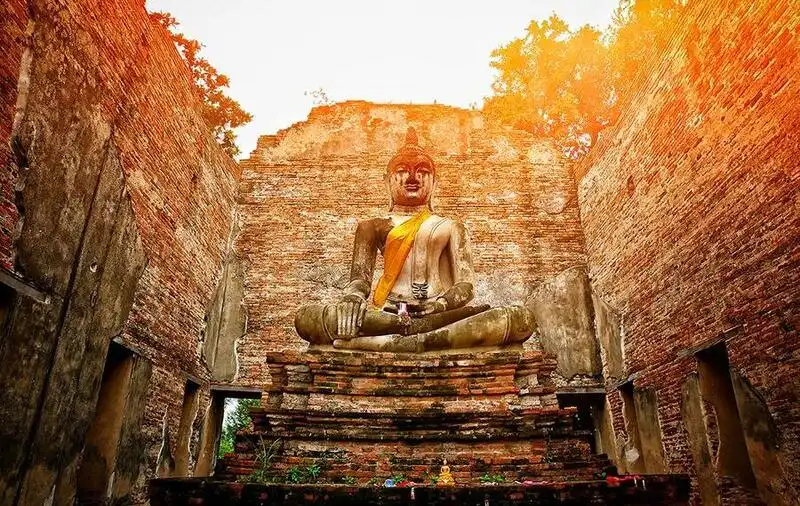
Wat Boromphuttharam is an important historical site of the old capital that many people end up “driving past without realizing it’s here,” mainly because it sits within the grounds of Phranakhon Si Ayutthaya Rajabhat University. That setting makes the atmosphere noticeably quieter than the city’s most popular temple stops, and it suits visitors who want to study craftsmanship without squeezing through crowds. What makes this place compelling isn’t only its identity as a late-Ayutthaya temple, but the “story of the place” itself—closely tied to King Phetracha’s accession and his intention to create a temple that would become an architectural memory of the Ban Phlu Luang dynasty.
If you’ve ever felt that many Ayutthaya temples share a similar mood, Wat Boromphuttharam tends to make people pause because its details read differently—from a layout “forced” by ancient transportation routes to its most distinctive hallmark, which gave it the well-known nickname “the Glazed Tile Temple.” The story goes that yellow glazed tiles were specially produced to roof key buildings and to decorate other parts of the compound. Even though what you see today is an archaeological ruin, imagining a time when roofs and gateways reflected a warm yellow sheen helps explain why this site is remembered as a “deliberate statement” rather than a temple that simply happened to exist.
Historically, Wat Boromphuttharam is often described as having been initiated during the reign of King Phetracha (around 2231–2246 BE) in the Pa Tong area, said to have been his former residence. Choosing this location carries clear symbolic weight: it anchors the dynasty’s legitimacy and memory in a place associated with his life before taking the throne, and then extends that meaning through a temple intended as a center of faith and a showcase of craftsmanship of its era.
One especially interesting aspect is how “spatial constraints” became the temple’s identity. The compound was bounded by Khlong Chakhrai Noi to the east and an old royal road to the west (often mentioned as the Maharatyah Road or Pa Tong Road). These lines of canal and road shaped the temple plan into a north–south orientation, with the temple facing north. As a result, the overall layout feels highly structured, offering a different impression from temples with wide open grounds within the main historical park zone.
When you step into the site, it’s worth pausing to take in the overall composition before rushing to take photos. The beauty of Wat Boromphuttharam lies in the proportions of its structures and the surviving traces of craftsmanship that can still be “read,” especially around the main ubosot (ordination hall) built in brick and plaster. Descriptions often highlight the carefully arranged front composition and the access system reflecting past ceremonial use, along with traces of boundary markers (sema stones) and architectural details that reward slow, unhurried observation.
Another element that makes the walk engaging is the remaining framework of gateways and openings where decorative traces can still be seen. Ruins like these tell their stories through “surfaces.” The slower you walk, the more you notice differences in plaster layers, repair marks, and materials weathered by centuries of sun and rain—an atmosphere that newly built temples simply can’t replicate.
The signature story that sets this site apart is the account of yellow glazed tiles that King Phetracha ordered to be produced for roofing the ubosot, the viharn, the sermon hall, and for decorating chedis and gateways. In Ayutthaya, the presence of such “colored material” was not ordinary—it implies specialized craftsmanship and organized production, reflecting both state capacity and the intention to make this temple visually memorable. Once you know this, standing before brick ruins becomes more than looking at old masonry; it becomes a way of seeing the historical ambition to make the temple “radiant,” both in faith and in art.
Later, during the reign of King Borommakot, Wat Boromphuttharam is said to have undergone major restoration, including the creation of three pairs of exquisitely inlaid mother-of-pearl doors. Accounts today mention that these doors were dispersed to major locations, such as Wat Phra Si Rattana Satsadaram (the Temple of the Emerald Buddha), Wat Benchamabophit Dusitwanaram, and another pair that was turned into a book cabinet and displayed at the National Museum in Bangkok. This detail gives the site a special appeal for museum lovers, because your trip can connect the “original place” with “preserved artworks,” like assembling different pieces of the same historical puzzle.
What many visitors appreciate most is the feeling of calm and breathing space. Because the site lies within a university campus, it tends to be less crowded than Ayutthaya’s most famous temples, letting you set your own rhythm—reading the space, studying the structures, and photographing light and shadow without rushing. It suits people who want to experience Ayutthaya more deeply, not just as a checklist of famous stops.
Getting There Wat Boromphuttharam is located within the grounds of Phranakhon Si Ayutthaya Rajabhat University on Ayutthaya Historical Island. If driving from Bangkok via Asia Road (Highway 32), turn toward Phra Nakhon Si Ayutthaya town, then head onto the island using the main connecting routes. The most convenient option is to set your navigation to “Wat Boromphuttharam” or “Wat Boromphuttharam” (English name), since the island area includes multiple junctions and some one-way streets. Following GPS guidance helps reduce unnecessary detours.
A benefit of the temple being on a university campus is that there is usually organized parking and walkways, though certain days may coincide with university events or local rush periods. If you want the most relaxed experience, visiting in the morning is ideal—especially for photography, as softer morning light gives the old brick surfaces clearer depth and texture.
Planning a smooth itinerary is easy because Wat Boromphuttharam is not far from the island’s major landmarks. You can link your route to Wat Phra Si Sanphet, Viharn Phra Mongkhon Bophit, the Chao Sam Phraya National Museum, Wat Mahathat, and Wat Ratchaburana in a single day, spending more time actually exploring than traveling. If you want a “full but not exhausting” day, this site works well as a calm starting point before heading to the most popular temples later in the morning or afternoon.
As with any heritage site, respectful etiquette matters. Dressing modestly naturally fits the setting, and if you take photos near fragile ruins, it is best to avoid climbing or touching vulnerable structures. Small care like this helps preserve Ayutthaya’s traces for future visitors to experience as closely to reality as possible.
| Site Summary | A significant late-Ayutthaya historical temple site within Phranakhon Si Ayutthaya Rajabhat University. Often associated with King Phetracha, it stands out for the story of “yellow glazed tiles” and a temple plan shaped by ancient canal-and-road boundaries. Best for a quiet, detail-focused walk and architectural observation. |
| Area / Location | Within Phranakhon Si Ayutthaya Rajabhat University, Ayutthaya Historical Island, Pratu Chai Subdistrict, Phra Nakhon Si Ayutthaya District, Phra Nakhon Si Ayutthaya Province |
| Address | Phranakhon Si Ayutthaya Rajabhat University area, Si Sanphet Road, Pratu Chai Subdistrict, Phra Nakhon Si Ayutthaya District, Phra Nakhon Si Ayutthaya 13000 |
| Key Highlights | Historical association with King Phetracha and the Pa Tong area (his former residence), the nickname “Glazed Tile Temple” linked to yellow glazed tiles, a north–south plan shaped by Khlong Chakhrai Noi and an old road alignment, and a quiet atmosphere suited to craft-focused walking and detailed photography |
| Administrator / Abbot (Latest) | No verified information indicating an active resident abbot at present (the site is used as a historical monument within the university grounds). For site-related contact, it is recommended to reach Phranakhon Si Ayutthaya Rajabhat University. |
| Open Days | Daily |
| Opening Hours | Approximately 08:00 – 16:30 (Hours may change depending on local announcements; checking before you go is recommended) |
| Admission Fee | Generally free of charge |
| Facilities | Walkways within the site area, parking within the university grounds (parking conditions may vary during events) |
| Related Organization (Contact) | Phranakhon Si Ayutthaya Rajabhat University Tel. 035-276-555 |
| Current Status | Open to visitors as a historical monument (daytime visits are recommended for safety and clearer viewing) |
| Nearby Attractions (Approximate Distance) | 1) Wat Phra Si Sanphet – approx. 2 km 2) Viharn Phra Mongkhon Bophit – approx. 2 km 3) Chao Sam Phraya National Museum – approx. 2 km 4) Wat Mahathat – approx. 3 km 5) Wat Ratchaburana – approx. 3 km 6) Wat Lokayasutharam – approx. 4 km 7) Wat Chaiwatthanaram – approx. 6 km |
| Nearby Restaurants (Distance + Phone) | 1) Coffee Old City Thai Bistro – approx. 3 km Tel. 089-889-9092 2) Malakor Kitchen and cafe – approx. 3 km Tel. 091-779-6475 3) Baan Pomphet – approx. 4 km Tel. 035-242-242 4) Boat Noodles (Pa Lek, original shop) – approx. 3 km Tel. 089-804-7418 5) Roti Sai Mai (Abideen + Pranom Saeng Arun) – approx. 4 km Tel. 080-075-3755 6) Kaffa Bistro Ayutthaya – approx. 8 km Tel. 084-040-1818 |
| Nearby Accommodations (Distance + Phone) | 1) Phuttal Residence – approx. 4 km Tel. 035-242-525 2) sala ayutthaya – approx. 5 km Tel. 035-242-588 3) iuDia on the River – approx. 5 km Tel. 086-080-1888 4) Krungsri River Hotel – approx. 6 km Tel. 035-244-333 5) Kantary Hotel Ayutthaya – approx. 10 km Tel. 035-337-177 |
Frequently Asked Questions (FAQ)
Q: Where is Wat Boromphuttharam located?
A: It is located within the grounds of Phranakhon Si Ayutthaya Rajabhat University on Ayutthaya Historical Island in Pratu Chai Subdistrict. The location is convenient and easily connected to the main landmark zone on the island.
Q: Which period was Wat Boromphuttharam built in?
A: It is commonly described as having been initiated during the reign of King Phetracha, around 2231–2246 BE, and is associated with the Pa Tong area said to have been his former residence.
Q: Why is Wat Boromphuttharam called the “Glazed Tile Temple”?
A: The site is nicknamed this because accounts mention yellow glazed tiles specially produced to roof key buildings and decorate parts of the temple, making it stand out from other temples in Ayutthaya.
Q: What time does Wat Boromphuttharam open?
A: Opening hours are generally reported as approximately 08:00 – 16:30, and it is commonly said to be open daily. However, hours may change depending on local announcements, so checking before you go is recommended.
Q: How much time should I plan to visit Wat Boromphuttharam?
A: For an overview walk and photos, about 30–60 minutes is usually enough. If you enjoy studying craftsmanship and details, allowing 1–1.5 hours is recommended.
Q: Where should I go next after visiting Wat Boromphuttharam?
A: You can continue to major sites on Ayutthaya Historical Island such as Wat Phra Si Sanphet, Viharn Phra Mongkhon Bophit, the Chao Sam Phraya National Museum, Wat Mahathat, and Wat Ratchaburana, which are all on convenient connecting routes.
Q: What is the best time to visit for comfortable walking and good photos?
A: Morning is generally the most comfortable, with softer light that adds depth to the old brick textures, especially if you plan to photograph architectural details and gateways.
 Wat Boromphuttharam Map
 Category:
  Group:
  Tag: ●Wat Boromphuttharam●wat boromphuttharam ●wat boromphuttharam ayutthaya ●glazed tile temple ayutthaya ●ayutthaya historical site ●ayutthaya old temple ●king phetracha temple ●ban phlu luang dynasty ●things to do in ayutthaya ●ayutthaya city island ●ayutthaya ruins Last Update: 2 MonthAgo
Comment
 Nearby Attractions
| Keyword (Advance) |
 Region
|
 Phranakhon Si Ayutthaya(
 Copyright 2012,