
lovethailand home >Central Travel Attractions >Phranakhon Si Ayutthaya Travel Attractions >Bang Pa In >Ban Len > Wat Chumphon Nikayaram Ratchaworawihan
TL;DR: Wat Chumphon Nikayaram Ratchaworawihan is located at Ban Len Subdistrict, Bang Pa-In District, Phra Nakhon Si Ayutthaya 13160, open Daily, hours 05:30 – 18:30 (approximate hours).
Wat Chumphon Nikayaram Ratchaworawihan
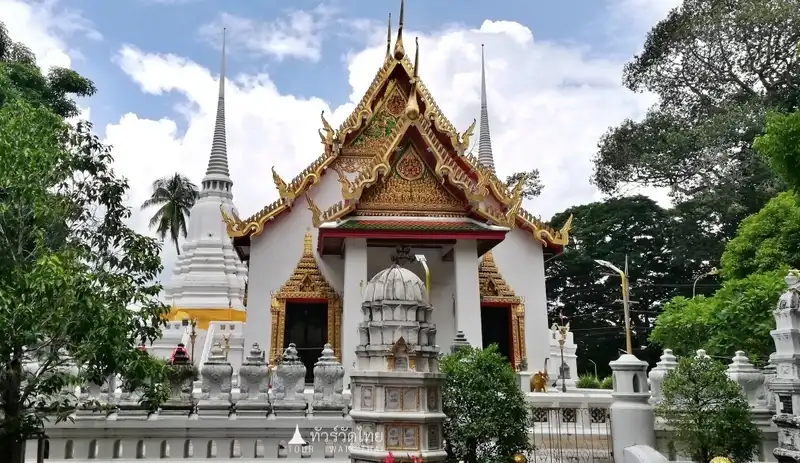
Open Days: Daily
Opening Hours: 05:30 – 18:30 (approximate hours)
Wat Chumphon Nikayaram Ratchaworawihan (Wat Chumphon) is located on Hua Ko (the island area) in Bang Pa-In, Ban Len Subdistrict, Bang Pa-In District, Phra Nakhon Si Ayutthaya. Many locals immediately recognize it as the “temple by the bridge leading to Bang Pa-In Railway Station,” because it faces one of the island’s key access routes. The surrounding landscape also makes the temple’s geographic context easy to understand: to the north, the temple borders the Bang Pa-In Royal Palace area, while to the west it meets the Chao Phraya River. This setting blends the calm of a sacred space with the gentle bustle of a historic zone where people still pass by throughout the day. Standing within the temple grounds and looking out toward the river, you can sense the pulse of an old city whose main waterway once connected communities, trade, and travel throughout the Chao Phraya basin for centuries.
The temple’s founding is directly tied to the Ayutthaya monarchy. It is said that King Prasat Thong ordered the construction of this temple around 1632 CE (B.E. 2175), on the former residential site of his royal mother. Choosing such a location gives the temple a meaning beyond routine religious functions. It becomes a place of royal memory and a reflection of the traditional Thai worldview in which a temple serves as a center for preserving virtue, dedicating merit, and reinforcing the bond between authority and the foundational value of gratitude.
At a later point in the Ayutthaya period, the temple underwent restoration when King Thai Sa (Khun Luang Thai Sa), who was ordained at Wat Khok Saeng at the time, came to renovate it. Multiple layers of restoration across different eras are a distinctive “historical signature” of many major temples in Ayutthaya, because religious sites closely connected to the court and local communities were continually repaired to remain suitable for worship and ceremonies. In the Rattanakosin period, Wat Chumphon Nikayaram was again restored during the reign of King Rama IV in 1863 CE (B.E. 2406). A royal statement was inscribed on a stone inscription affixed to two stupas behind the ordination hall. Although the text has faded and is now difficult to read, the continued presence of the inscription still functions as spatial evidence that the temple held sufficient importance to warrant a restoration recorded at royal level.
One of the most frequently mentioned highlights of Wat Chumphon Nikayaram is the architecture and art within the ordination hall, especially the “seven principal Buddha images.” These Buddha images are enshrined inside the hall, and it is said they were repaired during the reign of King Rama V in 1908 CE (B.E. 2451), together with restoration work on the ordination hall and the vihara. In addition, each Buddha image is accompanied by a stone plaque recording related biographical information, placed along the interior walls. This makes a visit to the ordination hall more than a brief act of worship; it becomes a way to understand Buddhist narratives and belief systems as they are expressed through sacred imagery in a real, living place.
Another reason many visitors spend more time inside the ordination hall is the mural paintings depicting episodes from the Buddha’s life. In Thai temple tradition, mural art often serves as a visual “storybook” for people of all generations, bridging abstract teachings with concrete, memorable imagery. Some visitors walk quietly and absorb the mood of the lines, colors, and composition, while others look carefully for familiar “scenes” from key moments in the Buddha’s life. When viewed together with the accompanying inscription plaques, the ordination hall becomes a space of learning that naturally exists alongside devotion.
On the southern side of the ordination hall stands a bell tower that is often noted by both travelers and devotees. It houses a large bell known for its powerful, resonant sound. In the context of Thai temples, a bell is not merely ceremonial sound; it helps mark the rhythm of temple life, from timekeeping and calling residents to chanting, to signaling important community activities. Some see the bell’s tone as a reminder to cultivate mindfulness, while others feel it affirms that this place of faith remains alive and actively relied upon as a spiritual anchor.
The temple’s close relationship with the Bang Pa-In Royal Palace to the north gives a distinctive atmosphere to any visit. Many travelers plan a continuous historical itinerary in Bang Pa-In, beginning at the palace complex and then moving to the temple to experience another dimension of local history through a sacred site. Walking within the temple grounds often feels quieter than the main tourist zone, yet everything remains connected by the same geography. This continuity helps visitors understand that Bang Pa-In is not simply a sightseeing stop, but a place where history, culture, and faith have been interwoven for a long time.
For those who come with serious historical interest, Wat Chumphon Nikayaram is a compelling case study in multi-era temple restoration. The site retains traces of restorations from both late Ayutthaya and the Rattanakosin period, especially during the reigns of King Rama IV and King Rama V, when major structures and significant artistic elements were repaired. This reflects an older conservation approach that prioritized practical functionality and devotional completeness. In other words, the temple needed to remain usable for ceremonies, appropriate for worship, and capable of continuing its role as a community center.
If asked what makes Wat Chumphon Nikayaram different from many other well-known temples in Ayutthaya, the answer is often found in the combination of three elements: its location tied to real travel routes and the Bang Pa-In Royal Palace, its association with King Prasat Thong that elevates its historical meaning, and the ordination hall’s sacred art featuring seven principal Buddha images with complete inscription plaques. Together, these components make the temple both a place of worship and learning, as well as a peaceful stop for anyone exploring Bang Pa-In.
In terms of living community practice, royal monasteries in Ayutthaya typically function as gathering spaces for merit-making activities throughout the Thai religious calendar, such as major Buddhist holy days, memorial merit-making ceremonies, kathin robe offerings, and occasional chanting or meditation events. Wat Chumphon Nikayaram also shares information about merit-making and religious activities through its communication channels from time to time, allowing interested visitors to follow schedules and join on appropriate dates. If you visit for faith-based cultural travel, attending on an event day can reveal the temple’s contemporary role more clearly. If you prefer a quieter atmosphere for appreciating sacred art and worshipping at a slower pace, weekday mornings are often more suitable.
Getting There Reaching Wat Chumphon Nikayaram is straightforward and comparatively convenient compared with several major temples in Ayutthaya. If you travel by train, you can get off at Bang Pa-In Railway Station, then walk or use local transport to cross the bridge into the Hua Ko area. The temple is easy to reference because it sits near the bridge and close to the palace boundary. If you drive, set your map pin to “Wat Chumphon Nikayaram Ratchaworawihan” and follow routes into Bang Pa-In. Once you reach the island area, use the bridge to the railway station and the palace perimeter fencing as clear landmarks. If you use public transport from Bangkok, you can take a van or bus to Bang Pa-In and continue by local taxi or hired transport. It is wise to allow extra time on weekends and during festivals when traffic can be heavier.
As with any Thai temple, respectful etiquette is recommended: dress modestly, avoid overly short or tight clothing, keep your voice low inside the ordination hall, do not touch Buddha images or murals, and remove shoes before entering sacred buildings as indicated by signs. If you plan to take photos, avoid using flash in interiors that contain murals or older objects, as a basic precaution against long-term deterioration.
For travelers who want to make the most of their time, Wat Chumphon Nikayaram fits well into a half-day visit combined with the Bang Pa-In Royal Palace, or as a stop before continuing toward Ayutthaya’s inner historic sites. The road network and visitor services in Ayutthaya are generally well developed. If you plan to appreciate details inside the ordination hall – such as viewing the seven Buddha images, reading the inscription plaques, and observing the Buddha-life murals – it is advisable to allow at least 45–90 minutes so your visit does not feel rushed.
Overall, Wat Chumphon Nikayaram Ratchaworawihan is a meaningful destination for both quiet worship and historical understanding through a real place. Its story stretches from the era of King Prasat Thong through multiple restorations across different reigns, into the present day as an active royal monastery for the Bang Pa-In community. When you leave the temple and look back toward the river and the palace boundary, it becomes easier to see why this small area on Hua Ko has long been a significant meeting point of history, faith, and riverside life along the Chao Phraya.
| Name | Wat Chumphon Nikayaram Ratchaworawihan |
| Address | Ban Len Subdistrict, Bang Pa-In District, Phra Nakhon Si Ayutthaya 13160 |
| Place Summary | A second-class royal monastery on Hua Ko (Bang Pa-In island area), near the bridge to Bang Pa-In Railway Station, bordering the Bang Pa-In Royal Palace zone and the Chao Phraya River |
| Key Highlights | Founded in the reign of King Prasat Thong, seven principal Buddha images with complete inscription plaques, Buddha-life murals, bell tower with a large resonant bell |
| Period | Ayutthaya (c. 1632 CE / B.E. 2175) – restored across multiple Rattanakosin reigns |
| Key Evidence | Royal restoration inscription associated with King Rama IV on two stupas behind the ordination hall (now faded), murals and inscription plaques inside the ordination hall |
| Name Origin | The name reflects its long-standing role as a royal monastery serving the Hua Ko (Bang Pa-In) community (the term “Chumphon” is also found in place- and community-linked temple names) |
| Abbot (Latest) | Phra Wachirakhunatharn (Luang Pho Poom) |
| Fees | No admission fee (donations welcome) |
| Travel | Train to Bang Pa-In Railway Station then cross the bridge into Hua Ko, drive and pin the temple name, or take public transport to Bang Pa-In and continue by local taxi |
| Current Status | Open for worship and visits |
| Nearby Tourist Attractions (Approx. Distance) | 1) Bang Pa-In Royal Palace – 1 km – Tel. 035-261-044 2) Wat Niwet Thammaprawat Ratchaworawihan – 2 km – Tel. 035-246-076 3) Arts of the Kingdom Museum – 8 km – Tel. 035-367-100 4) Kong Khong Market (Ban Saengsom) – 14 km – Tel. 035-796-447 5) Ayutthaya City Park – 24 km – Tel. 035-801-919 |
| Popular Restaurants Nearby (Approx. Distance) | 1) The Artisans Ayutthaya – 6 km – Tel. 061-195-9514 2) Ruen Jarung – 12 km – Tel. 094-956-6165 3) U-Khao Restaurant & Cafe – 13 km – Tel. 062-793-9993 4) Homm Tree – 9 km – Tel. 086-402-9728 5) Rak Bang Pa-In Café – 3 km – Tel. 094-862-9987 |
| Popular Accommodations Nearby (Approx. Distance) | 1) sala bang pa-in – 9 km – Tel. 035-246-388 2) Kantary Hotel Ayutthaya – 22 km – Tel. 035-337-177 3) Classic Kameo Hotel, Ayutthaya – 23 km – Tel. 035-212-535 4) Ayothaya Riverside Hotel – 21 km – Tel. 035-243-139 5) Baan Thai House Ayutthaya – 26 km – Tel. 035-259-760 |
Frequently Asked Questions (FAQ)
Q: Where is Wat Chumphon Nikayaram Ratchaworawihan located in Bang Pa-In?
A: It is located on Hua Ko (Bang Pa-In island area), near the bridge leading to Bang Pa-In Railway Station, bordering the Bang Pa-In Royal Palace zone and the Chao Phraya River.
Q: When was Wat Chumphon Nikayaram founded?
A: It is said to have been founded during the reign of King Prasat Thong around 1632 CE (B.E. 2175), and later restored across multiple periods into the Rattanakosin era.
Q: What are the key highlights inside the ordination hall?
A: The main highlights include seven principal Buddha images with complete inscription plaques, along with murals depicting episodes from the Buddha’s life.
Q: Does the temple have a notable bell tower or bell?
A: Yes. A bell tower on the southern side of the ordination hall houses a large bell known for its strong, resonant sound.
Q: Can I reach the temple by train?
A: Yes. You can get off at Bang Pa-In Railway Station, then walk or use local transport to cross the bridge into Hua Ko and continue to the temple near the bridge and palace boundary.
Q: What should I wear when visiting the temple?
A: Modest attire is recommended. Avoid overly short or tight clothing, remove shoes before entering sacred buildings, keep your voice low, and avoid touching murals or Buddha images.
 Category: ●Places of Worship
 Group: ●Temple
Last Update : 8 MonthAgo
 Last Update : 8 MonthAgo
 Click to Access the Navigation Map GPS
Wat Chumphon Nikayaram Ratchaworawihan Map
Recommend

 Art, Culture and Heritage
 Historical Sites and Monuments(7)
 Landmarks and Memorials(6)
 Royal Palace(4)
 Art, Craft Centres, Tradition(6)
 Museums(9)
 Educational Places
 Museum for Study(1)
 Educational Gardens, Farm(2)
 Training Center(1)
Temple(133)
Training Center(1)
Temple(133)
 Church(2)
 Mosque(2)
 Other Sacred Sites(15)
 Research and Development
 Royal Project(4)
 Suburban Living
 Village, Community(10)
 Local Market(7)
 Floating Market(3)
 Nature and Wildlife
 Dam, Reservoir, Lake(1)
 River, Canal(3)
 Islands(2)
 Other natural attractions(1)
 Entertainment and Agricultural
 Animal camps and shows(2)
 Farms, Parks and Ecotourism(4)
 Travel Articles, Recipes
 Travel Review, Food Review(2)


