
 Home
Home North(
 Chiang Mai(


Wat Nang Nai Thammikaram
Rating: 3.1/5 (8 votes)
 Search By
  Map
Map 
 Have Map
  No Map
Ang Thong attractions
Attractions in Thailand
Open Days: Open Daily
Opening Hours: 08:00 – 17:00
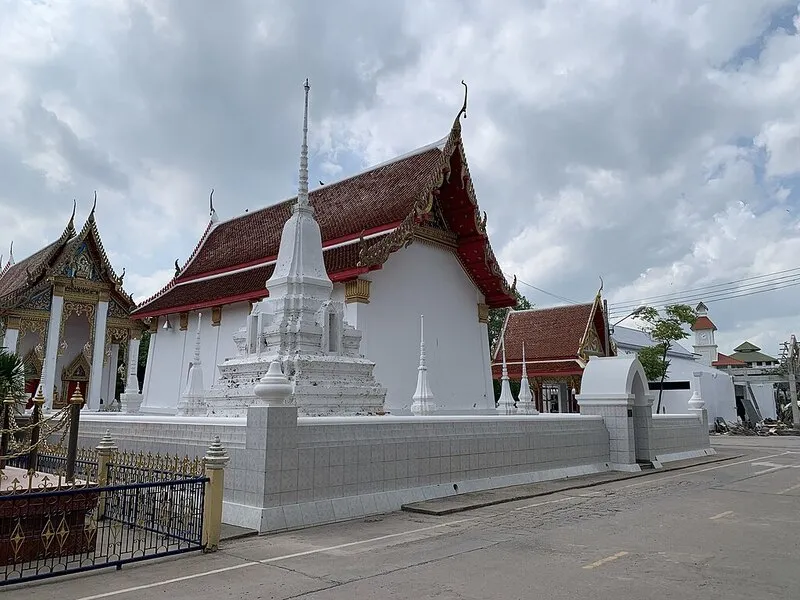
Wat Nang Nai Thammikaram in Ang Thong Province is a historic temple in Sala Chao Rong Thong Subdistrict, Wiset Chai Chan District. It was established around 1850 (B.E. 2393) by palace ladies-in-waiting as a royal merit-making offering in memory of King Nangklao (Rama III). The temple is widely associated with deep local devotion to Phra Upatcha Nhum Thammaramo, a revered monk of Ang Thong. Within the grounds are several important structures, including the ubosot (ordination hall), the Hall of Revered Masters (Hor Buraphachan), a sermon hall (sala kan parian), and two “yo mum mai sip song” style chedis. The temple also holds an annual festival during Chinese New Year, when locals gather to apply gold leaf to Luang Pho Nhum, reinforcing Wat Nang Nai’s role as both a sacred place and a key cultural destination in Ang Thong.
Wat Nang Nai Thammikaram, commonly known by locals as “Wat Nang Nai,” is located in Sala Chao Rong Thong Subdistrict, Wiset Chai Chan District, Ang Thong Province. This community temple carries significance in history, arts and culture, and local faith. Set amid long-established Central Thailand river-basin communities, the temple reflects the enduring relationship between temples and everyday life in the region. It is not only a site for religious rites, but also a long-standing center of community life—a place to make merit, meet, and participate in important local activities across generations.
The name “Wat Nang Nai” has a distinctive origin. The temple was founded by a group of palace ladies-in-waiting (“phnakngan nang nai”) who were originally from the Wiset Chai Chan area. After the passing of King Nangklao (Rama III) in the early Rattanakosin period, they jointly established the temple to dedicate merit to the monarch. In this way, the temple’s founding was not only an act of merit-making for royal dedication, but also a clear expression of local devotion and communal bonds, creating a religious center to anchor the spiritual life of people in the area.
Wat Nang Nai Thammikaram was built around 1850 (B.E. 2393), a period when Thai society was transitioning from early Rattanakosin toward a more modern era. Many rural temples were established to serve expanding communities, and Wat Nang Nai became one of the significant temples formed in that context. It has continued to function as a religious and educational center for the Sala Chao Rong Thong community over time.
Later, around 1910 (B.E. 2453), Wat Nang Nai received its “wisungkhamsima” (royal boundary grant), defining the official sacred precinct for ordination in accordance with Buddhist discipline. This milestone signaled the temple’s stability and formal recognition as a religious institution with an important role in both Buddhism and the local community.
The temple’s development became especially prominent during the tenure of Phra Upatcha Nhum Thammaramo, who assumed the position of abbot in 1925 (B.E. 2468). Luang Pho Nhum was a renowned monk and highly respected figure among local people. He played a major role in developing the temple in religious practice, education, and construction of various buildings within the grounds. With strong community support, Wat Nang Nai steadily flourished and became a central focus of devotion for people in Wiset Chai Chan.
Within the temple are several notable structures that reflect its evolution across different periods. The most important is the ubosot (ordination hall), distinguished by “bai sema” boundary stones embedded into the ubosot walls—a feature not commonly seen in typical temples. This distinctive characteristic gives Wat Nang Nai’s ubosot a unique identity. The ubosot underwent a major restoration in 1963 (B.E. 2506) to reinforce its structure and ensure it remained suitable for religious ceremonies.
Another key structure is the Hall of Revered Masters (Hor Buraphachan), created to preserve important objects and photographs of revered senior monks who contributed greatly to the temple. This hall was constructed over Luang Pho Nhum’s old hipped-roof kuti (monk’s residence) and was redesigned by faculty from King Mongkut’s Institute of Technology Ladkrabang. As a result, the hall presents an architectural blend of traditional roots and contemporary design.
Behind the Hall of Revered Masters is an old-style applied sermon hall (sala kan parian), an open structure used for religious activities and for housing various Buddha images in different postures. The temple also features two “yo mum mai sip song” chedis, a classic Thai architectural form often built at important temples. These chedis stand prominently and form a key part of the temple’s overall landscape.
Wat Nang Nai is also known for its perceived sacredness, especially the enduring devotion to Luang Pho Nhum Thammaramo. Local belief holds that he possessed exceptional spiritual merit. When visitors make wishes and later find them fulfilled, many bring soft drinks as offerings to “kae bon” (fulfill a vow), following a tradition passed down over time. For this reason, the worship area often displays vow offerings, reflecting the living faith that continues around the temple today.
One of the temple’s most important activities is its annual festival held during Chinese New Year. During the event, the temple welcomes the public to apply gold leaf to Luang Pho Nhum, make merit, and join various religious activities. The atmosphere becomes especially lively, as many people from both the local area and beyond travel to participate. Beyond devotional practice, the festival also serves as a meaningful community gathering that reinforces shared identity and warmth.
Overall, Wat Nang Nai maintains the calm simplicity typical of Central Thailand community temples. Visitors often feel the shade and ease provided by trees and open space, making it suitable for merit-making and quiet mental rest. Travelers interested in cultural routes frequently include Wat Nang Nai together with other important places in Ang Thong Province.
Getting There From Ang Thong town, travel toward Wiset Chai Chan District and continue to Sala Chao Rong Thong Subdistrict. The temple is not far from the main route, and the drive typically takes about 20 minutes by private car. From Bangkok, take Highway 32 through Phra Nakhon Si Ayutthaya into Ang Thong, then continue on to Wiset Chai Chan for convenient access.
| Name | Wat Nang Nai Thammikaram |
| Summary | A historic temple in Wiset Chai Chan, Ang Thong, founded by palace ladies-in-waiting as a royal merit-making dedication to Rama III, renowned for devotion to Luang Pho Nhum Thammaramo and its annual Chinese New Year festival. |
| Address | Sala Chao Rong Thong Subdistrict, Wiset Chai Chan District, Ang Thong Province |
| Highlights | Early Rattanakosin-era community temple; ubosot with sema stones embedded into the walls; the Hall of Revered Masters; two “yo mum mai sip song” chedis; and enduring devotion to Luang Pho Nhum Thammaramo. |
| Abbot / Temple Head (Latest) | Phra Khru Wiset Chai Khun |
| Current Status | An active community temple open for worship, merit-making, and cultural visits. |
| Nearby Attractions | 1) Wat Muang (Approx. 12 km) 2) Wat Khun Inthapramun (Approx. 15 km) 3) Talat Sala Chao Rong Thong (Approx. 3 km) 4) Wat Khian (Approx. 2 km) 5) Wat Chaiyo Worawihan (Approx. 20 km) |
| Nearby Restaurants | 1) Niramit Restaurant (Approx. 6 km) Tel. 081-852-4777 2) DR Steak (Approx. 10 km) Tel. 035-632-145 3) Somwang Phochana (Approx. 10 km) Tel. 090-958-0284 4) Samoe Jai Restaurant (Approx. 12 km) Tel. 035-622-755 5) Chaya Home Cafe (Approx. 11 km) Tel. 086-066-4311 |
| Nearby Accommodations | 1) Wiset Sabai Resort (Approx. 10 km) Tel. 081-587-5993 2) Patamanan Residence (Approx. 9 km) Tel. 095-505-1935 3) Tee-Nee Mee-Dee Resort (Approx. 11 km) Tel. 094-131-8081 4) Bualuang Ang Thong Hotel (Approx. 18 km) Tel. 035-611-116 5) Ratchaphruek DC Resort (Approx. 20 km) Tel. 080-193-3277 |
Frequently Asked Questions (FAQ)
Q: Where is Wat Nang Nai Thammikaram located?
A: Wat Nang Nai Thammikaram is located in Sala Chao Rong Thong Subdistrict, Wiset Chai Chan District, Ang Thong Province.
Q: When was Wat Nang Nai founded?
A: The temple was founded around 1850 (B.E. 2393) by palace ladies-in-waiting as a royal merit-making dedication to King Nangklao (Rama III).
Q: Who is Luang Pho Nhum?
A: Luang Pho Nhum Thammaramo was a revered monk and an influential abbot who played a major role in developing Wat Nang Nai and strengthening its religious and community presence.
Q: Does Wat Nang Nai have an annual festival?
A: Yes. The temple holds its annual festival during Chinese New Year, when many people come to apply gold leaf to Luang Pho Nhum and make merit.
Q: What are the highlights of Wat Nang Nai?
A: Key highlights include the temple’s founding history, devotion to Luang Pho Nhum, the ubosot with sema stones embedded into its walls, the Hall of Revered Masters, and the two “yo mum mai sip song” chedis.
Q: Which places can I visit together with Wat Nang Nai in one day?
A: Many visitors combine Wat Nang Nai with Wat Muang, Wat Khun Inthapramun, Wat Khian, Talat Sala Chao Rong Thong, and Wat Chaiyo Worawihan, depending on available time.
 Wat Nang Nai Thammikaram Map
 Category:
  Group:
  Tag: ●Wat Nang Nai Thammikaram●wat nang nai thammikaram ●wat nang nai ang thong ●wat nang nai wiset chai chan ●luang pho nhum thammaramo ●historic temple ang thong ●temples in ang thong thailand ●cultural temple ang thong ●buddhist temple wiset chai chan ●ang thong temple travel ●sacred temple ang thong Last Update: 2 WeekAgo
Comment
 Nearby Attractions
| Keyword (Advance) |
 Region
|
 Muang Ang Thong(
 Copyright 2012,